Want more images or videos?
Request additional images or videos from the seller
1 of 8

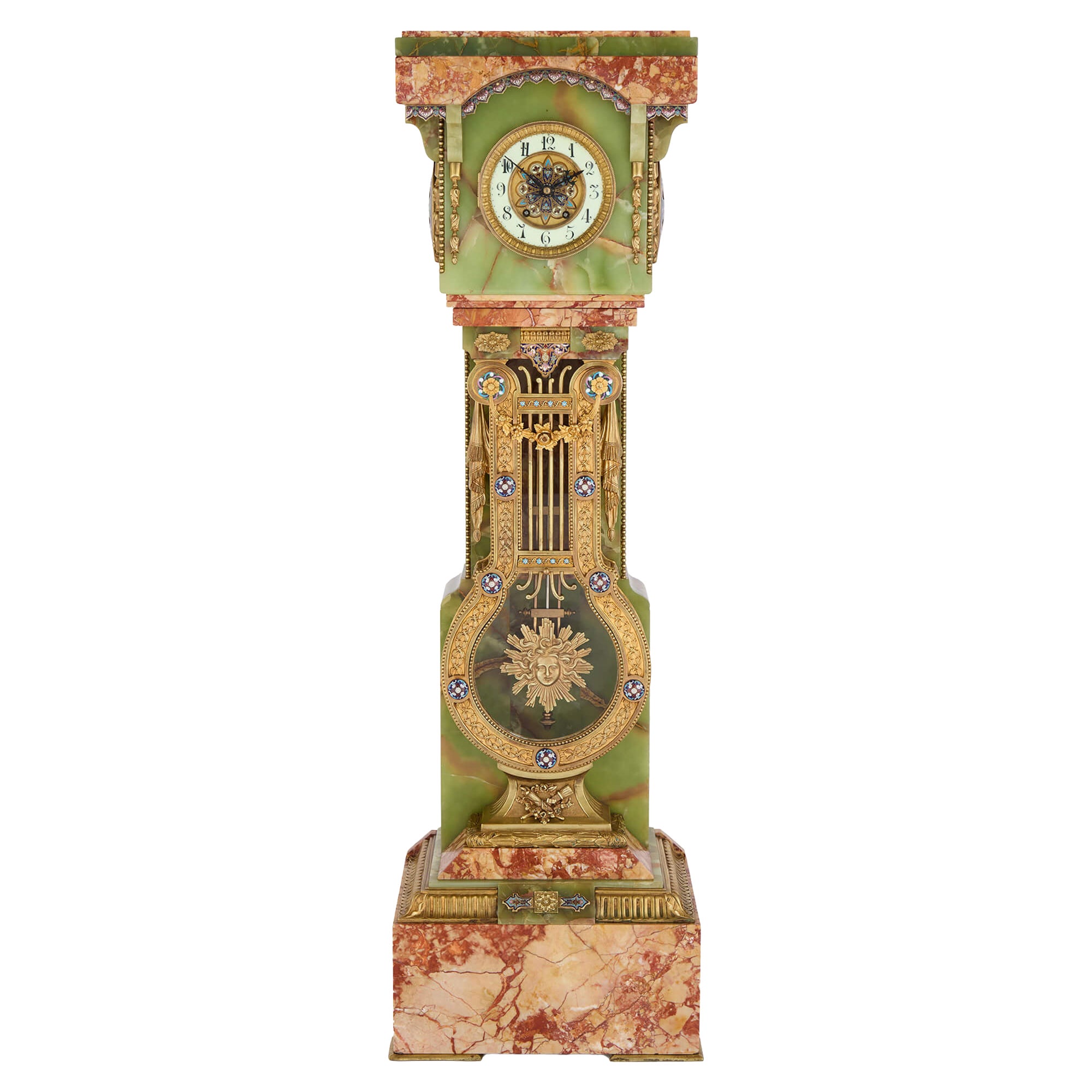
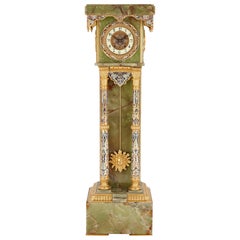
A Napoleon III Onyx and Champlevé Enamel Pedestal Clock

$52,293.08
£38,000
€45,247.95
CA$72,951.47
A$73,996.18
CHF 42,253.86
MX$896,117.82
NOK 497,431.16
SEK 495,780.27
DKK 338,231.67

About the Item

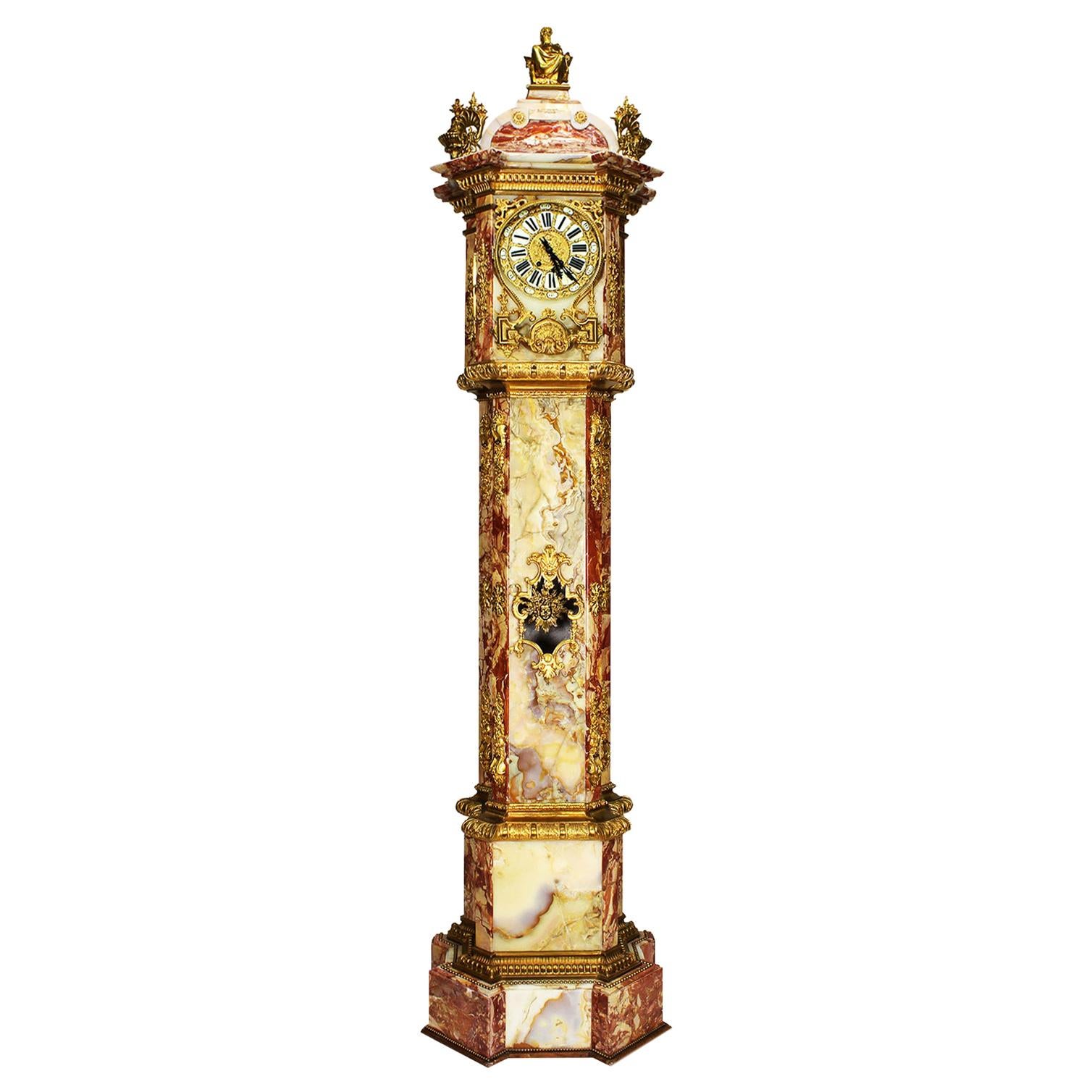
A Napoleon III Gilt-Bronze Mounted Onyx and Champlevé Enamel Pedestal Clock. The movement with a twin-barrelled eight-day anchor escapement with Brocot-type regulation striking on a bell. Stamped ‘VINCENTI & CIE, MEDAILLE D'ARGENT, 1855’, ‘4557’ and ‘77’. The backs of some gilt-bronzes stamped 'A G'. The tapering pedestal form ‘onyx du Pakistan’ case with a rectangular moulded top above an integral circular onyx dial, centred by a polychrome champlevé enamel rosette, with applied Roman numerals and blued steel hands within a hinged foliate cast glazed bezel, flanked by champlevé enamel spandrels and leaf cast pendant mounts. The lower pilaster section with a central champlevé enamel mount and apron, with inset angles, raised on a stepped plinth. France, Circa 1870. This opulent pedestal clock exemplifies the Second Empire's fascination with polychromy and luxurious materials; its eclectic design heavily influenced by the prevalent Orientalist movement. Inspired by the artistic traditions of Islamic art, the style is defined by intricate geometric patterns, arabesques, and vibrant polychrome details reminiscent of Moorish tilework and architecture. French artisans reimagined these motifs using techniques such as champlevé enamel and gilding, seamlessly blending Eastern aesthetics with French elegance. These designs became symbols of exoticism and opulence, celebrated at prestigious exhibitions and widely embraced by the European elite.
  • Dimensions:
    Height: 47.64 in (121 cm)Width: 14.97 in (38 cm)Depth: 9.45 in (24 cm)
  • Style:
    Napoleon III (Of the Period)
  • Materials and Techniques:
  • Place of Origin:
  • Period:
  • Date of Manufacture:
    Circa 1870
  • Condition:
    Wear consistent with age and use.
  • Seller Location:
    Brighton, GB
  • Reference Number:
    Seller: B764501stDibs: LU1028047425512

More From This Seller

View All
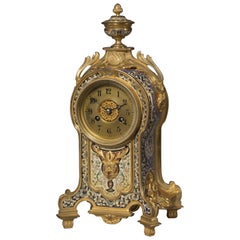
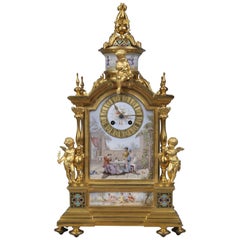
Fine Gilt-Bronze and Champlevé Enamel Clock, circa 1880

Fine Gilt-Bronze and Champlevé Enamel Clock, circa 1880

Located in Brighton, West Sussex

A fine gilt bronze and champlevé enamel clock. French, circa 1880. The movement with impressed stamp to the backplate 'Vincenti et Cie 'Médaille D'Argent 1855', 'PARIS'. Thi...

Category

Antique Late 19th Century French Mantel Clocks

Materials

Bronze, Enamel

Louis XVI Style Annular Dial Clock in the Manner of Lepaute, French, circa 1890

Louis XVI Style Annular Dial Clock in the Manner of Lepaute, French, circa 1890

By Jean-André Lepaute 1

Located in Brighton, West Sussex

A rare Louis XVI style gilt-bronze mounted marble annular dial pedestal clock in the manner of Jean-André and Jean-Baptiste Lepaute, attributed to Dufaud, Paris. The eight-day twin-train movement with circular plates and lateral lever escapement on a gilt platform, with cut bimetallic compensation balance, flat balance spring and index regulator, striking the hours and half-hours on a bell. The dial having twin revolving chapter rings with white enamel cartouches with Roman numerals on a revolving ring, with a revolving minute ring above with Arabic numerals, the time indicated by Cupid pointing with an arrow. This fine annular dial or ‘cercles tournants’ clock...

Category

Antique Late 19th Century French Louis XVI More Clocks

Materials

Marble, Bronze

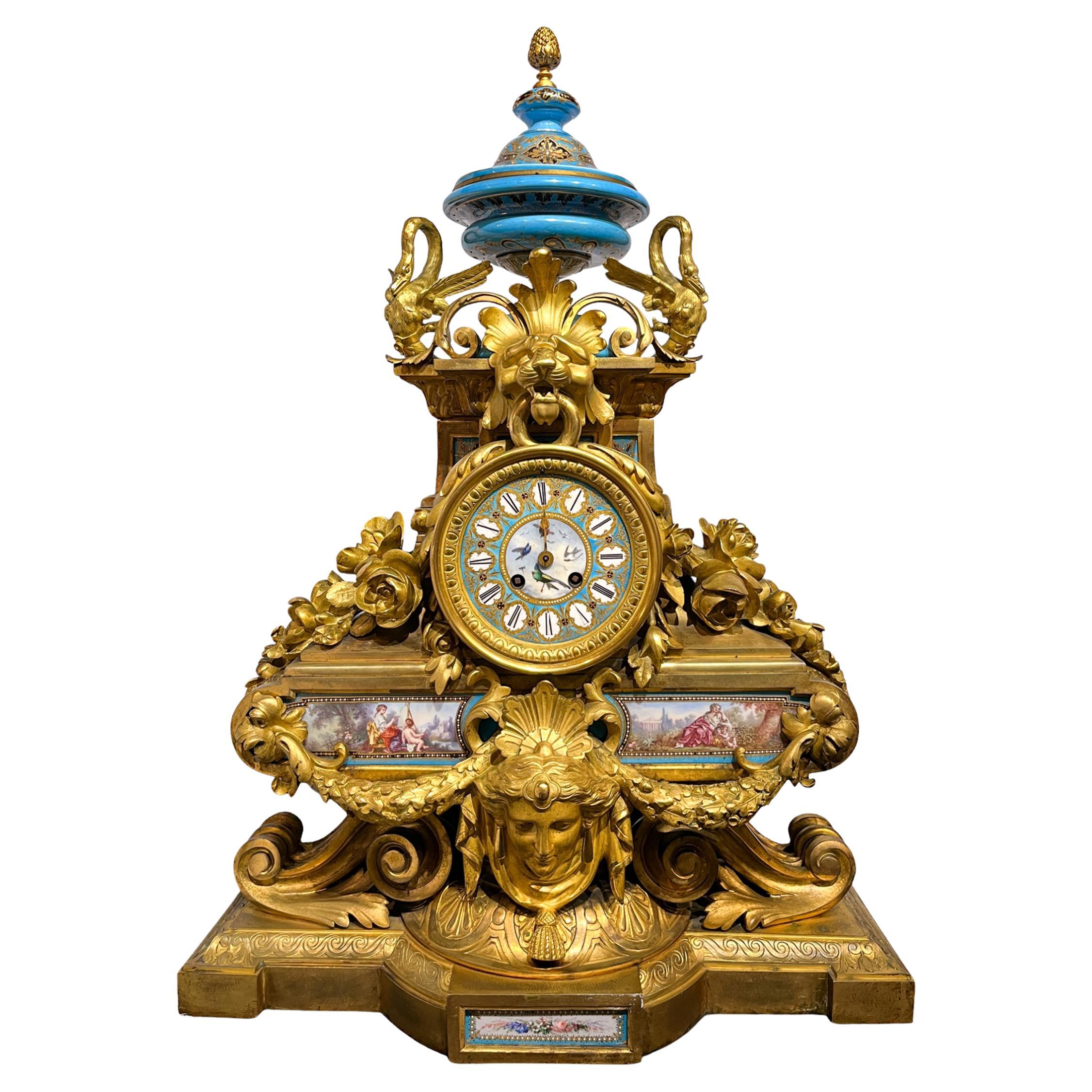
Napoléon III Sèvres Style Clock Garniture, Gilt-Bronze & Porcelain

Napoléon III Sèvres Style Clock Garniture, Gilt-Bronze & Porcelain

Located in Brighton, West Sussex

A fine Napoléon III gilt-bronze and sèvres style cobalt blue ground 'Jewelled' Porcelain Three-Piece Clock Garniture Comprising a mantel clock and a pair of five-light vase candel...

Category

Antique 19th Century French Napoleon III Mantel Clocks

Materials

Ormolu

Louis XVI Style Champlevé Enamel and Gilt-Bronze Mantel Clock, circa 1880

Louis XVI Style Champlevé Enamel and Gilt-Bronze Mantel Clock, circa 1880

By LeRoy

Located in Brighton, West Sussex

An exceptional Louis XVI style champlevé enamel and gilt-bronze mantel clock with finely painted neoclassical scenes by Leroy & Fils. French, circa 1880. Stamped to the movement ‘LEROY & FILS A PARIS, 823’. This fine gilt-bronze and champlevé enamel clock has an arched case with outset bulbous columns to the angles, it is surmounted by a drum top with a pierced scroll and ball finial and applied with expressive cherub mounts. The front and sides of the clock are all exceptionally finely painted with neoclassical scenes of figures in an architectural setting and the top and base enriched with fine polychrome champlevé enamel. The clock has an enamelled chapter ring with Roman numerals interspersed with anthemion devices and a twin barrelled, eight-day movement striking on a bell. The firm of Leroy et Fils was founded by Bazile Charles Leroy in 1789. He was a clockmaker to the Emperor Napoléon, The Duke of Orleans, The Duke of Bourbon and Princess Pauline. In 1823, he filed a patent for self-winding atmospheric clock operated by weathervane and in 1840 a patent for wind clocks. When Charles Louis died in 1865 his son Louis Leroy...

Category

Antique Late 19th Century French Louis XVI Mantel Clocks

Materials

Bronze, Enamel

Empire Clock in the Form of a Classical Urn, by Maison Lepautre, circa 1825

Empire Clock in the Form of a Classical Urn, by Maison Lepautre, circa 1825

By Pierre-Basile Lepaute

Located in Brighton, West Sussex

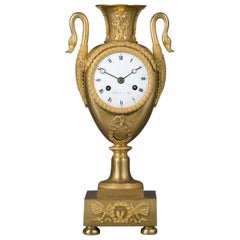
A gilt bronze Empire clock in the form of a classical urn, by Maison Lepautre. French, circa 1825. The dial signed 'Lepaute a Paris'. The clock has an ornate cast bezel with a 3-inch porcelain dial with Roman numerals and Breguet style hands. The twin train eight-day movement with outside count wheel striking on a bell and silk thread suspension. This elegant Empire style clock has a gilt bronze case in the form of a classical urn with swan neck handles and a winged cherub to the neck. The circular pedestal base is raised on a footed stepped square plinth. The Lepaute family were the premier French clockmakers of their day. Their significance lies in their contribution to the clock making industry which had hitherto come under the trade of locksmiths. The family held the brevet Horlogers du Roi. Jean-André Lepaute (1720–1789) arrived in Paris at an early age and in 1740 founded the family business. A skilled artist and mechanic, he quickly gained an excellent reputation. He was received as maître by the clockmakers guild in 1759, was granted royal lodgings from the king in The Luxembourg Palace, and was entrusted with the construction of the majority of the great public clocks of Paris. He executed, amongst others, those in The Luxembourg Palace, the Jardin des Plantes, the Château de Bellevue and the Château des Ternes. His clock at Paris’s École Militaire still works today. Three editions of his Traité d’Horlogerie were published in Paris in 1755, 1760 and 1767. A small volume, Description de Plusieurs Ouvrages d’Horlogerie appeared in 1764. Jean-André’s wife, Nicole-Reine Etable de la Brière (1723-1788), was a highly esteemed mathematician and astronomer. Her passion for science lent itself to Lepaute’s work and she played an active role in the scientific and mathematical aspects of the clock making. Jean-André’s younger brother Jean-Baptiste Lepaute (1727-1802) joined him in Paris in 1747 and immediately started working for the family business. He was received as maître in 1776 and was known for the clocks he constructed for the Paris Hôtel de Ville (1780), destroyed in a fire of 1871, and for the Hôtel des Invalides (1784). Jean-Baptiste took over the workshop when Jean-André retired in 1775. After Jean-Baptiste’s death in 1802, the firm was taken over by his nephew Pierre-Basil Lepaute (1750-1843) where he was duly joined by his own nephew Jean-Joseph (1768-1846) and son Pierre-Michel (1785-1849). By 1816, Pierre-Michel Lepaute was in charge of the business. His masterpieces include the astronomical clock in Paris’s Bureau...

Category

Antique Early 19th Century French Empire Mantel Clocks
Materials

Bronze

Napoléon III Marble Mantle Clock by James Pradier, France, Circa 1860

Napoléon III Marble Mantle Clock by James Pradier, France, Circa 1860

By J. Pradier

Located in Brighton, West Sussex

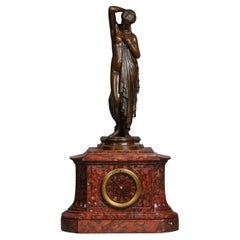
A Napoléon III Marble Mantle Clock With A Patinated Bronze Figure of 'Phryné' by James Pradier. France, Circa 1860. Surmounted by a finely cast pa...

Category

Antique 19th Century French Napoleon III Mantel Clocks

Materials

Griotte Marble, Bronze

You May Also Like

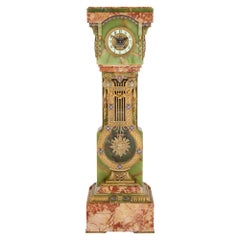
French Neoclassical Style Enamel, Onyx, and Gilt Bronze Pedestal Clock

French Neoclassical Style Enamel, Onyx, and Gilt Bronze Pedestal Clock

Located in London, GB

French neoclassical style enamel, onyx, and gilt bronze pedestal clock French, late 19th century Measures: Height 125cm, width 36cm, depth 30cm This beautiful pedestal clock has...

Category

Antique Late 19th Century French Neoclassical Grandfather Clocks and Lon...

Materials

Onyx, Ormolu, Bronze, Enamel

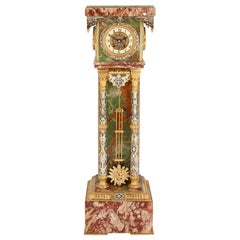
Antique French Green Onyx Champlevé Enamel Marble Ormolu Pedestal Clock

Antique French Green Onyx Champlevé Enamel Marble Ormolu Pedestal Clock

Located in London, GB

Antique French Green Onyx Champlevé Enamel Marble Ormolu Pedestal Clock French, Late 19th Century Height 136 cm, Width 41 cm, Depth 33 cm An impressive French pedestal clock in gr...

Category

Antique Late 19th Century French Neoclassical Grandfather Clocks and Lon...

Materials

Onyx, Marble, Enamel, Ormolu

Onyx, Marble, Gilt Bronze and Champlevé Enamel Pedestal Clock

Onyx, Marble, Gilt Bronze and Champlevé Enamel Pedestal Clock

Located in London, GB

This colorful pedestal clock has been crafted from fine red marble and green onyx, and beautifully decorated with gilt bronze (ormolu) and champlevé enamel. While a popular crafts material in ancient times, onyx was largely forgotten about until its rediscovery in the mid-19th century in Algeria by a French marble-worker called Delmonte. Onyx became highly fashionable in France following this discovery, and it was used to create a variety of decorative art objects. The clock features a green onyx cube-shaped case, which is surmounted by a slightly projecting red marble top. This top is fringed with champlevé enamel drapery-like motifs, with gilt bronze drop-finials. The case is mounted on its front with a circular dial, which features a central floral champlevé enamel motif, encircled by black Arabic Numerals. This dial is set within a gilt bronze egg-and-dart and champlevé enamel bezel. The sides of the case are mounted with circular gilt bronze barometers...

Category

Antique Late 19th Century French Neoclassical Grandfather Clocks and Lon...

Materials

Onyx, Marble, Ormolu, Bronze, Enamel

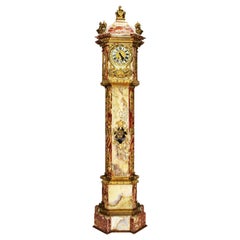
Monumental 19th Century Ormolu Mounted Onyx & Marble Longcase Grandfather Clock

Monumental 19th Century Ormolu Mounted Onyx & Marble Longcase Grandfather Clock

Located in Los Angeles, CA

A monumental architectural French 19th century neoclassical Revival gilt bronze mounted beige and red onyx longcase grandfather clock. The very impressive clock-case surmounted by a figure of seated Classical male figure...

Category

Antique Early 1900s French Neoclassical Revival Grandfather Clocks and L...

Materials

Onyx, Marble, Bronze

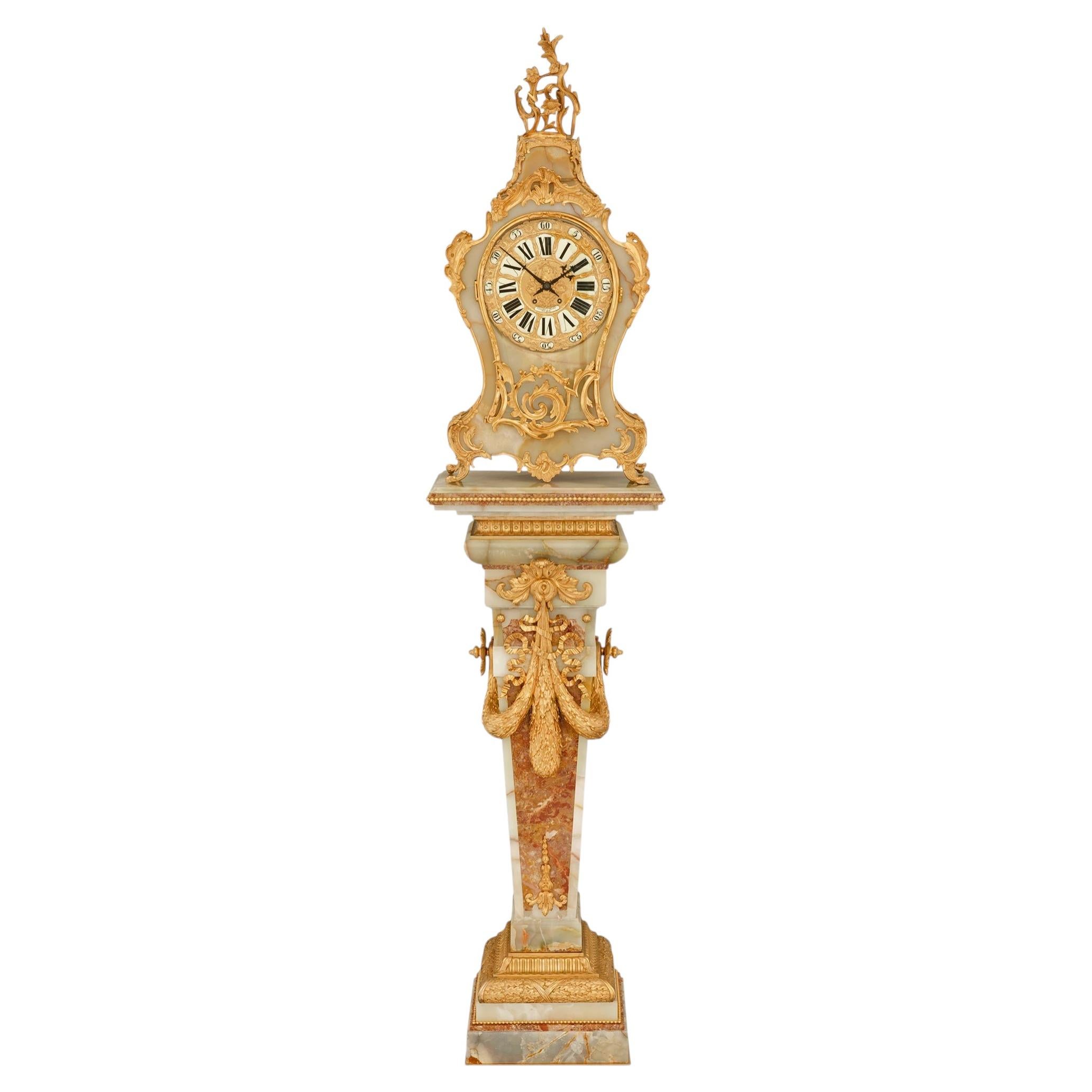
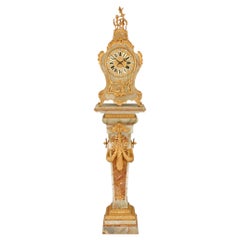
French Ormolu, Onyx and marble clock & pedestal, retailed by Camerden & Forster

French Ormolu, Onyx and marble clock & pedestal, retailed by Camerden & Forster

Located in West Palm Beach, FL

A stunning and most impressive French 19th century Louis XVI st. Ormolu, Onyx and marble clock and pedestal, retailed by Camerden & Forster. This most rare set is comprised of a rich...

Category

Antique 19th Century French Louis XVI Grandfather Clocks and Longcase Cl...

Materials

Onyx, Marble, Ormolu

Marble and Gilt Bronze Clock with Mythological Decor, Napoleon III Period.

Marble and Gilt Bronze Clock with Mythological Decor, Napoleon III Period.

Located in Saint-Ouen, FR

Marble and gilt bronze clock with mythological decor, 19th century, Napoleon III period. A 19th century Napoleon III period clock in marble and gilt bronze with a mythological theme...

Category

Antique 19th Century French Napoleon III Mantel Clocks

Materials

Marble, Bronze