Want more images or videos?
Request additional images or videos from the seller
1 of 11

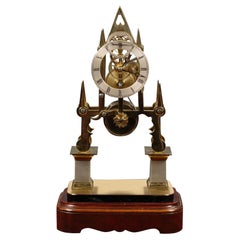
A very fine mid Victorian skeleton clock by Johnston of London

$7,674.30
£5,592.64
€6,659.73
CA$10,758.34
A$10,924.21
CHF 6,236.12
MX$132,000.43
NOK 73,253.43
SEK 73,053.57
DKK 49,786.80

About the Item

A very fine mid Victorian skeleton clock by Johnston of London, of large rectangular form comprising two openwork arabesque panels parti A very fine mid Victorian skeleton clock by Johnston of London, of large rectangular form comprising two openwork arabesque panels partially shielding the fusée bell striking movement, the polished scroll frame raised on shaped turned pillars, the foliate scrolled silvered and engraved dial with Roman numerals joined with delicate thistle motifs, housed in its integrated glazed brass case applied with a silvered maker’s labels stating ‘Johnston, 2 Elm Street, Gray’s Inn Lane, London’. English, circa 1852. Provenance: W. B. 1852 thence C. B. 1900 thence E. M. 1902 John Johnston is a rare maker and there is a certain amount of confusion about his business, with some sources stating that a David Graeme Johnston traded at 2 Elm Street until circa 1830 before being succeeded by his widow. However, the 1871 census reveals a John Johnston, “watch making, repairing”, then aged 44, registered at 2 Elm Street with his wife Matilda, aged 42. In the 1881 census, the couple were both still alive though confusingly had only aged by 6 years in the intervening 10 year period, being listed as 50 and 48 years old respectively. Matilda survived her husband and died in 1910. In Britten’s Former Clock & Watchmakers and Their Work, published in 1894, he listed “J. Johnston” as operating from the correct 2 Elm Street address in 1835. There are many prominent Johnston watch and clockmakers listed in Scotland and it is highly likely that John Johnston was descended from one of these families. Few surviving clocks and watches made by John Johnston are recorded but those that do all appear to be very high quality. Elm Street was located right in the centre of the historic clockmaking area in London and it is likely that much of Johnston’s work was carried out on behalf of retailers and other makers who then sold the work on as their own – this was common practice in the trade and remains the case today. ally shielding the fusée bell striking movement, the polished scroll frame raised on shaped turned pillars, the foliate scrolled silvered and engraved dial with Roman numerals joined with delicate thistle motifs, housed in its integrated glazed brass case applied with a silvered maker’s labels stating ‘Johnston, 2 Elm Street, Gray’s Inn Lane, London’. English, circa 1852. Provenance: W. B. 1852 thence C. B. 1900 thence E. M. 1902 John Johnston is a rare maker and there is a certain amount of confusion about his business, with some sources stating that a David Graeme Johnston traded at 2 Elm Street until circa 1830 before being succeeded by his widow. However, the 1871 census reveals a John Johnston, “watch making, repairing”, then aged 44, registered at 2 Elm Street with his wife Matilda, aged 42. In the 1881 census, the couple were both still alive though confusingly had only aged by 6 years in the intervening 10 year period, being listed as 50 and 48 years old respectively. Matilda survived her husband and died in 1910. In Britten’s Former Clock & Watchmakers and Their Work, published in 1894, he listed “J. Johnston” as operating from the correct 2 Elm Street address in 1835. There are many prominent Johnston watch and clockmakers listed in Scotland and it is highly likely that John Johnston was descended from one of these families. Few surviving clocks and watches made by John Johnston are recorded but those that do all appear to be very high quality. Elm Street was located right in the centre of the historic clockmaking area in London and it is likely that much of Johnston’s work was carried out on behalf of retailers and other makers who then sold the work on as their own – this was common practice in the trade and remains the case today.
  • Creator:
    John Johnston (Clockmaker)
  • Dimensions:
    Height: 15.5 in (39.37 cm)Width: 10.75 in (27.31 cm)Depth: 6.5 in (16.51 cm)
  • Style:
    Victorian (Of the Period)
  • Materials and Techniques:
  • Place of Origin:
  • Period:
  • Date of Manufacture:
    1852
  • Condition:
    Wear consistent with age and use.
  • Seller Location:
    Lymington, GB
  • Reference Number:
    1stDibs: LU973042600142

More From This Seller

View All
A Fine Late 19th Century French Le Roy and Fils Ormolu Mantel Clock

A Fine Late 19th Century French Le Roy and Fils Ormolu Mantel Clock

Located in Lymington, Hampshire

A Fine Late 19th Century French Le Roy and Fils Ormolu Mantel Clock The ornate case in the Louis XVI style with finely cast and chased ornament, a tribute to the art of the bronzier...

Category

Antique Late 19th Century French Louis XVI Mantel Clocks

Materials

Ormolu

Victorian Brass Novelty Clock by Elkington & Co

Victorian Brass Novelty Clock by Elkington & Co

By Elkington & Co.

Located in Lymington, Hampshire

A Victorian brass novelty clock by Elkington & Co., in the form of a double steering-wheel, one wheel enclosing a clock and the other a barometer, with ...

Category

Antique 1880s English Victorian Mantel Clocks

Materials

Brass

William IV Rosewood and Bronze Bracket Clock by Frodsham 185 & Baker

William IV Rosewood and Bronze Bracket Clock by Frodsham 185 & Baker

Located in Lymington, Hampshire

William IV rosewood and bronze bracket clock by Frodsham 185 & Baker, the brass eight-day movement striking on a bell, the backplate numbered ‘292’, the circular brass dial with roman numerals and an engine turned centre, signed ‘Frodsham & Baker Gracechurch St. London‘, in an architectural case with applied panels, the front decorated with a lion and foliage, the corners with quoins, the sides with scrolling leaves and palmettes, with a fan pagoda top with a retractable oriental gateway handle, on leaf scroll feet, with pendulum, winding key and case key. English, circa 1830. William Frodsham was an established London clockmaker. One of his sons, John Frodsham (1785-1849), went into partnership with Baker to form ‘Frodsham and Baker’ in 1809’. They were chronometer makers to the Admiralty and also made wall...

Category

Antique 1830s English Mantel Clocks
Materials

Bronze

Late 19th Century French Novelty ‘Quarterdeck’ Mantel Clock by Guilmet, Paris

Late 19th Century French Novelty ‘Quarterdeck’ Mantel Clock by Guilmet, Paris

By Andre Romain Guilmet

Located in Lymington, Hampshire

A late 19th century French gilt-brass and steel novelty ‘quarterdeck’ mantel clock by Guilmet, Paris, the eight-day gong striking movement with anchor escapement, circular gilt Roman...

Category

Antique 19th Century French Mantel Clocks

Materials

Brass

A late Louis XVI marble and ormolu portico clock

A late Louis XVI marble and ormolu portico clock

Located in Lymington, Hampshire

A late Louis XVI marble and ormolu portico clock, comprising a central drum-shaped clock with a sunburst pendulum, surmounted by the gilded figure of Athena wearing armour with a plu...

Category

Antique Late 18th Century French Louis XVI Mantel Clocks

Materials

Marble, Ormolu

Bracket Alarm Clock by John Taylor

Bracket Alarm Clock by John Taylor

Located in Lymington, Hampshire

A fine mahogany bracket alarm clock by John Taylor, the rectangular case enclosing an arched gilt and steel face with a clock-face, a silent/strike...

Category

Antique 1780s English Mantel Clocks
Materials

Mahogany

You May Also Like

William IV Double Fusee Skeleton Clock by A. Stewart, London

William IV Double Fusee Skeleton Clock by A. Stewart, London

Located in Norwich, GB

A William IV Skeleton clock of fine quality with two massive scroll plates sitting on rectangular, silvered plinths and standing on a mahogany base with block feet. Eight day doubl...

Category

Antique 1830s English William IV Mantel Clocks

Materials

Brass

19th Century French Skeleton Clock of Ormolu and Marble from Directoire Period

19th Century French Skeleton Clock of Ormolu and Marble from Directoire Period

Located in London, GB

A symbolic skeleton clock from the French Directoire period. A rectangular Carrara marble plinth with bronze toupie feet with knurled decoration supports an ormolu 'arc-de-ciel', wi...

Category

Antique Early 19th Century French Directoire Mantel Clocks

Materials

Carrara Marble, Ormolu, Bronze

Georgian Chain Fusee Skeleton Clock by Jones, Strand

Georgian Chain Fusee Skeleton Clock by Jones, Strand

Located in Norwich, GB

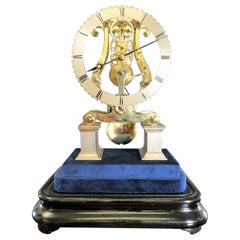
Georgian Skeleton Clock by Jones, The Strand, London Georgian skeleton clock standing on an ebonised stepped base lined with blue velvet and original square glass dome. Lyre ...

Category

Antique 1820s English Mantel Clocks
Materials

Brass

Fantastic quality antique Victorian French mantle clock

Fantastic quality antique Victorian French mantle clock

Located in Ipswich, GB

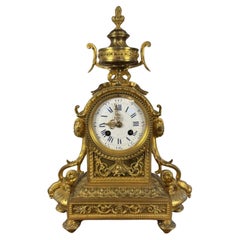
Fantastic quality antique Victorian French mantle clock, having a quality antique Victorian French mantle clock with a French eight day movement striking on bell, with circular ename...

Category

Antique Early 19th Century French Early Victorian Mantel Clocks

Materials

Brass

Bronze mantel clock, Vincenti & Cie, France, 1880s - 1890s

Bronze mantel clock, Vincenti & Cie, France, 1880s - 1890s

By Vincenti et Cie

Located in Rīga, LV

A French gilt bronze four-glass mantel clock, made in the late 19th century, circa 1880s–1890s. The movement is stamped Vincenti & Cie with the Médaille d’Argent 1855 mark. The cloc...

Category

Antique 1880s French Louis XVI Mantel Clocks

Materials

Bronze