Want more images or videos?
Request additional images or videos from the seller
1 of 10

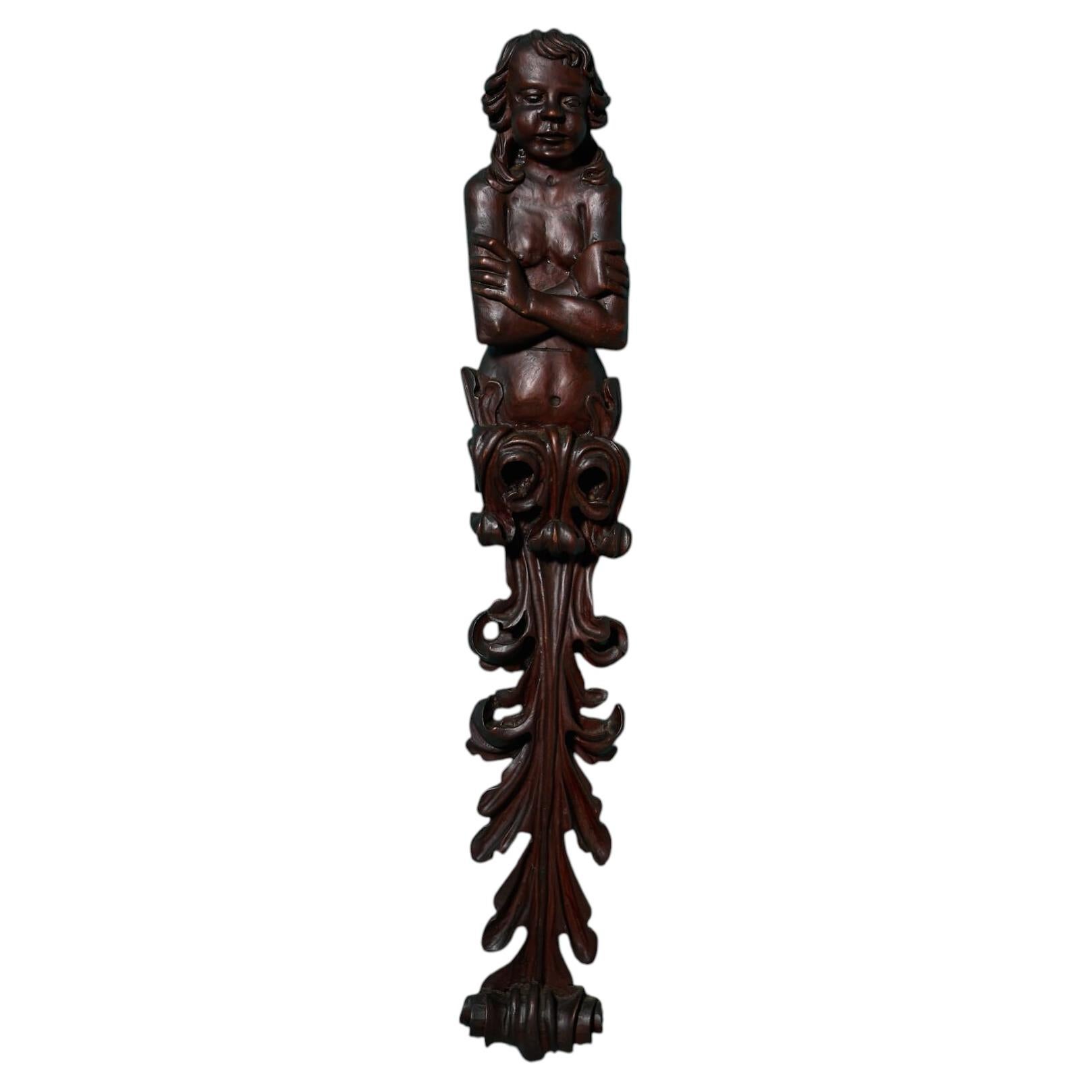
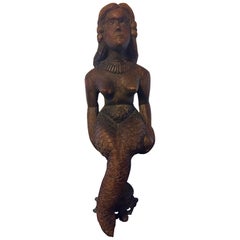
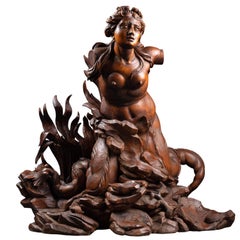
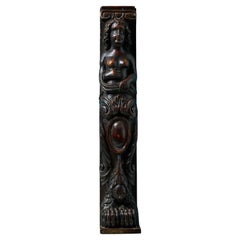
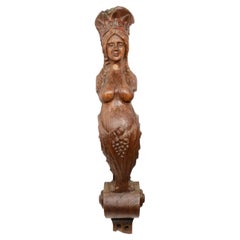
16th Century Southern Germany Carved Wood Bracket Depicting a Mermaid

$23,777.22
£17,498.80
€20,000VAT Included
CA$33,013.13
A$33,104.38
CHF 19,152.67
MX$403,099.85
NOK 222,261.07
SEK 226,535.46
DKK 152,516.80

About the Item

In Medieval Europe and even more during the early 16th century fantastic beasts could be found in Bestiaries, a literary genre close to poetry. A bestiary used the characteristics of living animals and imaginary creatures to be intepreted symbolically through moral and religious teachings. During the following centuries - and despite the progress of science leading to a better knowledge of an extremely complex zoological world - fantastic creatures kept inhabiting the Western culture, maybe as a reaction to a society more and more logical and Cartesian. Winged creatures are often hybrids, that is an association of different species’ body parts as it is the case with mermaids. The mythological tradition does not depict mermaids as we know them today with the bust of a woman and the bottom ending in a fish tail. Originally mermaids were represented as bird-women or a bird with the face of a woman and were called harpies. The iconography of the creature half-woman half-fish comes from Christian authors talking about « girls from the sea, misleading sailors with their great beauty and the softness of their voices. From head to navel their bodies look like the body of young virgins but they also present a fish tail » (Liber Monstronum). The mermaid we present follows the half-woman half-fish type with the exception of the arms shaped as acanthus leaves and two wings stemming from her shoulders and framing her round face and curly hair. The bust is soberly treated and ends by a drape on the hips, a foliated bunch of grapes in its centre. The particularity of this mermaid resides in the way her legs are depicted by the artist ; two fish tails with finely carved scales. Each tail is achieved by beautiful caudal fins. The harmony and beauty of this sculpture comes from the balance between the sobre treatment of the bust, highlighting the depth of the limewood and the subtlety of the carving for the fish tails. This wood carved bracket is a perfect example of Southern German sculptors’ artistry in the early 16th century.
  • Dimensions:
    Height: 51.58 in (131 cm)Width: 10.24 in (26 cm)Depth: 3.55 in (9 cm)
  • Style:
    Renaissance (Of the Period)
  • Materials and Techniques:
  • Place of Origin:
  • Period:
  • Date of Manufacture:
    16th Century
  • Condition:
    Repaired. Wear consistent with age and use. Minor structural damages. Minor fading.
  • Seller Location:
    Saint-Ouen, FR
  • Reference Number:
    1stDibs: LU3115327514672

More From This Seller

View All
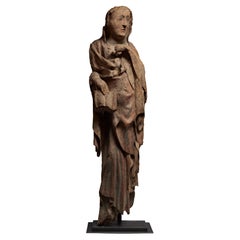
Saint Woman in polychrome carved wood

Saint Woman in polychrome carved wood

Located in Saint-Ouen, FR

SAINT WOMAN IN POLYCHROME CARVED WOOD   ORIGIN : ITALY PERIOD : late 13th century   Height : 103 cm Length : 28  cm Width : 16 cm  Remains of polychromy   ...

Category

Antique 15th Century and Earlier Italian Gothic Figurative Sculptures

Materials

Softwood

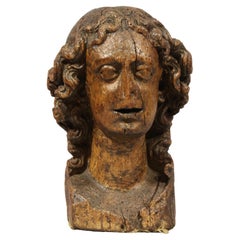
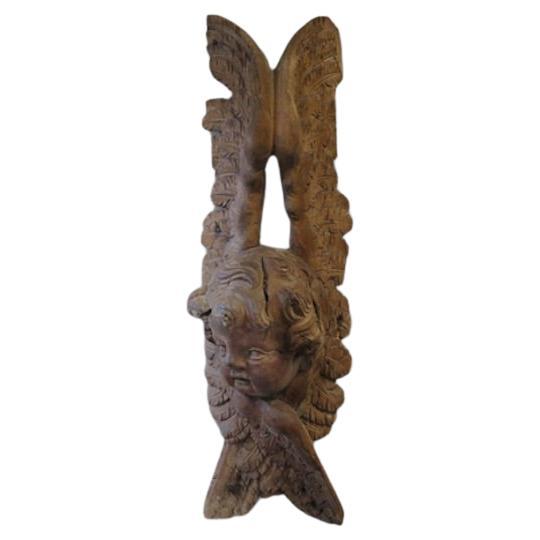
14th Century Sculpture of the Head of an Angel from East of France or Rhineland

14th Century Sculpture of the Head of an Angel from East of France or Rhineland

Located in Saint-Ouen, FR

This face with prominent eyes, open mouth and beautiful hairs with symetrical undulations may be the face of the Archangel Gabriel.  

Category

Antique 15th Century and Earlier French Gothic Figurative Sculptures

Materials

Wood

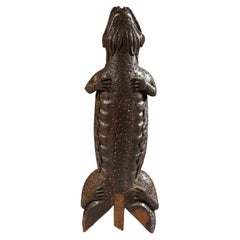
Element of an Outdoor Carved Woodwork Showing a Salamander from a Normand House

Element of an Outdoor Carved Woodwork Showing a Salamander from a Normand House

Located in Saint-Ouen, FR

This carved oak woodwork was probably placed on the facade of the house, close to the roofing framework of a Norman house. The sculptor had depicted the salamender frontview in a sty...

Category

Antique 16th Century French Gothic Statues

Materials

Oak

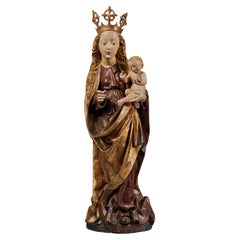
Polychrome carved wood Virgin and Child from the 15th Century

Polychrome carved wood Virgin and Child from the 15th Century

Located in Saint-Ouen, FR

POLYCHROME CARVED WOOD VIRGIN AND CHILD FROM THE 15TH CENTURY   ORIGIN: SOUTH GERMANY, SWABIA, NUREMBERG REGION PERIOD: 15th CENTURY   Height: 94,6cm Width : 28 cm Depth : 18 cm   Lime wood Original Polychromy Good state of conservation     From 1430 onwards, sculpture underwent a profound stylistic renewal which continued until 1530, the so-called late Gothic period. In the Germanic countries, original sculptures flourished in an expressive and sensitive vein.
This renewal was inspired by the art of Nicholas of Leiden, who was active in Strasbourg in the 1460's. His style broke with the refined and delicate art of the international Gothic style in force throughout Europe around 1400. The figures became more authentic and realistic. The bodies became denser. Clothes are animated by deep, broken folds, the fabrics are heavy and have a great decorative value. In addition, the polychromy is intended to be illusionistic. The painting makes it possible to restore the texture of the materials, the richness of the textiles and the natural skin tone of the characters.   The dissemination of images through engraving and the great mobility of the artists led to the success of this style, which conquered the Upper Rhine, Swabian, Tyrolean and Franconian regions, contributing to the formation of a common stylistic identity in these regions. The economic boom in the flourishing German cities was conducive to the development of original production. Attracted by this prosperity, numerous workshops were set up in order to meet the orders of religious communities, the Church and the laity, including a clientele of middle-class rockers.      This precious Virgin and Child is depicted standing on a crescent moon, her head encircled by a crown of tall flowers. Her long wavy hair spreads over her shoulders, framing her beautiful oval face. Under fine eyebrows drawn with a brushstroke, her almond-shaped, slightly drooping eyes look at the Child with infinite softness. She is dressed in a long red dress with a rounded neckline, belted under the chest. The heavy fabric of her dress spreads out in broken folds at her feet. On her shoulders she wears a golden cloak. The drapery has deep folds. She holds out her right hand while she holds the Christ Child with her left.   Christ, with his well-defined hair, is naked. His cheeks are highlighted with red, he holds an apple in his left hand and with the other hand makes a sign of blessing towards the faithful.   Virgins with Child on a crescent moon were very popular in the second half of the 15th century, especially as the central subject of altarpieces in southern Germany and Austria. The crescent moon on which Mary is standing is reminiscent of the Woman of the Apocalypse. Often equated with the Virgin Mary.    This episode is taken from the Book of Revelation (12:1-6)   1 Then a great sign appeared in heaven: a woman clothed with the sun, with the moon under her feet and a crown of twelve stars on her head. ; 2 She was pregnant, and she cried out because she was in labor, in pain from giving birth. ; 3 Then another sign appeared in heaven: it was a great fiery red dragon, with seven heads and ten horns, and seven royal crowns on his heads. ; 4 His tail swept down a third of heaven's stars and threw them to the earth. The dragon stood in front of the woman who was about to give birth so that when she gave birth, he might devour her child. ; 5 She gave birth to a son, a male child who is to rule all the nations with an iron rod. Her child was snatched up to God and his throne. ; 6 Then the woman fled into the desert, where God has prepared a place for her. There she will be taken care of for one thousand two hundred sixty days.   Some theologians see in this woman a reference to the Virgin Mary and in the child, Jesus.    
This remarkable work is a very fine example of sculpture from Swabian workshops in the last decades of the 15th century. It presents all the characteristic stylistic elements: a highly girdled silhouette, an abundant drapery with angular folds, but also a great physical presence accentuated by the polychromy that restores the anatomical details. This group is made of a wooden log. The deep folds of the drapery highlight the movement of the Virgin holding the child.       Bibliography :   Sophie Guillot de Suduiraut, Dévotion et Séduction, Sculptures souabes des musées de France, vers 1460-1530, Paris musée du Louvre-Éditions somogy, 2015   “Revelation 12 -   Common English Bible...

Category

Antique 15th Century and Earlier German Gothic Figurative Sculptures
Materials

Wood

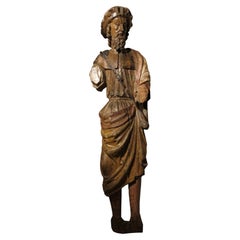
15th Century Carved Wood Depicting Saint James

15th Century Carved Wood Depicting Saint James

Located in Saint-Ouen, FR

The Saint depicted here is Saint James the Great. James is the brother of St. John the Evangelist. Nothing is known of his activities after the Ascension...

Category

Antique 15th Century and Earlier French Gothic Figurative Sculptures

Materials

Oak

Rare Nursing Virgin from the 14th century

Rare Nursing Virgin from the 14th century

Located in Saint-Ouen, FR

RARE NURSING VIRGIN FROM THE 14TH CENTURY ORIGIN : ITALY PERIOD : 14TH CENTURY Height : 60 cm Width : 20,5 cm Depth : 11 cm Wood Seated and in a very maternal position, Mary is wearing a red dress with a long, flowing cloak covering her narrow shoulders and falling down her body, with one side hugging her bust. Her hair, half hidden under a veil, frames an oval face featuring a high forehead, a long and thin nose, a small mouth with thin lips and half-closed eyes. Mary is carrying her son, the infant Jesus, who is wrapped in a cloak, in her lap. Jesus is being nursed by his mother, held by her left hand. This remarkable depiction, imbued with such gentleness, is directly inspired by the iconographic theme of the Virgin and Child in Majesty. It breaks with the hieratic, impassive style of the models from the 12th and 13th centuries, adding a touch of realism. From Virgin Queen, Mary became Virgin Mother. Linked to the development of the Marian cult, this type of representation, sometimes known as Virgo lactans, Virgin of Milk or Nurturing Virgin, remains extremely rare. This image of the Virgin Mary and the Infant Jesus is an extremely delicate representation of the intimate bond formed...

Category

Antique 15th Century and Earlier Italian Gothic Figurative Sculptures
Materials

Wood

You May Also Like

Vintage South Seas Carved Teak Mermaid

Vintage South Seas Carved Teak Mermaid

Located in Nantucket, MA

Early vintage or antique South Seas carved teak Mermaid, circa 1920s or perhaps earlier, a hand carved upright figure holding a carved shell, with deeply carved flowers in grooved hair flowing down back, shell necklace, and scale pattern throughout her tail. The statue is weathered, has a few age cracks, and the end of the tail is broken. Mounted long ago on a late Victorian brass lamp...

Category

Early 20th Century Pacific Islands Folk Art Sculptures and Carvings

Materials

Teak

Late 19th Century Signed Mahogany Nautical Hand-Carved Mermaid Sculpture Statue

Late 19th Century Signed Mahogany Nautical Hand-Carved Mermaid Sculpture Statue

Located in Miami, FL

Charming one of a kind, late 19th Century large Mahogany Mermaid Sculpture hand carved out of one piece of solid wood. Very detailed the Hair and Tail textured carvings, and the sensitivity of the Sculptor with the entire upper body. The Mermaid is holding a drum, the other arm can hold a flag. Another drum is next to her at the base. Signed by unknown Artist E. KETAN. The Nautical Mermaid...

Category

Antique Late 19th Century American Spanish Colonial Figurative Sculptures
Materials

Mahogany, Paint

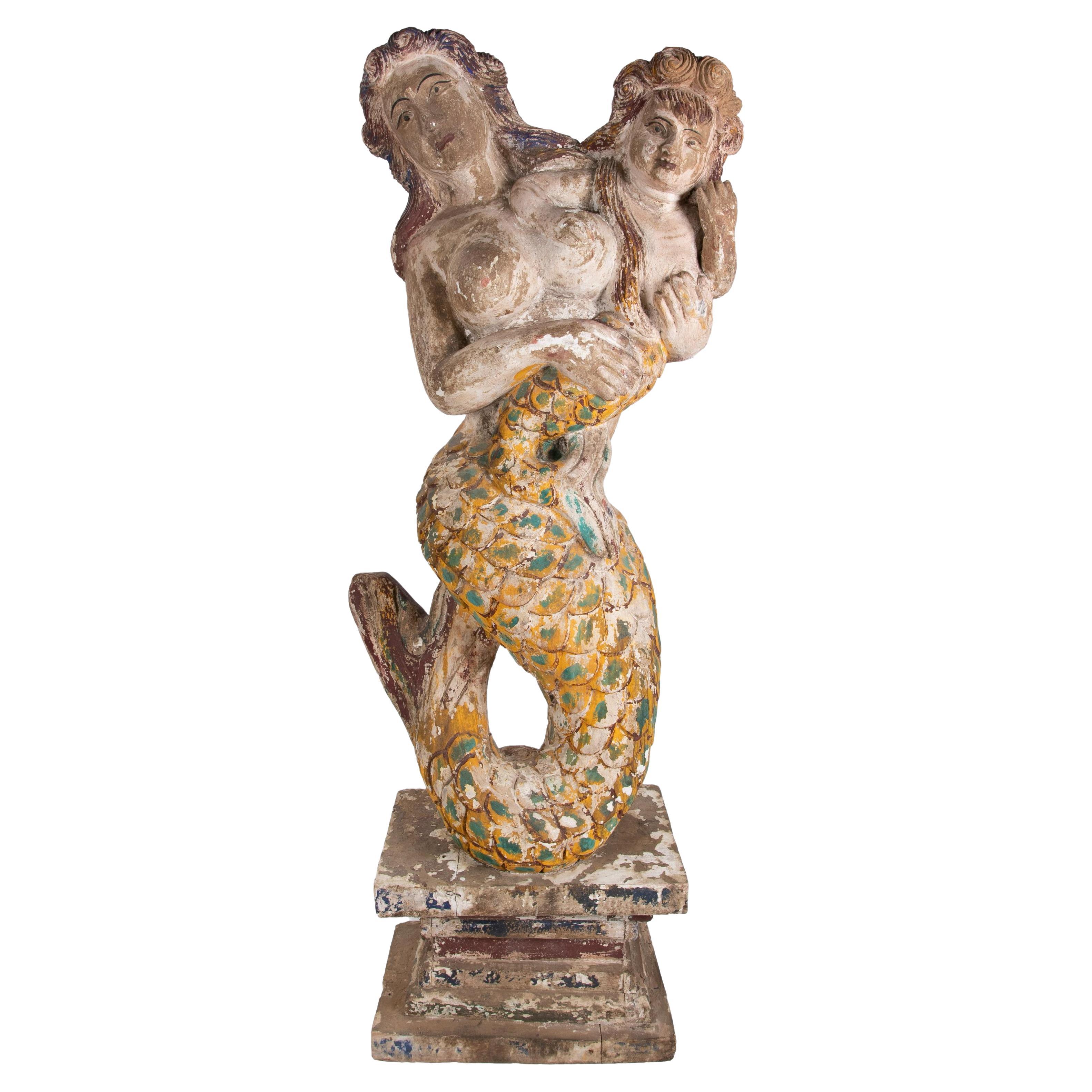
Vintage 1990s Spanish Hand Carved Wooden Painted Mermaid Sculpture

Vintage 1990s Spanish Hand Carved Wooden Painted Mermaid Sculpture

Located in Marbella, ES

Vintage 1990s Spanish hand carved wooden painted mermaidsculpture, reminiscent of a boats figurehead.

Category

Late 20th Century Spanish Figurative Sculptures

Materials

Wood

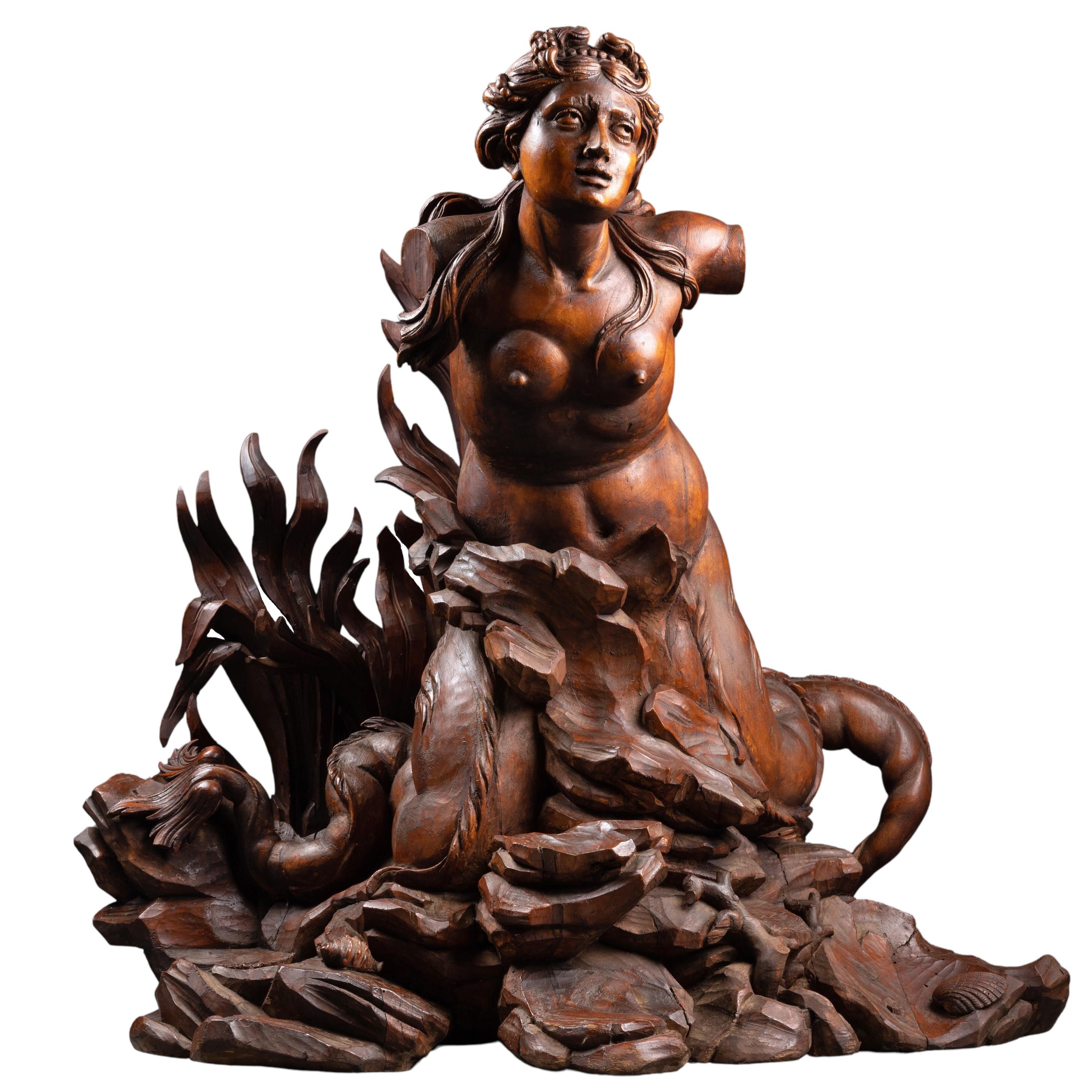
A late 17th Italian carved limewood figure of Mermaid, circle of Filippo Parodi

A late 17th Italian carved limewood figure of Mermaid, circle of Filippo Parodi

Located in PARIS, FR

A late 17th c. Italian carved figure of Mermaid, Circle of Filippo Parodi (Genoa, 1630 – July 22, 1702) Dimensions: h. 29.13 in, w. 30.31 in, p. 18.9 in (at the base) Magnificent Italian Baroque sculpture depicting a mermaid seated on the rock. All the virtuosity of the sculptor unfolds in this carved group. The fantastic creature is featured seated, the upper part of the body darting forward, the head looking upwards. Sophisticated hairstyle with rows of pearls intertwined in her hair, her loose locks fly in the wind and bring movement to the whole sculpture. The wide-open eyes with hollowed-out pupils make it possible to follow the mermaid's gaze, towards the sky. The half-open mouth further magnifies this bewitching and seductive attitude. Its long double tail ending in fins wraps on either side of a rocky mound strewn with objects evoking the underwater world: seashells and shells, branches of coral. The ornamental richness combined with the great care taken in its execution make it a work in which the splendor of Italian Baroque art unfolds in such characteristic scenic movement. The composition betrays a strong influence from Filippo Parodi, the leader of Genoese Baroque sculpture, and points to an artist from his circle. Our sculpture was probably part of a decorative monumental palace. The iconographic theme evoking the marine world finds its application in the numerous fountains and artificial grottos, designed in Italian palaces at the turn of the 17th and 18th centuries. Giacomo Filippo Parodi (Genoa 1630 – July 22, 1702) was an Italian Baroque sculptor of the Genoese school, who introduced Bernini's aesthetic to Genoa. In his youth fathers a first apprenticeship with a carpenter, he went to Rome where he became a pupil of Bernini. He had the opportunity to admire in person the works and style of the French sculptor Pierre Puget...

Category

Late 17th Century Baroque Figurative Sculptures

Materials

Wood

18th Century Handcarved Oak Caryatid

18th Century Handcarved Oak Caryatid

Located in Wormelow, Herefordshire

A beautiful late 17th/early 18th century handcarved oak caryatid, fitted with a hook to the reverse for wall hanging. More than 325 years old, this neoclassical style carving offer...

Category

Antique 18th Century Dutch Neoclassical Wall-mounted Sculptures

Materials

Oak

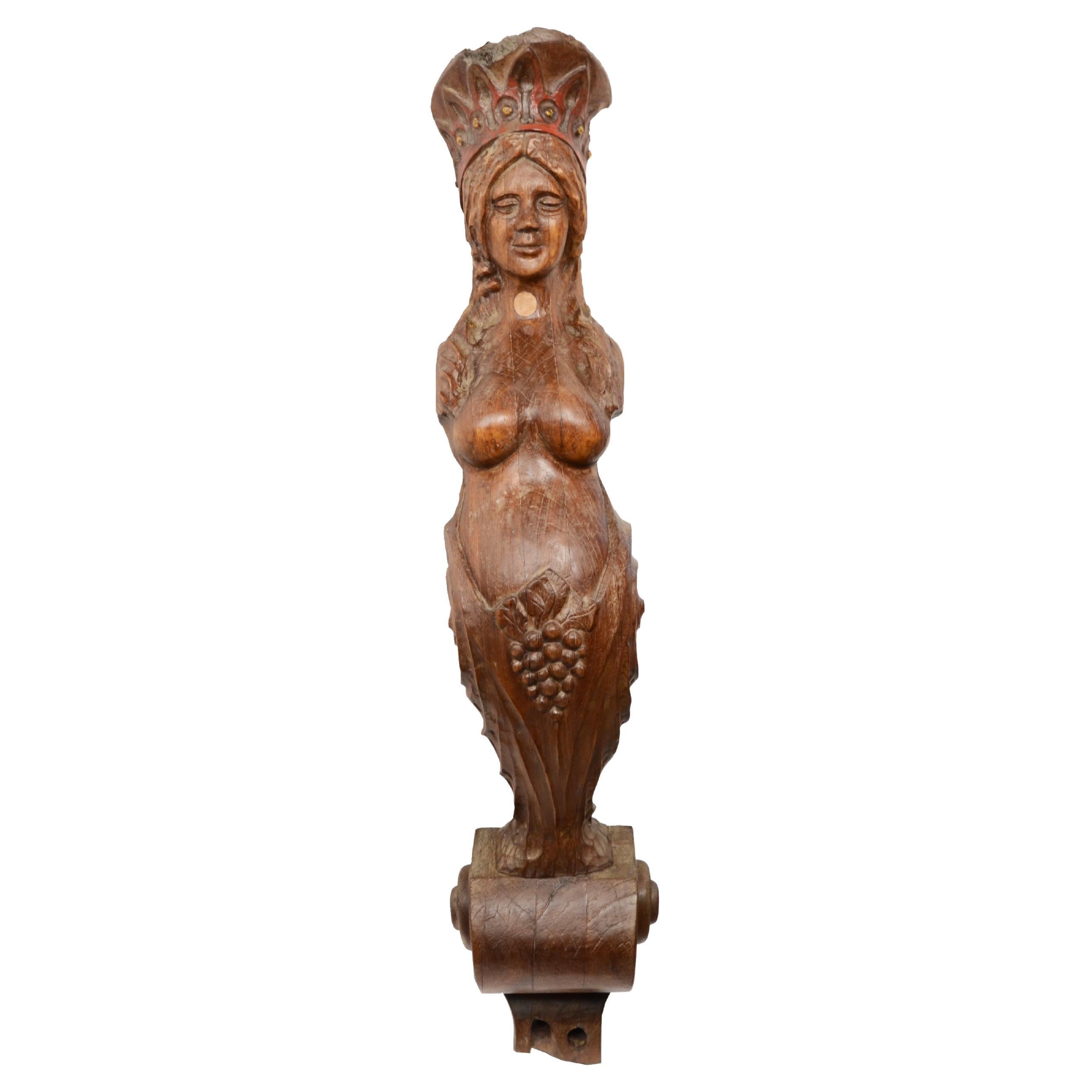
19th Century Carved Ship Figurehead Oak Wood Female Figure Antique Maritime

19th Century Carved Ship Figurehead Oak Wood Female Figure Antique Maritime

Located in Milan, IT

Figurehead in carved oak depicting a female figure whose body has the shape of a siren, symbol of fertility and protection, with female features in the upper part and fish tail inste...

Category

Antique 1870s Nautical Objects

Materials

Wood