Want more images or videos?
Request additional images or videos from the seller
1 of 9

English Majolica Cat Figure, Possibly William Brownfield, Victorian, 1880

$1,250
£934.68
€1,091.66
CA$1,756.25
A$1,778.74
CHF 1,021.80
MX$21,569.49
NOK 11,852.70
SEK 12,064.69
DKK 8,161.28

About the Item

English Majolica Cat Figure, Possibly William Brownfield, Victorian, 1880 Circa 1880 Cats are the rarities of Victorian majolica — for every one of them, the potteries turned out a kennel’s worth of dogs — and this one has personality to spare. Caught mid-prowl with ears pricked and tail streaming behind, the long-haired cat wears a lustrous orange-brown glaze over deeply tooled fur, with a great ruff at the neck and the eyes and whiskers accented in dark manganese. He advances across a hollow oval base glazed in two greens, a deep blue-green ground within a bright gadrooned rim, the cool colors setting off the warmth of the coat exactly as the Victorian modeler intended. Unmarked, as is typical, the figure is stylistically close to the animal models of William Brownfield of Cobridge, among the finest of the Staffordshire majolica makers. Dimensions Height: 6 inches (15.2 cm) Width: 9 inches (22.9 cm) Depth: 4¾ inches (12.1 cm) Condition Good antique condition. The end of the tail has been broken off and invisibly reattached. Provenance Earle D. Vandekar of Knightsbridge Historical Context Majolica — the brilliantly colored lead-glazed earthenware that swept England after its debut at the Great Exhibition of 1851 — delighted the Victorian home with animal subjects of every kind, and figures like this served as mantel ornaments full of character and color. Feline models survive in far smaller numbers than dogs and birds, making a well-modeled cat a genuine find for majolica collectors and cat fanciers alike. (Ref: NY9368/IAM)
  • Attributed to:
    William Brownfield (Manufacturer)
  • Dimensions:
    Height: 6 in (15.24 cm)Width: 9 in (22.86 cm)Depth: 4.75 in (12.07 cm)
  • Style:
    Victorian (Of the Period)
  • Materials and Techniques:
  • Period:
  • Date of Manufacture:
    1880-1890
  • Condition:
    Repaired: Original tail invisibly off/on. Minor structural damages.
  • Seller Location:
    Downingtown, PA
  • Reference Number:
    Seller: NY9368/IAM1stDibs: LU861027864492

More From This Seller

View All
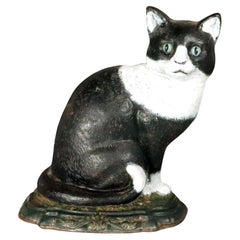
American Folk Art Door Stop in the Form of a Sitting Cast Iron Tuxedo Cat

American Folk Art Door Stop in the Form of a Sitting Cast Iron Tuxedo Cat

Located in Downingtown, PA

Cast Iron Charm: American Folk Art Cat Doorstop This charming piece of American folk art is a cast iron doorstop modeled in the form of a black and white tuxedo cat. Doorstops like ...

Category

Early 20th Century Folk Art Animal Sculptures

Materials

Iron

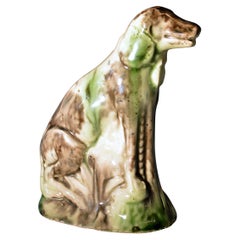
English Creamware Pottery Toy Whieldon-type Figure of a Hound

English Creamware Pottery Toy Whieldon-type Figure of a Hound

Located in Downingtown, PA

Georgian Creamware Toy Hound, Whieldon-Type Circa 1765-75 This charming Antique Creamware Figure of a hound is a superb example of 18th-century pottery. The small figure sits on its...

Category

Antique Mid-18th Century Figurative Sculptures

Materials

Ceramic, Creamware, Pottery

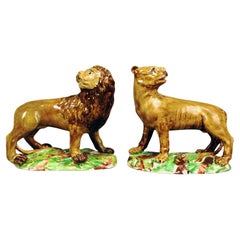
18th Century Ralph Wood Type Pearlware Lion and Lioness Figures

18th Century Ralph Wood Type Pearlware Lion and Lioness Figures

By Ralph Wood Pottery

Located in Downingtown, PA

Regal Guardians: A True Pair of Ralph Wood Type Pearlware Lions 1780-1800 This magnificent true pair of pearlware pottery figures—a majestic lion and its powerful lioness—exemplifies the high-quality decorative output of late 18th-century Staffordshire potteries in the manner of the celebrated Ralph Wood workshops. Displayed facing one another, these figures exude a regal yet charmingly naive presence typical of the period's finest folk-art ceramics. Each animal is masterfully modeled standing proudly on a slightly domed hollow base rendered in dynamic mottled green and brown glazes representing a grassy mound. The figures themselves are enriched with naturalistic brown glazes that flow and pool in the crevices of the modeling, dramatically highlighting the deeply textured mane of the male lion and emphasizing the sleek musculature of the lioness. The use of pearlware—a refinement of creamware with a whiter body and subtle blue tint to the glaze—indicates these were superior quality objects intended for prominent display. Dimensions 5 3/8 inches (13.65 cm) High 5 3/4 inches (14.61 cm) Long Provenance Produced in Staffordshire, England, circa 1780–1800. Historical Context Figures of lions and lionesses were enormously popular in 18th and 19th-century English pottery, serving as potent symbols of British national pride, strength, and imperial power. The Ralph Wood family of potters, working in Burslem, Staffordshire, were particularly renowned for their vibrant glazed figures, which are prized today for their distinctive aesthetic appeal and expressive modeling. The Ralph Wood pottery...

Category

Antique Late 18th Century English Georgian Animal Sculptures

Materials

Ceramic, Pearlware, Pottery

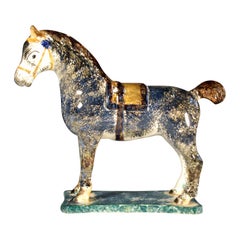
Newcastle Prattware Pottery Model of a Horse, St. Anthony Pottery, Newcastle

Newcastle Prattware Pottery Model of a Horse, St. Anthony Pottery, Newcastle

By Saint Anthony Pottery

Located in Downingtown, PA

Newcastle Folk Art: A St. Anthony Prattware Pottery Horse St. Anthony Pottery, Newcastle upon Tyne, Circa 1800–1820 This charming early 19th-century...

Category

Antique Early 19th Century English Regency Animal Sculptures

Materials

Pearlware, Pottery

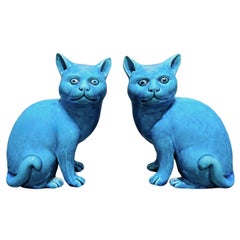
Chinese Export Porcelain Turquoise Cats

Chinese Export Porcelain Turquoise Cats

Located in Downingtown, PA

Pair of Chinese Export Porcelain Cats with Turquoise Glaze This striking pair of Chinese porcelain figures, dating from the Early 20th Century, depicts two domesticated cats posed a...

Category

Early 20th Century Chinese Chinese Export Porcelain

Materials

Porcelain

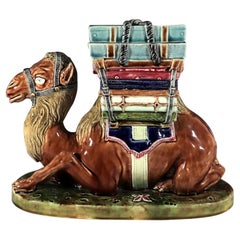
French Majolica Camel-Form Lidded Box

French Majolica Camel-Form Lidded Box

Located in Downingtown, PA

An Exotic Cargo: A French Majolica Camel-Form Lidded Box, St. Amand, Circa 1870 This charming French majolica lidded box is a delightful example of the imaginative and naturalistic forms that characterized 19th-century majolica production. Crafted by the St. Amand pottery in circa 1870, the piece is a sculptural rendering of a seated camel, a subject that would have appealed to the era's fascination with exoticism and global trade. The camel is naturalistically colored and rests on a raised, mottled green ground, suggesting a desert landscape. The lid of the box is formed by the camel's loaded pack, which is meticulously detailed with a variety of goods. This top section is removable, revealing a square, hollow interior in a contrasting light blue glaze—a small, hidden surprise. The impressed mark "St Ad" on the base confirms its origin from the Saint-Amand-les-Eaux pottery. This pottery, which was active from the 17th century to 1920, was renowned for its high-quality, brightly colored tin-glazed earthenware, a technique known as faience in France. St. Amand's work, often featuring rich glazes and creative forms, was widely exported and highly sought after for both tableware and decorative objects. Majolica, with its vibrant glazes and playful designs, saw a resurgence in popularity in the mid-19th century, particularly in England and France. This camel-form box is a perfect example of how the pottery of this period moved beyond purely functional forms to create whimsical and narrative pieces. It reflects a world increasingly connected by trade and travel, where images of distant lands and their inhabitants entered the domestic sphere. This piece, from a private New York collection and with a provenance tracing to Jesse Davis Antiques...

Category

Antique 1870s French Victorian Ceramics
Materials

Majolica

You May Also Like

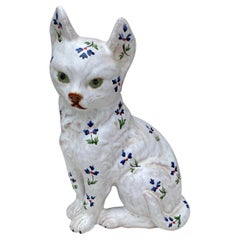
French Terra Cotta Majolica Cat Normandy Circa 1900

French Terra Cotta Majolica Cat Normandy Circa 1900

Located in Austin, TX

French Terracotta Majolica Cat Normandy Circa 1900. decorated with Cornflowers called Barbeaux in France. in the style and period of Emile Galle.

Category

Antique Early 1900s French French Provincial Animal Sculptures

Materials

Terracotta

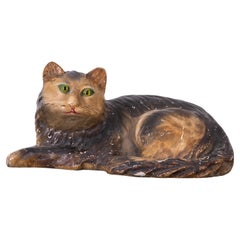
Pennsylvania Painted Chalkware Cat

Pennsylvania Painted Chalkware Cat

Located in Savannah, GA

A Pennsylvania painted chalkware cat, circa second half 19th century. These pieces usually painted by German-American folk artisans from Lancaster to Philadelphia were made to be a more accessible household ornament than expensive Staffordshire ceramics. They are more rare today due to their fragile gypsum composition. In the later part of the 19th century and into the 20th century these figures became popular as carnival prizes...

Category

Antique Late 19th Century American Victorian Animal Sculptures

Materials

Plaster

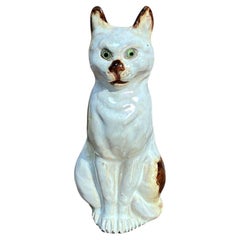
Terracotta Majolica Cat Bavent Normandy

Terracotta Majolica Cat Bavent Normandy

By Bavent

Located in Austin, TX

Terracotta Majolica Cat Bavent Normandy. H / 7.2inches , L / 4.3 by 3.5 inches.

Category

Antique Early 1900s French Rustic Animal Sculptures

Materials

Terracotta

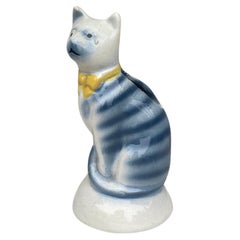
Italian Majolica Terracotta Cat Figure Sitting on a Pillow

Italian Majolica Terracotta Cat Figure Sitting on a Pillow

Located in Los Angeles, CA

A charming Italian majolica terracotta cat, beautifully hand-painted and glazed, seated regally upon a decorative pillow. Rich color and expressive detailing bring personality and wa...

Category

20th Century Italian Mid-Century Modern Animal Sculptures

Materials

Majolica, Terracotta, Paint