Want more images or videos?
Request additional images or videos from the seller
1 of 13

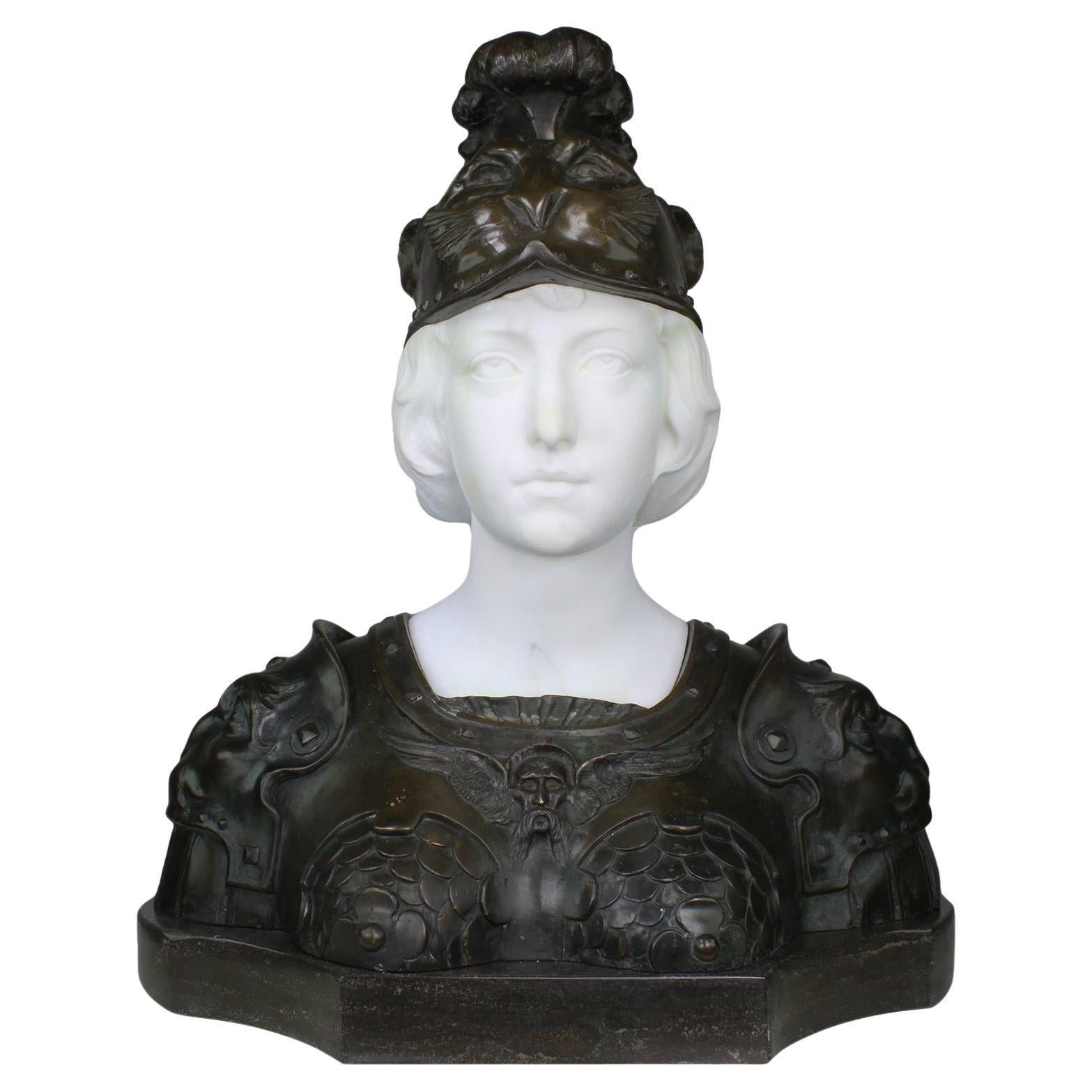
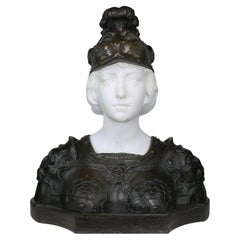
French 19th Century Neo-Classical St. Bronze, Marble, & Ormolu Bust of Marianne

$44,500
£33,739.48
€39,389.26
CA$63,630.65
A$64,611.71
CHF 36,883.82
MX$780,722.43
NOK 433,260.67
SEK 432,078.58
DKK 294,466.22

About the Item

A stunning and most impressive French 19th century Neo-Classical st. patinated bronze, silvered bronze, ormolu, Rosso Verona and white Carrara marble bust of Marianne in full armor. The bust is raised by a thick Rosso Verona marble base with an elegant scalloped shape adorned with richly chased masks and swaging berried laurel garlands and centered by a striking fitted ormolu plaque of men jousting on a medieval background. Above is the beautiful Marianne richly sculpted in white Carrara marble with exceptional attention to detail wearing in her remarkable patinated bronze armor and superb silvered bronze helmet.
  • Dimensions:
    Height: 27 in (68.58 cm)Width: 22 in (55.88 cm)Depth: 13 in (33.02 cm)
  • Style:
    Neoclassical (In the Style Of)
  • Materials and Techniques:
    Bronze,Marble,Ormolu,Patinated,Silvered
  • Place of Origin:
  • Period:
  • Date of Manufacture:
    1800s
  • Condition:
    Wear consistent with age and use.
  • Seller Location:
    West Palm Beach, FL
  • Reference Number:
    Seller: 129721stDibs: LU949931859792

More From This Seller

View All
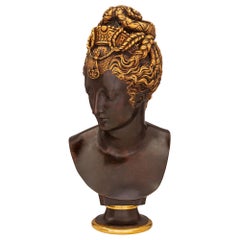
French late 19th century patinated Bronze and Ormolu bust of Raphaella

French late 19th century patinated Bronze and Ormolu bust of Raphaella

Located in West Palm Beach, FL

An elegant and most impressive French late 19th century patinated Bronze and Ormolu bust of Raphaella, signed Faure de Brousse. This beautiful bust depicts a Renaissance era princess...

Category

Antique Late 19th Century French Busts

Materials

Bronze, Ormolu

French 19th Century Belle Époque Period Bronze, Marble, and Ormolu Bust

French 19th Century Belle Époque Period Bronze, Marble, and Ormolu Bust

By Albert-Ernest Carrier-Belleuse

Located in West Palm Beach, FL

A beautiful and high quality French 19th century Louis XVI st. Belle Époque period ormolu, patinated bronze and Rouge Griotte marble bust of a young lady. The bust is raised by a squ...

Category

Antique 19th Century French Belle Époque Busts

Materials

Marble, Bronze, Ormolu

French 19th Century Egyptian Revival St. Bronze and Ormolu Bust

French 19th Century Egyptian Revival St. Bronze and Ormolu Bust

By Ferdinand Barbedienne

Located in West Palm Beach, FL

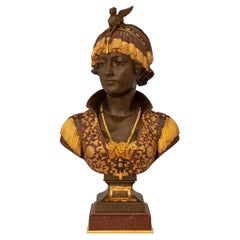
An exceptional French 19th century Egyptian Revival st. Belle Époque period patinated bronze and ormolu bust, signed by F. Barbedienne. The wonderful bust is raised by an elegant cir...

Category

Antique 19th Century French Egyptian Revival Busts

Materials

Bronze, Ormolu

Italian 19th century Bronze, Ormolu, and Marble statue, signed Ceribelli

Italian 19th century Bronze, Ormolu, and Marble statue, signed Ceribelli

By Cesar Ceribelli

Located in West Palm Beach, FL

An elegant and high quality Italian 19th century Neo-Greek st. patinated Bronze, Ormolu, and Rouge Griotte marble bust of Bianca Capello signed C. Ceribelli. This very attractive bus...

Category

Antique 19th Century Italian Greek Revival Figurative Sculptures

Materials

Griotte Marble, Bronze, Ormolu

French 19th Century Louis XVI Style Bronze and Ormolu Bust, Signed H. Dumaice

French 19th Century Louis XVI Style Bronze and Ormolu Bust, Signed H. Dumaice

Located in West Palm Beach, FL

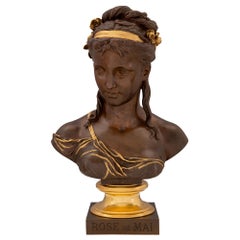
A stunning French 19th century Louis XVI st. patinated bronze and ormolu bust, signed H. DUMAICE. The bust is raised by a square patinated bronze base with the inscription ROSE de MA...

Category

Antique 19th Century French Louis XVI Busts

Materials

Bronze, Ormolu

You May Also Like

French 19th Century Bronze and White Marble Bust of Marianne in Full Armor

French 19th Century Bronze and White Marble Bust of Marianne in Full Armor

Located in Los Angeles, CA

A French 19th century bronze and marble bust of Marianne in full armor. The nicely cast Baroque Revival brown patinated bronze and carved white marble figure of Marianne, the allegorical personification of the French Republic, presented in her militaristic guise, reminiscent of Minerva, wearing a Phrygian helmet and armored breastplate centered by winged male mask and with lion shoulder armor pads, all raised on a conforming black marble base. Circa: 1890-1900. Marianne has been the national personification of the French Republic since the French Revolution, as a personification of liberty, equality, fraternity and reason, as well as a portrayal of the Goddess of Liberty. Marianne is displayed in many places in France and holds a place of honor in town halls and law courts. She is depicted in the Triumph of the Republic, a bronze sculpture overlooking the Place de la Nation in Paris, as well as represented with another Parisian statue on the Place de la République. Her profile stands out on the official government logo of the country, appears on French euro coins and on French postage stamps. She was also featured on the former franc currency and is officially used on most government documents. Marianne is a significant republican symbol; her French monarchist equivalent is often Joan of Arc. As a national icon Marianne represents opposition to monarchy and the championship of freedom and democracy against all forms of oppression. Other national symbols of Republican France include the tricolor flag, the national motto Liberté, Égalité, Fraternité, the national anthem "La Marseillaise", the coat of arms, and the official Great Seal of France. Marianne also wore a Cockade and a red Phrygian cap symbolizing Liberty. Minerva and its pendant bust of Mars evoke the classicizing subjects, bust-length formats, and style that originated in France during the reign of Louis XIV (1643–1715) and that concurrently was popularized across Europe. The busts' simple forms, stiff poses, and solemn facial types are consistent with the late Baroque sculptures that were carved in Flanders during this period. In Flanders, especially in Antwerp and Brussels, sculpture and architectural decoration traditionally was carved using combinations of native black marble (noir belge), mottled red marble (rouge belge), and white marble or alabaster. The use of these stones in colorful counterpoint speaks most strongly to the busts’ Flemish origins. The veneration of ideal heroes and heroines in ancient costume and arms took on extravagant form in the 17th century, with countless variations. Within this imaginative tradition, the identification of the pair as Minerva and Mars cannot be certain. The female bust, for example, could be identified as Bellona, Roman goddess of war, who is depicted in 17th and 18th century French paintings wearing flamboyantly plumed helmets and low-cut cuirasses that expose her breasts. Whatever their identities, the female and male warriors are portrayed as calm rather than bellicose beings. The sovereign pair does...

Category

Antique 19th Century French Baroque Revival Figurative Sculptures
Materials

Marble, Bronze

19th Century Louis-Robert Carrier-Belleuse Marble and Bronze Bust of Omphale

19th Century Louis-Robert Carrier-Belleuse Marble and Bronze Bust of Omphale

By Louis Robert Carrier-Belleuse

Located in Cincinnati, OH

This late 19th Century bust was executed by French painter and sculptor Louis-Robert Carrier-Belleuse (1848–1913), son and pupil of renowned sculptor Albert-Ernest Carrier-Belleuse. ...

Category

Antique Late 19th Century French Romantic Busts

Materials

Marble, Bronze

19th Century French Patinated Bronze Bust Of Ariadne

19th Century French Patinated Bronze Bust Of Ariadne

Located in Norwood, NJ

Antique 19th century French patinated bronze bust of Ariadne retailed by Tiffany & Co. Beautiful Grand Tour model mounted on a gilt bronze and rouge marble plinth. Marked Tiffany & Co. with inventory number. The Antinous bust based on the Lansdown Antinous marble found at Hadrian’s Villa...

Category

Antique 19th Century French Grand Tour Busts

Materials

Bronze

Early 20th-century bust by Fortunato Gori, made of gilt bronze and Carrara

Early 20th-century bust by Fortunato Gori, made of gilt bronze and Carrara

Located in Autonomous City Buenos Aires, CABA

The piece features a finely carved Carrara marble face paired with gilt bronze drapery and ornamental details, a material combination often seen in Gori's work. The contrast between ...

Category

20th Century French Other Busts

Materials

Carrara Marble, Bronze

Patinated Bronze Sculpture of Marianne, Early 20th Century.

Patinated Bronze Sculpture of Marianne, Early 20th Century.

Located in Saint-Ouen, FR

Patinated bronze sculpture of Marianne, early 20th century. Patinated bronze sculpture of Marianne, early 20th century. Dimensions : H: 23cm, W: 13cm, D: 9cm Contact us before orde...

Category

Early 20th Century French Art Nouveau Busts

Materials

Bronze

Antique Art Nouveau Female Carrara Marble Gilt Bronze Bust Statue Sculpture 1900

Antique Art Nouveau Female Carrara Marble Gilt Bronze Bust Statue Sculpture 1900

Located in Portland, OR

A very beautiful antique Art Nouveau bronzed Carrara marble sculpture bust of a young maiden circa 1900, by Gustave Van Vaerenbergh (1871-1927). The sculpture portrays a beautiful young maiden made from Cararra marble, she is wearing a laurel wreath in her hair. She wears a bronzed bodice with leaf decoration in relief and is raised on a varigated grey & white socle base. The sculpture is signed to the rear " G. V. Vaerenbergh" and numbered "1173", the bust is in excellent condition. Gustave Van Vaerenbergh attended classes at the Academy of Fine Arts in Ghent, Belgium from 1888 to 1890. Like many artists from a modest background (he was the son of a shoemaker) , Gustave Van Vaerenbergh went to work in companies where he could use his artistic talent and education for commercial purposes. In 1901 he moved to Saint-Josse-ten-Noode , and a year later to Schaerbeek where he would live for the rest of his life. He went to work there as a " mouleur en plâtre " (modeller or maker of matrices for plaster statues) at the company A. Carli Frères in the L'Olivierstraat in Schaerbeek, a company that produced commercial statues. This successful company, which was active from the beginning to the middle of the twentieth century , initially had about 20 employees and at its peak about 100 employees. The statues were distributed worldwide. Antonio Carli, a sculptor, was the founder of the Atelier A. Carli Frères, together with family members. They came from Bagni di Lucca...

Category

Early 1900s Art Nouveau Figurative Sculptures
Materials

Marble