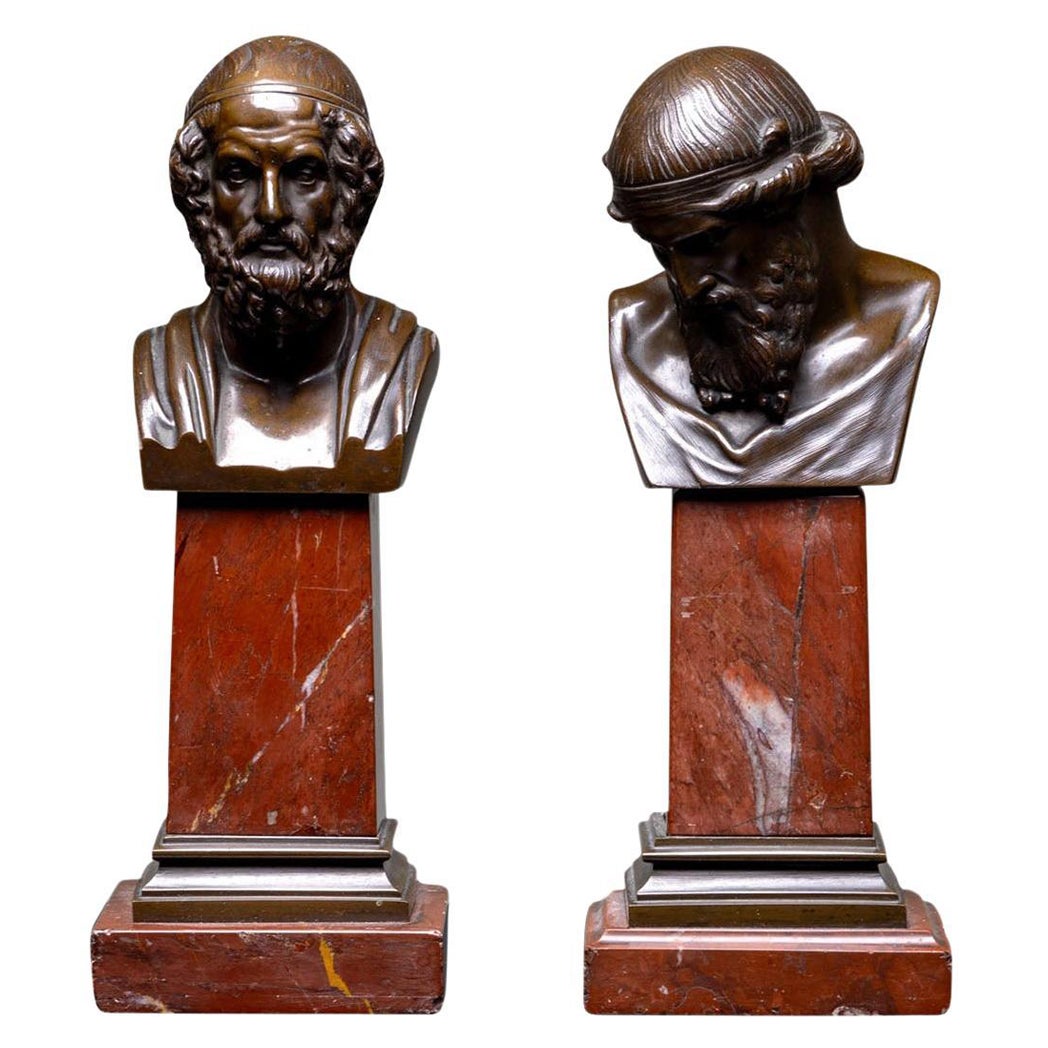
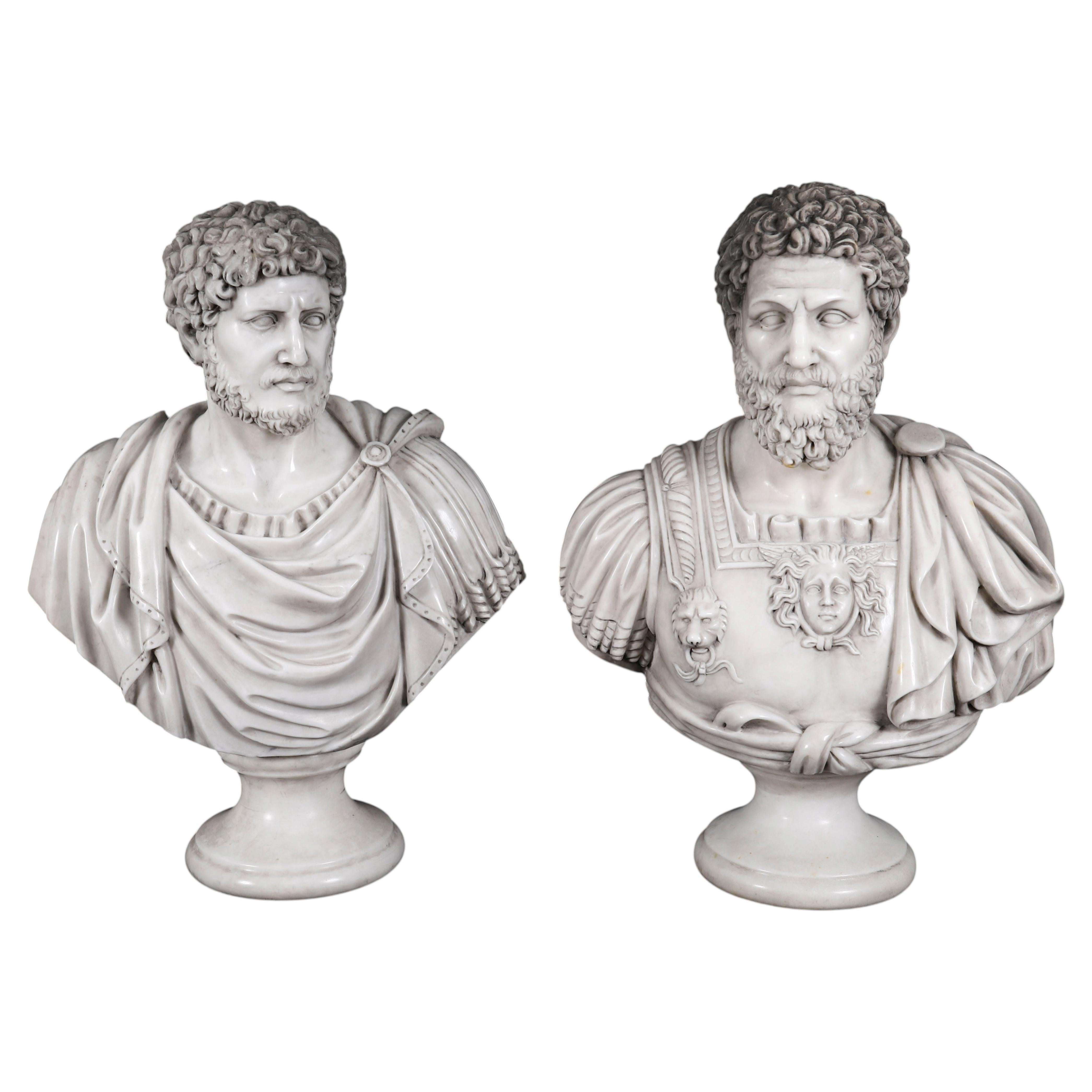
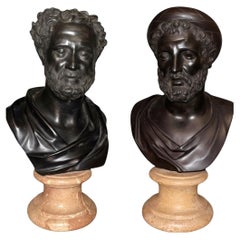
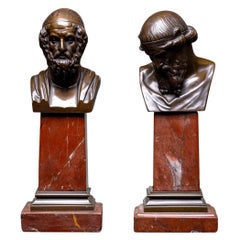
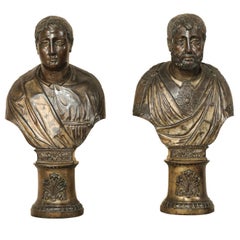
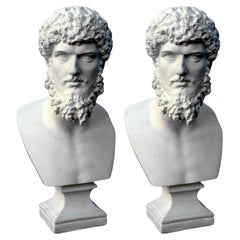
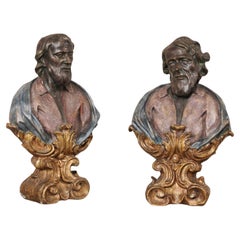
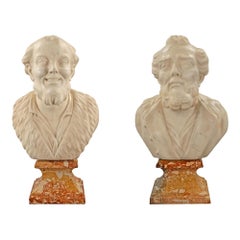
IMPORTANT PAIR OF BUSTS OF PYTHAGORAS AND EPICURUS
Circa late 18th century
Attributed to the workshop of Giacomo and Giancarlo Zoffoli
Unsigned, black and green patina with gilt bronze rim
18 3/8" H x 9" D x 9 1/2" W [Pythagoras]
18 7/8" H x 9" D x 9 3/8" W [Epicurus]
Provenance:
With Daniel Katz Ltd., London, reportedly acquired there in 1993
The Bill Blass Collection
Sotheby's, New York, Sale n07928, October 21-23, 2003, lot 6, achieved $ 33,000 USD
Private Collection
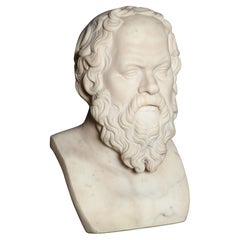
An inordinately fine pair of Italian bronze busts of philosophers Pythagoras and Epicurus attributed to the workshop of the Zoffoli brothers, each features a translucent silky surface over rich green patina overlaid with dark brown, black and reddish hues. The philosophers each are captured in slightly less than life-sized with truncated torso that allows for a squared plinth, this finished in a gilt-bronze rim. The passion for portraits of antiquity during the late 18th century set a long runway for firms like Zoffoli and Rhigetti to produce some of the finest examples of Italian bronze work for the clientele that demanded the absolute best.
There are no markings on the present busts to firmly place them with the Zoffoli foundry; they are are attributed to the firm due to the construction method and surface qualities. Zoffoli mastered the replication of the same greenish hue of copper sulfate deposits found on sculpture of antiquity and used this to create surfaces that were uniquely compelling. Much of their work can be found with the same complex patination as found in the present pair.
The breast of each philosopher is engraved with their respective names. The bust of Epicurus was likely modeled after the bust found in the Villa dei Papiri, Herculaneum in 1752, now in the permanent collection of the Naples Archeological Museum (acc. no. 11017) while the bust of Pythagoras appears to be largely interpreted from the bust discovered in the Villa in 1753 and also in the same museum collection (acc. no. 5607). Some artistic license was without doubt taken to remove the traditional head covering on the mathematician and make the pair more harmonious in presentation together.
Pythagoras (c. 570–495 BCE)
Pythagoras is remembered today primarily as a mathematician, but in his own time he was regarded as a semi-mystical figure whose teachings blended mathematics, music, cosmology and ethics into a unified worldview. At the heart of Pythagorean philosophy was the belief that numbers lie at the heart of all things: that beneath the apparent chaos of the world lies a hidden structure governed by harmony, proportion, and ratio.
He taught that the soul is immortal and that it passes through cycles of reincarnation. He believed that a life of disciplined purity incorporating practices of silence, music, vegetarianism, and self-control were keys to living a good life. To Pythagoras, mathematics was not just an abstract tool but a sacred language through which the divine order of the cosmos could be revealed.
Epicurus (341–270 BCE)
In contrast to Pythagoras, Epicurus approached life as a materialist. He believed that the universe is composed entirely of atoms and void, and that the gods, if they exist, do not intervene in human affairs. From this foundation, he constructed a moral philosophy centered on the pursuit of pleasure, which he defined not as indulgence, but as the absence of pain, fear, and anxiety.
Epicurus taught that the greatest sources of human suffering come not from physical discomfort, but from false beliefs. These false beliefs were especially harmful if they manifest fear of death and divine punishment. He proposed a lifestyle of simplicity, friendship and contemplation rooted in having only modest desires, a formula for life he reasoned was most likely to lead to true happiness. His garden school in Athens became a haven for men and women seeking tranquility through rational thought and honest fellowship.
Zoffoli Foundry:
Giacomo Zoffoli (1731–1785) and his younger brother Giovanni Zoffoli (1745–1805) operated one of the most important bronze foundries in eighteenth-century Rome. Established around 1760, their workshop quickly gained recognition for producing finely cast and patinated reductions of classical sculptures. These works, often modeled after celebrated Greco-Roman antiquities such as the Apollo Belvedere, the Laocoön, the Borghese and Medici vases, and the Capitoline Flora, were aimed at meeting the growing demand for collectible souvenirs among Grand Tour travelers. The Zoffoli bronzes were known for their high-quality metalwork and careful attention to surface finish, emulating Renaissance bronze techniques. Their workshop issued catalogues listing available models and prices, reflecting both the technical ambition and commercial savvy of their operation.
Many of their casts were acquired by European aristocracy, including King Gustavus III of Sweden and the Prince Regent of Britain, and their works entered numerous prominent private and royal collections. The Zoffoli legacy influenced subsequent Roman founders, including the Righetti family, and helped establish the bronze reduction as a core component of Neoclassical taste during the latter half of the eighteenth century.
Condition: Overall remaining in a very fine state of preservation. Rubbing has relieved the darkest layers of patination, this having developed into brighter reds and oranges in areas of relief. Abrasions around the edges of the rim. Numerous areas of patina wear in the flat sides of the torso on both figures, though mostly Epicurus. Several replaced screws in the rim.
ref. 504QPK23V
About silla antiques & art
Established in 2009, we have available in our 9000 square foot brick-and-mortar gallery an ever-changing selection of carefully curated and catalogued furniture, decorative arts, paintings, sculpture and estate jewelry. Our company has long specialized in sculpture circa 1860 through 1930 and as such the gallery always has a very large collection of exceptional European and American sculpture available on display.
The gallery is located at 117 W Burd Street in Shippensburg, Pennsylvania and is open by appointment only. We welcome your visit and would love to meet with you at the shop. For clients located outside of the area, we are always available to discuss items by video conferencing or by phone.