Video Loading
Want more images or videos?
Request additional images or videos from the seller
1 of 8

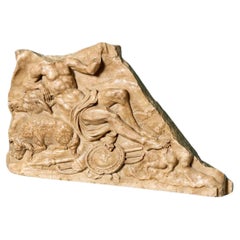
Ancient Roman Fragment with Damnatio ad Bestias

$35,298.31
£26,136.63
€30,000VAT Included
CA$49,165.54
A$50,019.58
CHF 28,666.22
MX$602,266.74
NOK 335,055.10
SEK 336,525.56
DKK 228,762.49

About the Item

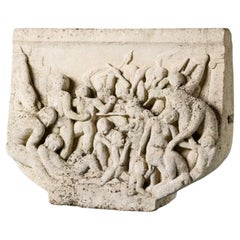
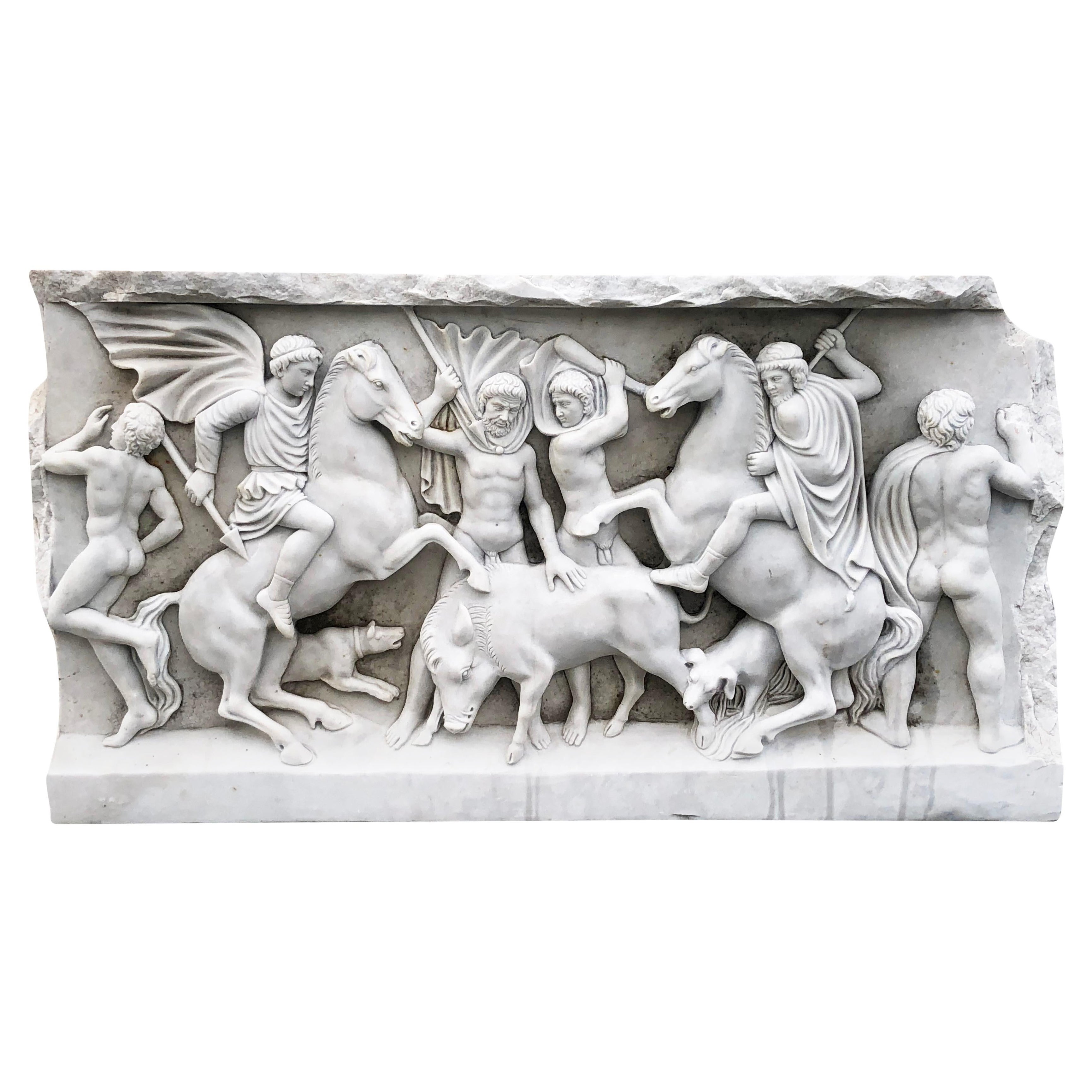
Provenance - Private collection of Alison Barker (1951-2021), Chichester, UK. Roman sculptural fragment carved in marble in relief on two planes. It presents, in a continuous composition in the form of a frieze, three interrelated figures: a tiger and two men. The beast appears raised on its hind legs, to the left, with its claws and jaws nailed to the back of one of the men. This one, about to die, bows to the second character, who appears standing before him, resting his right hand on the victim's head. The three figures are represented in strict profile, although this does not detract from the naturalism of the scene, whose dynamism is accentuated by the figures leaning to the left: the tiger supports its weight on its victim, and the latter on what appears to be its savior. who, although also leaning back, draws his left leg back to settle on the ground, restraining the movement of the other two figures. This is how the sculptor highlights, compositionally, the key role of this second figure, who is also highlighted by the richness of his clothes: while the attacked man wears a short tunic, the upright character wears a toga and a wide mantle that, swollen by the wind forms a great arc behind him. At the extreme left of the composition you can see part of a third figure, a bare leg, extended in full movement. Due to its format, narrow and elongated with a flat linteled area in the upper part, it can be deduced that this relief would originally belong to the sculptural decoration of a sarcophagus. It would be part of a longer continuous frieze, a common element in the ornamental composition of Roman sarcophagi. Regarding the theme represented, it is a scene from what is known as damnatio ad bestias, a type of death penalty that consisted of throwing the condemned man to wild beasts. This punishment could be carried out in different ways, but it usually took place in the circus arena. The custom, of Eastern origin, was imported to Rome not only as a punishment for criminals, but also, and at the same time, as a show. The preferred beasts were the big cats, especially the tiger, although throughout its centuries of development other wild animals such as the bear, the boar, the elephant or the rhinoceros were also used. Brought from Carthage by the victorious commanders of the Macedonians in 167 BC, the damnatio ad bestias was originally a punishment intended only for enemy soldiers accused of treason or desertion, who were tied to a post and left defenseless against animals. wild. Over time, given the love of the Roman people to contemplate these punishments, the damnatio ad bestias became a show of considerable complexity, with even theatrical overtones. The condemned could be placed in a cage full of beasts, or in the circus arena, tied up and defenseless. Sometimes, however, they were provided with weapons to make the spectacle more interesting, and these executions were even conceived as fantastic battles between men and animals: Pompey, during his second consulship (55 AD), organized a fight between gladiators strongly armed and eighteen elephants. The success of the show was such that a few decades later, in the 1980s, it was part of the inaugural games at the Flavio amphitheater. Although there were emperors, such as Caligula, who used this death penalty for all kinds of criminals indiscriminately, the Roman penal code dictated that the damnatio ad bestias was reserved for deserters from the army, those who used magic to harm others , poisoners, counterfeiters, political criminals, parricides, instigators of popular uprisings and child kidnappers. In addition, between the 1st and 3rd centuries it was also used as a punishment for escaped and Christian slaves. Proof of how popular this punishment was is the fact that the Lex Petronia, in the year 61, specifically prohibited citizens from throwing their slaves to wild beasts without prior trial. The practice was finally abolished in Rome in 681, though with one exception: in 1022, already in Byzantine times, a royal eunuch who had conspired against the emperor was thrown to the lions. Despite what can be seen in the relief under study, the damnatio ad bestias was not a punishment that contemplated the possibility of forgiveness. It was the most humiliating way to die, and at the same time an expensive and complex show to organize. There was therefore no possibility of going back. This allows us to think that, in the case of this relief, some kind of mythical scene is being represented. In fact, in the damnatio ad bestias it was common for the punishment to be staged as if it were a mythological story. Martial describes, for example, the death of a condemned man who, presented to the public as Orpheus, is torn to pieces by a bear on a stage decorated with trees, evoking the Garden of the Hesperides. in all In any case, the punishments-show were in Rome a clear expression of the power of the rulers, and this is precisely what is reflected in the relief under study: there is a dignified character (position, clothes, attitude) in whose hands the power rests about the life and death of the convicted person who, having broken the law, has lost all his rights, and any kind of control over his life. It is possible, therefore, a symbolic, moralizing reading of the scene, which tells us about the "just" punishment that awaits those who do not respect the common law.
  • Dimensions:
    Height: 8.47 in (21.5 cm)Width: 16.54 in (42 cm)Depth: 4.73 in (12 cm)
  • Style:
    Greco Roman (Of the Period)
  • Materials and Techniques:
  • Period:
  • Date of Manufacture:
    1st - 2nd century AD
  • Condition:
    Wear consistent with age and use. Fragment without restorations, in good condition.
  • Seller Location:
    BARCELONA, ES
  • Reference Number:
    Seller: 210062671stDibs: LU10999250293052

More From This Seller

View All
Ancient Roman Fragment of Relief in Marble

Ancient Roman Fragment of Relief in Marble

Located in BARCELONA, ES

25.5 cm with the stand. Provenance: R. C. Collection (1924 - 2023), Brussels, Belgium. Roman relief fragments, dating to the third century AD. Preserved in a fragmentary state, the...

Category

Antique 15th Century and Earlier Classical Roman Figurative Sculptures

Materials

Marble

Ancient Roman Relief with a Satyr in marble

Ancient Roman Relief with a Satyr in marble

Located in BARCELONA, ES

Provenance - Private collection, Brittany, France. - Galerie Ghezelbash, Paris. Relief carved in marble belonging to one of the scenes that decorated a Roman sarcophagus. It represe...

Category

Antique 15th Century and Earlier Greco Roman Figurative Sculptures

Materials

Marble

Ancient Roman Trapezophore of a satyr abducting a maenad

Ancient Roman Trapezophore of a satyr abducting a maenad

Located in BARCELONA, ES

Trapezophore of a Satyr abducting a Maenad Ancient Rome · 1st - 2nd century AD Marble Height 54 cm and 71 cm with the stand. Provenance: - Former private collection, United Kingd...

Category

Antique 15th Century and Earlier Classical Roman Figurative Sculptures

Materials

Marble

Ancient Roman Sculpture of the hero Hercules in marble

Ancient Roman Sculpture of the hero Hercules in marble

Located in BARCELONA, ES

55 cm with the stand. Provenance - Private collection, Pamiers, France. A small marble sculpture carved in the round depicting a standing, nude Hercules, with powerful muscles that...

Category

Antique 15th Century and Earlier Greco Roman Figurative Sculptures

Materials

Marble

2nd Century AD Roman Marble Relief Sculpture with Theatre Mask

2nd Century AD Roman Marble Relief Sculpture with Theatre Mask

Located in BARCELONA, ES

Relief with theatre mask Ancient Rome, 2nd century AD Marble 51 cm height. Provenance - Private collection, Switzerland, acquired in the 1980s – 1990s. - Private collection, Lond...

Category

Antique 15th Century and Earlier Classical Roman Figurative Sculptures

Materials

Marble

Corinthian capital. Roman, southern Iberian Peninsula, 1st-3rd century AD. 36 cm

Corinthian capital. Roman, southern Iberian Peninsula, 1st-3rd century AD. 36 cm

Located in BARCELONA, ES

Corinthian capital. Ancient Roman, southern Iberian Peninsula, 1st - 3rd century AD. Marble. Height 36 cm, width 35 cm and depth 25 cm. Condition Good state of preservation Prov...

Category

Antique 15th Century and Earlier Classical Roman Figurative Sculptures

Materials

Marble

You May Also Like

'The Calydonian Boar' 15th Century Italian Marble Fragment

'The Calydonian Boar' 15th Century Italian Marble Fragment

Located in Wormelow, Herefordshire

A large antique Italian marble fragment depicting a section of the Calydonian Boar Hunt. Likely once forming part of a great carved frieze, this marble fragment is thought to be 600 ...

Category

Antique 15th Century and Earlier Italian Renaissance Sculptures and Carv...

Materials

Marble

Ancient Roman Stele Relief Fragment

Ancient Roman Stele Relief Fragment

Located in New Orleans, LA

Ancient Roman Stele Relief Fragment Circa 1st Century BCE–1st Century CE This rare marble stele relief fragment is a remarkable artifact of ancient history. Dating to the 1st centur...

Category

Antique 15th Century and Earlier Greco Roman Antiquities

Materials

Marble

THE BATTLE OF THE CENTAURS - MICHELANGELO BUONARROTI - PLASTER CAST early 20th C

THE BATTLE OF THE CENTAURS - MICHELANGELO BUONARROTI - PLASTER CAST early 20th C

Located in Madrid, ES

THE BATTLE OF THE CENTAURS - MICHELANGELO BUONARROTI - PLASTER CAST early 20th Century Large ancient bas-relief reclaimed in plaster cast, 1:1 reproduction of the Battle of the Cent...

Category

Early 20th Century Italian Modern Figurative Sculptures

Materials

Plaster

Carved Antique Stone Sculpture by a Student of Hugh Casson

Carved Antique Stone Sculpture by a Student of Hugh Casson

Located in Wormelow, Herefordshire

This weathered antique stone sculpture was reputedly carved by a student of 20th century British architect and artist, Sir Hugh Casson. It depi...

Category

Mid-20th Century English Neoclassical Figurative Sculptures

Materials

Stone, Limestone

A Roman Marble Sculpture of Hercules, Circa 1st / 2nd Century AD Ex Sotheby's

A Roman Marble Sculpture of Hercules, Circa 1st / 2nd Century AD Ex Sotheby's

Located in ARMADALE, VIC

A Roman Marble Sculpture of Hercules, Circa 1st / 2nd Century AD The sculpture is nude except for the draped Nemean lion skin. Provenance: Sotheby's London, December 14, 1981, lot ...

Category

Antique 15th Century and Earlier Italian Classical Roman Figurative Scul...

Materials

Marble

Roman Marble Trapezophorus circa 1st-2nd Century A.D

Roman Marble Trapezophorus circa 1st-2nd Century A.D

Located in Madrid, ES

A Roman marble trapezophorus in the Form of a Barbarian Dacian young figure. Circa 1st-2nd century A.D. Measure: height 24 1/4 inches (62 cm). Property from Mr. Radu Moldovan, Skokie, Illinois Provenance: B.C. Holland Gallery...

Category

Antique 15th Century and Earlier Italian Classical Roman Figurative Scul...

Materials

Marble