1 of 9

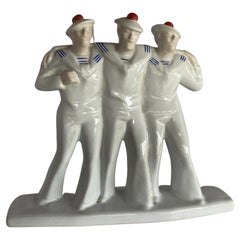
Art Deco Sailors on Leave Earthenware Ceramic Sculpture

Price:$1,050
$1,500List Price

You May Also Like

Art Deco Sailors on Leave Earthenware Ceramic Sculpture by Edouard Cazea

Art Deco Sailors on Leave Earthenware Ceramic Sculpture by Edouard Cazea

By Edouard Casaux

Located in Van Nuys, CA

French Matelots singing sailors Dax Art Deco Group. Art Deco Sailors on leave earthenware ceramic sculpture. The iconic original at the height of Art Deco was designed by Edouard Caz...

Category

Vintage 1930s Statues

Materials

Porcelain

Painted Ceramic Sculpture by Tizziano Galli, Italy, circa 1940

Painted Ceramic Sculpture by Tizziano Galli, Italy, circa 1940

By Tiziano Galli

Located in Buenos Aires, Buenos Aires

Painted ceramic sculpture by Tizziano Galli, Italy, circa 1940. Tiziano Galli, (1908-1986).

Category

Vintage 1940s Italian Art Deco Figurative Sculptures

Materials

Ceramic

Austrian Ceramic Collection by Leopold Anzengruber / Weiner Werkstatte / Bosse

Austrian Ceramic Collection by Leopold Anzengruber / Weiner Werkstatte / Bosse

$750Sale Price / set|21% Off

H 8.75 in W 7.5 in D 3.5 in

Austrian Ceramic Collection by Leopold Anzengruber / Weiner Werkstatte / Bosse

By Leopold Anzengruber

Located in Chicago, IL

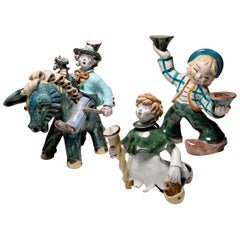
A group of 3 Austrian ceramic figures attributed to Leopold Anzengruber. Manner of Walter Bosse and the Wiener Werkstatte Dimension is of dancing large figure. Note: They are all ...

Category

Mid-20th Century Austrian Art Deco Figurative Sculptures

Materials

Ceramic

Art Deco Harlequin Glazed Earthenware Figurine

Art Deco Harlequin Glazed Earthenware Figurine

Located in Hamilton, Ontario

This Art Deco glazed earthenware figurine is unsigned and only numbered, but believed to have been made in either Germany or Austria in circa 1920. This figurine is done in a thick c...

Category

Early 20th Century German Art Deco Figurative Sculptures

Materials

Earthenware

Vally Wiethelthier, Drunken Sailor, Art Deco Art Ceramic Figurine, ca. 1925

Vally Wiethelthier, Drunken Sailor, Art Deco Art Ceramic Figurine, ca. 1925

Located in New York, NY

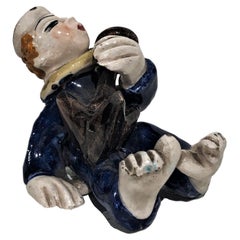
ABOUT This funny, humorous tabletop ceramic figurine depicts a drunken sailor lying on his back. Around his neck is a metal ring with an anchor on it. MARKINGS Signed on the left buttock: "Italy". DIMENSIONS: Height: 2.5 inches Width: 2 inches Depth: 3.5 inches VALERIE “VALLY” WIESELTHIER (Austrian-American, 1895 – 1945) was an outstanding ceramic artist. She was born to a Jewish family in Vienna, Austria. Her father, Wilhelm Wieselthier was a lawyer. Valluy attended theWiener Frauenacademie in Vienna from 1912 to 1914 and studied at the Vienna School of Applied Arts with Rosalinda Rothhansl, Kolo Moser, Jodef Hoffmann and Michael Powolny from 1914 to 1920. In addition, she worked as an auxiliary nurse during the First World War. From 1917 to 1922, she worked for the Wiener Werkstatte. From 1922 to 1927, she ran her own ceramic workshop in cooperation with the Augarten porcelain factory, which was newly founded in 1923, but also with other companies such as Friedrich Goldschider, Gmundner Keramik and Lobmeyr. Her expressive and humorous porcelain figures attracted attention at the Exposition Internationale des Arts Décoratifs et industriels modern in Paris in 1925 and are considered typical examples of the Art Deco style style. From 1928, the artist increasingly moved her center of life to the United States. She went to the International Exhibition of Ceramic Art in New York City in October 1928. In 1933, she moved to Chicago with Paul Lester Wiener...

Category

Vintage 1920s Italian Art Deco Figurative Sculptures

Materials

Ceramic

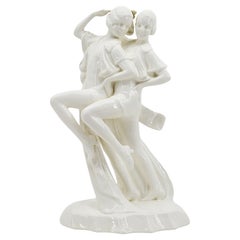
Art Deco Crackle Glaze Ceramic Dancers, Europe, 1925 Sculpture

Art Deco Crackle Glaze Ceramic Dancers, Europe, 1925 Sculpture

Located in Saint-Amans-des-Cots, FR

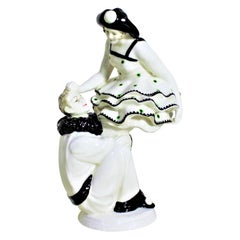
This captivating French Art Deco ceramic sculpture, dating from circa 1925, depicts two cabaret dancers performing a playful military-style march. Full of movement, theatrical expres...

Category

Vintage 1920s French Art Deco Figurative Sculptures

Materials

Ceramic

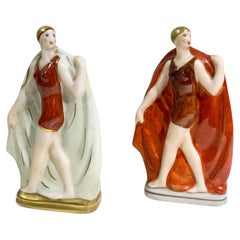
Set of 2 Art Deco Porcelain Figurines Signed Amelin - Rauche / "Limoges France"

Set of 2 Art Deco Porcelain Figurines Signed Amelin - Rauche / "Limoges France"

Located in Beirut, LB

Art Deco Figurines in Limoges porcelain, featuring a depiction of 2 young women swimmers adorned in a classic bathing suit featuring a more fitted and tailored look compared to the loose and boxy styles of the previous decades. In a playful gesture, a towel is casually draped over the shoulders, its wavy form adding a dynamic element to the scene. Hand-painted with the use of red , white and gold details accenting the dynamism. Initially, Limoges porcelain was made in the style of Meissen porcelain, with elaborate hand-painted designs and gold leaf decoration. However, by the early 19th century...

Category

Vintage 1930s French Art Deco Figurative Sculptures

Materials

Porcelain

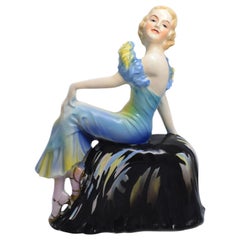
Art Deco 1930s Original Ceramic Figurine

Art Deco 1930s Original Ceramic Figurine

$583

H 7.49 in W 5.91 in D 2.76 in

Art Deco 1930s Original Ceramic Figurine

Located in Devon, England

A beautiful, elegant, stylish, Art Deco lady figurine seated on a draped seat. She is in excellent condition with no cracks, chips or restoratio...

Category

Mid-20th Century English Art Deco Figurative Sculptures

Materials

Ceramic

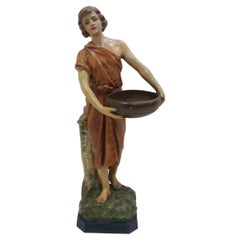
Art Deco Sculpture Women, 1930

Art Deco Sculpture Women, 1930

$1,470

H 29.93 in W 8.67 in D 8.67 in

Art Deco Sculpture Women, 1930

Located in Praha, CZ

- Made in Czechoslovakia - Made of terracotta - Author August Otto born 1868 in Oeslau near Coburg, died 1947. - From 1891 to 1915 he was a modeller in th...

Category

Vintage 1930s Czech Art Deco Figurative Sculptures

Materials

Terracotta

Art Deco Ceramic Sculpture by Keramos, Austria, 1934

Art Deco Ceramic Sculpture by Keramos, Austria, 1934

$24,000

H 20.87 in W 15.75 in D 8.27 in

Art Deco Ceramic Sculpture by Keramos, Austria, 1934

Located in Ciudad Autónoma Buenos Aires, C

Ceramic Sign: Made in Austria Keramos 2051 19/M Wiener Keramos, later Keramos AG or Keramos KG , was a Viennese ceramics manufacturer that made a name for itself especially in the interwar period . In addition to their own designs, designs from the dissolved Wiener Werkstätte were also produced from 1932 onwards. In over 60 years of company history, around 3000 model designs have been produced by around 60 ceramists. Keramos also carried out commissions from the Wiener Werkstätte, such as vases by Dagobert Peche . History The origins of the Keramos company lie in two companies with the same name. The company Keramos – Invalid Society for Viennese Art Ceramics was founded at the end of 1919 on the initiative of the three ceramists Rudolf Wolf, Heinrich Wolf and Ludwig Rys, who had become invalids in World War I. Production started in September 1920. Art-ceramic lamps, figures, vases and boxes were produced. The company Keramos – Viennese art ceramics and porcelain manufactory was founded in 1920. Josef Hoffmann was a shareholder of Keramos for a long time, as was the sculptor Rudolf Podany, who was engaged from the start and created a large number of designs. From 1921 Anton Klieber was employed, who was also responsible for most of the models. Around 1924 both companies were merged and converted into an AG, commercial director became Otto Köller, the technical directors were the brothers Rudolf and Heinrich Wolf. "Some war invalid ceramists founded a workshop with the help of some artists, which was subsequently financed by the state and later enlarged with its participation and converted into a joint-stock company." The company's headquarters were in the Hofburg , Schwarze-Adler-Stiege, the factory in the 10th district of Vienna, Schleiergasse 17. Artistic collaborators at that time were Eduard Klablena , Otto Prutscher , Karl Perl , Karin Jarl-Sakellarios , IDA Schwetz- Lehmann and Grete Fucik-Fischmeister. On February 23, 1928, the triangular mark was entered in the trademark register. It was now also produced for the Wiener Werkstätte. Difficulties for the company arose from the Great Depression . Around 1932, 50 people were employed and a large number of models from Eduard Klabena and the dissolved Wiener Werkstätte were taken over. The works created by Keramos were labeled with their company brands until after 1941. From 1939 the economic situation of the company was better managed by taking over the production of ceramic winter welfare organization badges, the so-called WHW badges. Before 1941 the company is converted into a KG named Keramos, Wiener Kunstkeramik und Porzellanmanufaktur Brüder Wolf KG . Otto Köller was no longer active from this point on. After the end of World War II, Robert Obsieger recommended Robert Mathis as the new head of Keramos, who took over the management of the ceramics manufactory in 1945. In 1949 Mathis introduced a new company logo, which was used alongside the existing triangle mark, the so-called coat of arms mark. Anton Klieber and Rudolf Podany continued to work as ceramists, and new artists such as Josef Lorenzl and Stephan Dakon , both of whom had previously worked for Goldscheider , as well as Rudolf Chocholka, Karl Grössl and Ina Eisenbeisser were engaged. New models such as dancers, children's figures, animals and nudes were created, as well as the well-known wall masks, young people and poodles from the mid-1950s, which corresponded to the trend at the time. In addition, however, traditional designs such as Madonna statues and busts, saints and angels were still made. Utility ceramics such as crockery, vases, lamp bases, candle holders and flower pots also became an important branch of production, and cooperation with the German manufacturer Carstens at the beginning of the 1960s was just as lucrative. In the course of the 1960s, the sales markets for figurative ceramics became increasingly difficult. So until 1982, production was increasingly shifted to everyday ceramics, since ceramic figures were no longer modern due to changing tastes and the spirit of the times. Ultimately, the economic situation at Keramos became more and more difficult and Klaus Mathis, the son of Robert Mathis and then director, who succeeded his father at the helm of the company at the beginning of the 1970s, initiated the liquidation of the company at the end of 1982 . Staff The following artistic collaborators have worked for Keramos over the years: Hans Adametz , Franz Barwig the Elder , Franz Barwig the Younger , Andreas Beck, Hans Bolek, Angelo Bortolotti, Hertha Bucher , Rudolf Chocholka, Stephan Dakon , Ferdinand Doblinger, Eckstein, Franz Eggenberger , Ina Eisenbeisser, English, Stephan Erdös, Alois Feichtinger, Feyslitz, Hans Friedberger, Grete Fucik-Fischmeister, Kurt Goebel, Anton Grath, Karl Grössl, M. Günther, Otto Hafenrichter, Arnold Hartig , Friedrich Herkner, Trude Hillinger, Leopold Hohl, Hostasch, Karl Jamök, Karin Jarl-Sakellarios , Eduard Klablena, Klar, Anton Klieber, Maria Klinger, Josef Kostial, Josef Lorenzl , Wilhelm Otto Lugerth, Viktor Matula, Gusty Mundt-Amman, Novotny, Carl Perl, Rudolf Podany, Friedrich Pollak, Hugo Postl, Adolf Prischl, Otto Prutscher , Max Rieder , Elisabeth Rieger-Hofmann, Walter Ritter , Willibald Russ, Karl Sailer, Schönberg, Schwarz, Ida Schwetz-Lehmann , Sult, Robert Ullmann , Otto Weigand, IDA Weiss-Moricz, Rudolf Wolf. Exhibitions • Jubilee exhibition of the Wiener Kunstgewerbeverein, Austrian Museum , Vienna 1924. • Arts and Crafts Exhibition, Paris, 1925. • Exhibition of Austrian arts and crafts...

Category

Vintage 1930s Austrian Art Deco Figurative Sculptures
Materials

Ceramic