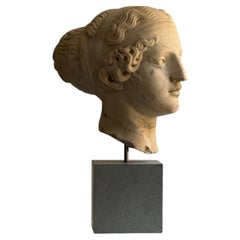
German ceroplast from the 17th century
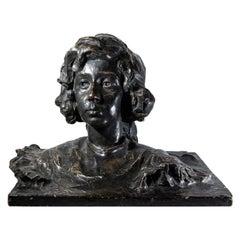
Bust of a gentlewoman
Wax, 36x32.5 cm
The use of making wax figures was very common, since ancient times, among the Greeks and Romans, and, as far as we have less evidence of it, also among the Egyptians and the peoples of earlier Asia. In the Middle Ages and modern times, wax was used by sculptors to model figures or objects to be cast in metal, to sketch works to be developed later into larger proportions, and finally as the actual sculpting material to cast or model figures in the round or bas-reliefs. Numerous examples have been preserved of wax sketches, including those by the hands of distinguished artists: that of Michelangelo's David (Florence, Buonarroti Gallery) and several of other figures, that of Cellini's Perseus (Florence, Bargello National Museum), that of Baccio Bandinelli's Hercules and Cacus (Berlin, Kaiser Friedrich Museum), those of Ferdinand I de' Medici (Berlin, Kaiser Friedrich Museum), and two reliefs of the Passion by Giambologna (London, Victoria and Albert Museum). As an actual sculptural material, wax served primarily for portraiture, whether for funerary figures that were displayed during honors rendered to the bodies of sovereigns or otherwise illustrious figures, votive figures, or finally for actual portraits. The use of funerary figures in colored wax and covered with sumptuous vestments is attested at least as early as the mid-14th century, at the courts of France and England, and also at the republic of Venice: eleven of those figures are still preserved in Westminster Abbey, and in the treasury of San Rocco in Venice the head of Doge Alvise IV Mocenigo. With the 16th century, ceroplastics also produced works independent of votive or funerary significance, and portrait-medallions were especially common, especially by Italian artists, such as Cellini, Leone Leoni, Alfonso Lombardi, Pastorino da Siena, Francesco Segala, and Abondio, which were also very much in vogue across the Alps. It is precisely to this latter case history of wax use in the artistic sphere that this artifact turns out to be ascribable. By shaping the unusual material, the ceroplast brings to life a fascinating female bust. The woman portrayed, with her elaborate hairstyle and exquisite jewelry parure, sensually displays both breasts: her body appears to be only partially covered by a red drape, the silky texture of which is expertly rendered in rich detail.