Video Loading
Want more images or videos?
Request additional images or videos from the seller
1 of 20


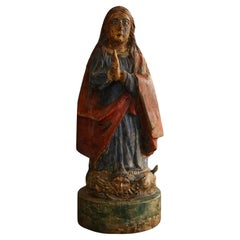
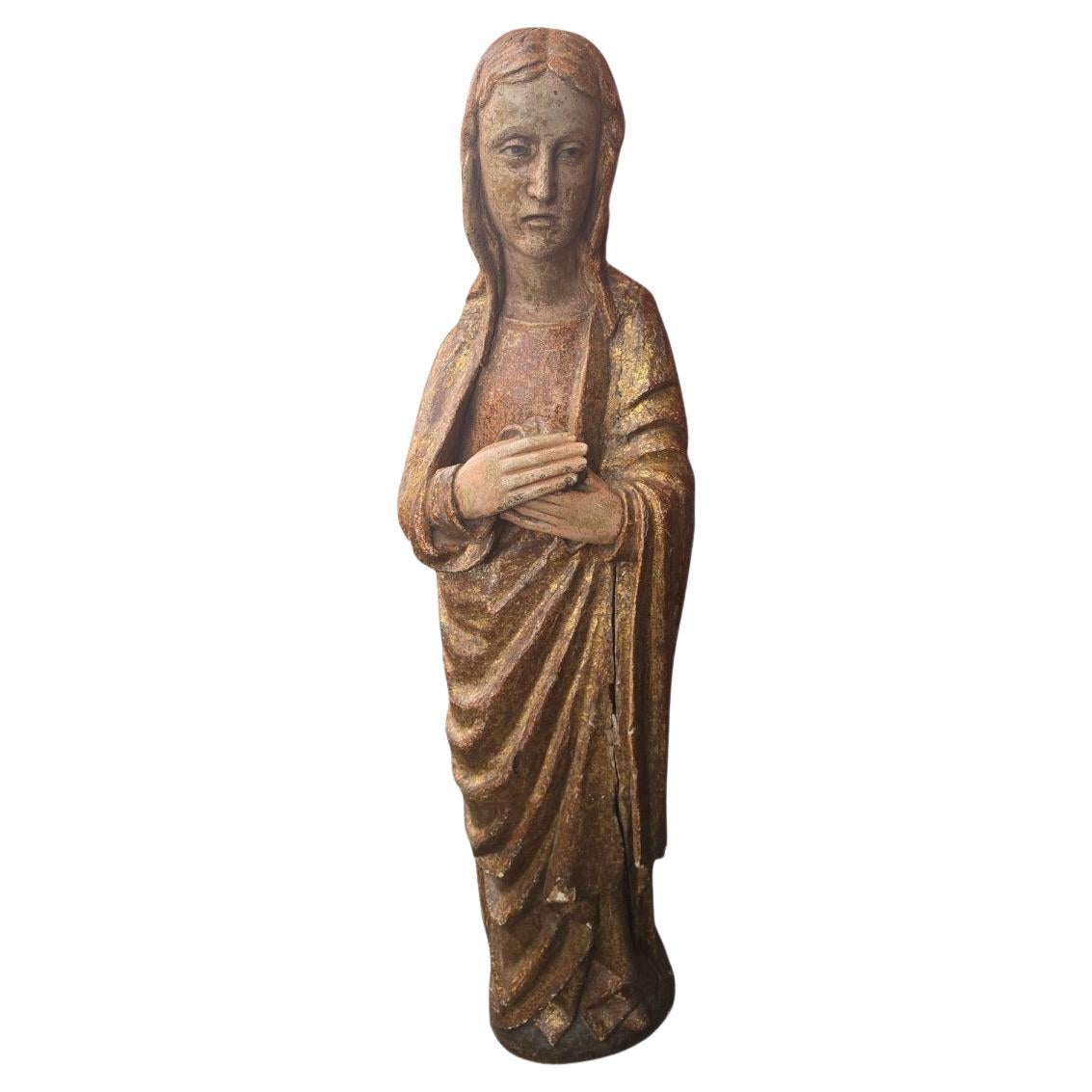
Polychrome Carved Wooden Virgin In Prayer, 16th Century, Italy

$8,824.58
£6,534.16
€7,500VAT Included
CA$12,291.38
A$12,504.89
CHF 7,166.55
MX$150,566.68
NOK 83,763.77
SEK 84,131.39
DKK 57,190.62

About the Item

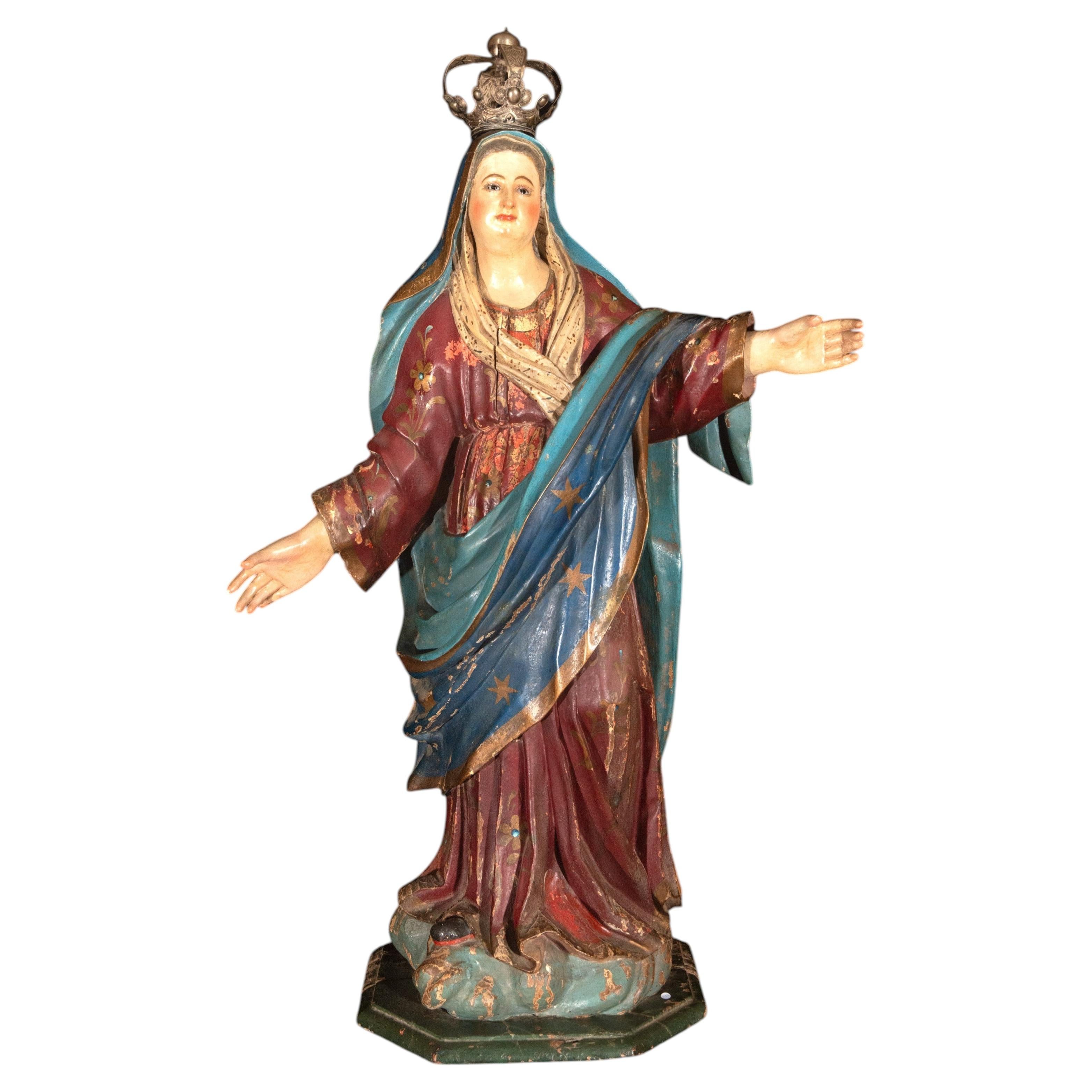
A remarkable carved and polychromed wooden sculpture depicting the Virgin Mary standing in prayer, her hands joined in a gesture of devotion and contemplation. Executed in Italy during the 16th century, and likely originating from the Emilia region, the figure retains a beautiful aged patina together with significant traces of its original polychromy in warm brick-red, brown and muted blue tones. The Virgin is portrayed wearing a long belted gown beneath a voluminous mantle whose elegant cascading folds envelop the figure with a sense of grace and serenity. Her delicately carved face, inclined downward in quiet meditation, conveys humility, compassion and spiritual introspection. The sculptor achieved a remarkable balance between monumentality and tenderness, characteristic of Italian Renaissance religious imagery. This iconography, widespread throughout Italian devotional art, symbolizes Mary's purity, obedience and acceptance of the divine will. Her joined hands evoke prayer and intercession, while her lowered gaze expresses humility before God. The protective mantle, an important Marian symbol, represents mercy and maternal protection extended to the faithful. Given its scale and conception, this sculpture was almost certainly created as part of a larger ecclesiastical ensemble. It may originally have belonged to a Crucifixion group, a Lamentation scene, or a devotional arrangement displayed within a church, chapel, or private oratory. Such figures were intended not only as sacred images but also as instruments of devotion, encouraging meditation on the Passion of Christ and the role of the Virgin as compassionate witness and intercessor. The surviving traces of original paint, combined with centuries of natural wear, endow the sculpture with exceptional authenticity and presence. Today, beyond its religious significance, it stands as a powerful example of Renaissance craftsmanship and would make a striking addition to any collection of European sculpture, religious art, or historically significant interiors. Italy, Emilia region, 16th century. Condition: Sold as found. Overall good antique condition with expected wear and losses consistent with age. Remnants of original polychromy throughout. Evidence of historic woodworm activity, minor losses and surface wear. Later iron display base. Dimensions Height: 122 cm (48.03 in.) Width: 45 cm (17.72 in.) Depth: 30 cm (11.81 in.) Weight:25 kg
  • Dimensions:
    Height: 48.04 in (122 cm)Width: 17.72 in (45 cm)Depth: 11.82 in (30 cm)
  • Style:
    Renaissance (Of the Period)
  • Materials and Techniques:
  • Place of Origin:
  • Period:
  • Date of Manufacture:
    unknown
  • Condition:
    Wear consistent with age and use. Minor losses. Minor structural damages. Minor fading.
  • Seller Location:
    MARSEILLE, FR
  • Reference Number:
    1stDibs: LU6656250727092

More From This Seller

View All
Madonna In Lacquered Wood H160cm, 17th Century Period

Madonna In Lacquered Wood H160cm, 17th Century Period

Located in MARSEILLE, FR

Madonna from the 17th century, in lacquered and carved wood, life-size: she stands, wrapped in her veils, her hands in prayer. This sculpture must have been leaning against a wal...

Category

Antique 17th Century Italian Louis XIV Figurative Sculptures

Materials

Wood

Egyptian Woman  With Urn, Orientalist Spelter, Signed, Late 19th Century

Egyptian Woman With Urn, Orientalist Spelter, Signed, Late 19th Century

Located in MARSEILLE, FR

Large subject in patinated spelter representing an Egyptian woman in a long tunic and wearing a crown with a bird, presenting an urn/offering in her hands Sculpture signed in the fo...

Category

Antique 19th Century French Moorish Figurative Sculptures

Materials

Spelter

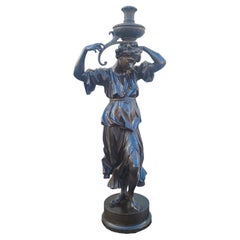
Large Sculpture in wood, 185cm High, Woman with vase, 19th Century

Large Sculpture in wood, 185cm High, Woman with vase, 19th Century

Located in MARSEILLE, FR

Large patinated wooden sculpture depicting a woman in a draped dress, carrying a vase on her head. The sculpture is of very high quality, particularly the patina, which gives it a...

Category

Antique 19th Century Italian Renaissance Figurative Sculptures

Materials

Wood

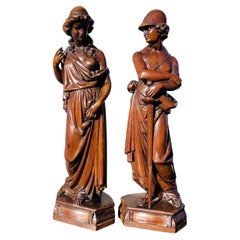
Pair Of Wooden Sculptures, H70cm, 19th Century

Pair Of Wooden Sculptures, H70cm, 19th Century

Located in MARSEILLE, FR

Pair of wooden sculptures depicting a man and a woman standing on a base decorated with an empty cartouche. 19th-century sculpture, some wear, cracks, losses, and an old sword re...

Category

Antique 19th Century Italian Louis XVI Figurative Sculptures

Materials

Wood

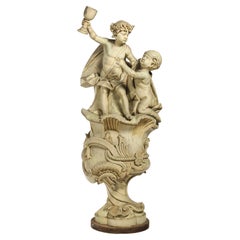
Large Putti Sculpture In Lacquered Wood, Italy, 19th Century

Large Putti Sculpture In Lacquered Wood, Italy, 19th Century

Located in MARSEILLE, FR

Large sculpture in cream lacquered carved wood, representing 2 putti on a large vase, celebrating a bacchanal: one of them has a head surrounded by a crown of flowers and brandishes ...

Category

Antique 19th Century Italian Louis XIV Figurative Sculptures

Materials

Wood

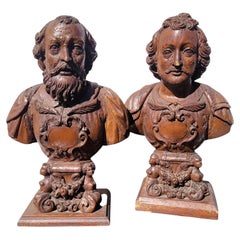
Rare Pair Of Reliquary Busts Made Of Carved Walnut, 17th Century

Rare Pair Of Reliquary Busts Made Of Carved Walnut, 17th Century

Located in MARSEILLE, FR

An impressive pair of carved wooden busts depicting two male figures, one bearded and the other one with moustache: rendered as half-length portraits, the figures wear richly ornamen...

Category

Antique 17th Century Italian Renaissance Figurative Sculptures

Materials

Walnut

You May Also Like

18th Century Italian Carved Wood Polychrome Virgin Mary Sculpture

18th Century Italian Carved Wood Polychrome Virgin Mary Sculpture

Located in Doha, QA

This is an outstanding Italian 18th century carved wood polychromed sculpture of Virgin Mary. The Sculpture is hand painted with some remains of a gold gilt in few places and originated until lately in a private Villa in Tuscany (Italy). The colors are typical red, blue and green are spectacular on this large figure. The Virgin's hands are joined together in a prayer, while standing on a pedestal on the both sides of which are devil's horns (bottom left side horn missing ) symbolising Holly Mary defeating the Evil, protected by the Holly Ghost and an Angel. A story tells the pose of the Virgin Mary sculpture...

Category

Antique 18th Century Italian Baroque Figurative Sculptures

Materials

Wood, Pine

Early 19th Century French Polychrome Carved Wooden Virgin Mary Sculpture

Early 19th Century French Polychrome Carved Wooden Virgin Mary Sculpture

Located in LEGNY, FR

Religious sculpture in carved and polychrome wood dating from the early 19th century, depicting the Virgin Mary in a graceful pose expressing gentleness, compassion, and benevolence....

Category

Antique Early 19th Century French Religious Items

Materials

Wood

Polychrome carved wood Virgin and Child from the 15th Century

Polychrome carved wood Virgin and Child from the 15th Century

Located in Saint-Ouen, FR

POLYCHROME CARVED WOOD VIRGIN AND CHILD FROM THE 15TH CENTURY   ORIGIN: SOUTH GERMANY, SWABIA, NUREMBERG REGION PERIOD: 15th CENTURY   Height: 94,6cm Width : 28 cm Depth : 18 cm   Lime wood Original Polychromy Good state of conservation     From 1430 onwards, sculpture underwent a profound stylistic renewal which continued until 1530, the so-called late Gothic period. In the Germanic countries, original sculptures flourished in an expressive and sensitive vein.
This renewal was inspired by the art of Nicholas of Leiden, who was active in Strasbourg in the 1460's. His style broke with the refined and delicate art of the international Gothic style in force throughout Europe around 1400. The figures became more authentic and realistic. The bodies became denser. Clothes are animated by deep, broken folds, the fabrics are heavy and have a great decorative value. In addition, the polychromy is intended to be illusionistic. The painting makes it possible to restore the texture of the materials, the richness of the textiles and the natural skin tone of the characters.   The dissemination of images through engraving and the great mobility of the artists led to the success of this style, which conquered the Upper Rhine, Swabian, Tyrolean and Franconian regions, contributing to the formation of a common stylistic identity in these regions. The economic boom in the flourishing German cities was conducive to the development of original production. Attracted by this prosperity, numerous workshops were set up in order to meet the orders of religious communities, the Church and the laity, including a clientele of middle-class rockers.      This precious Virgin and Child is depicted standing on a crescent moon, her head encircled by a crown of tall flowers. Her long wavy hair spreads over her shoulders, framing her beautiful oval face. Under fine eyebrows drawn with a brushstroke, her almond-shaped, slightly drooping eyes look at the Child with infinite softness. She is dressed in a long red dress with a rounded neckline, belted under the chest. The heavy fabric of her dress spreads out in broken folds at her feet. On her shoulders she wears a golden cloak. The drapery has deep folds. She holds out her right hand while she holds the Christ Child with her left.   Christ, with his well-defined hair, is naked. His cheeks are highlighted with red, he holds an apple in his left hand and with the other hand makes a sign of blessing towards the faithful.   Virgins with Child on a crescent moon were very popular in the second half of the 15th century, especially as the central subject of altarpieces in southern Germany and Austria. The crescent moon on which Mary is standing is reminiscent of the Woman of the Apocalypse. Often equated with the Virgin Mary.    This episode is taken from the Book of Revelation (12:1-6)   1 Then a great sign appeared in heaven: a woman clothed with the sun, with the moon under her feet and a crown of twelve stars on her head. ; 2 She was pregnant, and she cried out because she was in labor, in pain from giving birth. ; 3 Then another sign appeared in heaven: it was a great fiery red dragon, with seven heads and ten horns, and seven royal crowns on his heads. ; 4 His tail swept down a third of heaven's stars and threw them to the earth. The dragon stood in front of the woman who was about to give birth so that when she gave birth, he might devour her child. ; 5 She gave birth to a son, a male child who is to rule all the nations with an iron rod. Her child was snatched up to God and his throne. ; 6 Then the woman fled into the desert, where God has prepared a place for her. There she will be taken care of for one thousand two hundred sixty days.   Some theologians see in this woman a reference to the Virgin Mary and in the child, Jesus.    
This remarkable work is a very fine example of sculpture from Swabian workshops in the last decades of the 15th century. It presents all the characteristic stylistic elements: a highly girdled silhouette, an abundant drapery with angular folds, but also a great physical presence accentuated by the polychromy that restores the anatomical details. This group is made of a wooden log. The deep folds of the drapery highlight the movement of the Virgin holding the child.       Bibliography :   Sophie Guillot de Suduiraut, Dévotion et Séduction, Sculptures souabes des musées de France, vers 1460-1530, Paris musée du Louvre-Éditions somogy, 2015   “Revelation 12 -   Common English Bible...

Category

Antique 15th Century and Earlier German Gothic Figurative Sculptures
Materials

Wood

Renaissance polychrome and gilded wooden sculpture of Saint Anne, Spain, 16th ce

Renaissance polychrome and gilded wooden sculpture of Saint Anne, Spain, 16th ce

By Spanish Manufactory

Located in Madrid, ES

Renaissance polychrome and gilded wooden sculpture of Saint Anne, Spain, 16th century Imposing carved, polychrome, and gilded wooden sculpture, representing Saint Anne. Made in the ...

Category

Antique 16th Century Spanish Baroque Figurative Sculptures
Materials

Silver

Large Spanish Colonial Polychrome Virgin Mary, 18th Century

Large Spanish Colonial Polychrome Virgin Mary, 18th Century

Located in Madrid, ES

A striking Spanish Colonial polychrome carved wood sculpture depicting the Immaculate Conception, dating from the late 18th The Virgin is represented standing with open arms in a w...

Category

Antique 18th Century Peruvian Spanish Colonial Figurative Sculptures
Materials

Wood