Want more images or videos?
Request additional images or videos from the seller
1 of 19

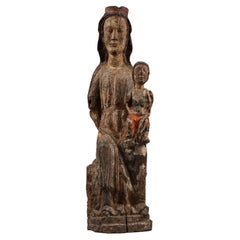
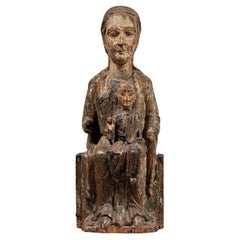
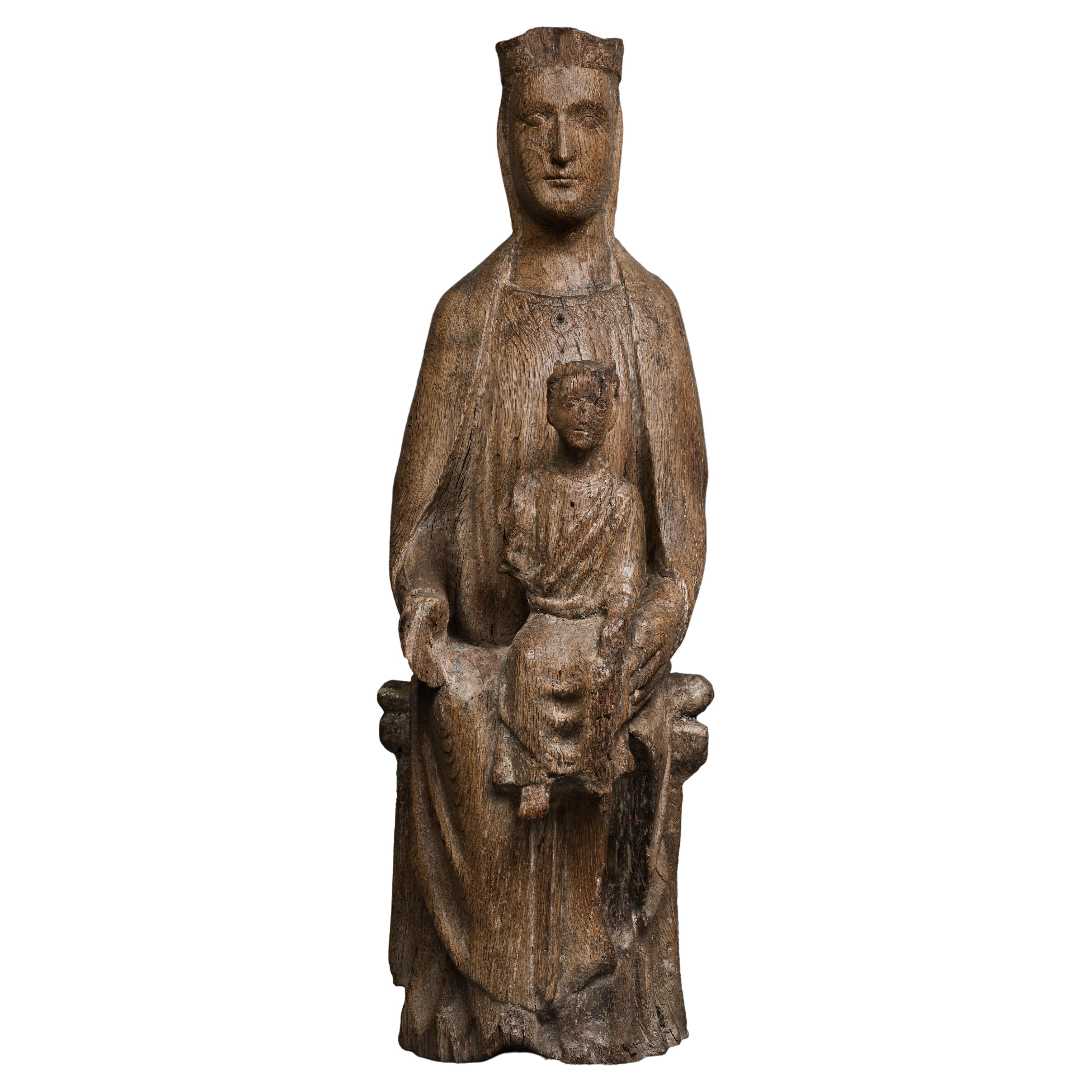
Seated Virgin with Child (Sedes Sapientiae) from the 12th Century in Spain

$9,113.05
£6,745.22
€7,740VAT Included
CA$12,695.74
A$12,912.76
CHF 7,383.74
MX$156,190.49
NOK 86,512.77
SEK 86,491.99
DKK 59,018.12

About the Item

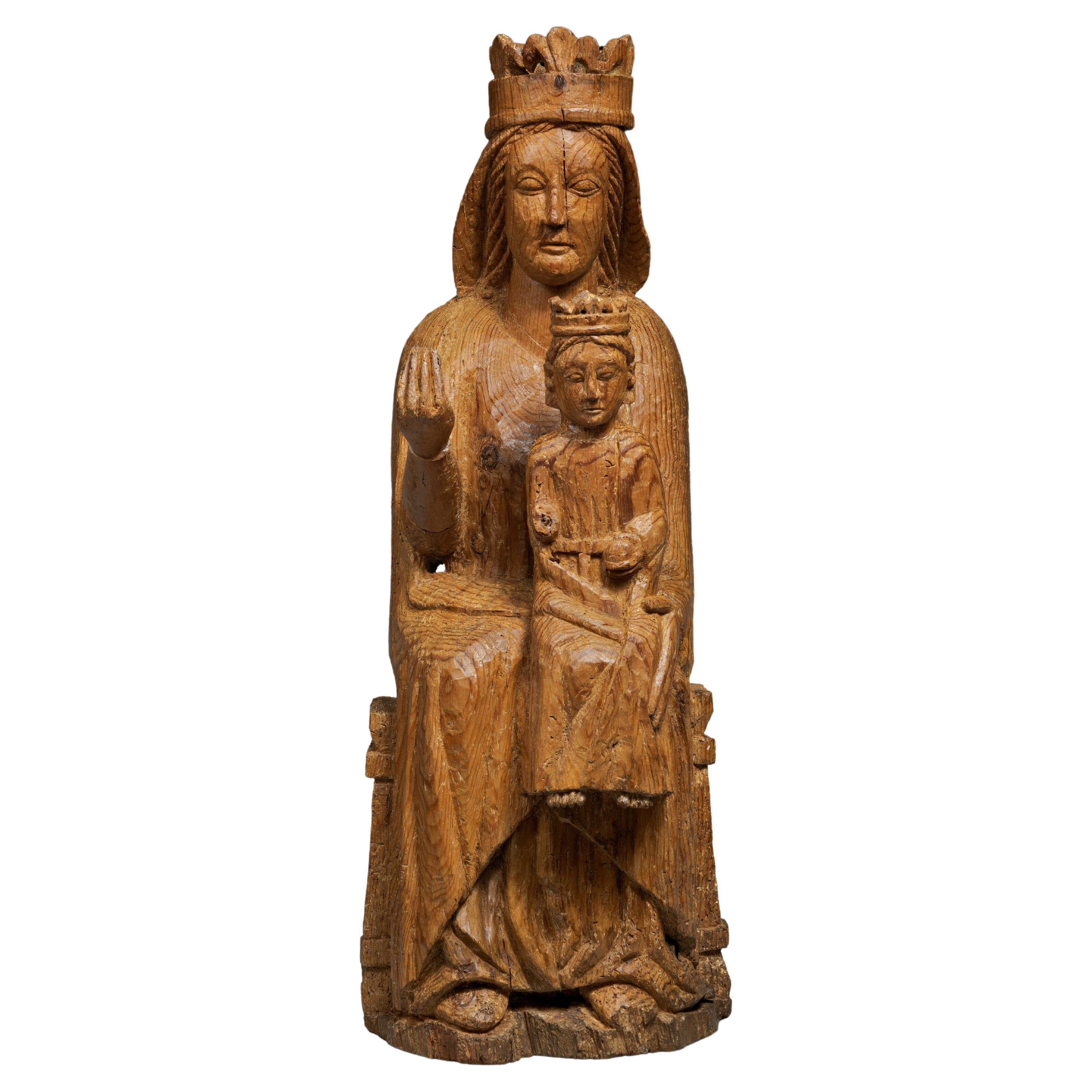
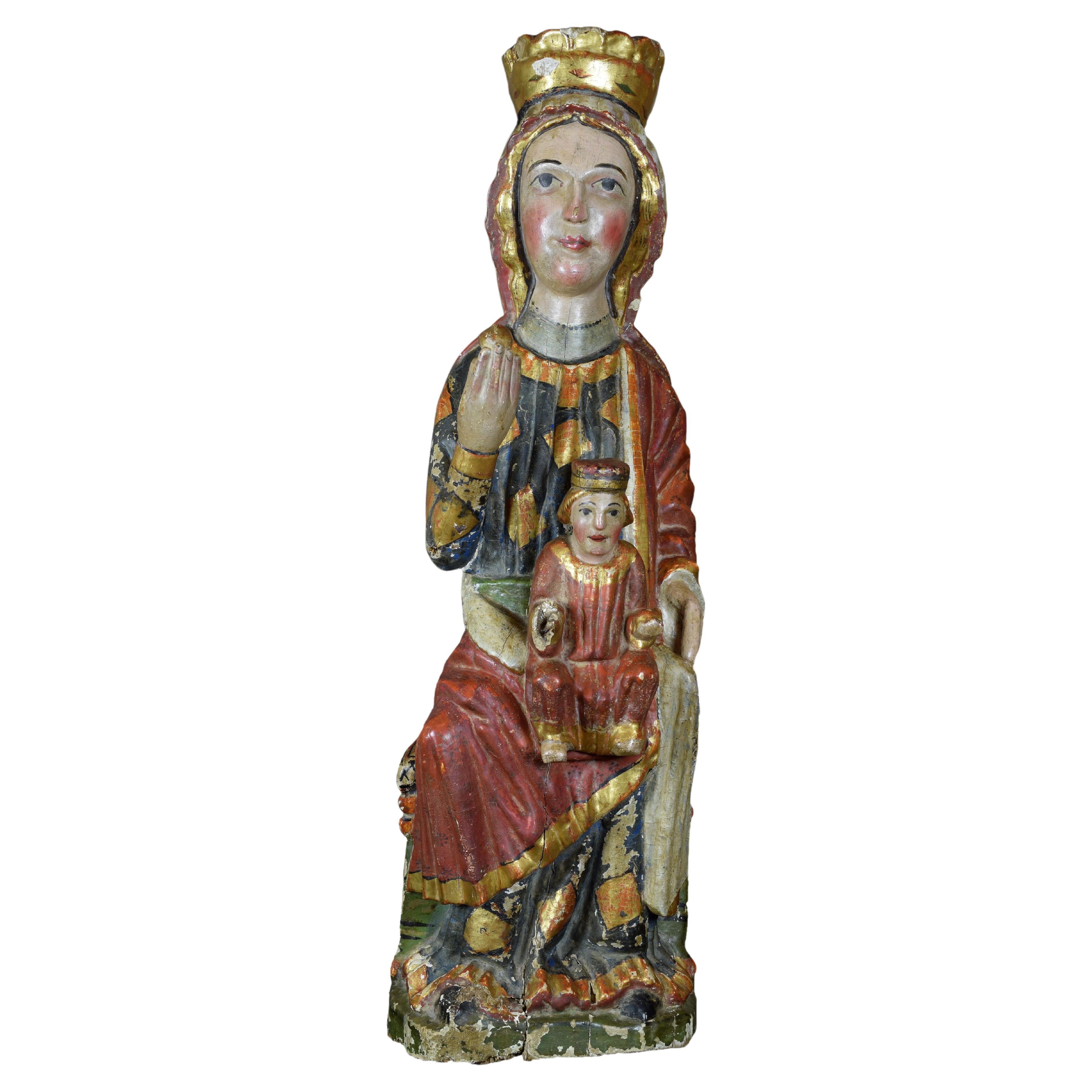
Technique: Tempera and oil on wood Dimensions: 25 x 11 x 8 cm Description: This exceptional work from the 12th century represents the Seated Virgin with Child (Sedes Sapientiae), standing out as an artistic treasure from medieval Spain. The portrayal of the Virgin enthroned with the Child on her lap is emblematic of Romanesque art, and this particular piece is a valuable and authentic example of that era. The current polychromy belongs to the Gothic period and overlays the original Romanesque layer. It is crucial to highlight that the current state of the artwork is the original, without any cleaning interventions, imparting a unique authenticity. The work exhibits architectural characteristics typical of Romanesque art, evident in the sides of the throne. The rigidity and symmetry characteristic of this style are reflected in the firm presentation of the Baby Jesus, noticeable in his gesture while holding his son. The Virgin wears a crown, symbolizing her royal character as the Queen of Heaven and Creation. Both figures retain traces of polychromy on the face and attire, adding layers of history and authenticity. While similar Romanesque Virgin images can be found in museums, this artwork stands out due to its original state and connection to the rich artistic and religious tradition of the Romanesque period. The 19th-century bronze base, though not included, adds an additional historical element. It is important to note that the artwork is awaiting certification from the Ministry of Culture of the Spanish Government, which will add an official layer of authenticity to this extraordinary piece and deepen its historical and cultural value.
  • Dimensions:
    Height: 9.85 in (25 cm)Width: 4.34 in (11 cm)Depth: 3.15 in (8 cm)
  • Materials and Techniques:
  • Period:
  • Date of Manufacture:
    1120
  • Condition:
  • Seller Location:
    Madrid, ES
  • Reference Number:
    1stDibs: LU5779237701372

More From This Seller

View All
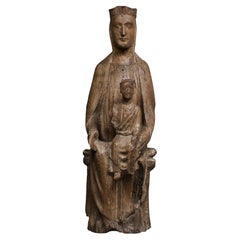
Seated Virgin and Child, both crowned, polychrome wood carving, Spanish school

Seated Virgin and Child, both crowned, polychrome wood carving, Spanish school

Located in Madrid, ES

Rare Spanish devotional sculpture depicting the Virgin in Majesty enthroned with the crowned Christ Child, carved in wood with remnants of original polychromy and gilding. Attributed...

Category

Antique 18th Century Spanish Baroque Figurative Sculptures

Materials

Wood

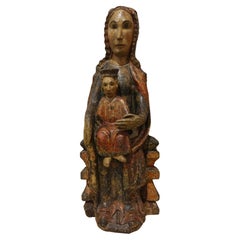
Virgin and Child in Polychrome Wood, Spanish/Colonial 18th century

Virgin and Child in Polychrome Wood, Spanish/Colonial 18th century

Located in Madrid, ES

Virgin and Child in Polychrome Wood on a Cloud with Cherubs, Spanish/Colonial School, 18th Century This devotional sculpture in carved wood, 61 cm in total height, depicts the Virgi...

Category

Antique Early 18th Century Spanish Baroque Figurative Sculptures

Materials

Silver

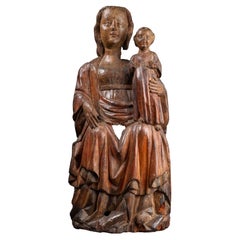
Renaissance Style Carved Wood Virgin and Child, Italian School, 16th-17th

Renaissance Style Carved Wood Virgin and Child, Italian School, 16th-17th

Located in Madrid, ES

A charming carved and polychromed wooden Virgin and Child, attributed to the Italian School and dating to the 16th century. The composition reflects Renaissance ideals, with a calm, ...

Category

Antique Early 17th Century Italian Renaissance Figurative Sculptures

Materials

Wood

Virgin and Child, polychrome wood carving, Hispanic school, 16th-17th century

Virgin and Child, polychrome wood carving, Hispanic school, 16th-17th century

Located in Madrid, ES

Virgin and Child, polychrome wood carving, Hispanic school, 16th-17th century This carved and polychrome wood sculpture depicts the Virgin Mary with the Child in her arms, crowned an...

Category

Antique 16th Century Spanish Baroque Figurative Sculptures

Materials

Silver

Early 16th Century Spanish Polychrome Virgin and Child Sculpture

Early 16th Century Spanish Polychrome Virgin and Child Sculpture

Located in Madrid, ES

A finely carved Spanish Virgin and Child sculpture dating to the early 16th century, executed in polychromed and gilded wood. The composition reflects the transition from the late G...

Category

Antique 16th Century Spanish Gothic Figurative Sculptures

Materials

Wood

Romanesque Sculpture of the Virgin – 15th Century

Romanesque Sculpture of the Virgin – 15th Century

Located in Madrid, ES

"Romanesque Sculpture of the Virgin – 15th Century" Period: 15th century Romanesque Technique: Carved and polychromed solid wood Dimensions: 124 x 36 x 17 cm Impressive Romanesque s...

Category

Antique 15th Century and Earlier Italian Greco Roman Figurative Sculptures

Materials

Wood

You May Also Like

Virgin and Child "Sedes Sapientiae", Seat of Holy Wisdom

Virgin and Child "Sedes Sapientiae", Seat of Holy Wisdom

Located in Saint-Ouen, FR

Virgin and child sedes sapientiae, seat of holy wisdom Origin : Northern Spain, castile, navarre or galicia. Period : early 13th century. Heigh...

Category

Antique 15th Century and Earlier Figurative Sculptures

Materials

Wood

VIrgin and Child “Sedes Sapientiae" Seat of Holy Wisdom

VIrgin and Child “Sedes Sapientiae" Seat of Holy Wisdom

Located in PARIS, FR

Virgin and Child "Sedes Sapientiae" (Throne of Wisdom in Latin), carved in soft wood on the back. The Virgin Mary is depicted seated, holding the Infant Jesus on her lap: she thus s...

Category

Antique 15th Century and Earlier Italian Gothic Figurative Sculptures

Materials

Wood

Virgin and the Child, Mosan Region, Second Half of 13th Century

Virgin and the Child, Mosan Region, Second Half of 13th Century

Located in Bruxelles, BE

A polychrome sculpture depicting the Virgin and the Child Mosan region, second half of 13th century Polychrome wood 73 x 29 X 12 cm Provenance : Former Belgian private collection from the beginning of the 20th century This remarkable early artwork portrays the Enthroned Virgin and Child, also known as Sedes Sapientiae, which translates to the 'Seat of Wisdom...

Category

Antique 15th Century and Earlier Belgian Medieval Figurative Sculptures

Materials

Wood

Virgin and Child in Majesty, also known as "Sedes Sapientae"

Virgin and Child in Majesty, also known as "Sedes Sapientae"

Located in Saint-Ouen, FR

VIRGIN AND CHILD IN MAJESTY, ALSO KNOWN AS "SEDES SAPIENTIAE"   ORIGIN : SPAIN, CATALOGNE PERIOD: EARLY 13th CENTURY   Height :  95 cm Width : 32 cm Depth : 28 cm   Softwood No polychromy     In the middle of the 12th century, the Virgin took her place in churches, seated in Majesty, serving as a throne for her son Jesus. She is then called Sedes Sapientiae, meaning the Throne of Wisdom. At that time, she is not represented for herself and only exists because she has been designated as Theotokos, the mother of God, at the Council of Ephesus in 431, where the divine nature of Christ was proclaimed from his birth.   The upright and perfectly hieratic bust of this Virgin and Child in Majesty is seated on a throne-bench. She is dressed in a tunic with a rounded neckline and covered with a fine mantle placed on her narrow shoulders. The supple and natural drapery follows the lines of the body.   Large curls frame her face with delicate and regular features, a long straight nose, almond-shaped eyes, and small lips.   She supports the Infant Jesus with her left hand. Like his mother, he is dressed in a long tunic, and his little feet are visible in the folds. He holds a small sphere in his left hand, while with his right hand, he gestures in blessing. The face of Christ bears a strong resemblance to his mother’s one, and he gives a slight smile.   The position of the Child is no longer as hieratic, nor frontal or central as in the early 12th century, but his face still turns towards the faithful.   The 13th century indeed emerges as a period of transition in the artistic domain. The statuary, while retaining certain characteristics still belonging to the habits of the previous century, also develops new formal solutions.   As a result, Mary maintains a hieratic and frontal position, while her son shifts to place himself well to the left on her knee. Similarly, while the Virgin seems perfectly still, Jesus, on the other hand, appears much more animated, especially in the positioning of his hands. His left hand holds the orb, and judging by the raised right arm directed towards the faithful, one can easily imagine that he was making a gesture of blessing.   The influence of the Sedes Sapientiae from previous centuries still seems particularly prevalent in this work.   These few characteristics allow dating this Spanish Virgin...

Category

Antique 15th Century and Earlier Spanish Gothic Figurative Sculptures
Materials

Softwood