Want more images or videos?
Request additional images or videos from the seller
1 of 10

Early 19th Century English Demilune Lusterware Bough Pot With Cover

$893.51
£654.80
€915VAT Included
CA$1,232.29
A$1,247.17
CHF 715.09
MX$15,126.60
NOK 8,316.23
SEK 8,465.12
DKK 5,718.65

About the Item

This demilune flower pot or bough pot for forcing springtime bulbs, is adorned with three landscape panels. Each panel, painted in pink lustre, depicts the same cottage in a pastoral setting from three different vantage points. Moulded into the top and bottom rims are acanthus leaves. Pieces in this shape, color and style have been attributed to the Hackwood company, and usually pieces like these, are not marked. William Hackwood & Son was an earthenware factory in Shelton, England, from 1818 until 1853. In addition to lustre ware, such as this pot, they made black basalt ware, cane ware and a variety of blue-printed dishes of excellent quality. This bough pot is complete with its three bulb holder lid. Should one wish, the lid can be turned over so the circular bulb holders don’t show above the surface of the pot. The pot is nine inches wide and slightly over seven inches high, with a depth of five and a half inches at its center point. The pot rests raised on spherical feet. The rustic panel decorations are in excellent condition and show no sign of wear. There is some wear to the lustre on the top edge and a small a small hairline crack on the upper half of the back of the pot. The glaze on the back of the pot, as is usual, has crackled. It is extremely rare to find a Staffordshire bough pot, from the early part of the 19th century, completely intact with its lid in such good condition.
  • Attributed to:
    Hackwood & Co. (Manufacturer)
  • Dimensions:
    Height: 7.29 in (18.5 cm)Width: 9.06 in (23 cm)Depth: 4.73 in (12 cm)
  • Materials and Techniques:
  • Place of Origin:
  • Period:
  • Date of Manufacture:
    circa 1830
  • Condition:
    Wear consistent with age and use. As seen in the photos, there is a hairline crack on the upper half of the back of the pot. There is some minor wear to the lustre paint dividing the panels. Otherwise the piece is in exceptional condition for its age.
  • Seller Location:
    Roma, IT
  • Reference Number:
    1stDibs: LU6910230918302

More From This Seller

View All
Murano Glass "Amphora" Pulegoso Vase by Napoleone Martinuzzi for Venini

Murano Glass "Amphora" Pulegoso Vase by Napoleone Martinuzzi for Venini

By Napoleone Martinuzzi, Paolo Venini

Located in Roma, RM

Stunning green Pulegoso Murano glass "Urn" vase with applied glass decoration. The base, mouth, decorations and handle were rolled gold gold leaf during hot phase of creation, leavin...

Category

Mid-20th Century Italian Mid-Century Modern Vases

Materials

Murano Glass

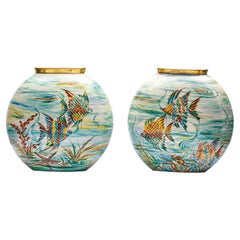
Pair of  Ceramic Vases by Guido Andlovitz for S.C.I. Levano

Pair of Ceramic Vases by Guido Andlovitz for S.C.I. Levano

By Guido Andlovitz

Located in Roma, RM

Originally designed by architect, designer and artistic director Guido Andlovitz in 1936 for Società Ceramica Italiana Laveno, this pair of vases are indeed the rarest of finds. The vases were manufactured in 1942, as attested to by the marking "N - 42" on the base of each vase. The gold rims and aquatic scenes that surround each vase, are unique to each piece and were painted by hand in 1943. They are both signed by the artist "Miruccia". One of the vases has the words “Anni di Guerra” (Year of War) written on the base in reference to the Second World War . Founded in Laveno in 1856 by Severino Revelli and some former employees of the "Richard" manufacturer in Milan. The "SCI" (Italian Ceramic Society) began its activity as a manufacturer of wall tiles and fine tableware. In 1883 it became a limited company and obtained its first successes at numerous national exhibitions. In 1895, Cavalier Luciano Scotti took over the company and, thanks to his intuition and his entrepreneurial skills, the factory grew substantially in a few years. In those years, some Liberty-style pieces designed by Giorgio Spertini, the author of noteworthy elegant "whiplash" creations, were created in the Laveno factory. In 1906 "SCI" presented numerous works at the International Exhibition of Decorative Arts in Milan. Other collaborators from the beginning of the century were Silvio and Piero De Ambrosis, Felice Palucco, Giancarlo Jacopini and the brothers Marco and Luigi Raggiori. However, it was in 1923 that, under the direction of Guido Andlovitz, the company reached the peak of its fame and in 1925 was a resounding success at the 2nd Monza Biennale. Andlovitz, who collaborated with the manufacturer for almost forty years, applied to the production process the principle of seriality, a concept also put into effect by Giò Ponti at "Richard-Ginori", adopting various types of decoration which, although moulded and decal stamped, still retained an undeniable elegance. In 1924 the "Società Ceramica Revelli" became a consortium with the "SCI", the partnership would continue until 1932 and saw Franco Revelli's company marketing pottery and table porcelain on behalf of "SCI". From 1925 porcelain and crockery began to appear in the factory's catalogs. In 1927 the company was present at the 3rd Biennial of Decorative Arts in Monza. Between the end of the 1920's and the beginning of the 1930's, the decorators Giuseppe Bellorini and Daniela Ferretto began to collaborate with the "SCI". As of 1932 the company managed two factories: that of Laveno, which, with over 1300 employees, produced strong pottery, tableware and artistic ceramics and the smaller factory of Verbano, which employed about 400 people and produced, in addition to ceramics for the electrotechnical industry, excellent table porcelain. The products were marketed in the company owned stores in Rome, Genoa and Naples. This was an initiative realised by Andlovitz himself. In the mid-thirties, the decorators Ada Corsi and Ida Fonini among others, collaborated with the "SCI". From 1936 to 1940 the artistic direction of the company was entrusted to the sculptor and modeler Angelo Biancini. In 1939 about 1300 people worked in the Laveno plant and in 1951 about 2300. In the years between the two wars among the collaborators of the factory were Sirio Tofanari...

Category

Vintage 1940s Italian Mid-Century Modern Vases
Materials

Ceramic

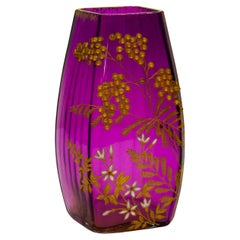
Ernest Baptiste Leveille Glass Vase with Gilt and Enamel Mimosa

Ernest Baptiste Leveille Glass Vase with Gilt and Enamel Mimosa

By Ernest Baptiste Leveille

Located in Roma, RM

Rare and important vase in amethyst glass, exquisitely painted in gilt enhanced with enamelling and glass beads. The painted design of a Mimosa branch in bloom extends to three sides of the vase. The gilt painting is enhanced with glass beads and white enamel flowers. Ernest-Baptiste Leveillé...

Category

Antique Late 19th Century French Art Nouveau Vases

Materials

Glass

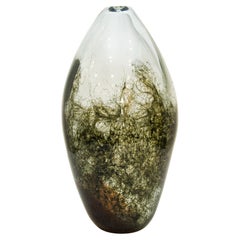
Murano Glass Crepuscolo Vase by Ercole Barovier for Barovier & Toso

Murano Glass Crepuscolo Vase by Ercole Barovier for Barovier & Toso

By Ercole Barovier

Located in Roma, RM

Rare and impressive "Crepuscolo" Murano glass vase from the late 1930's. Designed by the legendary Creative Director Ercole Barovier, employing his technique of inserting steel wool ...

Category

Vintage 1930s Italian Mid-Century Modern Vases
Materials

Murano Glass

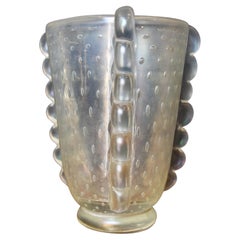
Murano Glass "Bullicante" Vase Signed by Franco Moretti

Murano Glass "Bullicante" Vase Signed by Franco Moretti

By Franco Moretti

Located in Roma, RM

Mid-Century Modern iridescent transparent vase, signed Franco Moretti, Murano – Venice, 1970's. Triangular-shaped vase with round base and bubble inclus...

Category

Vintage 1970s Italian Mid-Century Modern Vases
Materials

Murano Glass

Large Murano  Crackle Glass Vase With Fused Faceted Glass Block Base

Large Murano Crackle Glass Vase With Fused Faceted Glass Block Base

By Paolo Venini

Located in Roma, RM

This large unique Murano glass vase was made using the "Ghiachciato" technique, that gives the surface of the glass an irregular crackled appearance. The effect is created by submerg...

Category

Vintage 1980s Italian Mid-Century Modern Vases
Materials

Murano Glass

You May Also Like

Early 19th Century Hand-Painted Porcelain Cachepot Attributed to Tucker Factory

Early 19th Century Hand-Painted Porcelain Cachepot Attributed to Tucker Factory

Located in West Hollywood, CA

This rare and historically significant early 19th-century porcelain cachepot, attributed to the esteemed Tucker Factory of Philadelphia, stands as a remarkable example of early American ceramic innovation and refinement. Produced during a formative period in the United States when domestic porcelain production was still in its infancy, pieces such as this reflect both the ambition and artistry of one of America’s first successful porcelain manufactories. Elegantly formed with a balanced, classical silhouette, the cachepot features a gently flared rim and a smooth, rounded body that speaks to the refined neoclassical sensibilities of the Federal period. The surface is beautifully adorned with finely executed hand-painted decoration, likely influenced by European porcelain traditions yet interpreted through an emerging American lens. Subtle brushwork and carefully composed motifs—whether floral, geometric, or classical in nature—demonstrate the skill and precision of the artisan. The porcelain body exhibits a soft, luminous glaze with a slightly warm undertone, characteristic of early Tucker wares. Variations in tone, delicate inconsistencies in decoration, and minor kiln effects further enhance its authenticity, offering tangible evidence of its handcrafted origin. These nuances are highly prized by collectors, as they distinguish early American porcelain...

Category

Antique 19th Century American American Classical Planters, Cachepots and...

Materials

Porcelain

19th Century Hand-Painted Porcelain Cachepot Attributed to Tucker Factory

19th Century Hand-Painted Porcelain Cachepot Attributed to Tucker Factory

Located in West Hollywood, CA

This exceptional 19th-century porcelain cachepot, attributed to the esteemed Tucker Factory of Philadelphia, represents a remarkable example of early American ceramic artistry infuse...

Category

Antique 19th Century American American Classical Planters, Cachepots and...

Materials

Porcelain

19th Century French Faience Cache Pot Desvres

19th Century French Faience Cache Pot Desvres

By Desvres

Located in Austin, TX

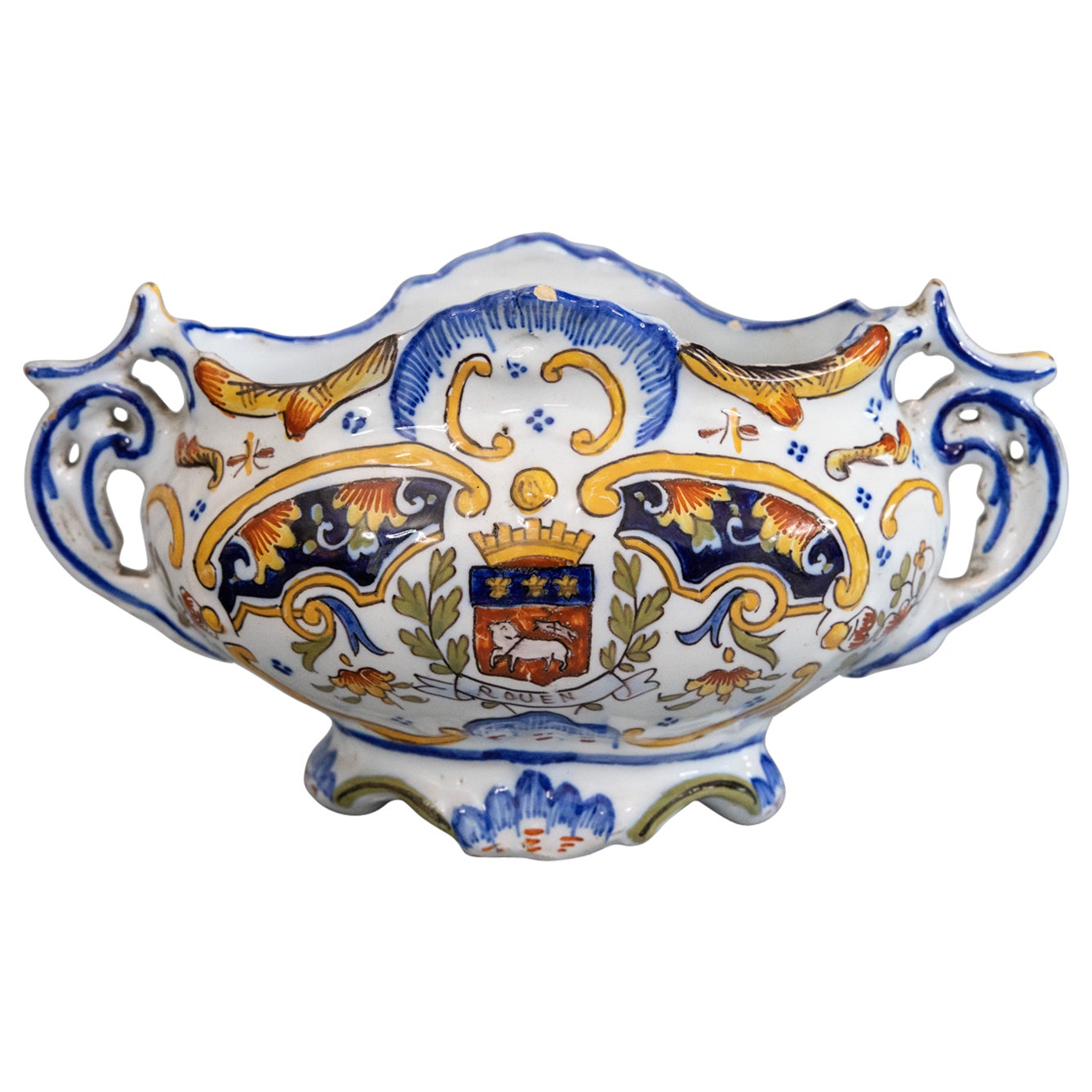
19th Century French Faience Cache Pot Desvres , hand painted with flowers on one side and coat of arms on the other side.

Category

Antique 1890s French Rustic Planters, Cachepots and Jardinières

Materials

Faience

French Lunéville Saint Clément Faience Cache Pot

French Lunéville Saint Clément Faience Cache Pot

By Luneville

Located in Winter Park, FL

French faience Lunéville Saint Clément cache pot, or planter. Hand-painted in typical floral design with vivid colors of pink, green, purple, ...

Category

Mid-20th Century French French Provincial Planters, Cachepots and Jardin...

Materials

Ceramic, Faience

19th Century French Faience Cachepot by Edmé Samson, Paris

19th Century French Faience Cachepot by Edmé Samson, Paris

By Edmé Samson

Located in LEGNY, FR

Elegant 19th-century faience cachepot, made by Edmé Samson in Paris (1810–1891) and stamped on the underside. This beautiful piece features a rich polychrome decoration inspired by ...

Category

Antique 1890s French Planters, Cachepots and Jardinières

Materials

Faience

French Majolica Cache Pot Longchamp , circa 1890

French Majolica Cache Pot Longchamp , circa 1890

By Longchamp

Located in Austin, TX

French Majolica Cache Pot Longchamp , circa 1890. H / 8.5 inches , D / 8.5 inches.

Category

Antique 1890s French Rustic Planters, Cachepots and Jardinières

Materials

Ceramic