Video Loading
Want more images or videos?
Request additional images or videos from the seller
1 of 22

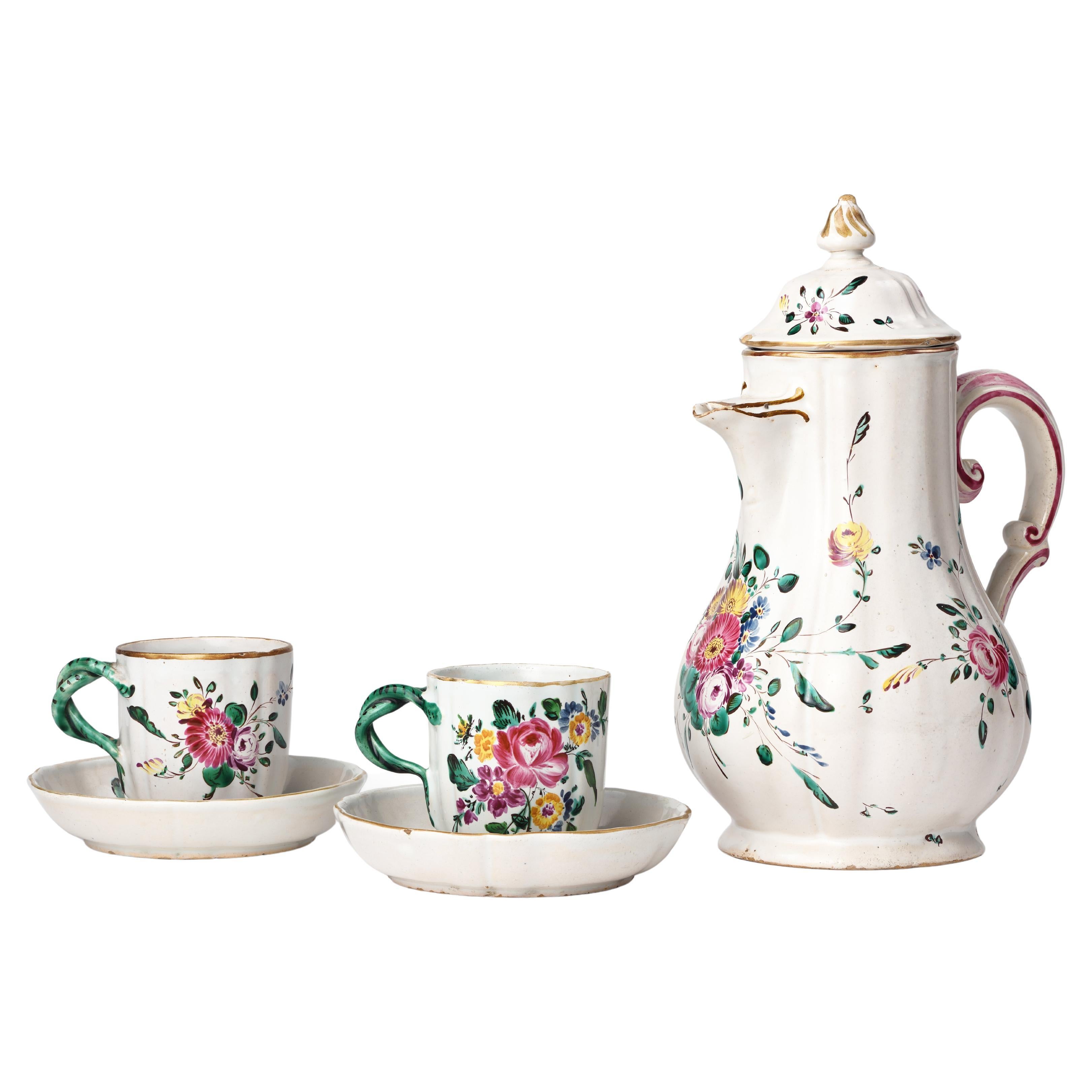
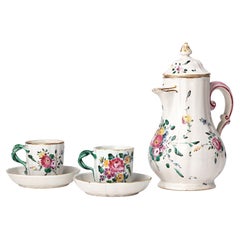
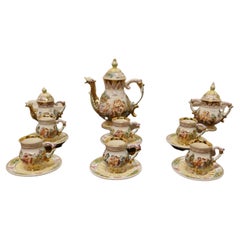
Antique Maiolica Coffee Set by Pasquale Rubati, Milan, 1770-1780

$5,354.07per set
£3,926.15per set
€4,500per setVAT Included
CA$7,420.37per set
A$7,454.72per set
CHF 4,299.95per set
MX$90,720.26per set
NOK 49,949.95per set
SEK 50,668.82per set
DKK 34,312.93per set

About the Item

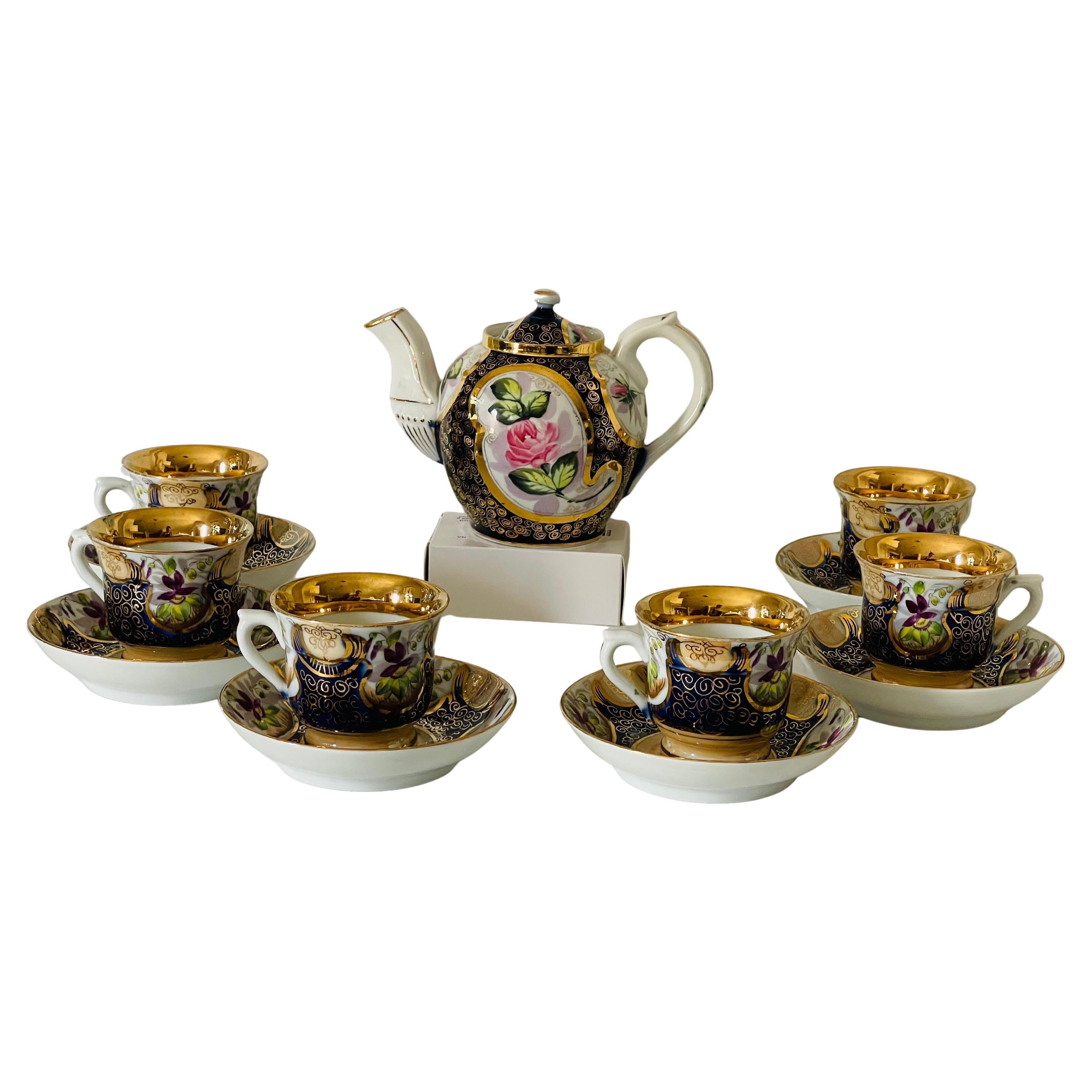
Coffee assortment with “barbotine” decoration Manufacture of Pasquale Rubati or Felice Clerici Milan, 1770- 1780 Maiolica polychrome decorated “a piccolo fuoco” (third fire). They measure: Coffee pot: 7.48 x 5.90 x 6.10 in (19 x 15 x 15.5 cm); weight 1.2 lb (574 g). Sugar bowl: 2.40 x 4.92 x 3.74 in (9.5 x 12.5 x 9.5 cm); weight 0.5 (223 g). Cup with saucer: the cup 1.77 x 3.14 in (cm 4.5 x 8) and the saucer diameter 4.92 in (12.5 cm); weight 0.4 lb (186 g). The coffee pot bears under the base the label of the famous exhibition of the Poldi Pezzoli Museum of 1964. State of conservation: the coffee pot has the addition of a grip lid and a covered chip on the edge; the body is affected by a crack that runs from the mouth along the body and around the belly of the container. The sugar bowl has two restored chips on the edge of the lid and two minor chips visible at the edge of the bowl. The cup and saucer are intact. The maiolica and porcelain factories of the eighteenth century mainly belonged to great royal or noble families who made the manufacture of ceramic works a sign of prestige. In Milan, under Maria Teresa of Austria, the time period witnessed a real opening to new industrialists who, by virtue of the privatizations granted by the government, assumed a real business risk, giving life, albeit not without conflict, to flourishing factories and to production which was among the most elegant and most requested at the moment and which still today remains object of collection. In Milan in the 18th century, two maiolica factories were active. The first was that of Felice Clerici, from 1745, and the second was opened by Pasquale Rubati in 1756, in competition with Felice, for whom he had been a worker. Upon Rubati's death, in 1796, the enterprise was continued for a few years under his son Carlo. The series of objects is decorated with flowers in relief, a subject referred to in the inventories as “alla barbottina”, to indicate the technique used to make it. The decorative motif features some many petalled flowers in relief, partly connected by little manganese branches with thin cobalt blue and copper green leaves and small insects scattered over the rest of the surface. The ornamentation originates from Chinese blanc de Chine decorations in relief or in any case from motifs from Canton. This style became one of the most sought-after decorations produced in Milan during the late eighteenth-century. The enamel is thin and blue whereas the polychromy is full and shows a skilful use of the various shades of green and the presence of "ferraccia" red. The flower corollas are obtained by applying thin spheres of very diluted clay, the “barbottina”, then shaped and left to dry. The coffee pot, with an enlarged, rotund, ribbed pyriform body, has a griffin beak pourer and a shaped handle, decorated in iron red; the lid is slightly raised and surmounted by a button knob (added during restoration. The oval sugar bowl, with a poded and swollen profile, has a coherent lid surmounted by a pear-shaped knob. The assortment is completed with an oriental-style bowl, without handle, but accompanied by a round saucer with a high brim and a ring foot. These are some of the most typical forms of production of the Clerici factory in Milan, even if, at least in the initial period, they were all also adopted by the competing manufacture of Pasquale Rubati. The latter boasted of having used this very decoration: "not found in any other factory", as confirmed by some well-known pieces that bear his signature (G. Gregorietti, Maioliche di Lodi, Milan and Pavia, exhibition catalog, Poldi Pezzoli Museum, Milan 1964, n. 386), while those known under the Clerici brand are few and probably replacement pieces (G. Gregorietti, Maioliche di Lodi, Milano e Pavia, exhibition catalogue, Museo Poldi Pezzoli, Milano 1964 n. 388). Various examples of comparison are known in public and private collections. Of particular interest is the comparison with the large group of "alla barbottina" works preserved in the Museum of Applied Art of the Castello Sforzesco in Milan (R. Ausenda, curated by, Musei e Gallerie di Milano. Museo d’Arti Applicate. Le ceramiche, Tomo secondo, Milano 2001 pp. 372-384, nn. 360-362.) Bibliography: G. Gregorietti, Maioliche di Lodi, Milano e Pavia, catalogo della mostra Museo Poldi Pezzoli, Milano 1964, nn. 390 the coffee pot; e 389-392 comparisons; R. Ausenda, a cura di, Musei e Gallerie di Milano. Museo d’Arti Applicate. Le ceramiche, Tomo secondo, Milano 2001, pp. 372-384, nn. 360-362.
  • Creator:
    Pasquale Rubati (Manufacturer)
  • Dimensions:
    Height: 7.49 in (19 cm)Width: 5.91 in (15 cm)Depth: 6.11 in (15.5 cm)
  • Sold As:
    Set of 3
  • Style:
    Rococo (Of the Period)
  • Materials and Techniques:
    Maiolica,Glazed
  • Place of Origin:
  • Period:
    1770-1779
  • Date of Manufacture:
    1770-1780
  • Condition:
    Repaired: The coffee pot has the addition of a grip lid. Minor losses. Minor fading. The coffee pot has the addition of a grip lid and a covered chip on the edge; the body is affected by a crack that runs from the mouth along the body and around the belly of the container. The sugar bowl has two restored chips on the edge of the lid.
  • Seller Location:
    Milano, IT
  • Reference Number:
    1stDibs: LU4352227685212

More From This Seller

View All
Antonio Ferretti Coffee Pot and Cups Set, Maiolica, Lodi, Circa 1765

Antonio Ferretti Coffee Pot and Cups Set, Maiolica, Lodi, Circa 1765

By Antonio Ferretti

Located in Milano, IT

A coffee pot and two cups with saucers Antonio Ferretti Manufacture Lodi, Circa 1765-1770 Maiolica polychrome decorated “a piccolo fuoco” (third fire). They measure: coffee pot: 9....

Category

Antique 1760s Italian Rococo Ceramics

Materials

Maiolica

Two Ancient Maiolica Pot Mustard Set, Milan, 1745-1788 Circa

Two Ancient Maiolica Pot Mustard Set, Milan, 1745-1788 Circa

By Felice Clerici

Located in Milano, IT

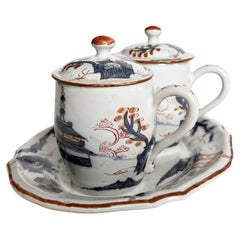
Two pot mustard set Felice Clerici or Pasquale Rubati Factory Milan, 1745-1788 Circa Majolica polychrome decorated "a piccolo fuoco" (third fire) It measures: 3.94 in in height x...

Category

Antique 18th Century and Earlier Italian Rococo Ceramics

Materials

Maiolica

Pair of Maiolica Coffee Pots by Pasquale Rubati, Milan, Circa 1770

Pair of Maiolica Coffee Pots by Pasquale Rubati, Milan, Circa 1770

By Pasquale Rubati

Located in Milano, IT

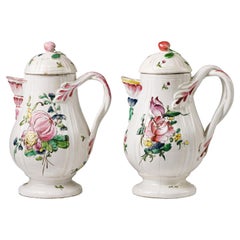
Pair of small coffee pots. Manufacture of Pasquale Rubati Milan, 1770 Circa Maiolica polychrome decorated “a piccolo fuoco” (third fire). a) height 7.87 x 5.51 x 3.93 in (20 x 14 x ...

Category

Antique 1760s Italian Neoclassical Ceramics

Materials

Maiolica

Antique Maiolica Bottle and Glass Coolers by Pasquale Rubati, 1770

Antique Maiolica Bottle and Glass Coolers by Pasquale Rubati, 1770

By Pasquale Rubati

Located in Milano, IT

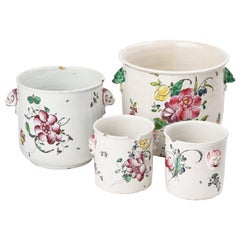
Assortment of bottle and glass coolers in Maiolica. Pasquale Rubati manufacture Milan, circa 1770 Maiolica polychrome decorated “a piccolo fuoco” (third fire) a - Bottle cooler 5.91 in x 5.91 in diameter (15 x 15 cm ) Weight: 1.86 lb (845 g) b - Bottle cooler 6.89 x 7.87 in diameter (17,5 x 20 cm) Weight: 2.09 lb (948 g) c - Pair of glass-cooler vases 3.94 x 3.94 in diameter (10 x 10 cm) Weight: 1.43 lb (650 g) Good state of conservation: a - some chipping from use on the edge; a - two fêlures covered on the edge; c - one has deep chippings on the edge and the other a subtle fêlure. Two Majolica factories were active in Milan in the 18th century. The first, starting from 1745, was owned by Felice Clerici; the other one by Pasquale Rubati from 1756. Rubati was in competition with Felice, whose worker he had been prior to opening his own workshop. On his death in 1796, the business was continued for a few more years by his son Carlo. Recent studies have recognized Pasquale Rubati's contribution as the creator of "Strasbourg-style" decorations with their particularly joyful depictions. This style had previously been attributed to the Lodi manufacturers. These works here, however, are a clear example of this production. The Majolica containers have different sizes, a cylindrical shape and rest on a low foot ring. The two largest are completed by handles in the shape of a zoomorphic mask with wide open jaws, while the smaller ones have handles applied with an anthropomorphic mask. All the works are characterized by elegant floral decoration. The two twin glass coolers show bunches of flowers centered around a main corolla, a rose or a peony paired...

Category

Antique 1770s Italian Rococo Ceramics

Materials

Maiolica

Three Dishes, Antonio Maria Coppellotti Factory, Lodi, Italy, Circa 1745

Three Dishes, Antonio Maria Coppellotti Factory, Lodi, Italy, Circa 1745

By Antonio Maria Coppellotti

Located in Milano, IT

Pair of round dishes and a small oval tray Antonio Maria Coppellotti factory Lodi, circa 1745 High fire polychrome majolica Dishes size: diameter 9.44 in, height 0.78 in (24 cm, 2 c...

Category

Antique 1740s Italian Rococo Delft and Faience

Materials

Maiolica

Antique Maiolica Sick Cup by Pasquale Rubati, Milan, Circa 1770-1780

Antique Maiolica Sick Cup by Pasquale Rubati, Milan, Circa 1770-1780

By Pasquale Rubati

Located in Milano, IT

Sick cup Pasquale Rubati Manufacture Milan, Circa 1770 - 1780 Maiolica decorated in polychrome “a piccolo fuoco” (third fire) It measures: h 2.36 x 7.4 x 7.87 (h 6 x 19 x 20 cm) ...

Category

Antique 1770s Italian Rococo Ceramics

Materials

Maiolica

You May Also Like

German Meissen 'Marcolini' Porcelain Tea and Coffee Service, circa 1790

German Meissen 'Marcolini' Porcelain Tea and Coffee Service, circa 1790

By Meissen Porcelain

Located in New York, NY

Comprising coffee pot, tea pot, covered cream jug, covered sugar, ten tea cups, six coffee cups, 16 saucers.

Category

Antique 1790s German Tea Sets

Materials

Porcelain

English Porcelain Part Set Tea Service, Worcester, circa 1770

English Porcelain Part Set Tea Service, Worcester, circa 1770

Located in New York, NY

Delicately enameled with turquoise garlands draped through hanging gilt rings beneath a royal blue and gilt border. Each piece with a neoclassical vase painted in grisaille and light...

Category

Antique 1770s English Tea Sets

Materials

Porcelain

Capodimonte Baroque Coffee Set, Porcelain, Mid-20th Century, Italy

Capodimonte Baroque Coffee Set, Porcelain, Mid-20th Century, Italy

By Capodimonte

Located in Godshill, Isle of Wight

Charming 20th Century Capodimonte Coffee Set A delightful set all fully marked beneath, Coffee Pot, Cream Jug, Sugar Jar and 6 Coffee Cans with Saucers T...

Category

Mid-20th Century Baroque Ceramics

Materials

Porcelain

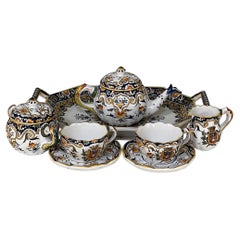
19th Century French Faience 8 Piece Hand-Painted Tea Service

19th Century French Faience 8 Piece Hand-Painted Tea Service

Located in Dallas, TX

19th century French faience 8 piece hand-painted tea service represents the remarkably unique and definitively French porcelains produced in the fabled region around Rouen! Hand-made...

Category

Antique Late 19th Century French French Provincial Tea Sets

Materials

Faience

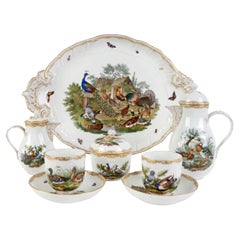
Porcelain coffee set with images of poultry KPM 1870s

Porcelain coffee set with images of poultry KPM 1870s

By Königliche Porzellan-Manufaktur (KPM)

Located in Rīga, LV

This KPM Berlin porcelain coffee set from the 1870s is a refined antique porcelain service decorated with hand-painted poultry scenes, delicate gilding and finely modelled floral fin...

Category

Antique 1870s German Rococo Revival Tea Sets

Materials

Porcelain

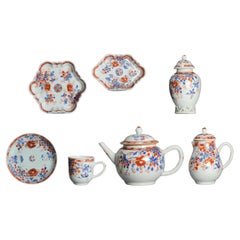
Antique Chinese Porcelain Polychrome Tea Set Overglaze Blue Yongzheng Period

Antique Chinese Porcelain Polychrome Tea Set Overglaze Blue Yongzheng Period

Located in Amsterdam, Noord Holland

Description Sharing with you this very nice example of an 18th century tea service pot. Dating to around 1730. Overglaze blue typical for the Yongzheng period Absolutely top quality ...

Category

Antique 18th Century Chinese Qing Ceramics

Materials

Porcelain