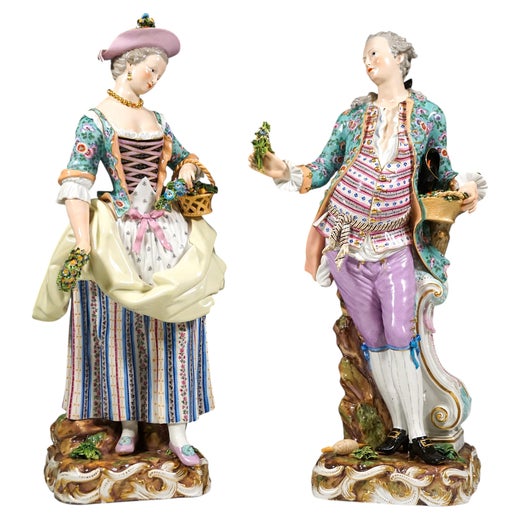
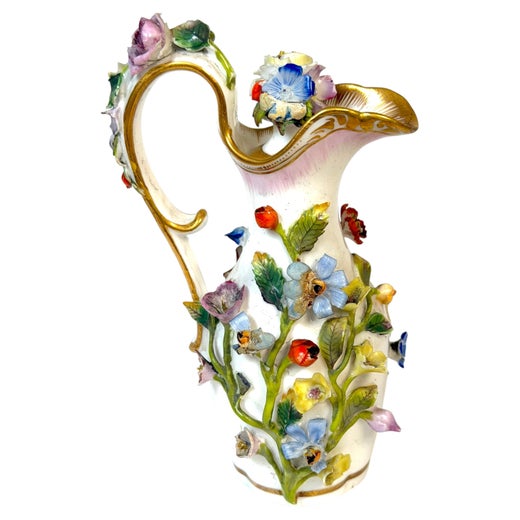
19th Century Germany Meissen Porcelain Grouping
By Meissen Porcelain
Located in Los Angeles, CA
19th century Germany Meissen porcelain grouping.
Category
Antique 19th Century German Porcelain
Materials
Porcelain
Johann Carl Schoenheit has been active at Meissen manufactory since 1745, and from 1765, the sculptor started designing his models. He was the assistant of Johann Joachim Kaendler in an earlier period and a colleague of Acier in the later period. He retired in 1794..
Meissen Porcelain (Staatliche Porzellan-Manufaktur Meissen) is one of the preeminent porcelain factories in Europe and was the first to produce true porcelain outside of Asia. It was established in 1710 under the auspices of King Augustus II “the Strong” of Saxony-Poland (1670–1733), a keen collector of Asian ceramics, particularly Ming porcelain.
In pursuing his passion, which he termed his “maladie de porcelaine,” Augustus spent vast sums, amassing some 20,000 pieces of Japanese and Chinese ceramics. These, along with examples of early Meissen, comprise the Porzellansammlung, or porcelain collection, of the Zwinger Palace, in Dresden.
The king was determined, however, to free the European market from its dependence on Asian imports and to give European artisans the freedom to create their own porcelain designs. To this end, he charged the scientist Ehrenfried Walther von Tschirnhaus and aspiring alchemist Johann Friedrich Böttger with the task of using local materials to produce true, hard-paste porcelain (as opposed to the soft-paste variety European ceramists in the Netherlands, Germany, France, Italy and Spain had been producing since the late Renaissance). In 1709, the pair succeeded in doing just that, employing kaolin, or “china clay.” A year later, the Meissen factory was born.
In its first decades, Meissen mostly looked to Asian models, producing wares based on Japanese Kakiemon ceramics and pieces with Chinese-inflected decorations called chinoiserie. During the 1720s its painters drew inspiration from the works of Watteau, and the scenes of courtly life, fruits and flowers that adorned fashionable textiles and wallpaper. It was in this period that Meissen introduced its famous cobalt-blue crossed swords logo — derived from the arms of the Elector of Saxony as Arch-Marshal of the Holy Roman Empire — to distinguish its products from those of competing factories that were beginning to spring up around Europe.
By the 1730s, Meissen’s modelers and decorators had mastered the style of Asian ceramics, and Augustus encouraged them to develop a new, original aesthetic. The factory’s director, Count Heinrich von Brühl, used Johann Wilhelm Weinmann’s botanical drawings as the basis for a new line of wares with European-style surface decoration. The Blue Onion pattern (Zwiebelmuster), first produced in 1739, melded Asian and European influences, closely following patterns used in Chinese underglaze-blue porcelain, but replacing exotic flora and fruits with Western varieties (likely peaches and pomegranates, not onions) along with peonies and asters.
During the same period, head modeler Joachim Kändler (1706–75) began crafting delicate porcelain figures derived from the Italian commedia dell’arte. Often used as centerpieces on banquet tables and decorated to reflect the latest fashions in courtly dress for men and women, these figurines were popular in their day, and are still considered among Meissen’s most iconic creations. Kändler also created the Swan Service, which, with its complex low-relief surface design and minimal decoration is considered a masterpiece of Baroque ceramics.
The rise of Neoclassicism in the latter half of the 18th century forced Meissen to change artistic direction and begin producing monumental vases, clocks, chandeliers and candelabra. In the 20th century, Meissen added to its 18th-century repertoire decidedly modern designs, including ones in the Art Nouveau style. The 1920s saw the introduction of numerous animal figures, such as the popular sea otter (Fischotter), which graced an East German postage stamp in the 1960s. Starting in 1933, artistic freedom was limited at the factory under the Nazi regime, and after World War II, when the region became part of East Germany, it struggled to reconcile its elite past with the values of the Communist government. In 1969, however, new artistic director Karl Petermann reintroduced the early designs and fostered a new degree of artistic license. Meissen became one of the few companies to prosper in East Germany.
Owned by the State of Saxony since reunification, in 1990, Meissen continues to produce its classic designs together with new ones developed collaboratively with artists from all over the world. In addition, through its artCAMPUS program, the factory has invited distinguished ceramic artists, such as Chris Antemann and Arlene Shechet, to work in its studios in collaboration with its skilled modelers and painters. The resulting works of contemporary sculpture are inspired by Meissen’s rich and complex legacy.
Find a collection of authentic Meissen Porcelain on 1stDibs.
19th Century Germany Meissen Porcelain Grouping
By Meissen Porcelain
Located in Los Angeles, CA
19th century Germany Meissen porcelain grouping.
Porcelain
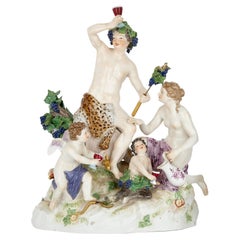
Antique Porcelain Group of Bacchus and Attendants by Meissen
By Meissen Porcelain
Located in London, GB
This piece is a superb example of the work of the Meissen porcelain manufactory. Modelled by E. A. Leuteritz in the 19th century based upon earlier models, it is a group piece, showi...
Porcelain
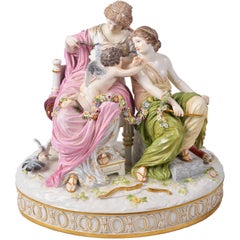
Meissen, Cupid in Trouble, 19th Century
By Meissen Porcelain
Located in Brighton, Sussex
A very good quality 19th century Meissen porcelain group, depicting a cupid in trouble, crossed swords to the base.
Porcelain
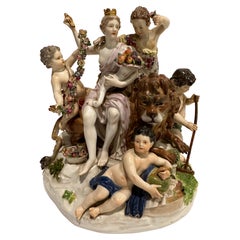
Meissen Group Six Figurines Allegory of Earth
By Meissen Porcelain
Located in Norwood, NJ
Large Meissen group of figurines which are Allegory of Earth assembled around a Lion's Figurine. Manufactory: Meissen Hallmarked: Blue Meissen Sword M...
Porcelain
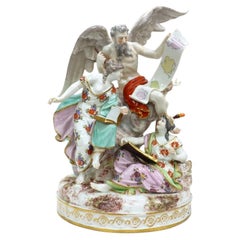
$2,950
H 17.25 in W 15.5 in D 10.5 in
German Dresden Style Classical Porcelain Figural Group After Max Eugene Clauss
Located in Big Flats, NY
This antique German Dresden style porcelain figural group, dating to approximately 1880, is crafted after the renowned works of Max Eugene Clauss. The classical composition features ...
Porcelain
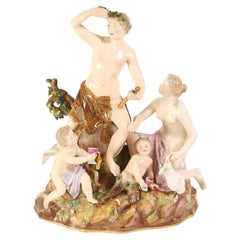
Meissen Porcelain Bacchus and Attendants Figural Group
By Meissen Porcelain
Located in Bradenton, FL
Superb example of 19th Century Meissen Porcelain. Bacchus and Attendants Figural Group modeled by Ernst August Leuteritz. The porcelain group depicts a youthful Bacchus, leopard skin...
Porcelain
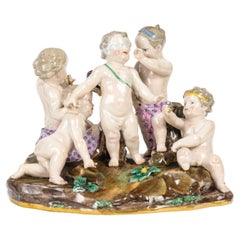
$5,708
H 7.49 in W 8.67 in D 5.12 in
Sculpture, Group in Meissen Porcelain, 19th Century, Napoleon III Period.
By Meissen Porcelain
Located in Saint-Ouen, FR
Sculpture, group in Meissen porcelain, 19th century, Napoleon III period. A Meissen porcelain sculpture of children playing colin maillard, 19th century, Napoleon III period. Dimen...
Porcelain
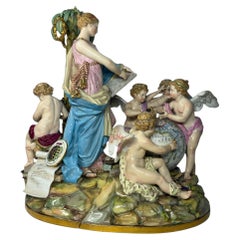
$26,000
H 16.15 in W 14.57 in D 10.63 in
Meissen Porcelain Allegorical Group Geography and Science Rococo Germany
By Meissen Porcelain
Located in Buenos Aires, Argentina
Monumental Meissen Porcelain Allegorical Group “Geography and Science” – Rococo Style, Germany, Circa 1870–1879 An exceptional and highly decorative monumental Meissen porcelain all...
Porcelain
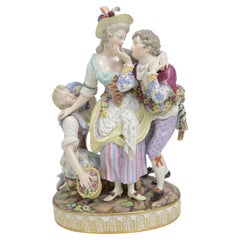
19th Century Meissen Group of Lovers
By Meissen Porcelain
Located in Brighton, Sussex
An enchanting late 19th Century large porcelain group of two ladies competing for the heart of a nobleman. Having wonderful bold colours, garlands of flowers, and an under glaze blue...
Porcelain
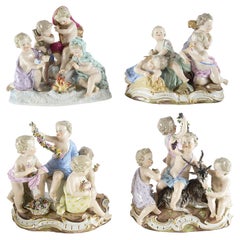
$11,121 / set
H 7.09 in W 7.49 in D 4.73 in
Meissen Set of the Four Seasons Porcelain Figures, 19th Century
By Meissen Porcelain
Located in Brighton, Sussex
An enchanting set of four, late 19th century Meissen porcelain groups, depicting the four seasons, each with putti playing around a logs fire, a bail of hay, picking grapes and garla...
Porcelain
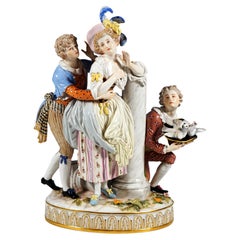
Large Meissen Rococo Genre Group, The Approach, by J.C. Schoenheit, Circa 1850
By Meissen Porcelain, Johann Carl Schoenheit
Located in Vienna, AT
Exceptional rare Meissen porcelain group: A group of three figures in elaborate Rococo attire: the young, pretty lady in a bodice dress with a low neckline, a long skirt, a bustle an...
Porcelain
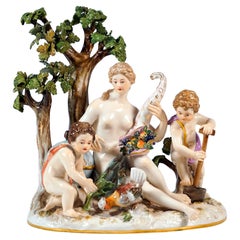
Meissen Porcelain Group Allegory 'Earth', by J.J. Kaendler, Germany, Circa 1860
By Meissen Porcelain, Johann Joachim Kaendler
Located in Vienna, AT
Very rare Meissen allegorical group of the 19th century: Ceres, the Roman goddess of the earth (Greek: Demeter), seated beneath a group of tr...
Porcelain
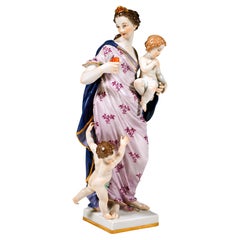
Meissen Group Allegory 'the Love', by J.J. Kaendler, Germany, circa 1900
By Meissen Porcelain, Johann Joachim Kaendler
Located in Vienna, AT
Very rare and exceptional porcelain figure group: Standing young beauty with her hair tied back at the nape of her neck and crowned with a tiara, wearing a long dress softly embraci...
Porcelain
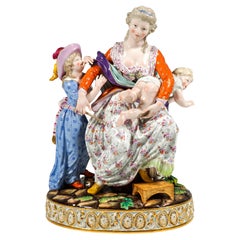
Early Meissen Rococo Group, Love and Indulgence, by J.C. Schoenheit, Circa 1840
By Johann Carl Schoenheit, Meissen Porcelain
Located in Vienna, AT
Exceptional Meissen porcelain genre group: Young mother seated on a magnificent Louis XVI-style armchair, her left foot set down on a low stool, a boy lying on his stomach on her left thigh, his white shirt slipped up to reveal his bare buttocks, which the mother has probably just struck with the cane in her left hand, to her right a girl in a dress and hat decorated with feathers, clasping her mother's arm so that she can no longer strike the boy. The group is based on an oval pedestal with gold heightened frieze decoration on the sides. Particularly elaborate, detailed design and staffage. This model was based on drawings by Johann Eleazar Zeissig, known as 'Schenau' (1737-1806). Designed by JOHANN CARL SCHÖNHEIT (1730 - 1805) in 1788 started working as an apprentice in the Meissen factory in 1741 and has been in a responsible position since 1768. For more than 20 years, Schönheit was an employee of both J.J. Kändler as well as from M.V. Acier, who entered the Meissen factory in 1762. After Kändler's death in 1775, Schönheit was head of the model department until 1794. Design of the model in 1788 Manufactory: Meissen Germany Dating: made around 1840 Material: white porcelain, glossy finish Technique: handmade porcelain, finest hand painting Dimensions: height: 25,5 cm / 10.03 in width: 18,0 cm / 7.08 in depth: 16,0 cm / 6.29 in Marks: Blue Meissen crossed sword mark Model number: I 66 / former's number 35 / painter Da.. Bibliography: Thomas & Sabine Bergmann, Meissen Artist's - Figures / Erlangen Germany 2014, Model numbers A1 - Z99, page 31...
Porcelain
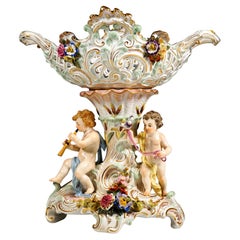
Meissen Splendour Centerpiece With Cupids by Paul Helmig, Germany, Around 1885
By Meissen Porcelain, Paul Helmig
Located in Vienna, AT
A special piece of porcelain from the late 19th century: A diamond-shaped earthen base rising on four sturdy rocaille elements, decorated with sculpted flowers and foliage, surrounde...
Porcelain
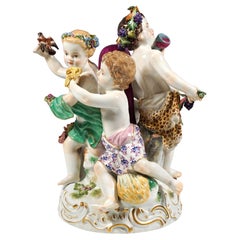
Large Meissen Cupid Group 'Allegory - The Four Seasons', By Leuteritz, Ca. 1880
By Meissen Porcelain, Ernst August Leuteritz
Located in Vienna, AT
An excellent and rare Meissen group of the seasons with large figures: Four amoretti wrapped in cloths grouped on a rock, representing the four seasons: a female amoretto as spring w...
Porcelain