Want more images or videos?
Request additional images or videos from the seller
1 of 7

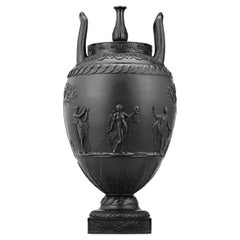
Wedgwood Black Basalt Ewers

$8,850List Priceper set

You May Also Like

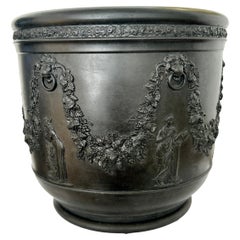
Large Wedgwood Solid Black Basalt Neoclassical Jardiniere

Large Wedgwood Solid Black Basalt Neoclassical Jardiniere

By Wedgwood

Located in Doraville, GA

Wedgwood black basalt jardiniere, made in England around 1900. The jardiniere has a floral banded border above fruiting grapevine festoons terminatin...

Category

Early 20th Century English Neoclassical Revival Planters, Cachepots and ...

Materials

Ceramic

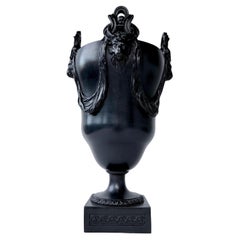
Exhibited 18th Century Wedgwood & Bentley Black Basalt Ware Four-Handled Vase

Exhibited 18th Century Wedgwood & Bentley Black Basalt Ware Four-Handled Vase

By Wedgwood & Bentley

Located in Asheville, NC

Etruria, Staffordshire, c.1780, thrown in four parts and bolted to a plinth built of five small slabs, decorated by molded handles with horned returns to high relief goats’ masks with drapery festoons, circular seal at bolt impressed “WEDGWOOD & BENTLEY: ETRURIA,” 18 in. Provenance: Dr. Ellis F. Rubin & Suzanne Borow Rubin. Exhibited at the Mint Museum in Charlotte, NC in 2020 and illustrated in “Classic Black: The Basalt Sculptures of Wedgwood...

Category

Antique 1780s English Neoclassical Pottery

Materials

Pottery

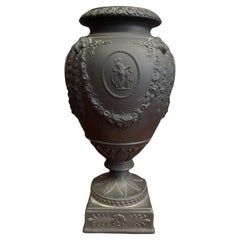
Small Early 19th-Century Wedgwood Balck Basalt Vase on a square base

Small Early 19th-Century Wedgwood Balck Basalt Vase on a square base

By Wedgwood

Located in Madrid, EX

This early 19th-century Wedgwood black basalt vase is a rare find...beautifully proportioned and irresistibly versatile. Its rich, matte finish complements...

Category

Antique Early 19th Century English Neoclassical Vases

Materials

Stoneware

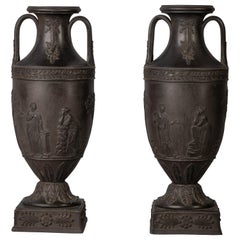
Pair of Wedgwood Black Basalt Two-Handled Vases, circa 1900

Pair of Wedgwood Black Basalt Two-Handled Vases, circa 1900

Located in New York, NY

Decorated with a frieze of classical figures between a berried vine border and upright acanthus leaves. The neck similarly decorated with pendant trophies between upright handles.

Category

Antique Early 1900s British Vases

Materials

Ceramic

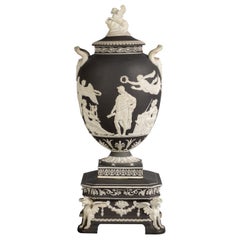
Wedgwood Black and White Jasper "Pegasus" Covered Vase, 19th Century

Wedgwood Black and White Jasper "Pegasus" Covered Vase, 19th Century

Located in New York, NY

The black jasper ovoid body decorated in white relief with the Apotheosis of Virgil after John Flaxman, the shoulder with snake handles above Medusa masks,...

Category

Antique 19th Century English Vases

Materials

Porcelain

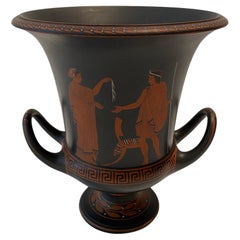
Wedgewood Black Basalt Stone Urn

Wedgewood Black Basalt Stone Urn

$4,500

H 11 in Dm 9.75 in

Wedgewood Black Basalt Stone Urn

By Wedgewood

Located in Los Angeles, CA

Wedgewood encaustic painted , matte finished black basalt stone urn. Hand painted decoration with 2 scenes. Egyptian Revival style. Circa 1790-1820.

Category

Antique 1790s English Egyptian Revival Urns

Materials

Stone

Pair of Antique Wedgwood & Bentley Black Basalt Jars England, Circa 1775

Pair of Antique Wedgwood & Bentley Black Basalt Jars England, Circa 1775

By Wedgwood & Bentley

Located in Katonah, NY

This pair of Wedgwood & Bentley black basalt urns was crafted at the renowned Etruria factory around 1775. They show the refined simplicity of Wedgwood's 18th-century neoclassical de...

Category

Antique Late 18th Century English Neoclassical Jars

Materials

Stoneware

Pair Black and Gold Staffordshire Pottery Vases Circa 1880

Pair Black and Gold Staffordshire Pottery Vases Circa 1880

By Staffordshire

Located in Katonah, NY

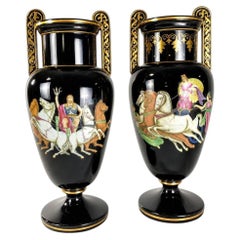
This pair of black Staffordshire pottery vases has a bold, architectural presence. The glossy black ground and burnished gold handles create immediate contrast, while mythological s...

Category

Antique Late 19th Century Neoclassical Vases

Materials

Pottery

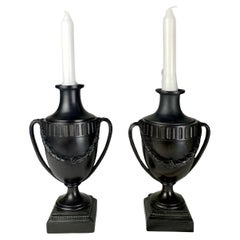
Pair of Italian Basalt with Gold Gilt Ormolu Urn/Vases - Wedgewood Style

Pair of Italian Basalt with Gold Gilt Ormolu Urn/Vases - Wedgewood Style

$1,984Sale Price / set|20% Off

H 12.5 in W 7 in D 7 in

Pair of Italian Basalt with Gold Gilt Ormolu Urn/Vases - Wedgewood Style

By Wedgewood

Located in Los Angeles, CA

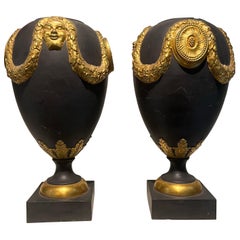
Pair of gorgeous black vases (possibly basalt) with gilt ormolu details. Stamped Italy. Please note these do have some signs of age with some chips (See pics).

Category

Antique 19th Century Italian Neoclassical Urns

Materials

Ormolu

More From This Seller

View All
Wedgwood Black Basalt Two-Handled Urn

Wedgwood Black Basalt Two-Handled Urn

By Wedgwood

Located in New Orleans, LA

A remarkable example of Josiah Wedgwood's legendary ceramic art, the importance and rarity of this urn vase simply cannot be overstated. Black basalt refers to the fine-grained stoneware developed by Josiah Wedgwood in the 1760s that was inspired by the hard, natural stone known as Egyptian basalt...

Category

Antique 19th Century English Urns

Materials

Ceramic, Stoneware

Wedgwood Black Basalt Pastille Burner

Wedgwood Black Basalt Pastille Burner

By Wedgewood

Located in New Orleans, LA

Wedgwood began crafting pastille burners in the early nineteenth century, and this stunning dolphin burner is a gorgeous example of his innovative desi...

Category

Antique 19th Century English Decorative Bowls

Materials

Ceramic

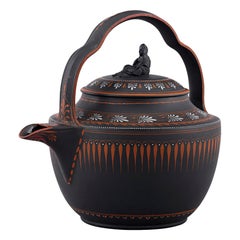
Wedgwood Black Basalt and Encaustic Enamel Rum Kettle

Wedgwood Black Basalt and Encaustic Enamel Rum Kettle

By Wedgwood

Located in New Orleans, LA

Crafted by Wedgwood, this rare, round-shaped rum kettle is comprised of black basalt and features a molded bail handle and glazed interior. Referred to as “...

Category

Antique Early 19th Century English Classical Greek Ceramics

Materials

Enamel

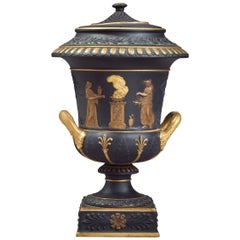
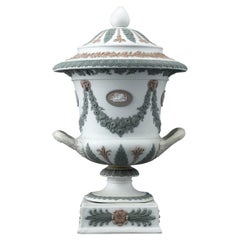
Wedgwood Tri-Colored Jasper Vase

Wedgwood Tri-Colored Jasper Vase

By Wedgwood

Located in New Orleans, LA

This exceptional and rare Wedgwood tri-colored jasper vase exemplifies that renowned firm’s classical artistry. Crafted of jasper, perhaps the greatest of Josiah Wedgwood’s porcelain innovations, in the shape of an ancient Greek calyx krater...

Category

Early 20th Century English Classical Greek Vases

Materials

Ceramic

Sèvres Porcelain and Dorè Bronze Vases

Sèvres Porcelain and Dorè Bronze Vases

By Manufacture Nationale de Sèvres

Located in New Orleans, LA

Pair of Porcelain and Dorè Bronze Vases Sèvres Circa 1845 With porcelain vessels in the iconic Sèvres cobalt blue, encased in lavish doré bronze armatures, this pair of Louis XVI-style urns epitomizes the masterful craftsmanship and refined beauty of the famed porcelain manufactory. Each urn is adorned with three finely chased caryatid figures joined by floral garlands, resting upon a reticulated circular gilt bronze base. Since its founding in the 18th century, the Sèvres porcelain manufactory has been synonymous with the finest porcelain wares. Established under the patronage of Louis XV and Madame de Pompadour, the firm quickly became the official royal porcelain producer. Throughout the 19th century, Sèvres expanded its repertoire, designing distinct vase forms that ranged from neoclassical grandeur to Gothic delicacy. These exceptional urns pay homage to Pierre Gouthière, one of the most renowned bronze artists of the preceding century. Appointed gilder to King Louis XV in 1767, Gouthière revolutionized metalwork, pioneering a gilding technique that achieved an exquisite matte finish. Similar caryatid figures appear on vases once owned by the Duke of Talleyrand, while similar mermaid motifs—prevalent in Gouthière’s work—can be found on a serpentine marble vase in the Louvre. These vases embody the grandeur of Louis XVI-style ornamentation, blending rich materials with impeccable detail. Each: 19 3/4 high x 13" diameter Marked under bronze Sèvres Louis Philippe...

Category

Antique 19th Century French Louis XVI Vases

Materials

Bronze

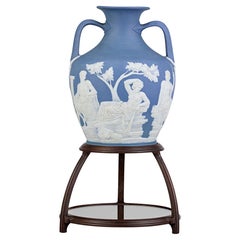
Wedgwood First Edition Portland Vase

Wedgwood First Edition Portland Vase

By Josiah Wedgwood

Located in New Orleans, LA

This extraordinary First Edition Wedgwood rendering of the legendary Portland Vase is one of the rarest masterpieces of Josiah Wedgwood, the most important ceramics manufacturer of the 18th century. A tour de force of ceramic art, the Portland Vase First Editions are regarded as one of the greatest ceramic accomplishments of the 18th century, and they are a testament to the superior skill of Josiah Wedgwood, his extraordinary ambition and his tireless dedication to perfection. One of the very few First Editions still in private hands, this exceptional Wedgwood Portland Vase is one of the most important works of ceramics on the market. The story of Wedgwood and the Portland Vase is legendary. The original Portland Vase is the ancient world's most famous decorative arts masterpiece—a cameo glass vase dating to circa 25 CE with a frieze representing the myth of Peleus and Thetis, initially thought to be carved from stone. When it was first rediscovered around 1582, it captivated the world with its opaque white cameo figures over its rich blue background. After the vase was excavated it was owned by Cardinal Barberini, whose family later sold it to the Duke of Hamilton who eventually sold it to the Duchess of Portland, from whom the famed vase now takes its name. The famed British sculptor John Flaxman was likely the first to have brought the vase to Wedgwood’s attention. In a letter dated February 5, 1784, he wrote: “I wish you may soon come to town to see William Hamilton’s vase, it is the finest production of Art that has been brought to England and seems to be the very apex of perfection to which you are endeavouring to bring your bisque and jasper…” Indeed, the Portland Vase is a masterpiece of cameo-cutting, with a stunning frieze of opaque white cameo glass over its translucent deep blue form. Its beauty and translucence would inspire Wedgwood to undertake his years-long endeavor to precisely replicate the original in porcelain. Upon closer examination, Wedgwood realized the vase was not made of stone or earthenware, but of cameo glass—a technique so advanced it remains the masterpiece of cameo-cutting. Today, the vase is housed in the British Museum, where it is the second most viewed antiquity, only after the Rosetta Stone. It then took Wedgwood several painstaking years to craft his unparalleled copy of the vase, during which he perfected the jasperware technique that would become his crowning achievement. To this day, the renowned porcelain firm regards the vase as its most momentous triumph, so much so that the vessel’s silhouette is incorporated into the Wedgwood logo. The four years it took Wedgwood to complete his vase were not without tribulations. From the start, Wedgwood encountered numerous problems with his copies, from cracking and blistering to the difficulty of replicating the translucent effects of the original. The first acceptable copy was produced in October 1789 and sent to Wedgwood’s physician and friend Erasmus Darwin, the grandfather of Charles Darwin. Wedgwood presented another copy to Queen Charlotte in May 1790 and afterward organized a private exhibition of the vase at the Portland House in London. The viewing proved so popular that Wedgwood was forced to restrict the show to 1,900 visitors. Much of London wished to see Wedgwood’s greatest major achievement. Perhaps the highest praise of Wedgwood’s copy came from the famed artist Sir Joshua Reynolds, the founder of the British Royal Academy: “I can venture to declare it a correct and faithful imitation, both in regard to the general effect, and the most minute detail of the part.” Over the next few years, Wedgwood's oven records listed 43 First Edition copies of the Portland Vase produced between 1791 and 1796, 11 of which were broken during the firing process. In all, it is believed around 30 First Edition vases were completed, though an unknown number of these were somewhat damaged—one of these imperfect examples is currently held by the Victoria & Albert Museum in London. The perfect examples such as ours have found their way into the most important museum collections in the world. The British Museum (London), Art Institute of Chicago, Birmingham Museum of Art, Museum of Fine Arts (Boston) and the Fitzwilliam Museum (Cambridge, UK), among others, all hold one of these highly coveted vases in their collections. In terms of technical achievement, the First Edition Portland Vases...

Category

Antique 18th Century English Classical Roman Vases
Materials

Porcelain