Want more images or videos?
Request additional images or videos from the seller
1 of 10

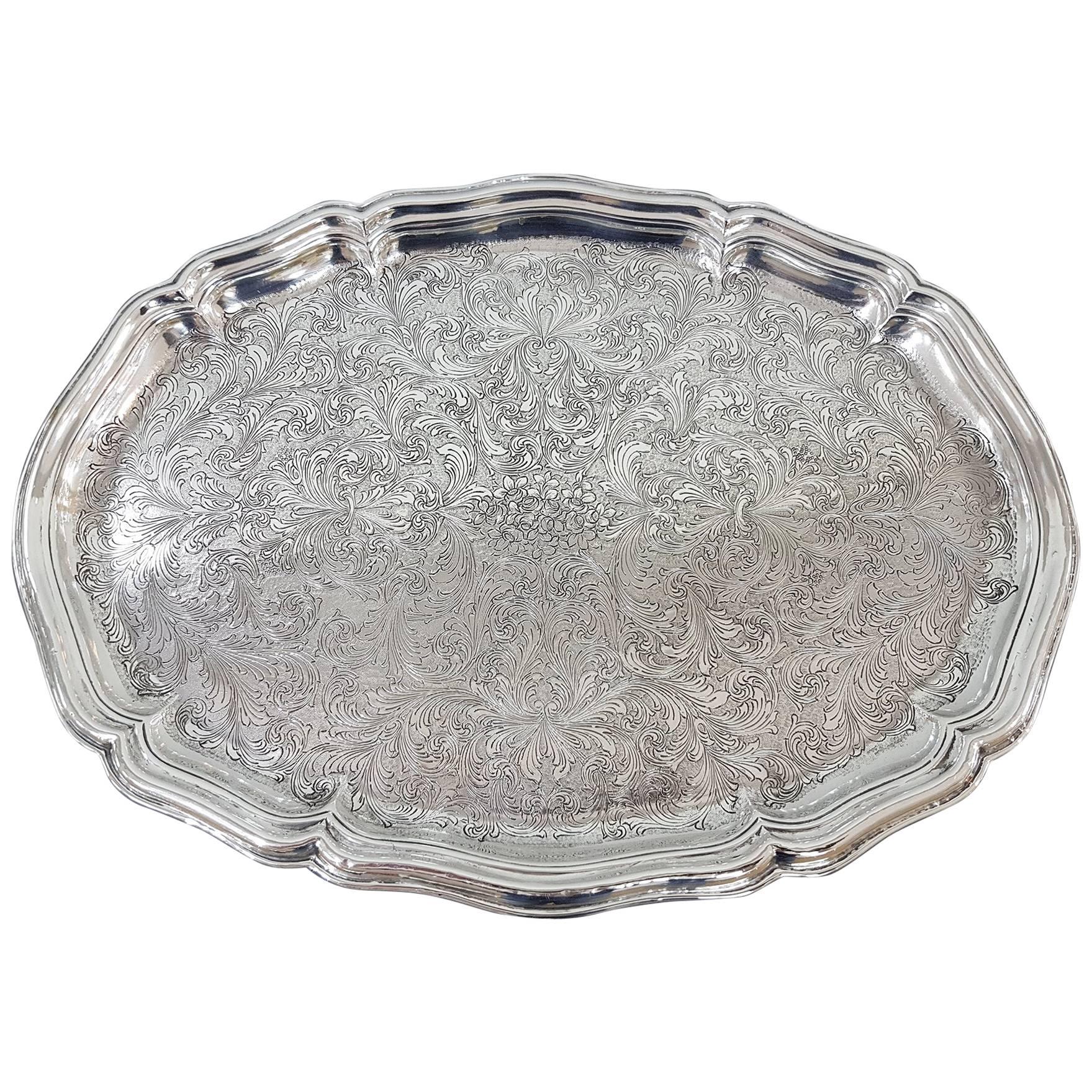
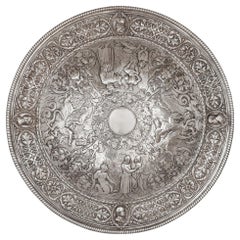
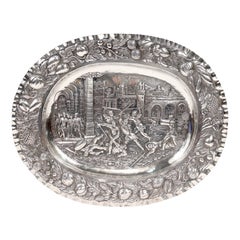
Oval-shaped Silver Tray by Georg Roth & Co. Embossed with a Napoleonic Scene

$15,175.10
£11,027.34
€13,130.65
CA$21,170.02
A$21,473.18
CHF 12,261.78
MX$260,047.26
NOK 144,351.12
SEK 143,872.04
DKK 98,152.52

About the Item

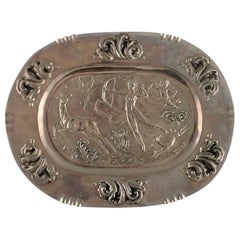
Oval-shaped silver tray by Georg Roth & Co. embossed with a Napoleonic scene German, Late 19th Century Height 3cm, width 57.5cm, depth 47.5cm, weight 1.87kg This superb piece of silverware depicts Napoleon’s return from the island of Elba in 1815, which was to be his final military action before his defeat by the British at Waterloo. Embossed after a painting by Charles de Steuben entitled ‘Napoleon’s Return from Elba’ (1818), the central panel depicts Napoleon triumphantly leading his troops, holding his standard high. The panel is rendered with impressive similarity to the original painting, with many of the minute expressions, costumes, and background details of the painting captured by the tray’s maker. Surrounding the scene is a circular border, which features further armorial decoration, as well as decorative foliate designs. The entire tray is surrounded by a crimped-edge rim. The hallmarks of the German silversmiths Georg Roth & Co. can be seen in the upper left corner. Based in Hanau, the company was renowned for creating fine silverware pieces in the opulent French Rococo style. Rendered with an extraordinary level of detail, this impressive tray depicts a pivotal moment in history, making it a prime collector’s item for anyone interested in military antiques.
  • Creator:
    Georg Roth (Maker)
  • Dimensions:
    Height: 1.19 in (3 cm)Width: 22.64 in (57.5 cm)Depth: 18.71 in (47.5 cm)
  • Style:
    Rococo (In the Style Of)
  • Materials and Techniques:
    Silver,Embossed
  • Place of Origin:
  • Period:
  • Date of Manufacture:
    Late 19th Century
  • Condition:
    Wear consistent with age and use.
  • Seller Location:
    London, GB
  • Reference Number:
    Seller: 131851stDibs: LU95639573063

More From This Seller

View All
18th Century Silver Salver by Paul de Lamerie

18th Century Silver Salver by Paul de Lamerie

By Paul de Lamerie

Located in London, GB

18th century silver salver by Paul de Lamerie English, 1744 Height 3cm, diameter 27cm Hailing from the workshop of the eminent Dutch-born English sil...

Category

Antique 18th Century English Rococo Sterling Silver

Materials

Silver

Large Silver Salver by Dobson & Sons, 19th Century

Large Silver Salver by Dobson & Sons, 19th Century

By Dobson and Sons

Located in London, GB

Large silver salver by Dobson & Sons, 19th century English, c.1893 Height 6.5cm, diameter 64cm Weight 5kg This exquisite antique tray is crafted entirely of solid silver, making...

Category

Antique Late 19th Century English Victorian Tableware

Materials

Silver

Very Large French Silvered Bronze Jardinière in the Manner of Christofle

Very Large French Silvered Bronze Jardinière in the Manner of Christofle

By Christofle

Located in London, GB

Very large French silvered bronze jardinière in the manner of Christofle French, Late 19th Century Height 45cm, width 102cm, depth 56cm This stunning silvered bronze jardinière is...

Category

Antique Late 19th Century French Neoclassical Planters and Jardinieres

Materials

Bronze

Antique German Naive Engraved Pewter Tray

Antique German Naive Engraved Pewter Tray

Located in London, GB

Antique German naive engraved pewter tray German, c. 1743 Height 4.5cm, width 98cm, depth 56cm This fine German tray is crafted from pewter, an alloy ...

Category

Antique 1740s German More Dining and Entertaining

Materials

Pewter

You May Also Like

Swedish Designer, Large Oval Serving Dish in Metal with Classicist Hunting Scene

Swedish Designer, Large Oval Serving Dish in Metal with Classicist Hunting Scene

Located in København, Copenhagen

Swedish designer. Large oval serving dish in metal with a classicist hunting scene. Diana the goddess of the hunt, 1910-1920. Measures: 39 x 29.5 cm. In excellent condition.

Category

Early 20th Century Swedish Platters and Serveware

Materials

Metal

Silver wall salver with battle scene, monogram & ornate relief

Silver wall salver with battle scene, monogram & ornate relief

Located in Porto, PT

Description: Silver wall salver with relief featuring a scene of knights fighting, monogram cartouche, wavy border and profusely embossed with birds, fruits and leaves. Metal:. Origi...

Category

20th Century European Platters and Serveware

Materials

Silver

Antique German Silver Repoussé Battle Scene Tray, Circa 1850

Antique German Silver Repoussé Battle Scene Tray, Circa 1850

Located in Dallas, TX

This richly decorated silver serving tray with repousse work is from Germany’s Gründerzeit period, circa 1850. The exquisite repoussage depicts an unknown military skirmish of soldiers with spears and swords on horseback. The chaotic action of the scene is offset by the whimsical décor...

Category

Antique 19th Century German Platters and Serveware

Materials

Silver

Elaborate Victorian Sterling Silver Gallery Tray by Martin & Hall, 1897

Elaborate Victorian Sterling Silver Gallery Tray by Martin & Hall, 1897

By Martin & Hall

Located in London, London

Hallmarked in Sheffield in 1897 by Martin & Hall this elaborate Victorian antique sterling silver oval tray has a finely pierced gallery with an intricate interlocking design. Th...

Category

Antique 1890s English Victorian Platters and Serveware

Materials

Sterling Silver

Antique Large William IV Silver Tray Salver by Paul Storr 19th Century

Antique Large William IV Silver Tray Salver by Paul Storr 19th Century

By Paul Storr

Located in London, GB

This is a wonderful English antique William IV sterling silver tray, or salver, by the world famous silversmith Paul Storr. It has clear hallmarks for London 1820 the makers mark of Paul Storr. It is typical of his work with the octafoil shape and the exquisitely detailed reeded rim, and it is raised on four delightful foliate and scroll feet. The centre is engraved with a shield shaped coat of arms which I have had researched. The Marital Arms of Knollis and Hallifax The armorial bearings as engraved upon this George IV Large English Sterling Silver Footed Salver by Paul Storr hallmarked London 1820 are those of the family of Knollis with Hallifax in pretence. These armorial bearings denote the marshalling of a marital coat showing the arms of the husband over the entire surface of the shield, whilst the arms of the wife (as an heraldic heiress) are placed on a small shield (known as an escutcheon of pretence) centrally on the husband’s arms. They may be blazoned as follows: Arms: Quarterly 1st and 4th Azure crusily of cross crosslets a cross moline voided or (for Knollys) 2nd and 3rd Gules on a chevron argent three roses of the field barbed proper (for Knollys) over all an escutcheon of pretence Or on a pile engrailed sable between two fountains barry wavy of six argent and azure three cross crosslets of the first (for Hallifax) Crest: An elephant argent [differenced with a mullet1 ] (for Knollys) Motto: In utrumque paratus [Prepared for either] (for Knollys) These armorial bearings undoubtedly commemorate the marriage of The Honourable and Reverend Francis Knollis2 (baptised 3rd January 1743 died 27th February 1826), 1 The cadency mark for a third son of a family. 2 Francis appears to have preferred this spelling of his family’s surname. It is spelt as it is to be pronounced. of Burford in the County of Oxfordshire and of Eastleach Martin in the County of Gloucestershire and Mary Hallifax (baptised 5th March 1753 buried 18th December 1830). Francis and Mary were married at the Parish Church of St Mary, Ewell in the County of Surrey on the 9th June 1772. Francis was the third son of Charles Knollys (the titular 5th Earl of Banbury) 3 and his wife, Martha Hughes, whilst Mary was the daughter of The Reverend James Hallifax, of Ewell aforesaid and his wife, Elizabeth Chardavoyn. 3 Francis’s father claimed to be the 5th Earl of Banbury. A claim that continued to be pursued by the family until William Knollys, the titular 8th Earl of Banbury (born 1763 died 1834) was forced to discontinue its use by a resolution of the House of Lords which rejected his claim to the earldom in 1813. The crest surmounts a detailed dedication: This piece of plate was presented to the Honourable Rev Knolls by the inhabitants of the town and immediate neighbourhood of Burford on his completing the fiftieth year of his incumbency as the vicar of Burford. In testimony of their high respect 11th April 1821 There is no mistaking its unique quality and design, which is sure to make it a treasured piece by any discerning collector. Condition: In excellent condition with clear hallmarks and no dings, dents or signs of repair. Please see photos for confirmation. Dimensions in cm: Height 3 x Width 36 x Depth 36 Weight 1.52 kg Dimensions in inches: Height 1 inch x Width 1 foot, 2 inches x Depth 1 foot, 2 inches Weight 49 troy oz Paul Storr born in London England in 1771, was to become one of the most talented silversmiths of the nineteenth century. Today his legacy of exceptionally well crafted silver, found worldwide in museums and private collections, leaves one in awe when compared to that of his contemporaries.After having served a seven year apprenticeship from the age of 14, he began his career in 1792 when he went into a brief partnership with William Frisbee. This did not last and in 1793 a new mark, (his initials ‘P S’) was entered. By the beginning of the nineteenth century he had established himself as one of London’s top silversmiths producing, amongst others, commissions for Royalty. In 1801 he married Elizabeth Susanna Beyer with whom he was to have ten children. In 1807 Paul Storr entered into a working relationship with Philip Rundell and by 1811 was a partner, and managing the workshops for Rundell, Bridge & Rundell. During this period he kept his own marks and separate workshop. However it was through Rundell, Bridge & Rundell who were appointed Goldsmith in Ordinary to George III in 1804 that his reputation as a master silversmith grew. His talents lay in being able to transform ideas and designs from Rundell, Bridge & Rundell’s designers, William Theed...

Category

Antique 1820s English William IV Sterling Silver
Materials

Sterling Silver