Want more images or videos?
Request additional images or videos from the seller
1 of 9

Ancient Egyptian Canopic Jars, Carved Alabaster, 12th Dynasty

$225,000
£168,242.78
€196,497.90
CA$316,124.78
A$320,217.68
CHF 183,862.32
MX$3,882,543.30
NOK 2,133,486.39
SEK 2,171,643.75
DKK 1,469,029.50

About the Item

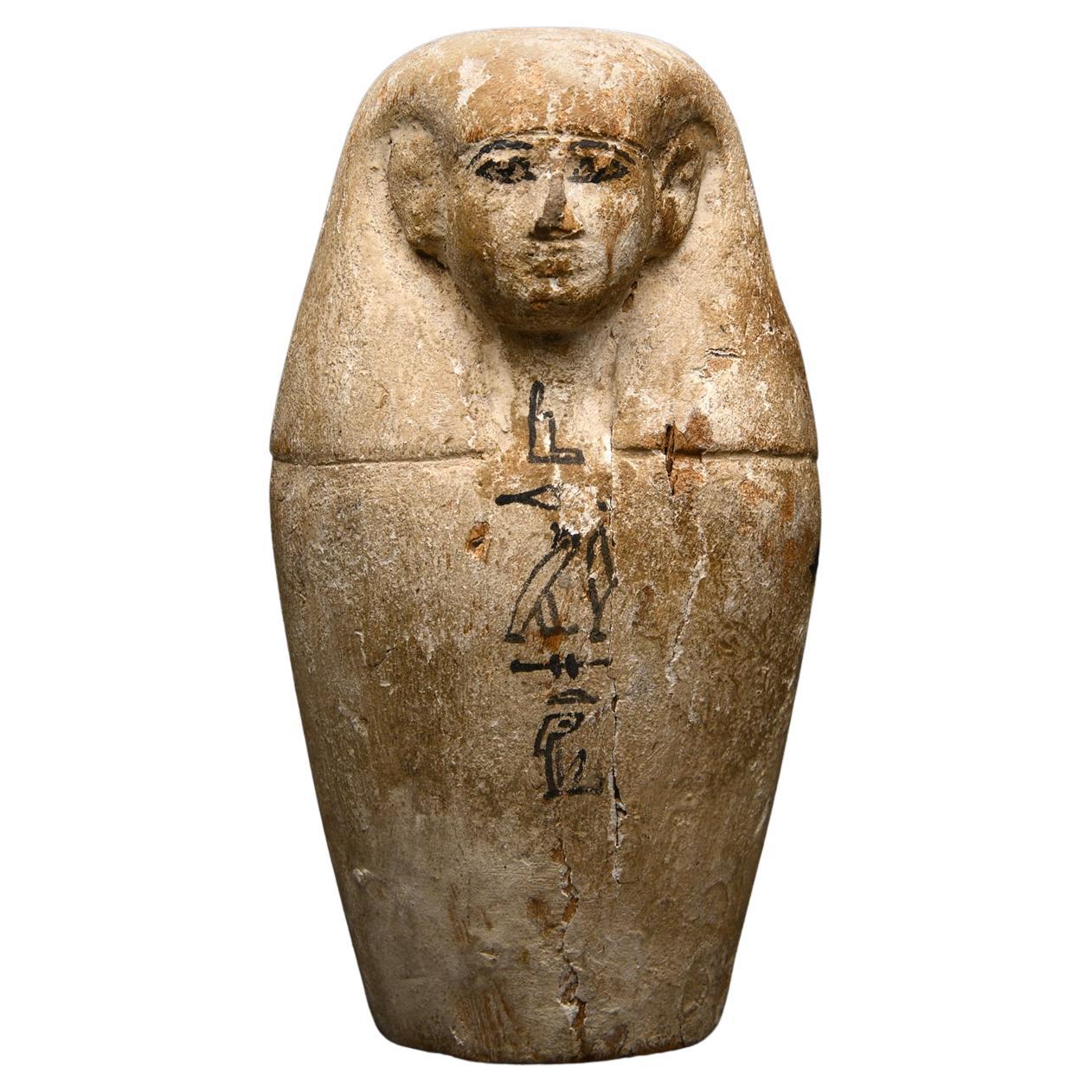
This set of two canopic jars represents unequivocal masterpieces of the type. Carved out of a beautifully rich white veined caramel alabaster, both jars are deftly executed and of robust, elegant proportion. Each with rounded shoulders tapering to a flat base, and featuring lids in the form of the human-headed Imsety, one of the four sons of Horus. Both serene oval faces executed with heavy upper eyelids, a broad nose, thick lips and prominent ears. Notes As early as the Fourth Dynasty of the Old Kingdom, the internal organs of the deceased were removed from the body during the process of mummification.' These organs, the most easily prone to putrefaction, were then placed in special containers, the so-called canopic jars-always a set of four-and buried beside the sarcophagus or coffin with the mummy. The procedure was motivated by the belief that only a complete body, with all of its components, could guarantee an individual's rebirth and the desired afterlife. The earliest known examples were simple stone jars with shallow disklike lids, usually uninscribed. During the First Intermediate Period (the Ninth-Tenth Dynasty, ca. 2100 B.C.), the style changed to lids with human heads, and entire sets of jars were produced from a variety of materials. It was not until the late Eighteenth Dynasty (ca. 1300 B.C.) that the lids were carved in the characteristic form with the four Sons of Horus, each associated with one of the viscera. Four funerary goddesses, in addition to the canopic deities, protected the jars' contents. Human-headed Imsety guarded the liver (under the protection of the goddess Isis, baboon-headed Hapy guarded the lungs (under the goddess Nephthys), jackal-headed Duamutef guarded the stomach (under the goddess Neith) and falcon-headed Qebehsenuef guarded the intestines (under the goddess Serket). The form and iconography of canopic jars and the chests that contained them remained in use till Greco-Roman times, and they were an indispensable element of standard burials, both royal and private. Published Monument Gallery Los Angeles Volume III, 2023, illus. 5, p. 18. Provenance Said to be found in Dahshur in 1896. Palm Beach Private Collection. Alice Tully (1902-1993), New York. French Furniture, European Works of Art and Porcelain from the Collection of Alice Tully; Christie’s, New York, 26-28 October 1994. Antiquities Christie's New York, June 4, 2015. Private Collection, Los Angeles California.
  • Dimensions:
    Height: 13.75 in (34.93 cm)Diameter: 8 in (20.32 cm)
  • Style:
    Egyptian (Of the Period)
  • Materials and Techniques:
  • Place of Origin:
  • Period:
  • Date of Manufacture:
    Middle Kingdom, 12th Dynasty, 1985 BC to 1773 BC
  • Condition:
    Wear consistent with age and use. Each intact as preserved, with some minor cracks and areas of heavy surface wear and incrustation. With some hairline cracks and chips. A label in one reading "Foiulles de Dachour", 1896.
  • Seller Location:
    Beverly Hills, CA
  • Reference Number:
    Seller: MS.00321stDibs: LU10743247947422

More From This Seller

View All
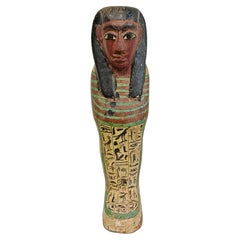
Ancient Egyptian Wood Dummy Canopic Jar

Ancient Egyptian Wood Dummy Canopic Jar

Located in Beverly Hills, CA

This beautifully rendered 'dummy' canopic jar is In the form of the human-headed Son of Horus, Imsety. It features an incised line indicating the division between the jar and the lid...

Category

Antique 15th Century and Earlier Egyptian Egyptian Antiquities

Materials

Wood

Egyptian Alabaster Canopic Jar of PEDIHORMEDNU

Egyptian Alabaster Canopic Jar of PEDIHORMEDNU

Located in Beverly Hills, CA

This exceptional canopic jar of broad-shouldered ovoid form, features four columns of incised inscription which include the owner’s name and that of the falcon-headed Son of Horus Qe...

Category

Antique 15th Century and Earlier Egyptian Egyptian Antiquities

Materials

Alabaster

Ancient Egyptian Alabaster Jar, Early Dynastic Period

Ancient Egyptian Alabaster Jar, Early Dynastic Period

Located in Beverly Hills, CA

This beautiful squat bodied vessel hails from the very earliest dynastic period in Egyptian art. Carved from an opaque creamy alabaster, it features a wide mouth, and a round should...

Category

Antique 15th Century and Earlier Egyptian Egyptian Jars

Materials

Alabaster

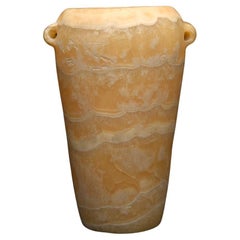
Ancient Egyptian Middle Kingdom Alabaster Jar

Ancient Egyptian Middle Kingdom Alabaster Jar

Located in Beverly Hills, CA

Of beautiful rich, translucent alabaster, banded with creamy hightlights, this sizeable vessel is of exceptional quality. The cylindrical squat piriform body tapers to a flat base, ...

Category

Antique 15th Century and Earlier Egyptian Egyptian Vases

Materials

Alabaster

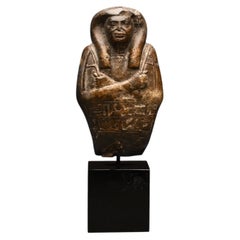
Egyptian Fragmentary Serpentine Shabti for Petamenope, 25th Dynasty

Egyptian Fragmentary Serpentine Shabti for Petamenope, 25th Dynasty

Located in Beverly Hills, CA

Large stone shabtis, known from the late Middle Kingdom and 18th Dynasty, reappeared in the 25th Dynasty for the pharaohs, Theban God's Wives, and the highest officials of Dynasty XX...

Category

Antique 15th Century and Earlier Egyptian Egyptian Antiquities

Materials

Serpentine

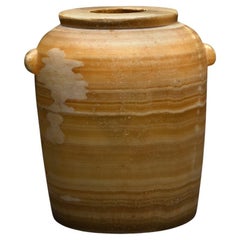
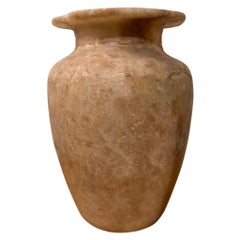
Ancient Egyptian Alabaster Storage Jar

Ancient Egyptian Alabaster Storage Jar

Located in Beverly Hills, CA

A large, and very fine barrel-shaped jar of alabster with well defined bands of creme and caramel highlights. Twin vestigial lug handles are located on each side below a wide disc ri...

Category

Antique 15th Century and Earlier Egyptian Egyptian Vases

Materials

Alabaster

You May Also Like

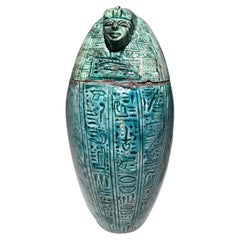
19th Century Egyptian Canopic Jar

19th Century Egyptian Canopic Jar

Located in Madrid, ES

Discover a fascinating piece of history with this exquisite 19th-century Egyptian canopic jar, expertly crafted from glazed faience. This unique artifact not only showcases the artis...

Category

Antique 1880s Jars

Materials

Faience

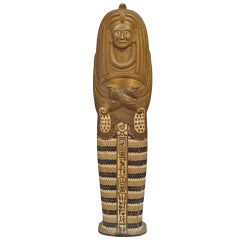
Antique Decorative figurine depicting an Egyptian mummy, 1920s

Antique Decorative figurine depicting an Egyptian mummy, 1920s

Located in Beograd, RS

In this listing you will find a large antique statue depicting an Egyptian mummy. It is carved in the softwood and hand-painted in Egyptian revival styl...

Category

Vintage 1920s Egyptian Egyptian Revival Figurative Sculptures

Materials

Softwood

Grand Tour Ancient Egyptian Style Alabaster Storage Jar

Grand Tour Ancient Egyptian Style Alabaster Storage Jar

Located in Stamford, CT

19th century hand carved alabaster storage jar in the ancient Egyptian Late Dynastic style, with tapering neck topped by a wide everted rim. Great evocative decorative piece for the ...

Category

Antique Late 19th Century Egyptian Grand Tour Jars

Materials

Alabaster

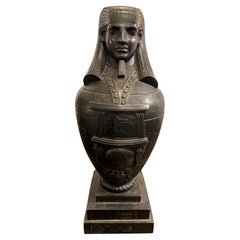
A Bronzed Metal Canopic Jar with Base, Early 20th Century

A Bronzed Metal Canopic Jar with Base, Early 20th Century

Located in ARMADALE, VIC

A Bronzed Metal Canopic Jar with Base, Early 20th Century Description: The jar with a lid in the form of a humanoid head wearing the pharaonic nemes headdress and false beard, ident...

Category

Early 20th Century Egyptian Jars

Materials

Metal

Nebamun Ancient Egyptian Vase or Vessel by Artist G. Lamiè

Nebamun Ancient Egyptian Vase or Vessel by Artist G. Lamiè

Located in Atlanta, GA

Inspired by the celebrated wall paintings from the Tomb of Nebamun in ancient Thebes, the Nebamun Vessel is a contemporary interpretation of an object that could have existed within ...

Category

2010s American Egyptian Revival Vases

Materials

Clay, Plaster