Want more images or videos?
Request additional images or videos from the seller
1 of 8

Stars & Stripe Pennant from the March on Washington, August 28, 1963

Price Upon Request
Price Upon Request
Price Upon Request
Price Upon Request
Price Upon Request
Price Upon Request
Price Upon Request
Price Upon Request
Price Upon Request
Price Upon Request

About the Item

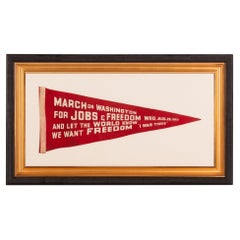
BOLDLY GRAPHIC AND UNUSUAL STARS & STRIPES PENNANT FROM THE ‘MARCH ON WASHINGTON’ OF AUGUST 28TH, 1963, WHEN MARTIN LUTHER KING DELIVERED HIS HISTORIC "I HAVE A DREAM" SPEECH; THIS EXAMPLE EXHIBITED AT THE REGINALD F. LEWIS MUSEUM OF MARYLAND AFRICAN AMERICAN HISTORY: Stars & Stripes flags, banners, and pennants, made during the 19th century, were sometimes adorned with interesting graphics and textual messages. This continued into the beginning of the 20th century but dwindled quickly during the first quarter. After this time, it is very unusual to find interesting adaptations of the American national flag, printed with patriotic and political messages, especially with aesthetics that seem to hail from the previous century. This fantastic and rare political pennant was flown in tribute of what would soon be touted as one of the most galvanizing events in American civil rights history. It would have been raised and waved by an attendee on that landmark day, in August of 1963, in our nation's capital, when Martin Luther King, Jr. delivered his "I Have a Dream" speech. Printed on paper, the triangular design is comprised of a vertical blue bar, on which 43 stars surround the words that served as the mantra of the 1960's black rights movement: "We Shall Overcome". Joan Baez sung the folk song of the same name that day at the parade, written by Pete Seeger and others, to the crowd in attendance estimated between 200,000 and 300,000. The star count has no specific meaning. The stars simply serve to decorate the text and complete the flag-like image. The blue bar is followed by a field of 17 stripes—again with their number merely decorative—on which the following words appear in the same blue ink: "I Marched for Equality in the Freedom Parade; August 28, 1963; Washington, D. C." The official title for the assembly was "The March on Washington for Jobs and Freedom." Two blue stars follow in the last white stripe, for unknown purpose, possibly once again for artistic balance. Today just a tiny handful of examples are known, in addition to this one. I acquired and sold three others, now in private collections. This exact pennant was lent by Jeff R. Bridgman Antiques, Inc. to the Reginald F. Lewis Museum for Maryland African American History and Culture for an exhibit entitled "For Whom it Stands: The Flag and the American People," from May 17, 2014 – February 28, 2015. It is illustrated twice in a book by the same name, authored by Michelle Joan Wilkerson (2015, Reginald F. Lewis Museum for Maryland African American History and Culture), p. 22 and 61. One of the others, in a private collection in Washington, D.C., was carried by a woman by the name of Theresa Gehring, recollected in a story that she dictated to her son, documenting the day's events. Another is among the holdings of the Smithsonian. I also acquired a period photograph of one of these pennants in use on August 27th, 1963, affixed to an automobile antenna. The photo was taken by United Press International (UPI), during preparations for the event. At least two other images also survive of these pennants, being displayed by attendees of the march, on the same day. Provenance: (see above for exhibition history) Mounting: The solid walnut frame retains its original varnished surface and dates to the Civil War era. This is a pressure mount between 100% cotton velvet and U.V. protective plexiglass. Condition: The pennant was formerly framed, probably by the original owner, and it was folded at the top and bottom. There is pigment loss at the creases. Two punched holes allowed a wooden dowel to be inserted, which is an unusual method of affixing a staff. There are minor tears around the holes. The extreme tip at the fly end is slightly torn. There is minor soiling throughout. Because paper parade flags and pennants rarely survived, the state of preservation is expected and perfectly acceptable. Further, the extreme rarity warrants practically any condition.
  • Dimensions:
    Height: 18.75 in (47.63 cm)Width: 24.75 in (62.87 cm)Depth: 3 in (7.62 cm)
  • Materials and Techniques:
  • Place of Origin:
  • Period:
  • Date of Manufacture:
    1963
  • Condition:
    See Item Description.
  • Seller Location:
    York County, PA
  • Reference Number:
    Seller: pat-2511stDibs: LU849744272432

More From This Seller

View All
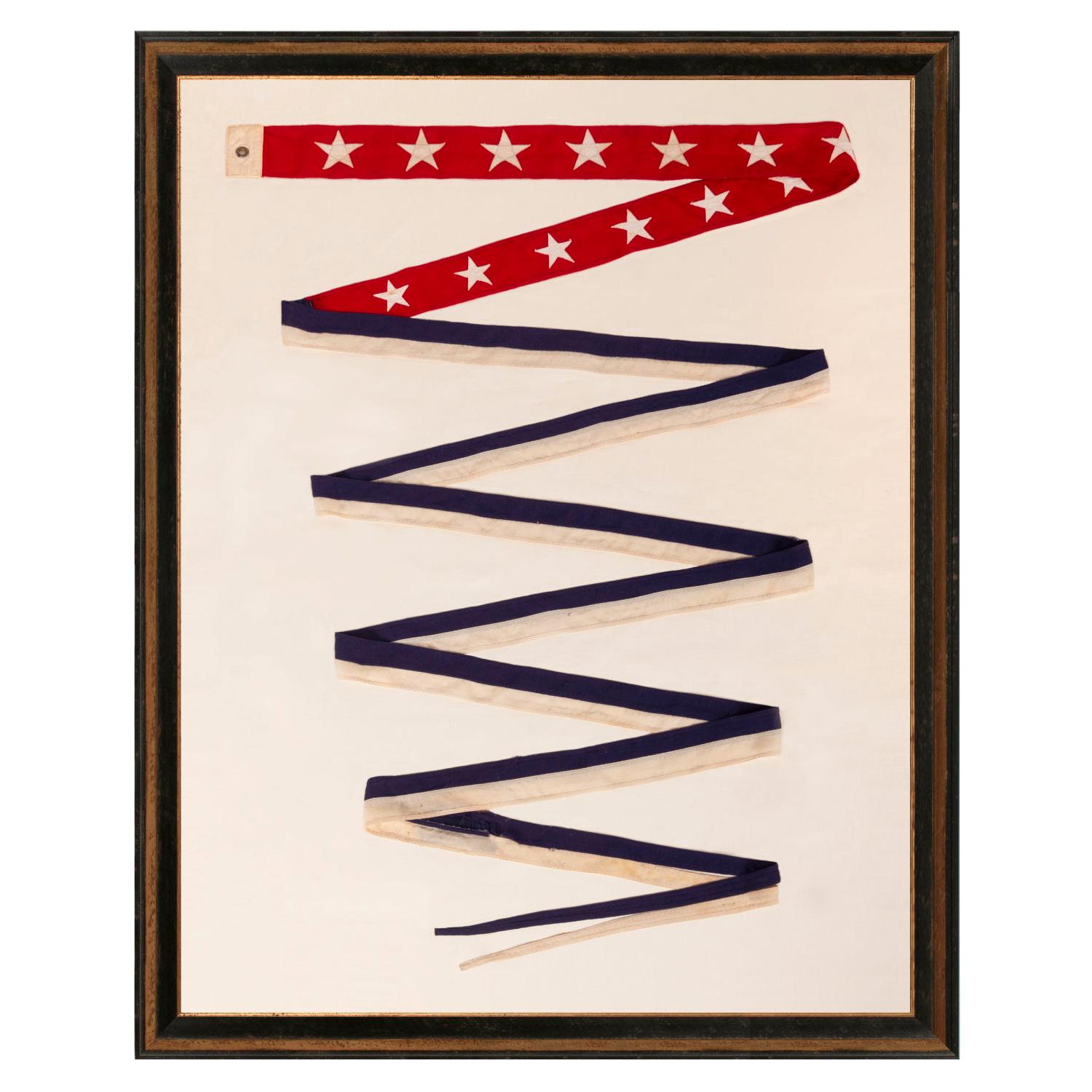
U.S War Department Commissioning Pennant with 13 Stars

U.S War Department Commissioning Pennant with 13 Stars

Located in York County, PA

EXTREMELY RARE U.S. WAR DEPARTMENT COMMISSIONING PENNANT WITH 13 STARS, A REVERSAL OF THE U.S. NAVY COLOR SCHEME, TWENTY-FOUR FEET ON THE FLY, SP...

Category

20th Century American Political and Patriotic Memorabilia

Materials

Wool

Commission Pennant with 13 Stars, like for Private Vessel, Ca 1892-1910

Commission Pennant with 13 Stars, like for Private Vessel, Ca 1892-1910

Located in York County, PA

Commission pennants are the distinguishing mark of a commissioned U.S. Navy ship. Flown at the topmast, the typical American format is a long blue field, usually with a single row of white stars, although sometimes with their total divided into two rows, followed by two long stripes, red-over-white. A ship became commissioned when this pennant was hoisted. Flown during both times of peace and war, the only time the pennant is not flown is if a flag officer or civilian official was aboard and replaced it with their own flag. Sometimes the owners of private ships mimicked the use of Navy signals. Some seafaring men would have served in the Navy and become privy to various practices in that capacity. Others flew them purely for stylistic reasons, either on a regular basis or while the boat was dressed for special occasion. Hudson River steamers regularly flew pennants of this nature, as evidenced by period photography as well as the paintings of artists such as John and James Bard...

Category

Antique Late 19th Century American Political and Patriotic Memorabilia

Materials

Wool

33 star Antique American Parade Flag with Stars in a Double Wreath Configuration

33 star Antique American Parade Flag with Stars in a Double Wreath Configuration

Located in York County, PA

33 STARS IN A DOUBLE-WREATH CONFIGURATION, ON AN ANTIQUE AMERICAN FLAG DATING IMMEDIATELY PRE-CIVIL WAR THROUGH THE WAR'S OPENING YEAR, REFLECTS THE ADDITION OF OREGON TO THE UNION, ...

Category

Mid-20th Century American Political and Patriotic Memorabilia

Materials

Cotton

Martin Luther King Pennant, March on Washington, I Have A Dream, Aug 28, 1963

Martin Luther King Pennant, March on Washington, I Have A Dream, Aug 28, 1963

Located in York County, PA

RARE FELT PENNANT FROM THE MARCH ON WASHINGTON, AUGUST 28, 1963, WHEN MARTIN LUTHER KING DELIVERED HIS HISTORIC "I HAVE A DREAM" SPEECH Printed in white pigment on scarlet red felt,...

Category

Mid-20th Century American Political and Patriotic Memorabilia

Materials

Felt

13 Star Antique Parade Flag, Hand Inscribed by the Owner in Salem, MA 1896

13 Star Antique Parade Flag, Hand Inscribed by the Owner in Salem, MA 1896

Located in York County, PA

ANTIQUE AMERICAN FLAG WITH 13 STARS ARRANGED IN 6-POINTED GREAT STAR / STAR OF DAVID PATTERN, OF A TYPE MADE FOR THE 1876 CENTENNIAL OF AMERICAN INDEPENDENCE, WORN AND HAND-INSCRIBED...

Category

Antique 1870s American Political and Patriotic Memorabilia

Materials

Cotton

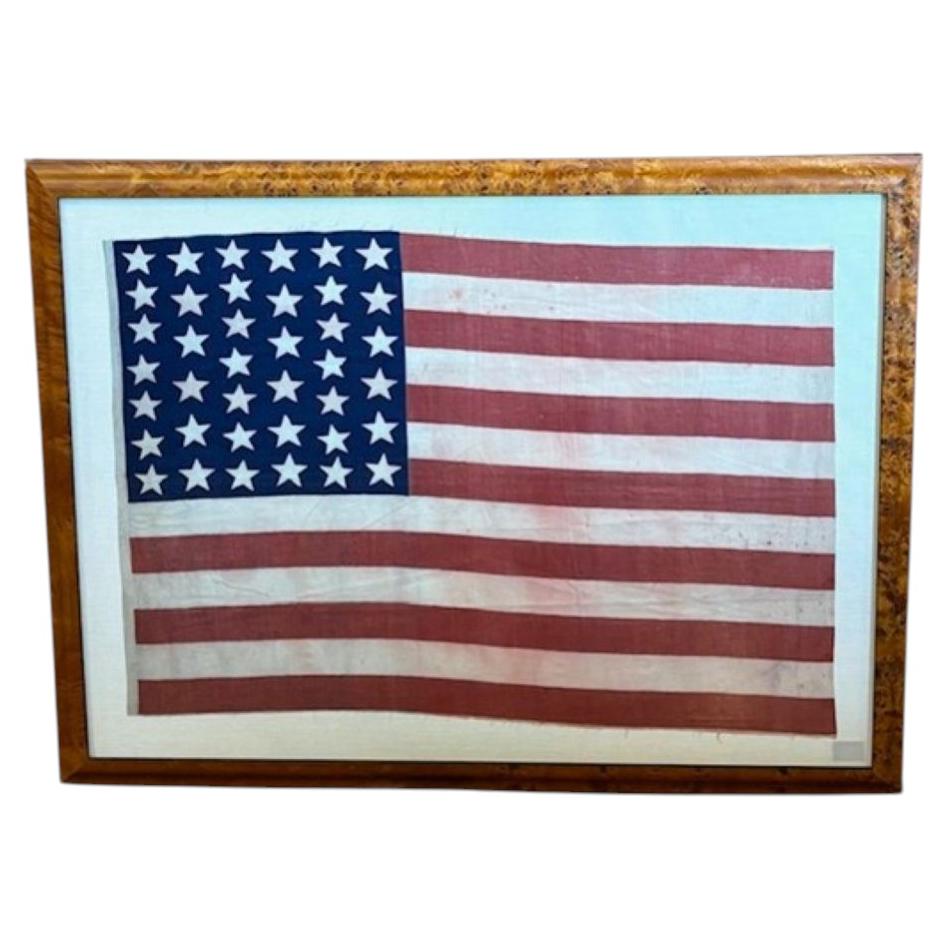
38 Star Antique American Parade Flag, Colorado Statehood, ca 1876-1889

38 Star Antique American Parade Flag, Colorado Statehood, ca 1876-1889

Located in York County, PA

38 STARS IN AN EXTREMELY UNUSUAL CONFIGURATION THAT BEARS A CLUSTER OF 6 SMALL STARS WITHIN A LINEAL PATTERN OF LARGER STARS, 1876-1889, COLORADO STATEHOOD 38 star American national parade flag, printed on cotton. This is an extremely rare example of a lineal pattern flag with a wreath or cluster of smaller stars inserted in the center. A very small number of flags in this style are known to have survived, the colors of which are typically saturated and vibrant, like this example, in scarlet red and rich, royal blue. The particular wreath in the center of the configuration is really more of a pentagon with a single, center star. The reason for the choice of the design and 6 smaller stars seems a curious one on the surface, but its purpose was probably nothing more than to simply augment a 36 star print block to one with 38 stars. One may observe how 4 stars, that would have comprised the center of a 6 x 6 pattern, could have simply been removed and 6 smaller stars inserted in their place, in an artful fashion. At least two other similar 38-star patterns are known that incorporate 4 small stars intermingled between rows of what most certainly were two very similar 34-star flag print blocks originally. It was easier to modify these blocks rather than create brand new ones. In these particular instances, the results are rare, quirky configurations that are highly prized by collectors. Colorado became the 38th state on August 1st, 1876. This was the year of our nation’s 100-year anniversary of independence. Per the Third Flag Act of 1818, stars were not officially added until the 4th of July following a state's addition. For this reason, 37 was the official star count for the American flag in 1876. Flag-making was a competitive venture, however, and few flag-makers would have been continuing to produce 37 star flags when their competitors were making 38’s. It is for this reason that 38 and 13 stars (to represent the original 13 colonies) are more often seen at the Centennial International Exposition, the six-month long World’s Fair held in Philadelphia in honor of the event. Some flag-makers would have been adding a star for the 38th state even before it entered the Union, in the early part of 1876 or even prior. In fact, many makers of parade flags were actually producing 39 star flags, in hopeful anticipation of the addition of two more Western Territories instead of one. But the 39th state would not join the Union for another 13 years, when the Dakota Territory entered as two states on the same day. The 38 star flag became official on July 4th, 1877 and was generally used until the addition of the Dakotas in 1889. Provenance: Jeff R. Bridgman Antiques to the late collector Jim Ring...

Category

Antique Late 19th Century American Political and Patriotic Memorabilia
Materials

Cotton

You May Also Like

36-Star American Printed Parade Flag, Circa 1865-1867

36-Star American Printed Parade Flag, Circa 1865-1867

Located in Colorado Springs, CO

This is an antique 36-star American flag, as striking as it is scarce. The flag has a glazed cotton construction, with a blue canton printed with 36 white stars. The stars are arrang...

Category

Antique 1860s American Political and Patriotic Memorabilia
Materials

Cotton

American 39 Star Flag, circa 1889

American 39 Star Flag, circa 1889

Located in Nantucket, MA

Antique American 39 Star Flag, circa 1889, a printed cotton flag bearing 39 stars in the wavy star pattern. Never an official American flag, this configuration anticipated the admiss...

Category

Antique Late 19th Century American Federal Political and Patriotic Memor...

Materials

Cotton

13-Star Wool American Flag, with Zig-Zag Stars, Circa 1900

13-Star Wool American Flag, with Zig-Zag Stars, Circa 1900

Located in Colorado Springs, CO

This is a beautiful 13-star American flag, each star sewn with zig-zag stitching. The wool flag was sewn at the turn of the century, circa 1900. The flag features 13 white stars rest...

Category

Antique Early 1900s American American Classical Political and Patriotic ...

Materials

Brass

Centennial Celebration "1776-1876" American Flag Banner

Centennial Celebration "1776-1876" American Flag Banner

Located in Colorado Springs, CO

Presented is a rare Centennial patriotic flag banner, dating to 1876. The flag’s brilliant blue canton is spectacular, with 81 five-pointed, rayed stars, arranged to read “1776” and “1876.” The flag’s design is completed with thirteen alternating red and white stripes. The flag is a three-piece, treadle-sewn sewn construction, printed on a thin wool and cotton blend. Along the edge, there is a narrow, treadle-sewn sleeve made of cotton tape. In the lead up to the nation’s Centennial in 1876, flag makers and individuals looked to the past for designs to produce as part of the country’s many celebrations. Popular interpretation of the stars and stripes undoubtedly reached its climax of variety and originality at the time of our Nation’s first Centennial. Since no design restrictions were placed on flagmaker’s imaginations and no strict distinctions were drawn between official and unofficial star counts, it is no surprise that, on the occasion of the Centennial, creativity in flag design was not the exception, but the rule. The cantons from this period presented an array of geometric abstractions. Great star patterns, referred to as the “starry flower of Liberty” by Oliver Wendell Holmes, that were popular from 1818 and on, resurfaced in Centennial flags...

Category

Antique 1870s American Political and Patriotic Memorabilia
Materials

Wool, Cotton

U.S. Ensign American Flag with 48 Stars c.1912-1959

U.S. Ensign American Flag with 48 Stars c.1912-1959

Located in San Francisco, CA

ABOUT An authentic, vintage 48-Star United States National Ensign flag. An ensign is a specific category of national flag flown exclusively on ships, boats, and other maritime vessel...

Category

Early 20th Century Industrial Political and Patriotic Memorabilia
Materials

Brass

Framed Hand Sewn Patriotic Sham Made from a Flag and Ship Ribbons

Framed Hand Sewn Patriotic Sham Made from a Flag and Ship Ribbons

Located in Los Angeles, CA

This Great framed Folk Art sham with 48star flag and ship ribbons is a great patriotic item. The top left corner as well as the bottom right corner are scraps of a 48 star linen flag and in between them are ribbons of ships names that are sewn together in a collage. The American ships span three centuries of ships ribbons, from late 19th century to present day ships. As well as the "USS Utah" which was sunk during the attack on Pearl Harbor. This great and proud sham is not only a great American item but is a Symbol of hope and unity throughout the ages. Serves better as a hanging Folk Art...

Category

20th Century American Folk Art Political and Patriotic Memorabilia
Materials

Plexiglass