Want more images or videos?
Request additional images or videos from the seller
1 of 6

WWI Bond Drive Flag, With Prussian Blue Eagle, ca 1919

Price Upon Request
Price Upon Request
Price Upon Request
Price Upon Request
Price Upon Request
Price Upon Request
Price Upon Request
Price Upon Request
Price Upon Request
Price Upon Request

About the Item

WWI BOND DRIVE FLAG WITH A WHIMSICAL & ARTISTICALLY COMPELLING EAGLE, PERCHED DIRECTLY ON THE LOWER EDGE OF THE TEXTILE (HIGHLY UNUSUAL), WITH WINGS UPSTRETCHED IN A “V” FOR “VICTORY” TO CRADLE THE WORDS “VICTORY CHEST 100%;” PRUSSIAN BLUE ON A WHITE GROUND; LIKELY MADE FOR THE 5TH BOND SUBSCRIPTION, ISSUED MAY 20TH, 1919 U.S. involvement in WWI cost the federal government more than $30 billion. This occurred at a time when total annual federal expenditures were less than $1 billion ($970 million in 1913, for ex., prior to wartime build-up). Due to such disparity, the importance of war drives in the First and Second World Wars cannot be understated. Because federally issued war bonds not only raised cash for the war, but simultaneously removed it from the economy, it had a second positive effect by helping to keep inflation at bay during a war-time, economic boom. In all, there were four bond drives initiated during WWI itself, called “Liberty Loans,” plus a fifth “Victory Loan” drive announced after the armistice was signed on November 11th, 1918. The bonds offered subscriptions as follows*: First Liberty Loan - $2 Billion, issued Apr. 24th, 1917 (issued on Flag Day, June 14th) Second Liberty Loan - $3 Billion, Oct. 1st, 1917 (issued Nov. 15th) Third Liberty Loan - $3 Billion, Apr. 5th, 1918 (issued May 9th) Forth Liberty Loan - $6 Billion, Sept. 28th, 1918 (issued October 24th) Fifth “Victory” Loan - $4.5 Billion, April 21st, 1919 (issued May 20th) Though the last was called a “Victory Loan” instead of a “Liberty Loan,” all were often referred to as “Victory Loans” in American propaganda. President Woodrow Wilson appointed muckraking journalist George Creel to develop a campaign to induce bonds subscription. Posters produced as a result illustrated   Germans burning homes and destroying cities. Slogans ranged from "Buy Bonds Till It Hurts" to "Come Across or the Kaiser Will." Non-subscribers were labeled “slackers,” with the suggestion that such individuals be ridiculed and “picked up by the ‘slacker wagon.’” The tactic worked and bond subscriptions were represented by about 1 in 6 households. Reports that a huge proportion of the money came from low income households, those who made less than $2,000 year, are distorted by the fact that the lowest denominations received priority and were issued first, to increase the number of involved households. J.D. Rockefeller, for example, put in for $15 million in the First Liberty Loan, but was awarded just $3 million. This highly unusual flag, printed on cotton or a wool and cotton blended fabric and bound on all sides with machine stitching, was almost certainly made for the fifth campaign. The imagery consists of a whimsical and artistically compelling eagle, with wings stretched skyward in a “V” for “Victory,” cradling the words: “Victory Chest 100%.” This verbiage is probably celebratory, signifying that the $4.5 billion subscription was fulfilled. Note the beautiful, Prussian or cornflower blue coloration. A poster used to track the volume of subscriptions, with a thermometer in the center and the slogan “Turn up the Heat!” illustrates a yellow eagle with a similarly stylized design. This is the only example of this flag I have ever encountered, and I know of nothing identical in posters, fliers, or other wartime material. Mounting: The flag was mounted and framed within our own conservation department, which is led by master’s degree trained staff. We take great care in the mounting and preservation of flags and have framed thousands of examples; more than anyone worldwide. The background is 100% cotton twill, black in color, that was washed and treated for colorfastness. The black-painted molding, with its wide, serpentine profile, is Italian. The glazing is U.V. protective acrylic (Plexiglas). Feel free to contact us for more details. Condition: There are no significant condition issues.
  • Dimensions:
    Height: 39.75 in (100.97 cm)Width: 515 in (1,308.1 cm)Depth: 2.5 in (6.35 cm)
  • Materials and Techniques:
  • Place of Origin:
  • Period:
    1910-1919
  • Date of Manufacture:
    1919
  • Condition:
    See Item Description.
  • Seller Location:
    York County, PA
  • Reference Number:
    Seller: ofj-10121stDibs: LU849743098482

More From This Seller

View All
30 Star Antique American Parade Flag, Wisconsin Statehood, ca 1848-1850

30 Star Antique American Parade Flag, Wisconsin Statehood, ca 1848-1850

Located in York County, PA

ANTIQUE AMERICAN PARADE FLAG WITH 30 STARS, THE ONLY KNOWN EXAMPLE IN THIS SIMPLE BUT EXTRAORDINARY STYLE, PRE-CIVIL WAR, OFFICIAL FOR JUST TWO YEARS, REFLECTS THE ADDITION OF WISCON...

Category

Antique Mid-19th Century American Political and Patriotic Memorabilia

Materials

Cotton

Homemade, Antique American Flag with Exceptional Folk Qualities, 1896-1908

Homemade, Antique American Flag with Exceptional Folk Qualities, 1896-1908

Located in York County, PA

HOMEMADE, ANTIQUE AMERICAN FLAG WITH A TINY CANTON RESTING ON THE 6TH STRIPE AND AN EXTREMELY FOLKY PRESENTATION OF 45 STARS IN A “NOTCHED” PATTERN THAT MIGHT BE UNIQUE TO THIS EXAMP...

Category

Antique 1890s American Political and Patriotic Memorabilia

Materials

Cotton

45 Stars Antique American Parade Flag, Utah Statehood, ca 1896-1908

45 Stars Antique American Parade Flag, Utah Statehood, ca 1896-1908

Located in York County, PA

45 STAR ANTIQUE AMERICAN PARADE FLAG WITH ITS STARS ARRANGED IN A NOTCHED PATTERN, 1896-1908, UTAH STATEHOOD: 45 star American national flag, printed on coarse, glazed cotton. Evide...

Category

Antique 1890s American Political and Patriotic Memorabilia

Materials

Cotton

38 Star Antique American Parade Flag, Colorado Statehood, ca 1876-1889

38 Star Antique American Parade Flag, Colorado Statehood, ca 1876-1889

Located in York County, PA

38 STARS IN AN EXTREMELY UNUSUAL CONFIGURATION THAT BEARS A CLUSTER OF 6 SMALL STARS WITHIN A LINEAL PATTERN OF LARGER STARS, 1876-1889, COLORADO STATEHOOD 38 star American national parade flag, printed on cotton. This is an extremely rare example of a lineal pattern flag with a wreath or cluster of smaller stars inserted in the center. A very small number of flags in this style are known to have survived, the colors of which are typically saturated and vibrant, like this example, in scarlet red and rich, royal blue. The particular wreath in the center of the configuration is really more of a pentagon with a single, center star. The reason for the choice of the design and 6 smaller stars seems a curious one on the surface, but its purpose was probably nothing more than to simply augment a 36 star print block to one with 38 stars. One may observe how 4 stars, that would have comprised the center of a 6 x 6 pattern, could have simply been removed and 6 smaller stars inserted in their place, in an artful fashion. At least two other similar 38-star patterns are known that incorporate 4 small stars intermingled between rows of what most certainly were two very similar 34-star flag print blocks originally. It was easier to modify these blocks rather than create brand new ones. In these particular instances, the results are rare, quirky configurations that are highly prized by collectors. Colorado became the 38th state on August 1st, 1876. This was the year of our nation’s 100-year anniversary of independence. Per the Third Flag Act of 1818, stars were not officially added until the 4th of July following a state's addition. For this reason, 37 was the official star count for the American flag in 1876. Flag-making was a competitive venture, however, and few flag-makers would have been continuing to produce 37 star flags when their competitors were making 38’s. It is for this reason that 38 and 13 stars (to represent the original 13 colonies) are more often seen at the Centennial International Exposition, the six-month long World’s Fair held in Philadelphia in honor of the event. Some flag-makers would have been adding a star for the 38th state even before it entered the Union, in the early part of 1876 or even prior. In fact, many makers of parade flags were actually producing 39 star flags, in hopeful anticipation of the addition of two more Western Territories instead of one. But the 39th state would not join the Union for another 13 years, when the Dakota Territory entered as two states on the same day. The 38 star flag became official on July 4th, 1877 and was generally used until the addition of the Dakotas in 1889. Provenance: Jeff R. Bridgman Antiques to the late collector Jim Ring...

Category

Antique Late 19th Century American Political and Patriotic Memorabilia

Materials

Cotton

13 Star American Parade Flag with Rare Design, circa 1888 Ex Richard Pierce

13 Star American Parade Flag with Rare Design, circa 1888 Ex Richard Pierce

Located in York County, PA

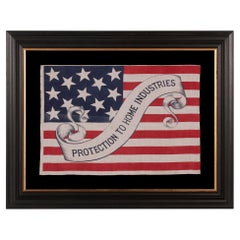
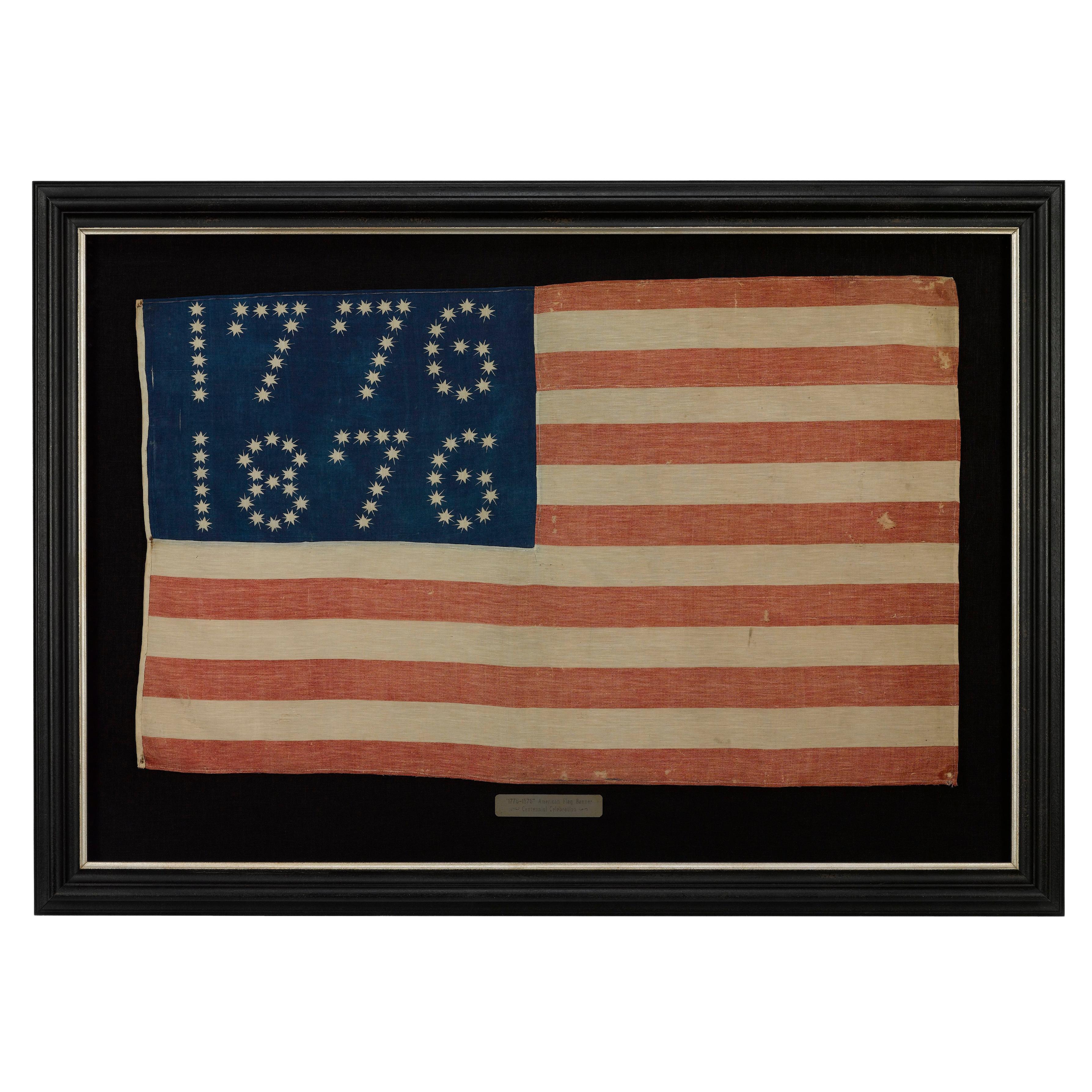
13 Star American parade flag in an extremely rare design, with “protection to home industries” slogan on a fanciful, scrolling streamer, made for the 1888 presidential campaign of Benjamin Harrison; formerly in the collection of Richard pierce. 1888 Benjamin Harrison campaign flag, printed on cotton, with 13 large stars in a 3-2-3-2-3 pattern, upon which a whimsical, scrolling streamer is superimposed that features the slogan: “Protection to Home Industries.” There are numerous styles of both documented and undocumented, red, white, and blue bandanas and handkerchiefs, made for Harrison’s campaign in this year, as well as from the subsequent one, in 1892. Most bear variations of text to support the “Protection for American Industries” platform of the Republican Party. America was in the midst of the industrial age and there was a great deal of public interest, both in protecting growth and discouraging both imported goods and immigration. The constant stream of immigrants posed great challenges for a working families, competing for scarce jobs, in work environments that were already often far from ideal. In post-Civil War America, many of the working men were Civil War veterans. Bandanas abound from Harrison’s Campaigns, but flags do not. This example, along with three others, were once part of an 1888 patriotic quilt that was disassembled by a dealer and sold piecemeal to collectors. I eventually acquired all four. Fifteen to twenty years ago, these were the only four known copies. A couple of others have since surfaced, but the total count known still stands closer to 5 than 10. The use of 13 stars is seen in the flags of various candidates in the 19th century. Among these are Abraham Lincoln (1860 campaign), Henry Clay (1844 campaign), John Fremont (1856), and Benjamin Harrison’s grandfather, William Henry Harrison...

Category

Antique 1880s American Political and Patriotic Memorabilia
Materials

Cotton

44 Star Antique American Parade Flag, Wyoming Statehood, ca 1890-1896

44 Star Antique American Parade Flag, Wyoming Statehood, ca 1890-1896

Located in York County, PA

44 STAR ANTIQUE AMERICAN PARADE FLAG WITH ENDEARING WEAR FROM LONG TERM USE AND WITH ITS STARS ARRANGED IN A NOTCHED PATTERN THAT LEAVES 4 SPACES OPEN FOR THE REMAINING WESTERN TERRI...

Category

Antique 1890s American Political and Patriotic Memorabilia
Materials

Cotton

You May Also Like

Historic World War I Era Rare Three Star Service Flag, circa 1917

Historic World War I Era Rare Three Star Service Flag, circa 1917

Located in Nantucket, MA

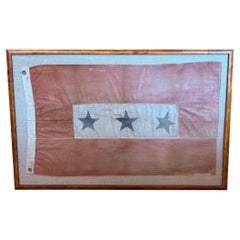
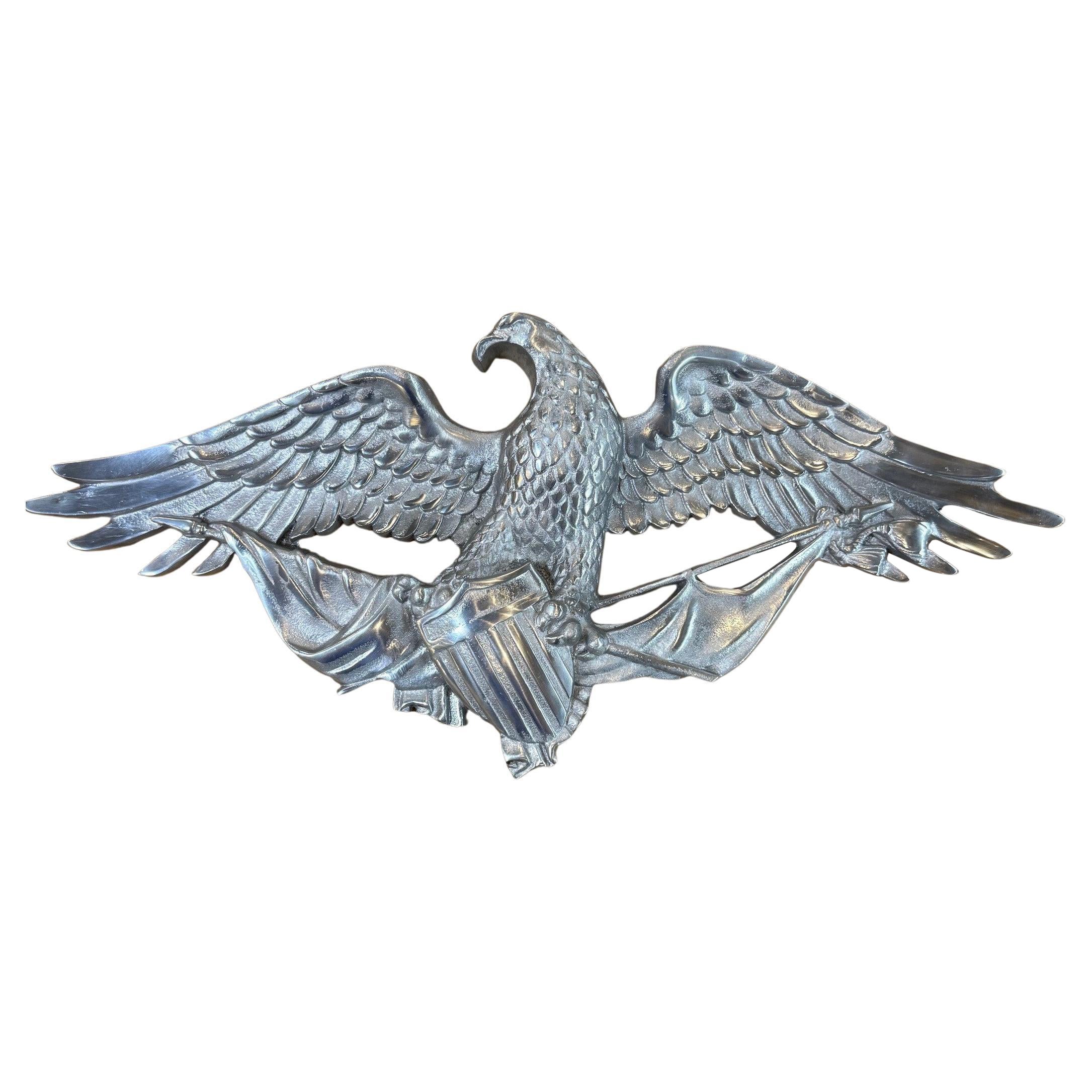
Antique Historic World War I Era Rare Three Star Service Flag, circa 1917, a linen flag having three blue stars hand-stitched onto a white canton on a red field. A World War I flag h...

Category

Vintage 1910s American Federal Political and Patriotic Memorabilia
Materials

Linen

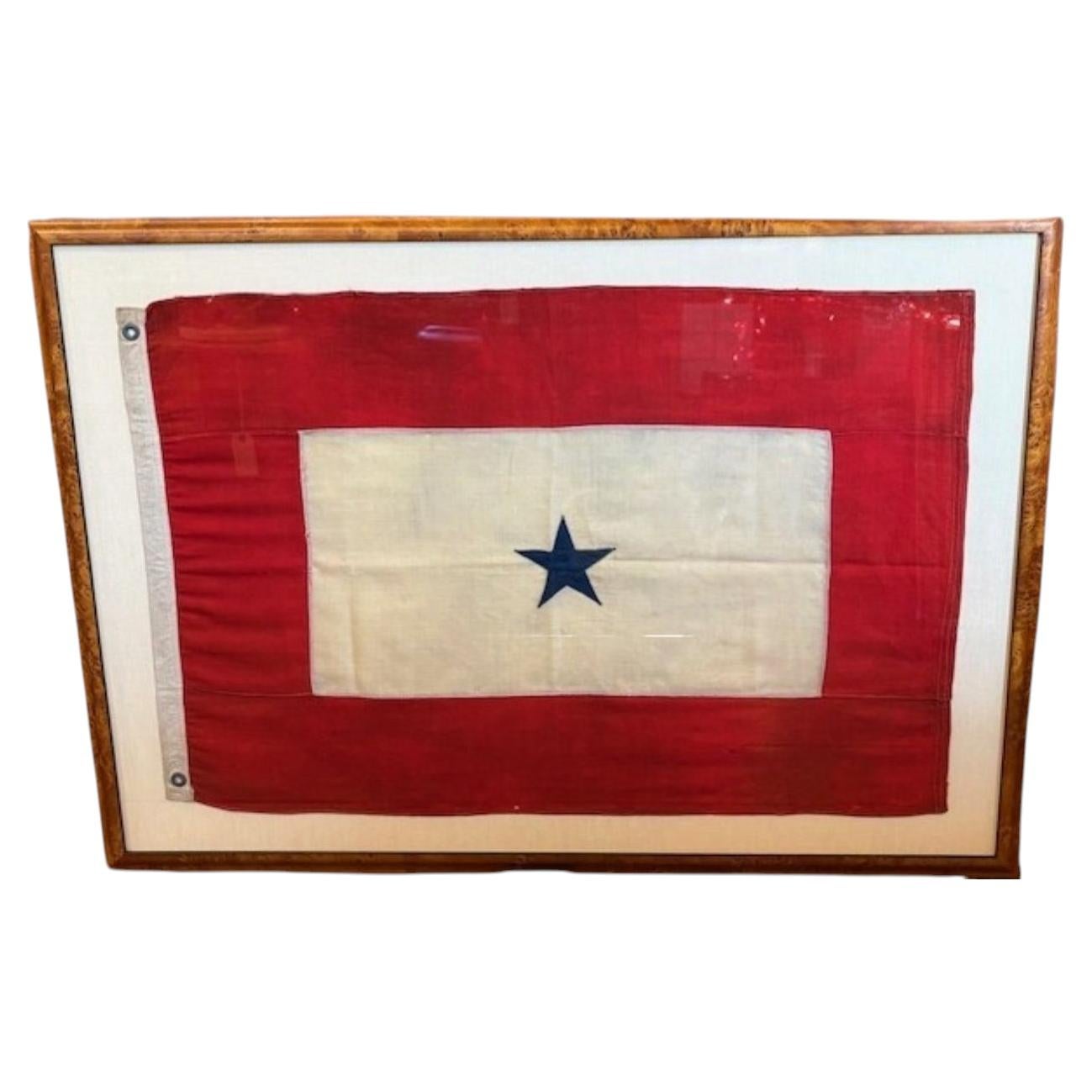
Historic World War I Era Blue Star Service Flag, circa 1917

Historic World War I Era Blue Star Service Flag, circa 1917

Located in Nantucket, MA

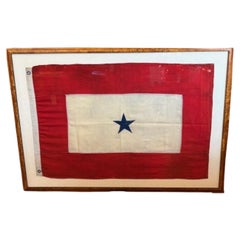
Antique Historic World War I Era Blue Star Service Flag, circa 1917, a linen flag having a single blue star stitched onto a white canton on a red field. A World War I flag honoring a...

Category

Vintage 1910s American Federal Political and Patriotic Memorabilia
Materials

Linen

U.S. Ensign American Flag with 48 Stars c.1912-1959

U.S. Ensign American Flag with 48 Stars c.1912-1959

Located in San Francisco, CA

ABOUT An authentic, vintage 48-Star United States National Ensign flag. An ensign is a specific category of national flag flown exclusively on ships, boats, and other maritime vessel...

Category

Early 20th Century Industrial Political and Patriotic Memorabilia
Materials

Brass

American 39 Star Flag, circa 1889

American 39 Star Flag, circa 1889

Located in Nantucket, MA

Antique American 39 Star Flag, circa 1889, a printed cotton flag bearing 39 stars in the wavy star pattern. Never an official American flag, this configuration anticipated the admiss...

Category

Antique Late 19th Century American Federal Political and Patriotic Memor...

Materials

Cotton

Polished Aluminum Bald Eagle Clutching USA Flag and Crest Wall Decor

Polished Aluminum Bald Eagle Clutching USA Flag and Crest Wall Decor

Located in Stamford, CT

Large Bald Eagle clutching USA Flag and crest wall decor. This large patriotic eagle wall plaque is a beautiful piece made with hand crafted polished aluminum very good quality and w...

Category

2010s Indian American Classical Political and Patriotic Memorabilia
Materials

Aluminum

Vintage 1912 Arizona and New Mexico Statehood Flag

Vintage 1912 Arizona and New Mexico Statehood Flag

Located in Coeur d'Alene, ID

25th Design Patriotic American silk flag with 48 stars. Arizona Statehood Feb 14, 1912; New Mexico Statehood Jan 6, 1912 Period: 1912 Origin: United States Size: 12" x 17". Family ...

Category

Vintage 1910s American Historical Memorabilia

Materials

Silk