Want more images or videos?
Request additional images or videos from the seller
1 of 13

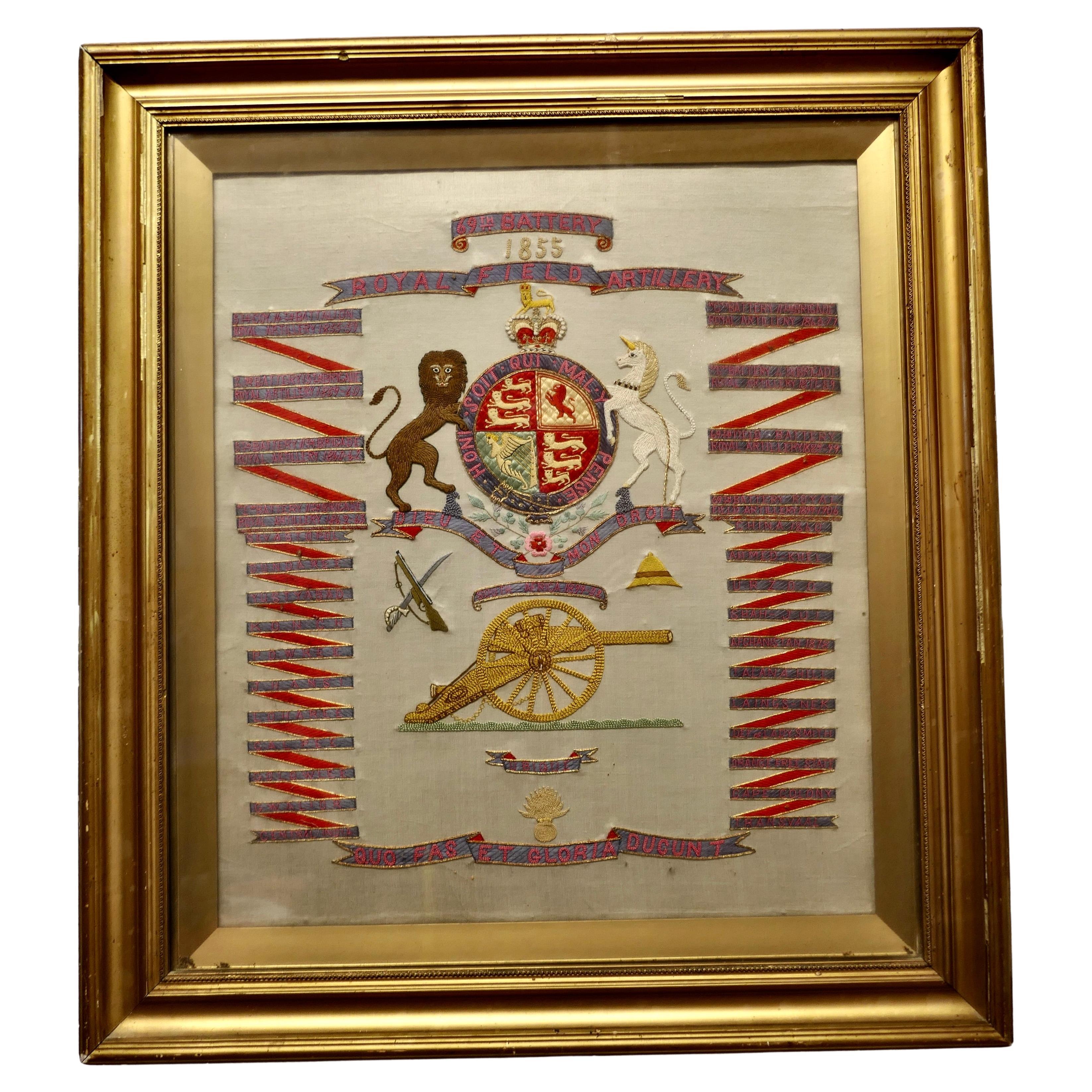
Soldier's Woolwork Royal Artillery Badge, American Flag, British, circa 1885

$4,750
£3,575.14
€4,182.69
CA$6,717.83
A$6,823.26
CHF 3,932.05
MX$82,380.73
NOK 45,674.45
SEK 46,055.53
DKK 31,266.97

About the Item

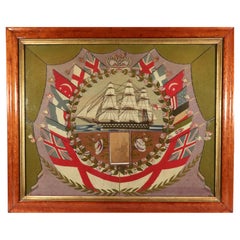
Soldier's Woolwork Royal Artillery Badge, American Flag, British, circa 1885 This large British soldier's woolwork picture is finely embroidered with the badge of the Royal Artillery, the shield worked with the regiment's field gun and rammer propped against the wheel, within a garter bearing the mottoes "Ubique" (Everywhere) and "Quo Fas et Gloria Ducunt" (Whither Right and Glory Lead) beneath a crown. The badge is set against a boldly crossed display of the American Stars and Stripes and the British Union Flag, with the smaller French tricolor and British Red Ensign crossed behind the crown, the whole framed by arching sprays of laurel. Around the central device, embroidered scrolls carry the names of campaigns: "Sicily", "Crimea" and "Alipore" above, and "Soudan", "Inkerman", "Sebastopol" and "New Zealand" below, above the initials "RA". The characters "Q" and "1" flanking the motto ribbon are probably a battery designation in the letter-and-number form used by the Royal Artillery before 1889, denoting Q Battery, 1st Brigade — placed where a gunner would record his own unit. The picture is worked throughout in fine wool stitches of considerable subtlety, in a palette of reds, blues, greens, and creams, and is presented in a period bird's-eye maple frame. Dimensions Height: 28¾ inches (73 cm) Width: 28¾ inches (73 cm) Depth: 1¾ inches (4.4 cm) Provenance Private Connecticut collection Condition In excellent original condition, with no repairs or damage. Campaigns Sicily recalls the British garrison and defense of the island against Napoleonic France between 1806 and 1815, the Mediterranean stronghold from which the expedition that triumphed at Maida was launched. Crimea commemorates the war of 1854–1856, in which Britain, France, and Ottoman Turkey — the alliance echoed in the flags above — fought Russia in defense of the Ottoman Empire. Inkerman, fought in dense fog on 5 November 1854 and remembered as "the Soldier's Battle", saw the Anglo-French repulse of a massive Russian sortie in some of the fiercest close-quarter fighting of the war. Sebastopol names the eleven-month allied siege of Russia's great Black Sea naval base, above all an artilleryman's battle of bombardment and counter-bombardment, which ended with the city's fall in September 1855. Alipore, a village on the Grand Trunk Road before Delhi, was the point at which the British columns converged in June 1857 during the Indian Mutiny, and the scene of fighting on the lines of communication during the siege of Delhi that followed. New Zealand refers to the campaigns against the Maori of the 1840s to 1860s, in which Royal Artillery batteries served in the difficult bush warfare of Taranaki and the Waikato. Soudan commemorates the campaigns of 1884–1885 on the Nile and at Suakin, mounted for the relief of General Gordon at Khartoum. Historical Context The Royal Artillery occupies a unique place in the honors of the British Army. In 1832 King William IV granted the regiment the mottoes "Ubique" and "Quo Fas et Gloria Ducunt", and the following year "Ubique" was confirmed as a single battle honor standing in place of all others, past and future, in recognition of the Gunners' presence in every campaign of the Army; the regiment's guns themselves are accorded the status of Colors. Because the Royal Artillery carries no named battle honors, the campaigns embroidered here — spanning nearly a century from Sicily through the Crimean battles of Inkerman and Sebastopol to New Zealand and the Soudan — commemorate the Gunners' worldwide service, the later names falling within the maker's own era, and the probable battery designation beneath the badge lends the work the character of a personal tribute in wool. The battery-and-brigade form of that designation was in use until the brigade system was abolished in July 1889, which together with the Soudan scroll suggests a date of about 1885–1890. Embroidered pictures of this kind were worked by soldiers as well as sailors in the second half of the nineteenth century, whether during long postings abroad, in convalescence, or in retirement, and regimental examples celebrating the maker's corps rank among the most personal of all British military folk art. The prominent pairing of the Stars and Stripes with the Union Flag, an emblem of Anglo-American friendship found on woolworks of the period, makes this example particularly appealing. (Ref: NY11201-nmrr)
  • Dimensions:
    Height: 28.75 in (73.03 cm)Width: 28.75 in (73.03 cm)Depth: 1.5 in (3.81 cm)
  • Style:
    Country (Of the Period)
  • Materials and Techniques:
  • Place of Origin:
  • Period:
  • Date of Manufacture:
    1885
  • Condition:
    Wear consistent with age and use.
  • Seller Location:
    Downingtown, PA
  • Reference Number:
    Seller: NY11201-nmrr1stDibs: LU861050895412

More From This Seller

View All
Sailor's Woolwork (Woolie) with Heart Valentine and Flag Surround

Sailor's Woolwork (Woolie) with Heart Valentine and Flag Surround

Located in Downingtown, PA

A Heartfelt Salute: A Sailor's "Woolie" of Nations Circa 1880 This vibrant and distinctive piece is a prime example of sailor's woolwork, often referred to as a "woolie," a popular ...

Category

Antique 1880s English Victorian Nautical Objects

Materials

Wool

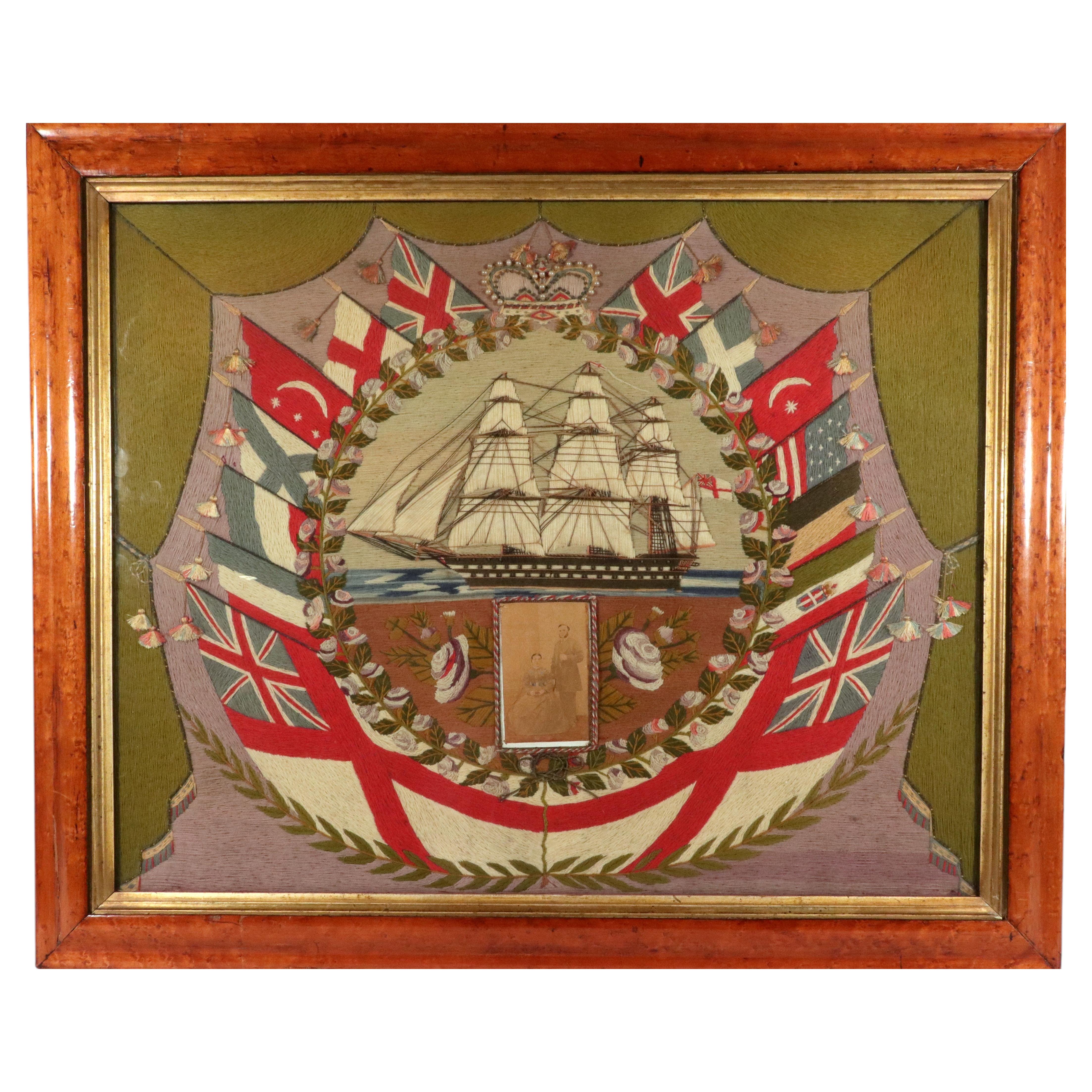
Sailor's Woolwork Picture, Royal Navy Ship & Flags of All Nations, circa 1875

Sailor's Woolwork Picture, Royal Navy Ship & Flags of All Nations, circa 1875

Located in Downingtown, PA

Sailor's Woolwork Picture, Royal Navy Ship and Flags of All Nations Circa 1875–1890 This elaborate and finely worked woolwork centers on a circular medallion depicting a Royal Navy ...

Category

Antique 1870s English Victorian Nautical Objects

Materials

Wool

Sailor's Woolwork Flag of Nations, H.M.S. Trafalgar, British, circa 1865

Sailor's Woolwork Flag of Nations, H.M.S. Trafalgar, British, circa 1865

Located in Downingtown, PA

Sailor's Woolwork Flag of Nations, H.M.S. Trafalgar, British, Circa 1865–1875 This British sailor's woolwork of the "Flag of Nations" type depicts H.M.S. Trafalgar, the 120-gun fi...

Category

Antique Mid-19th Century Nautical Objects

Materials

Wool

Large Sailor's Woolwork of Britannia with Ships Celebrating Trade and Commerce

Large Sailor's Woolwork of Britannia with Ships Celebrating Trade and Commerce

Located in Downingtown, PA

Ruling the Waves: A Grand Victorian Sailor's Woolie of Britannia, Trade, and Commerce This remarkable large-scale sailor's woolwork, or "woolie," is a triumphant expression of Victo...

Category

Antique Late 19th Century English Victorian Nautical Objects

Materials

Wool

Sailor's Woolwork Picture, Royal Navy Ship, Padded Trapunto Sails, circa 1865

Sailor's Woolwork Picture, Royal Navy Ship, Padded Trapunto Sails, circa 1865

Located in Downingtown, PA

Sailor's Woolwork Picture, Royal Navy Ship with Padded Trapunto Sails Circa 1865–1885 This British sailor's woolwork is worked in colored wools, a port-broadside view of a Royal Nav...

Category

Antique Mid-19th Century English Country Nautical Objects

Materials

Wool

British Sailor's Woolwork of a Royal Navy Second Rate Battleship

British Sailor's Woolwork of a Royal Navy Second Rate Battleship

Located in Downingtown, PA

Stitches of the Sea: A Royal Navy Masterpiece in Wool British, Circa 1875 This engaging example of British Sailor's Woolwork, commonly known as a "Woolie," dates to approximately 18...

Category

Antique 1870s English Folk Art Nautical Objects

Materials

Wool

You May Also Like

Early 20th Century Japanese Embroidered Military Souvenir

Early 20th Century Japanese Embroidered Military Souvenir

Located in Fort Collins, CO

Beautiful and extraordinarily rare 5400early 20th Century hand embroidered panel, commissioned to a Japanese artisan for a European sailor to document his travels in the navy. The pa...

Category

Early 20th Century Japanese Folk Art Tapestries

Materials

Silk, Glass, Walnut

13-Star Wool American Flag, with Zig-Zag Stars, Circa 1900

13-Star Wool American Flag, with Zig-Zag Stars, Circa 1900

Located in Colorado Springs, CO

This is a beautiful 13-star American flag, each star sewn with zig-zag stitching. The wool flag was sewn at the turn of the century, circa 1900. The flag features 13 white stars rest...

Category

Antique Early 1900s American American Classical Political and Patriotic ...

Materials

Brass

38 Star Antique Flag, Stars in Double Wreath Pattern, Colorado Statehood 1876-89

38 Star Antique Flag, Stars in Double Wreath Pattern, Colorado Statehood 1876-89

Located in York County, PA

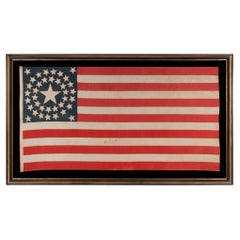
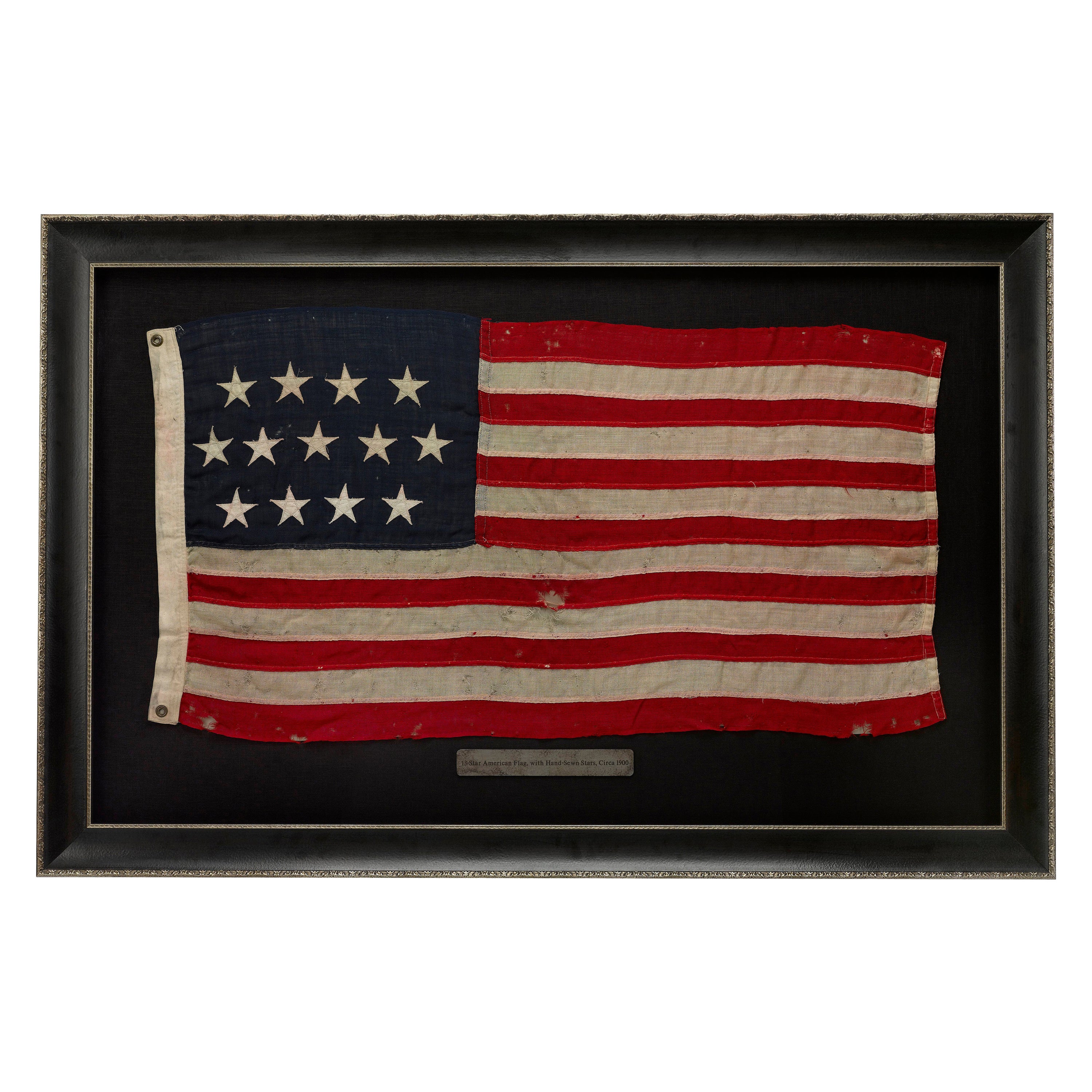
38 STAR ANTIQUE AMERICAN FLAG WITH A DOUBLE-WREATH CONFIGURATION THAT FEATURES AN ENORMOUS CENTER STAR, REFLECTS THE PERIOD OF COLORADO STATEHOOD, 1876-1889: 38 star American national flag, made entirely of plain weave cotton. The stars are arranged in a medallion configuration. This features an enormous center star, surrounded by two wreaths of much smaller stars, with a flanking star in each corner of the blue canton. The sort of disparity here, present in the scale of the large star, versus those around it, is both exceptionally unusual and graphically dynamic. Colorado became the 38th state on August 1st, 1876. This was the year of our nation’s centennial. Per the Third Flag Act of 1818, stars were not officially added until the 4th of July following a state's addition. For this reason, 37 remained the official star count for the American flag until part way through the following year. Flag-making was a competitive venture, however, and few flag-makers would have continued to produce 37 star flags when their competitors were making 38’s. Many flag-makers added a 38th star before Colorado entered the Union, in the early part of 1876, or possibly even prior. In fact, many makers of printed flags, called parade flags or hand-wavers, were actually producing flags in the 39 star count, in hopeful anticipation of the addition of two more Western Territories instead of one. It is for these reasons that 38, 39, and 13 stars, to representing the original 13 colonies, are most often seen on flags displayed at the Centennial International Exhibition. Hosted in Philadelphia, this enormous event was our nation’s first World’s Fair, lasted for a duration of six months, and served as the nucleus of celebrations held to honor America’s 100-year anniversary of independence. The 38 star flag became official on July 4th, 1877 and was generally used until the 39th state was added in November of 1889. This is probably a homemade flag, though sewn by a very skilled hand, or possibly, by two different individuals. The stripes are pieced and sewn entirely by hand, with remarkable care and precision. The canton is constructed of two lengths of blue fabric, that have been joined with treadle stitching. This was joined to the striped field by hand. The stars are double-appliquéd (applied to both sides) with treadle stitching. There is a treadle-sewn, cotton binding along the hoist, with five, hand-sewn grommets. It is extremely unusual to encounter this combination of sewing methods. Soon after the sewing machine was mass-marketed, in the mid-1850’s, flag-makers both public and private made good use of treadle machines, to join stripes, when constructing American flags. During the Civil War (1861-65), most stripes were treadle-sewn. Stars were another matter. Until the advent of electric machines...

Category

Antique Late 19th Century American Political and Patriotic Memorabilia
Materials

Cotton

36 Star Antique American Parade Flag, with Canted Stars, ca 1864-1867

36 Star Antique American Parade Flag, with Canted Stars, ca 1864-1867

Located in York County, PA

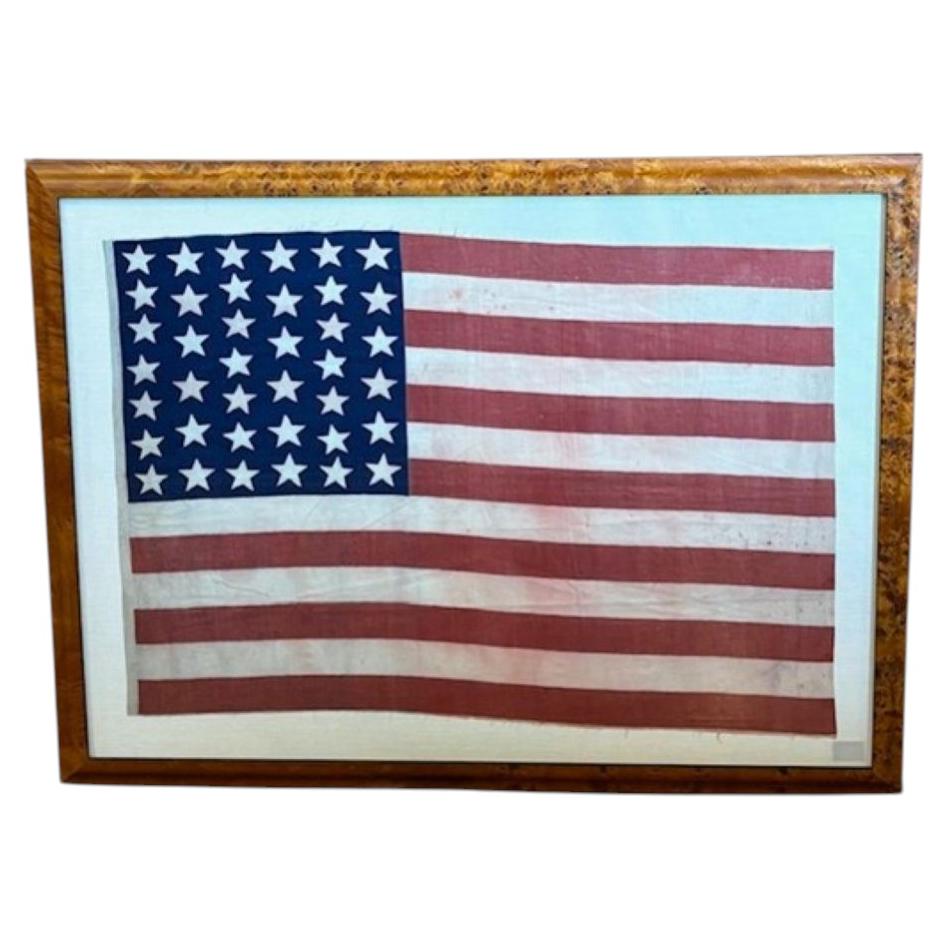
36 STAR ANTIQUE AMERICAN PARADE FLAG WITH CANTED STARS IN DANCING ROWS, ON A BEAUTIFUL, CORNFLOWER BLUE CANTON; CIVIL WAR ERA, NEVADA STATEHOOD, 1864-1867 36 star antique American f...

Category

Antique 1860s American Political and Patriotic Memorabilia
Materials

Cotton

34 Stars in an Outstanding Oval Medallion Configuration, Civil War Period

34 Stars in an Outstanding Oval Medallion Configuration, Civil War Period

Located in York County, PA

34 STARS IN AN OUTSTANDING OVAL MEDALLION CONFIGURATION, ON A NARROW CANTON THAT RESTS ON THE 6TH STRIPE, ON A HOMEMADE, ANTIQUE AMERICAN FLAG OF THE CIVIL WAR PERIOD, ENTIRELY HAND-...

Category

Antique 1860s American Political and Patriotic Memorabilia
Materials

Cotton

American 39 Star Flag, circa 1889

American 39 Star Flag, circa 1889

Located in Nantucket, MA

Antique American 39 Star Flag, circa 1889, a printed cotton flag bearing 39 stars in the wavy star pattern. Never an official American flag, this configuration anticipated the admiss...

Category

Antique Late 19th Century American Federal Political and Patriotic Memor...

Materials

Cotton