“40 Acres and a Mule” Satirical Folk Art Painting, American School, Late 19th Century
Oil on Canvas, laid to stiff board.
Measures: 22.875" w x 19.125" h
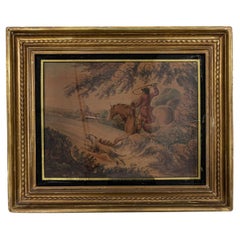
A compelling and historically resonant oil painting on canvas depicting a Black man astride a startled donkey, rendered in a comic narrative style characteristic of postbellum American folk art. Likely executed in the Southern United States during the late 19th century, this unsigned work emerges from a broader vernacular tradition that satirized rural life and, more pointedly, reflected white anxieties and humor regarding newly emancipated African Americans in the Reconstruction and Jim Crow eras.
The central figure—a Black man in rustic attire, riding boots, and red waistcoat—is shown recoiling in alarm as the donkey beneath him jolts forward, eyes wide, startled mid-stride. The animal’s reins drag along the ground, and its left foreleg remains hobbled by a lingering tether, a detail which amplifies the chaotic energy of the scene. The man clutches a switch or whip, his body twisted in comic disarray, suggesting a loss of control both literal and symbolic. The tightly framed composition places the action against a stark wall and picket fence, emphasizing the theatrical quality of the episode.
This painting can be contextualized within a genre of American popular art that often portrayed African Americans in exaggerated or farcical situations, a visual rhetoric most famously codified in the "Darktown" lithograph series by Currier & Ives (1870s–1890s), in which Black figures are shown engaging in slapstick misadventures. Yet, unlike printed caricatures, this oil painting carries the immediacy and permanence of canvas, indicating it may have served as a more personal or localized expression of similar themes—possibly created by an itinerant artist or regional painter drawing from the same cultural motifs.
Thematically, the image serves as a satirical commentary—perhaps consciously or unconsciously—on the failed promise of post-Civil War reparations embodied in the phrase “40 Acres and a Mule.” First proposed in 1865 under Special Field Order No. 15 issued by Union General William Tecumseh Sherman, the phrase referred to the plan to redistribute confiscated Confederate land to formerly enslaved people, each family receiving forty acres and a mule to work the land and build self-sufficient lives. Though radical in its implications, the order was swiftly reversed after President Andrew Johnson assumed office, and the vast majority of land was returned to white landowners. The phrase became emblematic of broken Reconstruction promises, lingering as both a symbol of hope and a bitter historical irony.
In the context of this painting, the image of a Black man atop an uncontrollable or uncooperative donkey becomes a mocking visual allegory—whether intended as such or not—of the impossibility of upward mobility for freedmen in the postbellum South. The "mule," meant to be a tool of independence, is here transformed into a source of embarrassment or chaos. Whether viewed as a crude racial caricature, a piece of folk storytelling, or a satirical lamentation of a failed promise, the work engages directly with the social dynamics of its time. The anonymity of the artist further underlines its likely folk or regional origins, but the technical execution—particularly in the modeling of the donkey, the compositional balance, and the expressive body language—suggests an artist of competence, if not formal academic training.
Acquired in South Carolina, the painting reflects Southern regional visual culture, where themes of African American life—often filtered through minstrel traditions, oral storytelling, and white patronage—were widely consumed and circulated. The work bears comparison to American genre paintings of the same period, including the narrative scenes of William Sidney Mount, albeit without Mount’s sympathetic realism, as well as to the less documented but equally vibrant world of African American-themed folk art, whether satirical or celebratory.