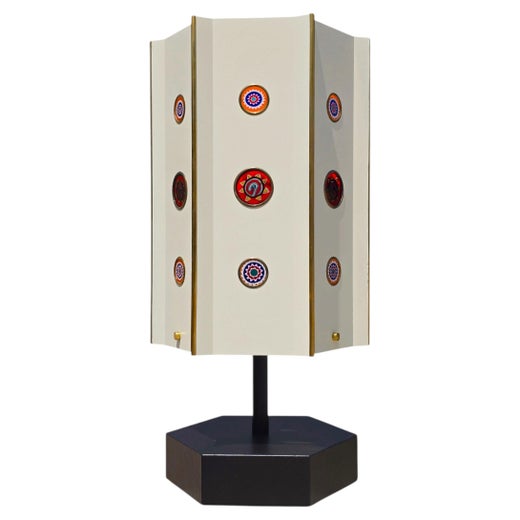

Italian Floor Lamp by Angelo Lelli for Arredoluce
By Angelo Lelii, Arredoluce
Located in Middlesex, NJ
Italian floor lamp by Angelo Lelli for Arredoluce.
Category
Angelo Lelii’s energetic and imaginative floor lamps, sconces and chandeliers often reflected his singular personality — whimsical but practical. He is responsible for some of the most delightfully eye-pleasing but functional works in the history of Italian mid-century modern lighting design.
Lelii was born Paolo Angelo Lelii in the seaport town of Ancona and moved to Milan when he was quite young. Not much is known about his early life — online resources frequently have his last name misspelled “Lelli” — except that he studied at the Superior Institute of Industrial Art in nearby Monza.
While there was no shortage of pioneering work being done in the field of mid-century modern lighting design, Lelii was a visionary whose dream was to create technologically advanced lighting that embodied the simple lines of modern design but would be defined by his own imaginative twists. In 1943, Lelii opened his first workshop in a tiny basement in Monza, under the name Arredoluce. A few years later, he designed the single-light, bent-arm Tris floor lamp. Later that year, he exhibited his Triennale floor lamp at the Milan Triennale VIII and garnered wide acclaim. This iconic, slender lamp features three adjustable arms with enameled aluminum shades.
Lelii’s sculptural fixtures in brass and cast iron appeared in the acclaimed design journal Domus, and he embarked on high-profile collaborations with Italian modernist legends such as Gio Ponti — a giant of architecture and design as well as a founder of Domus — Memphis Group member Ettore Sottsass Jr. and the brothers Castiglioni (formally known as Achille, Pier Giacomo and Livio).
Massive success followed for Arredoluce from the late 1950s and into the 1960s. For Lelii, there was his seminal Stella ceiling lamp, featuring opaque, acid-etched glass globe shades; his minimalist Cobra table lamp, which was one of the world’s first low voltage light fixtures; and his aptly named Eye floor lamp. Lelii continued to oversee design and production at his revolutionary lighting firm until his death in 1979.
Find vintage Angelo Lelii lighting on 1stDibs.
The lighting company Arredoluce opened in 1943, at the start of a golden era of modernist Italian design, and was born of the confluence of an eager entrepreneurial business spirit and a fresh, innovative, forward-looking creative atmosphere.
Angelo Lelii (1911–79), the founder of Arredoluce, which was based in the Milanese district of Monza, was a gifted and at times brilliant designer. He had the insight to commission works from other greats of the day, including Gio Ponti, Vico Magistretti, the brothers Achille and Pier Giacomo Castiglioni and Ettore Sottsass Jr.
Lelii’s designs cover a broad aesthetic range. His most famous work, the Triennale floor lamp (circa 1947), is both elegant and practical, with three omnidirectional lighting booms attached to a central pole. His well-known ceiling light of 1954 — in which a conical canister bounces light upward off a lighting-arced enameled-aluminum sheet — is a piece of design poetry. And his 1962 Cobra table lamp has a wild, almost Surrealist look, featuring a sculptured rod of polished metal with a socket that, like his Eye floor lamp of the early 1960s, holds an eyeball-like directional bulb.
Arredoluce also placed few constraints on the creativity of the designers it employed from outside the company. The Castiglioni brothers’ Tubino table lamp of 1951, for example, is a remarkably early example of minimalist design. The company both fostered the tradition-minded aspect of Ponti’s sensibility and produced several of his experimental pieces in Lucite in the 1950s; and Sottsass’s UFO table lamp of 1957, a sandwich of two plastic bubbled tablets on four legs, prefigures the look of his postmodern works for the Memphis Group by more than 20 years.
From the stylish and utilitarian to the avant-garde, vintage Arredoluce floor lamps, table lamps, chandeliers and other lighting includes some of the most diverse, remarkable — and collectible — designs of the late 20th century.
Italian Floor Lamp by Angelo Lelli for Arredoluce
By Angelo Lelii, Arredoluce
Located in Middlesex, NJ
Italian floor lamp by Angelo Lelli for Arredoluce.
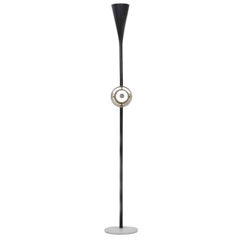
Italian Floor Lamp by Angelo Lelli
By Angelo Lelii
Located in Los Angeles, CA
Beautiful and rare floor lamp by Angelo Lelli, Model 12555 Occhio. Metal and brass with marble base. Italy, 1956.
Metal, Brass
$4,000
H 79 in W 12.5 in D 12.5 in
Mid Century Floor Lamp by Angelo Lelli for Arredoluce Made in Italy circa 1950's
By Angelo Lelii, Arredoluce
Located in New York, NY
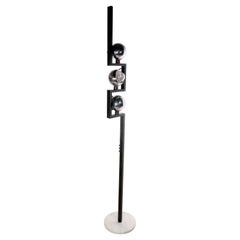
Classic Mid Century chrome, black and marble floor lamp, designed by Angelo Lelli, made in Italy by Arredoluce, circa 1950's. The lamp features three chrome ball shades, which are movable and mount on magnetic bases, the steel vertical post mounts on a marble disk...
Marble, Steel, Chrome
$9,500
H 66.5 in W 26 in D 11.5 in
Italian Mid-Century Modern Counter-Balance Floor Lamp, Angelo Lelli, Arredoluce
By Arredoluce
Located in New York, NY
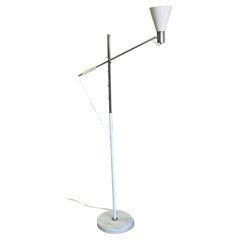
A Rare Model Italian Mid-century Modern Cantilevered Floor Lamp, attributed to Angelo Lelli and Arredoluce, exhibiting innovative engineering, craftsmanship and aesthetics. The standing lamp features a single cantilevered arm supported by a unique hook...
Carrara Marble, Steel, Nickel
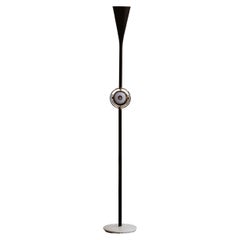
Angelo Lelii “Polifemo” Floor Lamp for Arredoluce, 1956
By Angelo Lelii, Arredoluce
Located in Lonigo, Veneto
Angelo Lelii “Polifemo” floor lamp for Arredoluce, iron, brass, glass and marble, Italy, 1956. The "Polifemo" floor lamp, designed by Angelo Lelli for Arredoluce in 1956, is a notab...
Marble, Brass, Iron
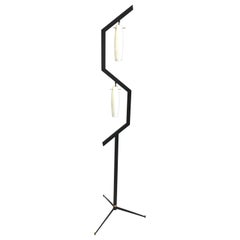
Italian Mid-Century Modern Floor Lamp in the style of Arredoluce
By Angelo Lelii, Arredoluce
Located in New York, NY
Rare and exceptional Italian Mid-Century Modern floor lamp in the style of Angelo Lelli for Arredoluce. The entire composition is ultra-modern / futurist in its conception; it's dari...
Brass, Metal
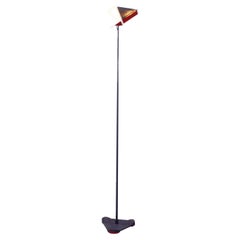
Italian Mid-Century Modern Floor Lamp by Arteluce, 1980s
By Arteluce
Located in MIlano, IT
Italian Mid-Century Modern floor lamp by Arteluce, 1980s. Floor lamp with structure and triangular base in black metal and pyramidal lampshade in black and red metal. Produced by...
Metal
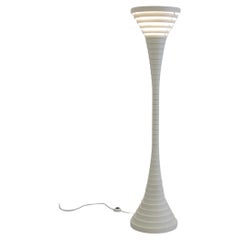
Floor lamp designed by Silvio BILANGIONE and Paolo PORTOGHESI, 1967
By Paolo Portoghesi, Silvio Bilangione
Located in Berlin, Berlin
Floor lamp by Silvio Bilangione and Paolo Portoghesi. Italy, Fumagalli, 1967. 'HELGA' floor lamp has a solid wood base and a shaped plywood top, lacquered in white satin paint. One ...
Plywood
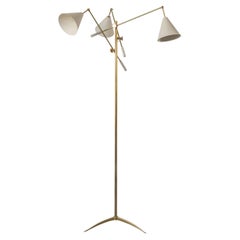
1950s Italian 'Triennale' Floor Lamp
By Arredoluce, Angelo Lelii
Located in London, GB
A 1950s Italian brass and aluminium 'Triennale' floor lamp, in the style of Angelo Lelii for Arredoluce. The finely engineered tripod base supports a slender brass stem and three fu...
Aluminum, Brass
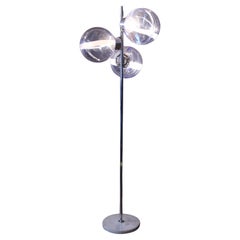
Membrane floor lamp by Toni Zuccheri for Venini, 1960s
By Toni Zuccheri
Located in Vigevano, PV
beautiful floor lamp with marble base from the early 1960s. This lamp may have some flaws in the chrome plating.
Marble, Steel
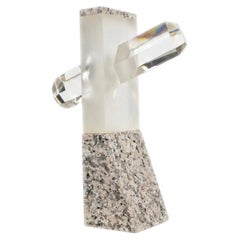
Contemporary Art Glass & Granite Sculpture by Kit Karbler & Michael David
Located in Englewood, NJ
A Contemporary Studio Art Glass & Granite Prismatic "Totem" by, Kit Karbler & Michael David. The Sculpture is an acid-etched glass block with prismatic glass crystal protruding throu...
Granite
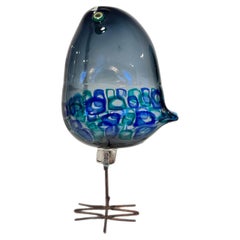
Mid Century Modern Art Glass Pulcino Bird by, Alessandro Pianon for VIstosi
By Alessandro Pianon, Vistosi
Located in Englewood, NJ
An iconic and rare Italian Mid-Century Modern art glass "Pulcino" bird designed by, Alessandro Pianon for Vetreria Vistosi. The pulcino is on raised copper feet and decorated with ap...
Copper
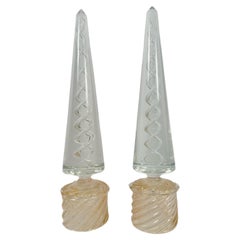
Pair of Murano Italian Mid Century Modern Art Glass Obelisks
Located in Englewood, NJ
Pair of Murano Italian Mid Century Modern Art Glass Obelisks each decorated with clear lattice/spiral decoration cased in heavy clear glass further decorated gold speckled and scallo...
Art Glass
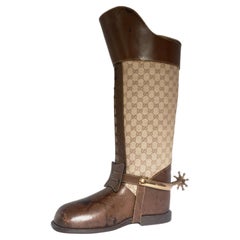
1970s' Vintage Gucci Oversized Equestrian Boot Umbrella Holder
By Gucci
Located in Englewood, NJ
A Mid 20th Century Monumental and Extremely Rare Vintage "Equestrian Boot" Umbrella Holder by, Italian Luxury Brand Gucci. The boot is decorated with Gucci's classic interlocking g's on canvas and further with leather accents, laces front buckle and and finishing with a bras spur. The umbrella stand retains its all original brass liner. There are very few of these examples in existence as these were solely produced for a few of the Flagship Gucci Stores and were not never released nor produced for the retail market making this an extremely rare piece of authentic vintage Gucci. circa 1970s. Signature: The boot is signed on the leather strap "Gucci Italy" Measurements: height: 25.25 in x width: 18 in. x depth: 18 in. Condition: The umbrella stand is in very good condition. Showing no major damage to it. There is some scuffing to the leather on the heel where the spur is located. Some staining to the front of the boot but really adds to the charm of the natural patina from age. The leather is sound throughout as well as the canvas which has minimal glue staining at the seams. The spur is intact and spins freely. The original brass liner is in good condition with some denting from use. It is free from repairs and is in its original condition. References: For a similar and smaller example see: Sotheby's New York - Important 20th Century Design - June 8th, 2005 - lot 12 Notes: Gucci Museo in Florence, Italy currently does not have this example in their collection. The Gucci Equestrian Boot Umbrella Holder was exclusively made for GUCCI retail stores only and were never made for the retail market. This is the second example we have owned and can and very few of these ever make it to market. Biography: Inspired by his experience as a porter at The Savoy hotel in London, Guccio Gucci established his eponymous artisanal luggage atelier in 1921 on Via della Vigna Nuova in Florence. His vision combined exceptional Tuscan materials and craftsmanship with the elegant English aesthetic. These early years established the brand's origins in the world of travel and exploration, which have remained intrinsically linked to Gucci's heritage. The late 1930s saw the introduction of canvas into the offering to provide enhanced durability. The Diamante fabric emerged and became one of the first distinctive elements of the House with its emblematic diamond motif. This was a precursor of the GG monogram canvas still featured today on a selection of bags. A need for creativity and resourcefulness in the 1940s led to the development of enduring House codes. Amid Italy’s post-war era when traditional raw materials were in short supply, a visionary Guccio Gucci turned to the lightweight and durable bamboo in 1947. Through innovative craft techniques, Guccio and his Florentine artisans created the Bamboo bag, the predecessor to the House’s iconic Bamboo 1947 handbag. 1953 was a pivotal year for the House, marking Gucci’s expansion outside of Italy with its first store in New York City. This was also when it introduced footwear, most notably the Horsebit 1953 loafer defined by an equestrian accoutrement that Gucci began using earlier in the decade to evoke the life and style that surrounded horseback riding. The emblem was continuously reinterpreted, with the Horsebit 1955 bag referring to the year its specific version of the hardware appeared in Gucci's collections. Back in Florence in 1953, the House purchased the historic Palazzo Settimanni as the site for its growing artisanal production in the heart of the city. As Gucci continued to grow rapidly, the brand's influence spread to an international clientele of jet setters, Hollywood stars, dignitaries, and socialites. Signature products and prints emerging during this period included the predecessor to the Jackie 1961 bag...
Brass
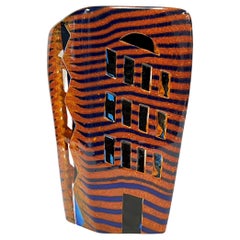
An American Contemporary Studio Art Glass Cityscape Sculpture by, José Chardiet
By José Chardiet
Located in Englewood, NJ
A rare American Modern cast and hot sculpted glass “Cityscape” sculpture by, Cuban born glass artist José Chardiet decorated as a three dimensional building finished in colors of blu...
Art Glass
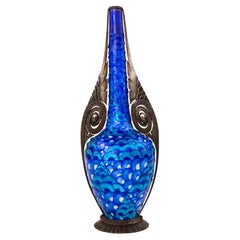
French Art Deco Enameled and Wrought Iron Decorated Vase by Camille Fauré
By Camille Fauré
Located in Englewood, NJ
An extremely rare French Art Deco enameled laid on copper and wrought iron decorated vase by, Camille Fauré. The vase is decorated with an enameled geometric design in colors of blue, black, and white further set into a decorated hand forged wrought iron mount. The vase is signed "C.FAURÉ.LIMOGES". - circa 1940s' Measurements: height: 13.5 in. x width: 5 in. x diameter: 5.25 in. Biography: Camille Faurè produced designs for Limoges, long famed for its enamels Born in Perigueux in 1872, he spent a long apprenticeship before setting up his own workshop at Limoges, where he worked for over fifty years. Fauré became Limoges most famous and talented enamel artist. He exhibited in the 1925 International Exhibition in Paris that gave name to Art Deco. His early work, like his Post World War II designs, involved large floral patterns, often in rich colors keeping in line with the Art Nouveau movement. He exhibited through his Paris shop...
Enamel, Wrought Iron