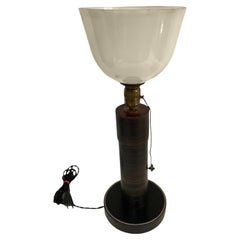
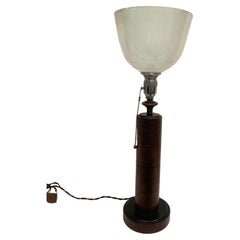
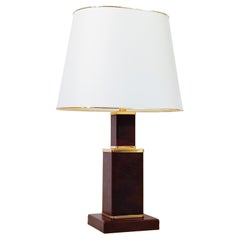
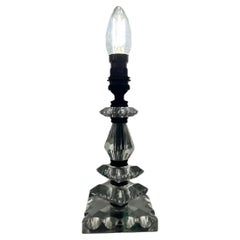
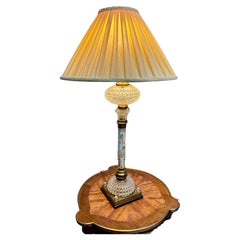
1950's Stitched leather table lamp by Hermès and Paul Dupré-Lafon
By Hermès
Located in Bois-Colombes, FR
1950's Stitched leather table lamp designed by Paul Dupré-Lafon for Hermès France
Vintage 1950s French Table Lamps
Leather, Opaline Glass
For Hermès, what began as a maker of leather equestrian goods for European noblemen would eventually grow into one of the most storied fashion labels in the world. In 1837, German-born French entrepreneur Thierry Hermès opened a saddle and harness purveyor in Paris. Gradually, the house extended into accessories and luggage for its riders, and today, in paying homage to its origins, the family-run luxury brand resurfaces horse motifs in everything from clothing and modernist jewelry to pillows and handbags.
The first top-handled bag ever produced by Hermès was the Haut à courroies, which made its debut in 1892. A tall bag secured with a folded leather flap (fastened with bridle-inspired straps), it was designed to transport riding boots and a harness.
As the world made the switch from horse to automobile, the bag adapted, becoming a multifunctional travel satchel instead of a designated saddlebag. Today, 120 years later, the HAC remains in Hermès’s line — and its distinctive flap and clasping straps have laid the groundwork for some of the house’s other iconic bags.
In the 1930s, Robert Dumas (son-in-law to Émile-Maurice Hermès, Thierry’s grandson) designed a smaller, trapezoidal take on the flap bag with a handle and two side straps. Later, actress Grace Kelly, then engaged to Prince Rainier of Monaco, is said to have used one of these bags to conceal her pregnancy during the 1950s. Because she was photographed constantly, the coverage catapulted her handbag to international popularity.
In 1977, Hermès officially renamed the model for her, and the Kelly bag was born. Each Kelly bag takes between 18 and 25 hours to produce, and its 680 hand stitches owe solely to one Hermès artisan.
Robert Dumas was also responsible for another one of the brand’s most iconic offerings: the launch of its first silk scarf on the occasion of Hermès’s 100th anniversary in 1937. Based on a woodblock designed by Dumas and printed on Chinese silk, the accessory was an immediate hit.
Today, vintage Hermès scarves, typically adorned in rich colors and elaborate patterns, serve many functions, just as they did back then. Well-heeled women wear it on their heads, around their necks and, in a genius piece of cross-promotion, tied to the straps of their Hermès bags. Kelly even once used one as a sling for her broken arm.
In 1981, Robert Dumas’s son Jean-Louis Dumas, then Hermès chairman, found himself sitting next to French actress and musician Jane Birkin on a plane, where she was complaining about finding a suitable carryall for the necessary accoutrements of motherhood. After the two travelers were properly introduced, Birkin helped design Jean-Louis’s most famous contribution to the Hermès canon: the Birkin bag, a roomy, square catchall with the HAC’s trademark leather flap top and the addition of a lock and key.
Owing to the brand’s legendary commitment to deft, handcrafted construction, the Birkin is an investment that is coveted by collectors everywhere.
While the Kelly and Birkin may be standouts, gracing the arms of everyone from royal heiresses to hip-hop stars in the past few decades, the handbags are but a small part of Hermès’s fashion offerings.
Since the 1920s, the brand has produced some of the most desirable leather goods in the world. There’s the Constance bag, a favorite of Jacqueline Kennedy, the recently relaunched 1970s-era Evelyne and, on the vintage market, a slew of designs dating back to the 1920s.
Good design never goes out of style. Find a variety of vintage Hermès handbags, day dresses, shoes and more on 1stDibs.
One of the world’s foremost crystal manufacturers, Baccarat has long been emblematic of luxury and exquisite craftsmanship. Starting in the early 19th century, objects produced by the French company — from stemware to chandeliers to brightly colored paperweights — became a staple of noble and wealthy households across Europe and as far afield as India. Along with the purity and quality of their glass, Baccarat crystal makers can boast a remarkable fluency with a range of design styles — from cut-glass neoclassical pieces to sinuously etched Art Nouveau designs.
Baccarat began as a kind of industrial development project. In 1764, the Bishop of Metz and other landowners in heavily forested northeastern France persuaded Louis XV to sanction a glassworks in the area — timber being a key resource required for the furnaces used in glass production.
In its early years the company produced humble products such as window panes and simple drinking glasses. In 1816 a new owner began making crystal, and seven years later Louis XVIII — who had taken the throne after the defeat of Napoleon — gave Baccarat its first royal commission, for tableware. In the ensuing years, an estimated one-third of the company’s workforce was dedicated to commissions to the Russian imperial court alone.
Spurred by the intense competition between global industries in the latter 19th century — fought in public view in the many world expositions of the era — Compagnie des Cristalleries de Baccarat, as it had finally become known, elevated its level of artistry by adopting new technologies and creating a rigorous training program. The firm broadened its stylistic range, embracing Asian influences and new engraving methods, and increasing production of its now iconic millefiori paperweights.
The designer Georges Chevalier, who worked for Baccarat for more than five decades beginning in 1916, ushered the company into the realm of modernist design. In recent years, Baccarat has employed such renowned contemporary designers as Philippe Starck and Marcel Wanders, ensuring that Baccarat crystal will continue to enjoy pride of place on up-to-date tables. But as you will see from the offerings on these pages, Baccarat has items to suit any taste.
Find antique Baccarat decanters, vases, candle holders, chandeliers and other furnishings and objects for sale on 1stDibs.
1950's Stitched leather table lamp by Hermès and Paul Dupré-Lafon
By Hermès
Located in Bois-Colombes, FR
1950's Stitched leather table lamp designed by Paul Dupré-Lafon for Hermès France
Leather, Opaline Glass
Louis XV Style Three Light Bouillotte Lamp France
By Maison Baguès
Located in Den Haag, NL
Louis XV style bouillotte table lamp with Three candlesticks, , a green fabric shade, adjustable in height . Very good quality lamp . solid Brass . so stylish on your Desk .
Brass
Stitched leather table lamp by Paul Dupré-Lafon for Hermès
By Hermès
Located in Bois-Colombes, FR
Very nice stitched leather table lamp by Paul Dupre-Lafon for Hermès Dimensions given without shade No shade included Great condition Signed
Leather
$11,950Sale Price|35% Off
H 33.5 in Dm 12 in
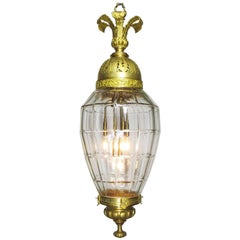
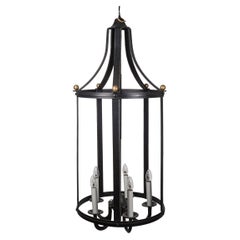
Fine French 19th-20th Century Belle ÉPoque Lantern, Attributed to Baccarat
By Cristalleries De Baccarat
Located in Los Angeles, CA
A fine French 19th-20th century Belle Époque gilt bronze "Versailles" style four light hanging lantern attributed to Baccarat, Paris, circa 1900. Measures: Height: 33 1/2 inches (8...
Bronze
$3,944Sale Price|30% Off
H 25.4 in W 15.56 in D 10.83 in
Dupré-Lafon. Art Deco and Hollywood Regency style table lamp, France, 1960s
By Hermès, Paul Dupré-Lafon
Located in SANT ADRIÀ DE BESÒS, ES
Art Deco and Hollywood Regency style table lamp, France, 1960s. Skyscraper-shaped table lamp made of faux leather and brass. Several prismatic levels and a cylindrical upper axis of ...
Metal, Chrome, Brass
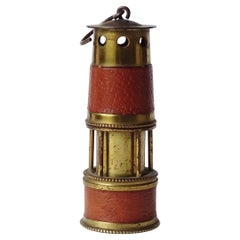
Leather and Brass Miners Lamp Shaped Table Lighter, France 1960s
By Hermès
Located in Milan, IT
Attributed to Hermes, leather and brass miners table lighter. France 1960s.
Brass
$790
H 7.88 in W 3.55 in D 3.55 in
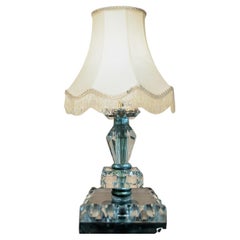
Art Deco Lamp ITSO Baccarat, France circa 1940, Attr. to Jacques Adnet
By Jacques Adnet, Baccarat
Located in Merida, Yucatan
Beautiful Art Deco table lamp in the style of Baccarat and Jacques Adnet, unmarked. Manufactured in hand cut crystal. France circa 1940. The pieces "spin" so their position can be ad...
Crystal
Art Deco Lamp by Baccarat, France circa 1940, Attr. to Jacques Adnet
By Jacques Adnet, Baccarat
Located in Merida, Yucatan
Beautiful table lamp by Baccarat, France in hand cut Lead glass, circa 1940. The pieces "spin" so their position can be adjusted. The lamp is in great condition with no chips or bre...
Crystal
$1,568Sale Price|20% Off
H 37 in W 6.5 in D 6.5 in
19th Century Cut Crystal Brass Trimmed Baccarat Style Lamp
By Baccarat
Located in Vancouver, British Columbia
A late 19th C cut crystal oil lamp now electrified. Fortunately the wiring is external so there is no damage to the original lamp. The crystal and bra...
Crystal, Brass

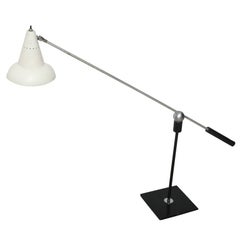
Gilbert Waltrous Heifetz Table Lamp, circa 1950s
By Heifetz, Gilbert Watrous
Located in New York, NY
Gilbert Waltrous for Heifetz Manufacturing Co. table lamp. The arm balances on a magnetic 3" ball perched on a rod mounted on a black enameled square ...
Metal, Steel

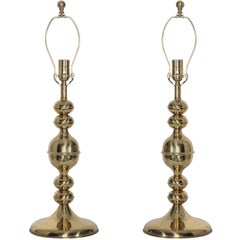
Pair of Brass Kosta Table Lamps, circa 1970s
By Kosta Boda
Located in New York, NY
Pair of stylized brass round globe-shaped table lamps made by Kosta AB. They measure 20"H to top of the socket, have a 7"H harp and base is 8"DIA. The lamps have been re-wired and th...
Brass

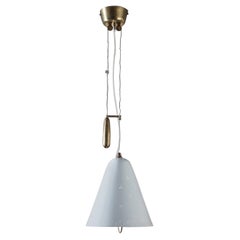
Paavo Tynell Pendant Light, Idman Oy Model No. A 1942, circa 1950s
By Paavo Tynell, Idman Oy
Located in New York, NY
Mid century lighting designer Paavo Tynell's Counterbalance pendant light Model No. A 1942 was made by Idman Oy, circa 1950s. This is an a...
Metal, Brass

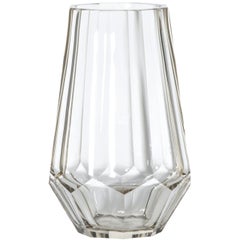
Josef Hoffmann Vase, Wiener Werkstatte, circa 1915 - 1920
By Josef Hoffmann, Moser Glassworks, Wiener Werkstätte
Located in New York, NY
Josef Hoffmann cut and ground clear crystal vase made by Ludwig Moser & Söhne, Karlsbad for Wiener Werkstätte circa 1915 - 1920. Stamp signature to underside: [MOSER KARLSBAD WW CZEC...
Glass

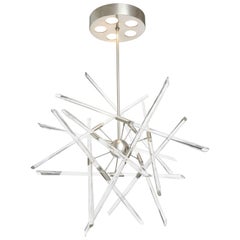
Barry Entner Tangent Glass and Metal Chandelier, 2016
By Barry Entner
Located in New York, NY
Contemporary American artist Barry Entner's Tangent Chandelier is comprised of clear textured solid glass sticks and a nickel plated steel frame. The canopy holds 5 LED round lights that shine down on the adjustable sticks as they orbit a 5"DIA steel globe. From the artist's perspective, sculptural lighting originates as a sculptural vision rather than a commercial product design. Suspending sculpture in midair allows him to create an unlimited array of forms free from the limitations of gravity. The lighting aspect is designed specifically to enhance the form, color and the magical beauty of the glass itself. He intentionally employs certain techniques to highlight the unique properties of glass. Each of Barry Entner's works has a life of its own due to visual shifts in form and color, which give the pieces movement. These effects are dependent on the perspective of the viewer and the amount of ambient light. About the artist: Barry Entner was born on November 1, 1959 in Brookline, Massachusetts. In the late 1970's, Barry attended Tulane University, New Orleans, Louisiana, where he studied developmental psychology, cultural anthropology and philosophy. He also began to study glass sculpture under Gene Koss...
Metal, Nickel
Nils Landberg Red Expo Tulip Vase, Orrefors Glassworks, circa 1950s
By Nils Landberg, Orrefors
Located in New York, NY
Mid century glass artist Nils Landberg's Red Expo Tulip Vase was designed for Orrefors glassworks in the 1950's. This delicately tinted vase is hand blown glass signed with incised s...
Glass
What these styles lack in name recognition they more than make up for in cachet.
Before the Birkin there was the Haut à Courroies, which has become the chic carryall of choice for the league's most stylish athletes.