Want more images or videos?
Request additional images or videos from the seller
1 of 11

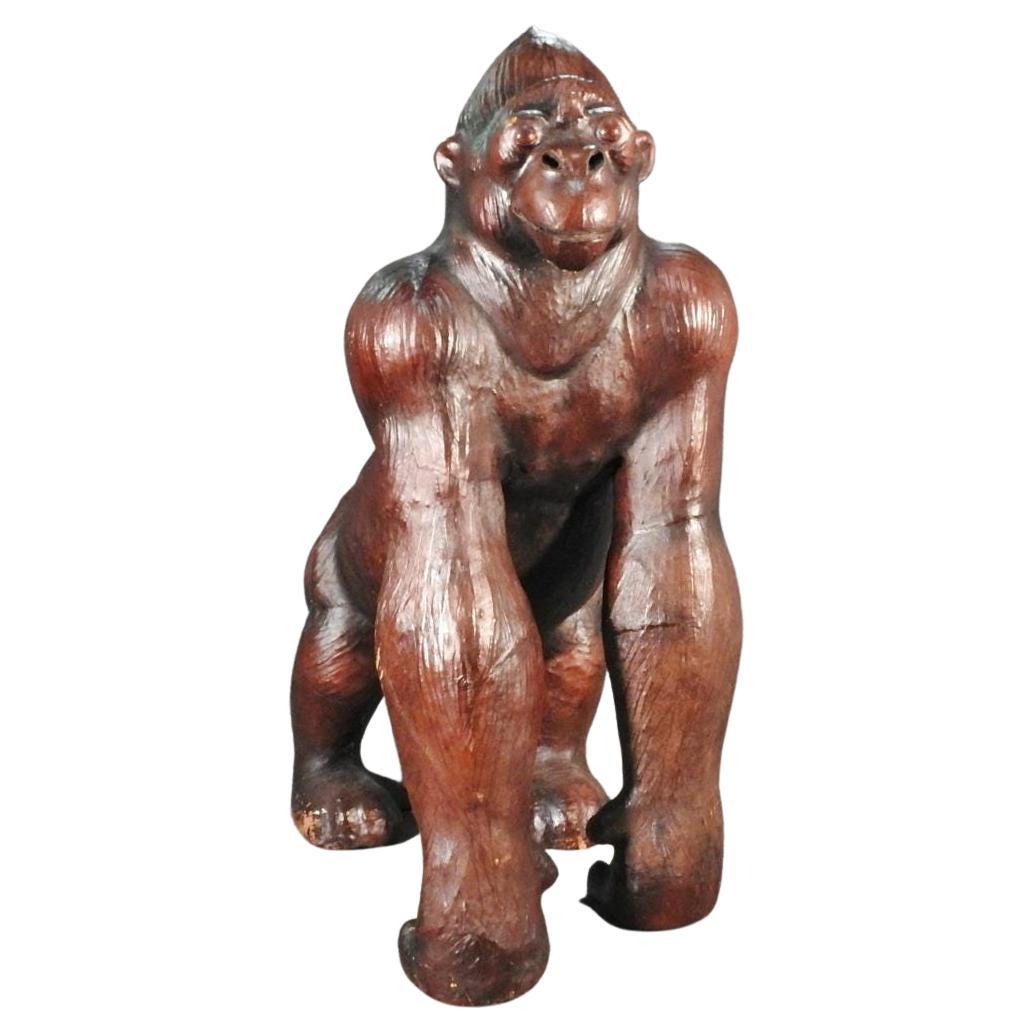
Anatomical Model of Gorilla by Dr. Louis Auzoux Plus Unique Handwritten Booklet

$231,002.40
£170,897.66
€236,925VAT Included
CA$319,718.88
A$320,881.28
CHF 187,115.87
MX$3,900,983.80
NOK 2,150,147.28
SEK 2,211,316.71
DKK 1,486,754.57

About the Item

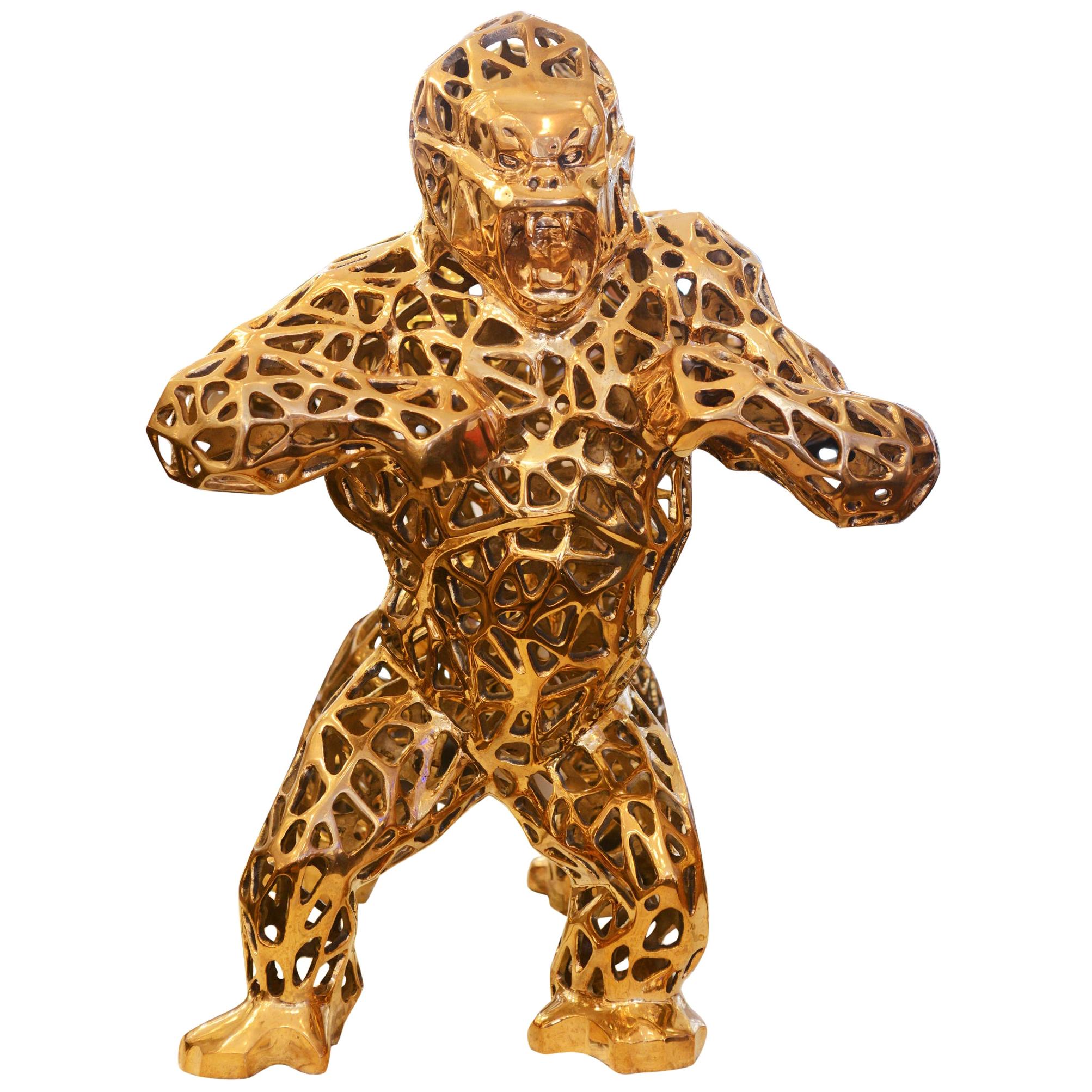
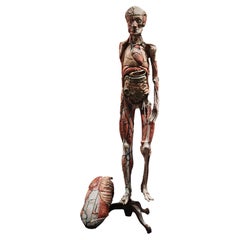
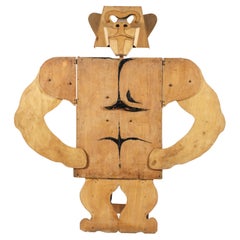
Sinke & van Tongeren exhibited this extremely rare Auzoux Gorilla by carefully taking apart the model and creating an exploded view of this historically important piece. When viewed from a particular angle all pieces come together to form the original shape. It was part of the exhibition called ‘TIER’ at MOA in The Netherlands The story of a remarkable 19th century anatomical model created just four years after Darwin unleashed a political storm with his theories on human evolution. The publication of Charles Darwin’s controversial On the Origin of Species in 1859 caused debates to rage about human evolution, debates which witnessed the politicisation of a creature whose existence had only recently been confirmed by modern science. On one side of the argument was the Darwinian camp; on the other were those opposed to Darwin’s theory, such as Richard Owen, the famed Director of the Natural History Museum and a man who, interestingly, coined the word ‘dinosaur’. Tales of the creature in question had endured for centuries, but up until 1847 it remained a myth, an unknown. This all changed thanks to the missionary Thomas Savage and the anatomist Jeffries Wyman who wrote a paper for the journal of the Boston Society of Natural History in which they described a new species: Troglodytes gorilla. (Later, in 1929, Harvard zoologist Harold Coolidge would apply the synonym Gorilla gorilla that we still use today.) Despite only recently being formally introduced to the gorilla — a creature Darwin argued was among its closest relations, mankind’s first encounters very likely took place in the 5th century B.C. when the Carthaginian Hanno the Navigator recorded coming across ‘women with hairy bodies, whom our interpreters called “gorillae”’. Later, Pliny recorded in his Natural History that their furs were preserved until the Battle of Carthage (149 B.C.). As a response to this increased public interest, the French naturalist and anatomical model maker Dr. Louis Auzoux announced that he was keen to dissect an ape as his next challenge. He mentioned as much to the Emperor Napoleon III when presenting to the family a lecture on anatomy. The Emperor duly obliged and organised for a specimen preserved in alcohol to be transported back to France from an 1863 expedition to Gabon. As a theatrical act of scientific teaching, Auzoux dissected the gorilla to demonstrate its anatomy. The dissection took place in front of a crowd at the amphitheatre of the Ecole de Médecine in Paris. Later, a full size model of the gorilla was announced in the journal Le Cosmos; revue des sciences et de leurs applications as an upcoming new addition to the works of Auzoux. Dr. Auzoux was a leading pioneer of three-dimensional didactic models which he made with a secret recipe containing not only paper but also clay and cork (pieces of which can be seen in this specimen). These models, which he called ‘anatomie clastique’ (from the Greek ‘klastos’, meaning broken in pieces), were specifically designed to be taken apart, piece-by-piece as if carrying out a dissection, in order to facilitate the teaching of students in universities. Each part of the model would have carried applied numbered labels and arrows instructing the student as to which piece to remove next. The lack of these on the this example points to it being the initial prototype by Auzoux, from which moulds were then taken before being cast and then carefully painted and numbered. The pose for the Gorilla perhaps apes an 1858 lithograph by Marie Firmin Bocourt that appeared in the Archives du Muséum d’Histoire Naturelle vol. X. Starting out by making models of human legs and other human anatomical models — his first was presented to the Académie Royale de Médecin and earned him a commission, Auzoux recognised a gap in the market with the lack of materials for medical students. Fresh bodies could only be dissected and used for teaching so often before turning, and the industry for providing dissectible wax teaching models was not well established and prohibitively expensive. Auzoux capitalised on the situation, founding a long-running and successful company providing schools and universities around the world with expertly made and durable didactic models. His catalogue eventually listed 110 models, and the commissaries of the Académie Royale de Médecin frequently praised the importance of the models, in 1831 reporting that ‘France has the advantage of surpassing the other countries in the art of anatomical imitations’. Auzoux was made a member of the Légion d’Honneur. Today his anatomical models are highly sought after for both their scientific and artistic merits, and can be seen in museum collections from India through Europe to the U.S. The Gorilla is perhaps his most ambitious of all the models; in 1869 it was advertised at a price of 3,000 Francs. It is certainly the rarest, only four are known: in Paris at the Musée Histoire Naturelle, one in a private museum, another in La Musée d’Anatomie Montpelier (formerly in the collection Delmas-Orfla-Rouvière), and the current example. Even more rare is the autograph manuscript that accompanies this rare prototype model. Titled ‘Anatomie clastique du docteur Auzoux Tableau Synoptique du Gorille’. 65 handwritten pages describing the 1,193 removable pieces of the Gorilla’s anatomy. A unique and original document that completes this important piece of natural history and science.
  • Creator:
  • Dimensions:
    Height: 66.93 in (170 cm)Width: 35.44 in (90 cm)Depth: 31.5 in (80 cm)
  • Materials and Techniques:
  • Place of Origin:
  • Period:
  • Date of Manufacture:
    1863
  • Condition:
    Wear consistent with age and use.
  • Seller Location:
    Haarlem, NL
  • Reference Number:
    1stDibs: LU102948991091

More From This Seller

View All
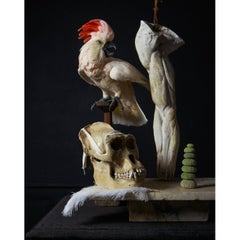
‘Les Peintures des Taxidermistes’ No. 3, Art Print Photo by Sinke & Van Tongeren

‘Les Peintures des Taxidermistes’ No. 3, Art Print Photo by Sinke & Van Tongeren

By Sinke & Van Tongeren

Located in Haarlem, NL

The third series of photographs by Fine Taxidermists Sinke & Van Tongeren After observing and analyzing so many 17th century paintings, they were inspired to create a new series of ...

Category

Antique Early 17th Century Dutch Renaissance Photography

Materials

Paper

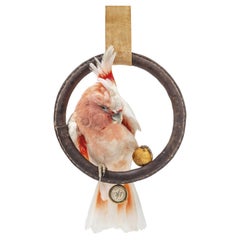
Fine Taxidermy Major Mitchell's Cockatoo by Sinke & Van Tongeren

Fine Taxidermy Major Mitchell's Cockatoo by Sinke & Van Tongeren

By Sinke & Van Tongeren

Located in Haarlem, NL

This elegant composition features a Cacatua leadbeateri, known for its soft pink plumage and lively, inquisitive character. The bird is suspended within an antique leather ring, hung...

Category

21st Century and Contemporary Dutch Victorian Taxidermy

Materials

Animal Skin

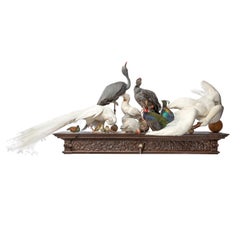
'Quoting Charles Darwin I' a Fine Taxidermy Tableaux by Sinke & Van Tongeren

'Quoting Charles Darwin I' a Fine Taxidermy Tableaux by Sinke & Van Tongeren

By Sinke & Van Tongeren

Located in Haarlem, NL

This monumental work is inspired on the famous quote of Darwin. “If everyone were cast in the same mould, there would be no such thing as beauty.” It is because of this quote that we added Darwin to our name Darwin, Sinke & van Tongeren. This quote also fits our goal to do all our taxidermy work without the use of factory moulds that are typical for contemporary taxidermy. We sculpt all our bodies by hand and therefor can create the unique poses like how they line up in this mayor work. We combined many different birds with many different features from many different points of the compass. Together they form a 17th Century like composition of colours and poses. This collection varies from the rare African Congo Peafowl and a gracious Stanley Crane to a regular Dutch chicken. Quoting Charles Darwin...

Category

21st Century and Contemporary Dutch Victorian Taxidermy

Materials

Animal Skin

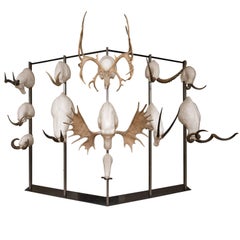
Trophees Defence from Exhibition Tier at Moa by Sinke & Van Tongeren

Trophees Defence from Exhibition Tier at Moa by Sinke & Van Tongeren

By Sinke & Van Tongeren

Located in Haarlem, NL

Title: Trophees Defence An impressive set of 12 sculptures creating a wall of weaponry. Real antique horns and antlers facing the viewer and forcing it into defence. From left ...

Category

21st Century and Contemporary Dutch Animal Sculptures

Fine Taxidermy Duyvenbode's Lory by Sinke & Van Tongeren

Fine Taxidermy Duyvenbode's Lory by Sinke & Van Tongeren

By Sinke & Van Tongeren

Located in Haarlem, NL

The Duyvenbode’s Lory (Chalcopsitta duivenbodei) is found in northern New Guinea. Named after Maarten Dirk van Renesse van Duivenbode (June 2, 1804 – March 31, 1878) who was a Dutch merchant, trader of bird skins for fashion and naturalia. The colour palette of this bird is very special. Almost bronze like. A great match with the antique velvet base. Note: All animals used for their work came from captivity and died on natural causes. No animals are raised or killed for their work. The works of Dutch Artists Sinke and van Tongeren are inspired by golden age old master painters...

Category

21st Century and Contemporary Dutch Victorian Taxidermy

Materials

Animal Skin

Fine Taxidermy Salmon-Crested Cockatoo by Sinke & Van Tongeren

Fine Taxidermy Salmon-Crested Cockatoo by Sinke & Van Tongeren

By Sinke & Van Tongeren

Located in Haarlem, NL

A cockatoo stands in a lively, dancing pose on an antique gilded base. It balances carefully on coral spheres, giving the work a sense of lightness and movement. The bird’s feathers ...

Category

21st Century and Contemporary Dutch Victorian Taxidermy

Materials

Animal Skin

You May Also Like

20th Century Biscuit Porcelain Gorilla Skeleton by James Webster

20th Century Biscuit Porcelain Gorilla Skeleton by James Webster

Located in London, by appointment only

A fine biscuit porcelain gorilla skeleton naturalistically cast. James Webster 2014 Measures: Height 16in, width 20in, depth 9in. Raised on a steel base and concrete plinth...

Category

2010s English Modern Animal Sculptures

Materials

Porcelain

A large adjustable wooden gorilla by Luigi Nervo

A large adjustable wooden gorilla by Luigi Nervo

Located in Diest, BE

Sculpture/installation by the Italian artist and sculptor Luigi Nervo (Turin 1930-Turin 2006). Nervo began his career as an industrial designer and later started experimenting with ...

Category

Vintage 1970s Italian Animal Sculptures

Materials

Wood

Bernard & Arnaud Bessoud “Gorilla” Bronze Sculpture, Artist’s Proof 1/4, 2005

Bernard & Arnaud Bessoud “Gorilla” Bronze Sculpture, Artist’s Proof 1/4, 2005

By Bernard & Arnaud Bessoud

Located in LEGNY, FR

Gorilla – Artist’s Proof No. 1/4 Bernard & Arnaud Bessoud, 2005 Foundry: Chapon An iconic sculpture by the duo Bernard & Arnaud Bessoud, this bronze gorilla embodies both the power...

Category

Early 2000s French Animal Sculptures

Materials

Bronze

Large Carved Wooden Gorilla Sculpture, 20th Century.

Large Carved Wooden Gorilla Sculpture, 20th Century.

Located in Saint-Ouen, FR

Large carved wooden gorilla sculpture, 20th century. Hand-carved wooden sculpture depicting a gorilla, H: 105cm, W: 50cm, D: 40cm Please contact us...

Category

20th Century French Art Deco Animal Sculptures

Materials

Wood

Anatomical Skeletal Cast, Italy 80s

Anatomical Skeletal Cast, Italy 80s

Located in Los Angeles, CA

The figure’s head is slightly tilted, giving it an expressive look, and the torso is sculpted to reveal muscles and tendons, giving insight into the human body’s structure beneath th...

Category

Vintage 1980s Italian Mid-Century Modern Sculptures and Carvings

Materials

Plaster