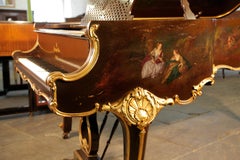
Rococo Musical Instruments

ROCOCO STYLE

Rococo was an aesthetic movement in the fine and decorative arts in the 18th century that found its inspiration in nature and fostered an overall lightness and delicacy of form, construction and ornament in interior design. Rococo furniture, while greatly influenced by trends in Italy and Germany, is often called Louis XV style — the movement having reached its best expression during that sybaritic French king’s reign.

The term “rococo” is thought to be a portmanteau of the French words rocaille and coquilles — “rock” and “shells” — organic motifs frequently used in architecture and design of the style.

When it comes to authentic Rococo furniture's characteristics, it is above all sensuous and social. The furniture of earlier eras in Europe had been heavy in every sense; the Rococo period saw the appearance of light-framed upholstered armchairs, side chairs and occasional tables that could easily be moved to form conversational circles.

The signal detail of Rococo furniture design is the gently curved cabriole, or S-shaped chair-, table-, and cabinet-leg. It imitates the bend of a tree limb or a flower stem. In a further reference to nature, furnishings were often asymmetrical and painted white, or in soft, pastel shades. Rococo has become a timeless style, and as the furniture pieces presented on 1stDibs demonstrate, its playful, sculptural forms can provide visual excitement to contemporary, clean-lined spaces.

to
2
2
68
57
41
38
18
10
9
9
7
7
6
4
3
3
2
2
1
1
1
1
1
1
1
1
2
1
1
2
2
2
Style: Rococo
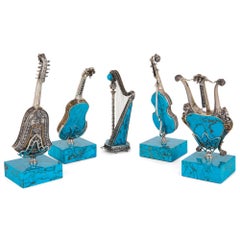
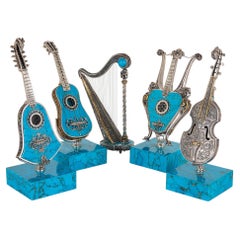
Set of Five Spanish Turquoise and Silver Miniature Musical Instruments

Set of Five Spanish Turquoise and Silver Miniature Musical Instruments

Located in London, GB

Set of Five Spanish Turquoise and Silver Miniature Musical Instruments Spain, Late 19th Century Comprising five pieces Smallest (harp): Height 13.5cm, width 8cm, depth 5cm Largest (c...

Category

Late 19th Century Spanish Antique Rococo Musical Instruments

Materials

Silver

Related Items
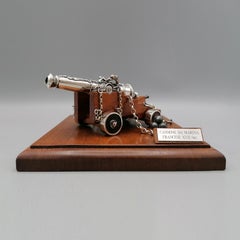
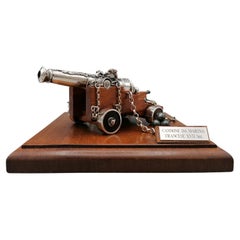
Italian Silver and Wood Miniature of French Navy Cannon

Italian Silver and Wood Miniature of French Navy Cannon

By Arval Argenti Valenza

Located in VALENZA, IT

Reproduction depicting a Navy cannon. France XVII century. The cannon is mounted on 4 silver and wood wheels and is fixed to the wooden base by means of chains, which originally hel...

Category

1980s Italian Vintage Rococo Musical Instruments

Materials

Silver

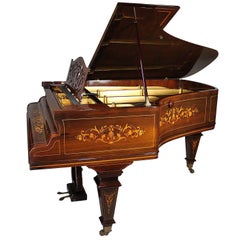
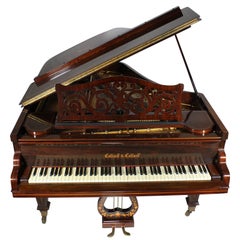
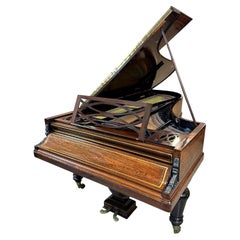
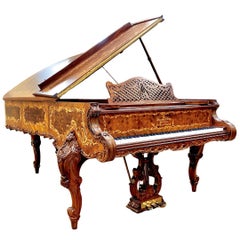
A Fine19th Century Louis XIV Style Collard & Collard Marquetry Baby Grand Piano

A Fine19th Century Louis XIV Style Collard & Collard Marquetry Baby Grand Piano

$68,750Sale Price|27% Off

H 40.25 in W 72 in D 55.5 in

A Fine19th Century Louis XIV Style Collard & Collard Marquetry Baby Grand Piano

By Collard & Collard

Located in Los Angeles, CA

A very fine Anglo-French 19th century rosewood, palisander, amboyna and satinwood marquetry (inlaid) art-case baby grand piano, the works by "Collard & Collard". The intricately ...

Category

Late 19th Century English Antique Rococo Musical Instruments

Materials

Bronze

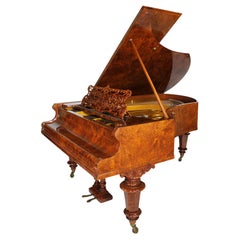
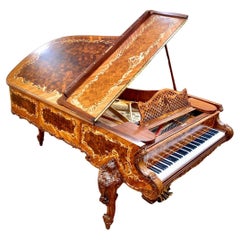
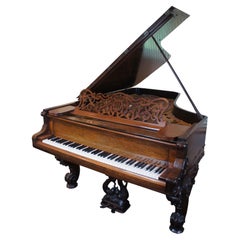
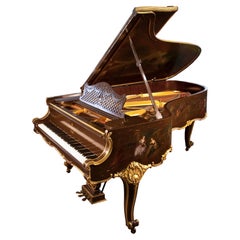
A German 19th Century Louis XVI Style Burr Walnut Bechstein Concert Grand Piano

A German 19th Century Louis XVI Style Burr Walnut Bechstein Concert Grand Piano

By Bechstein Piano Company

Located in Los Angeles, CA

A Very Fine German 19th Century Louis XVI Style Burr Walnut Bechstein Concert Grand Piano, Serial No. 5655. The beautifully crafted Grand piano, raised on three tapered barrel shaped legs, with an intricately carved ornate music desk and original keys. Circa: 1872. Length: 80 inches (203.2 cm) Width: 59 inches: (149.9 cm) Height (top closed): 38 5/8 inches (98.1 cm) C. Bechstein Pianofortefabrik C. Bechstein Pianofortefabrik AG (also known as Bechstein) is a German manufacturer of pianos, established in 1853 by Carl Bechstein. Before Bechstein Young Carl Bechstein studied and worked in France and England as a piano craftsman, before he became an independent piano maker. His first pianos were made for other companies. C. Bechstein C. Bechstein piano factory was founded on 1 October 1853 by Carl Bechstein in Berlin, Germany. Carl Bechstein set out to manufacture a piano able to withstand the great demands imposed on the instrument by the virtuosi of the time, such as Franz Liszt. In 1857, Hans von Bülow (Liszt's son-in-law) gave the first public performance on a Bechstein grand piano by performing Liszt's Piano Sonata in B minor in Berlin By 1870, with endorsements from Franz Liszt and Hans von Bülow, Bechstein pianos had become a staple in many concert halls and private mansions. By that time three piano makers, all of which were founded in 1853, became established as the industry leaders across the world: Bechstein, Blüthner and Steinway & Sons. In 1881 Bechstein began supplying pianos to Queen Victoria. A gilded art-case piano was delivered to Buckingham Palace, followed by several more Bechstein pianos to Windsor Castle and other royal residences. By January 1886 they were among the piano manufacturers holding a Royal Warrant as a supplier to the Queen. Several British embassies across the world acquired Bechstein pianos. In 1885, Bechstein opened a branch in London, that eventually grew to become the largest showroom and dealership in Europe. By 1890 showrooms had been opened in Paris, Vienna, and Saint Petersburg. On 31 May 1901, Bechstein Hall, built at a cost of £100,000, was opened next to the company's London showroom at 36-40 Wigmore Street. Between 1901 and 1914, C. Bechstein was the largest piano dealership in London. At that time, Bechstein was patronized by the tsars of Russia, the royal families of Spain, Belgium, the Netherlands, Italy, Sweden, Norway, Austria and Denmark, and other royalty and aristocracy. The list of royal clients of Bechstein may be found on the soundboard of vintage Bechstein pianos made before the Second World War. The list is part of the original Bechstein trademark logo; it can be seen under the strings in the center of a piano's soundboard. The signature of Carl Bechstein The years from the 1870s through 1914 brought Bechstein their most dramatic increase in sales. In 1880 a second Bechstein factory was opened in Berlin, and the third factory was opened in 1897 in Berlin-Kreuzberg. Production reached 3,700 pianos annually in 1900, and 4,600 in 1910, making Bechstein the largest German manufacturer of high-end pianos. At that time, about three quarters of production went to international markets, especially Britain and the Commonwealth, and Russia. Carl Bechstein died in 1900, and the Bechstein company continued to operate under the management of his sons. Between 1900 and 1914 C. Bechstein was one of the leading piano makers in the world, employing 1,200 craftsmen and workers by 1913 and making five thousand pianos per year. First World War C. Bechstein suffered huge property losses in London, Paris, and St. Petersburg during World War I. The largest loss was in London. Although the company's position in the United Kingdom was initially unaffected, with the company still listed as holding a Royal Warrant in January 1915, Warrants to both King George V, and his wife Queen Mary were cancelled on 13 April 1915. Bechstein was not the only musical concern to be affected by growing anti-German sentiment: there were earlier attempts, led by William Boosey, to boycott German music altogether. In 1915, despite being a Baronet and Privy Counsellor, Sir Edgar Speyer, who was then funding the Proms, was forced to leave the country. Following the passing of the Trading with the Enemy Amendment Act 1916 the British arm of the company was wound-up on 5 June 1916, all Bechstein property, including the concert hall and showrooms full of pianos, were seized as "enemy property" and closed. In 1916 the hall was sold as alien property at auction to Debenhams for £56,500. It was renamed Wigmore Hall, and then re-opened under the new name in 1917. All 137 Bechstein pianos at the Bechstein showrooms were confiscated too, and became property of the new owner of the Hall. After a dispute with his brother, Edwin Bechstein left the company and was paid off. Eventually the Bechstein factory resumed full-scale production during the 1920s. At that time, technical innovations and inventions of new materials and tools, as well as improvements in piano design and construction, had allowed Bechstein to become one of the leading piano makers again. The most successful models were the updated "A"-185 and "B"-208 grand pianos. The upright pianos became more popular after the war, and C. Bechstein were successful with its upright pianos Model-8 and Model-9, both of which have been considered the finest upright pianos. As the company was changed into a joint-stock company 1923, Edwin Bechstein and his wife Helene, bought themselves back into the company as shareholders. In 1930 the company collaborated with German electrical goods manufacturer Siemens under Nobel laureate Walther Nernst to produce one of the first electric pianos...

Category

19th Century German Antique Rococo Musical Instruments
Materials

Bronze

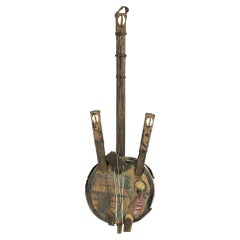
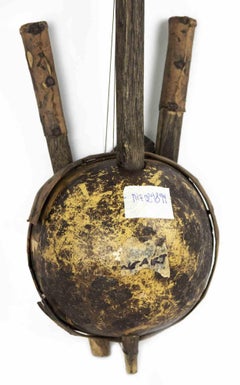
Mid-20th Century Italian Ethnic Musical Instrument in Wood

Mid-20th Century Italian Ethnic Musical Instrument in Wood

Located in Roma, IT

Ethnic musical instrument is a unique object realized in the half of the 20th century. Ethnic musical instrument made by craftsmanship with wood and recycled materials. Mint c...

Category

1970s Italian Vintage Rococo Musical Instruments

Materials

Wood

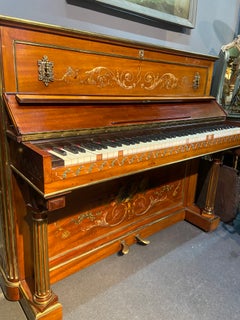
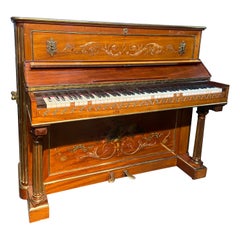
19th Century Pleyel French Upright Piano Hand Painted Decoration and Fluted Legs

19th Century Pleyel French Upright Piano Hand Painted Decoration and Fluted Legs

$7,948Sale Price|65% Off

H 44.89 in W 54.34 in D 20.87 in

19th Century Pleyel French Upright Piano Hand Painted Decoration and Fluted Legs

By Pleyel

Located in Sofia, BG

This rare upright piano was made by Pleyel in France in September 1871 according to the Pleyel Archives found at Musée de la Musique. The natural wood cabinet is beautifully decorated with hand painted floral garlands. The piano sides are square and it has fluted, columnar legs resting on original castors. The instrument...

Category

Late 19th Century French Antique Rococo Musical Instruments

Materials

Brass

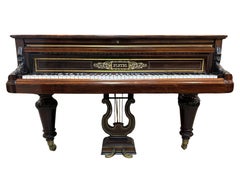
Pleyel Grand Piano, Paris 1870

Pleyel Grand Piano, Paris 1870

$75,000Sale Price|40% Off

H 38.5 in W 54.5 in D 103.25 in

Pleyel Grand Piano, Paris 1870

By Pleyel

Located in Littleton, CO

Please note: We are available to directly assist with coordinating pickup and delivery by trusted professionals experienced in transporting historic and concert-grade pianos. This Pleyel concert grand piano crafted in Paris in 1870 is a timeless masterpiece that embodies the elegance and craftsmanship of 19th-century French piano manufacturing. Pleyel instruments are renowned for their exceptional quality and rich musicality, representing the pinnacle of piano design in the Romantic era, and this piano – an early example of the technological innovation of cross-stringing that was burgeoning during the period – is one in a series of only six ever produced. This piano is in extraordinarily immaculate condition with nearly every original part, including the soundboard, pristine ivory keys, and the brass inlay in its beautifully figured walnut cabinet. Candle stands slide forward on either side of the collapsable music desk. This piano was first purchased by the French Count Charles Étienne Gustave Le Clerc, count of Juigné (1825-1900), one of the wealthiest landowners in Brittany and a member of the French National Assembly, later a member of the House of Representatives, and in late life, the Senate. The piano was restored in 1997 at Maison Erard by master restorationist Frits Janmaat in Amsterdam, and later conditioned by Edwin Beunk. In recent years, some of Europe's finest historically-informed musical artists played this Pleyel in PBS concert performances in collaboration with the late Sergiu Luca. Standing on substantial carved legs and brass wheels, the piano exudes a majestic presence through the graceful lines of its Second Empire style cabinet that embodies the period's aesthetics. The keyboard, meticulously crafted from ivory and ebony, is a testament to the attention to detail in every aspect. Its 85 keys...

Category

17th Century French Antique Rococo Musical Instruments

Materials

Walnut

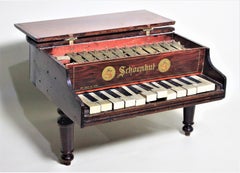
Liberace Autographed Vintage Schoenhut Toy Grand Piano

Liberace Autographed Vintage Schoenhut Toy Grand Piano

By Schoenhut

Located in Hamilton, Ontario

Made by the renowned American toy manufacturer in approximately 1920, this wooden toy baby grand piano has been autographed in two places by the legendary Liberace. The piano shows o...

Category

Early 20th Century American Rococo Musical Instruments

Materials

Brass

Erard Parallel-Strung Grand Piano with Bench, Paris, 1895

Erard Parallel-Strung Grand Piano with Bench, Paris, 1895

$150,000Sale Price|40% Off

H 37.75 in W 53 in D 83.5 in

Erard Parallel-Strung Grand Piano with Bench, Paris, 1895

By Maison Erard, Sébastien Érard

Located in Littleton, CO

Please note: We are available to directly assist with coordinating pickup and delivery by trusted professionals experienced in transporting historic and concert-grade pianos. This b...

Category

1890s French Antique Rococo Musical Instruments

Materials

Metal

Erard Parallel-Strung Grand Piano, Paris, 1845

Erard Parallel-Strung Grand Piano, Paris, 1845

$45,000Sale Price|40% Off

H 37 in W 52 in D 95 in

Erard Parallel-Strung Grand Piano, Paris, 1845

By Sébastien Érard

Located in Littleton, CO

Please note: We are available to directly assist with coordinating pickup and delivery by trusted professionals experienced in transporting historic and concert-grade pianos. This Erard parallel-strung grand piano, crafted in Paris in 1845 (serial number: 18725), has been extraordinarily well-tended, restored and maintained, enduring today as not only a spectacular example of the pinnacle of 19th Century piano design - characterized by its innovative construction and exceptional sonoral qualities - but also as a premium instrument by the most advanced modern standards, concert-ready for world-class, discriminating performers and their audiences. Erard was a renowned piano manufacturer established by Sébastien Erard, and for much of the 19th Century, the company produced some of the most exquisite and innovative European pianos of the era. The sound produced by this parallel-strung grand piano is characterized by a clarity and transparency that distinguishes it from its contemporaries. The parallel arrangement of strings contributes to a more direct transfer of sound energy, resulting in a balanced and articulate tone across the instrument's registers. This piano's tone is beloved for its sweetness in the treble range and a robust quality in the bass, while also allowing for an especially nuanced and expressive interpretation of the musical repertoire of its era. The ebony and ivory keyboard is a testament to the meticulous attention Erard paid to the tactile experience of playing. Each key is precision-weighted, providing a responsive touch that allows the pianist to articulate a wide range of dynamics and expressiveness. An interior faux tableau latches to the outer case lid in an open position for maximum concert volume, and rests in a lowered position to maintain a softer, more muted experience. The year 1845 places this Erard instrument in the heart of the Romantic era, a period marked by a surge in musical creativity and emotional expression. Composer/performers like Chopin and Liszt were drawn to Erard grand...

Category

Mid-19th Century French Antique Rococo Musical Instruments

Materials

Wood

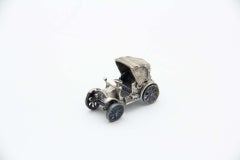
Silver car miniature

Silver car miniature

$150

H 1.07 in W 0.79 in D 0.79 in

Silver car miniature

Located in Porto, PT

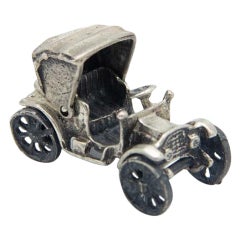
Description: Silver miniature car with hinged hood. Metal: Silver. Origin: Italian. Brand: Arrezo. Weight: 9.17 grams. Dimensions: 2.7cmx2cm. Content: 800/1000. Assay Mark: Yes. Addi...

Category

20th Century European Rococo Musical Instruments

Materials

Silver

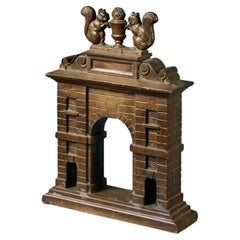
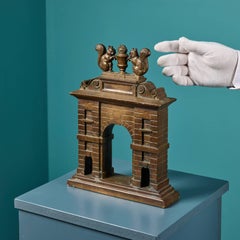
Grand Tour Style Scale Architectural Model of an Archway

Grand Tour Style Scale Architectural Model of an Archway

Located in Wormelow, Herefordshire

A handsomely made bronze scale architectural model of an arched gateway circa 1880. It is of Grand Tour style, ornamented with a decorative finial to the ...

Category

Late 19th Century English Antique Rococo Musical Instruments

Materials

Bronze

Previously Available Items
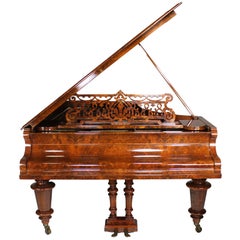
Antique 1880s Victorian Weber Carved Rosewood Rococo Grand Piano

Antique 1880s Victorian Weber Carved Rosewood Rococo Grand Piano

By Weber

Located in Dayton, OH

Antique Weber grand piano, circa 1880s. Made of Rosewood with Baroque and Rococo styling. An elaborate case with serpentine trim, acanthus foliate and scrolling detail. The piano ...

Category

Late 19th Century American Antique Rococo Musical Instruments
Materials

Rosewood

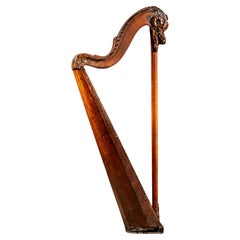
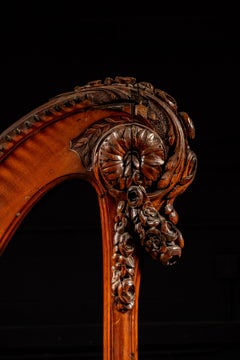
Late 18th Century Cousineau Single Action Pedal Harp

Late 18th Century Cousineau Single Action Pedal Harp

By Georges Cousineau

Located in Dekalb, IL

c. 1770s pedal harp manufactured by Georges Cousineau (1733-1800), a French luthier who specialized in harps; Cousineau's signature is present on the soundboard as well as the city o...

Category

Late 18th Century French Antique Rococo Musical Instruments
Materials

Wood

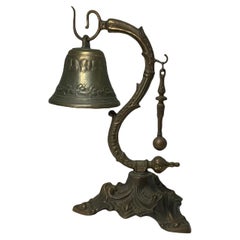
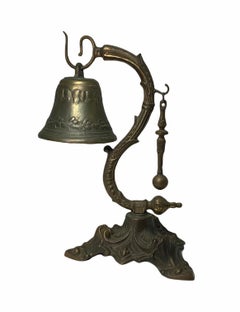
Rococo Style Heavy White Metal Call Bell

Rococo Style Heavy White Metal Call Bell

Sold

H 12.5 in W 10 in D 7 in

Rococo Style Heavy White Metal Call Bell

Located in Guaynabo, PR

This a bronze color heavy white metal call bell with a stand and a small bell stick. The bell is adorned with some repousse bay leaves branches. It hangs fro...

Category

20th Century Unknown Rococo Musical Instruments
Materials

Metal

Rococo musical instruments for sale on 1stDibs.
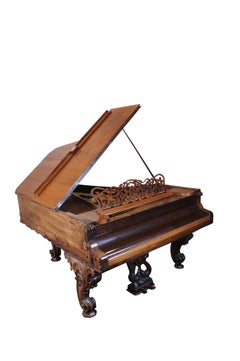
Find a broad range of unique Rococo musical instruments for sale on 1stDibs. Many of these items were first offered in the Early 20th Century, but contemporary artisans have continued to produce works inspired by this style. If you’re looking to add vintage musical instruments created in this style to your space, the works available on 1stDibs include more furniture and collectibles and other home furnishings, frequently crafted with wood, mahogany and other materials. If you’re shopping for used Rococo musical instruments made in a specific country, there are Europe, Germany, and Unknown pieces for sale on 1stDibs. It’s true that these talented designers have at times inspired knockoffs, but our experienced specialists have partnered with only top vetted sellers to offer authentic pieces that come with a buyer protection guarantee. Prices for musical instruments differ depending upon multiple factors, including designer, materials, construction methods, condition and provenance. On 1stDibs, the price for these items starts at $375 and tops out at $159,194 while the average work can sell for $87,416.