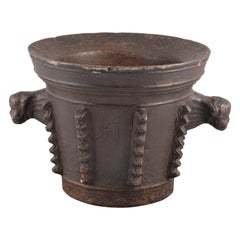
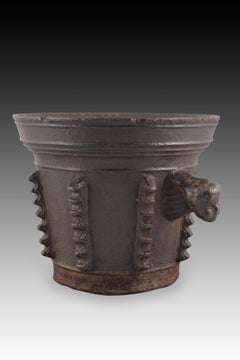
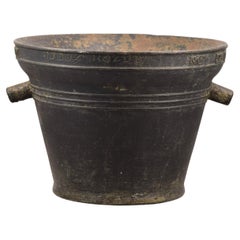
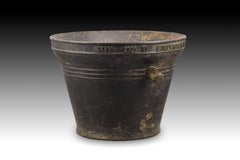
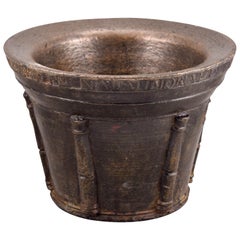
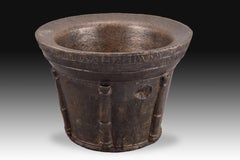
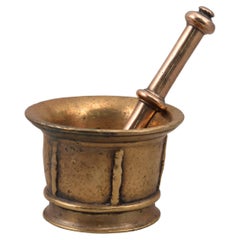
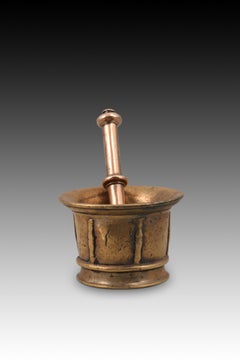
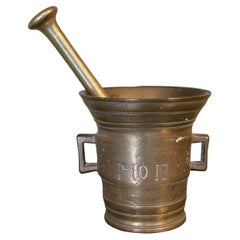
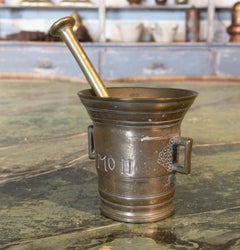
Mortar with Inscriptions. Bronze, Spain, 1823
Mortar with inscriptions. Bronze. Spain, 1823.
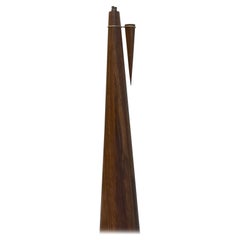
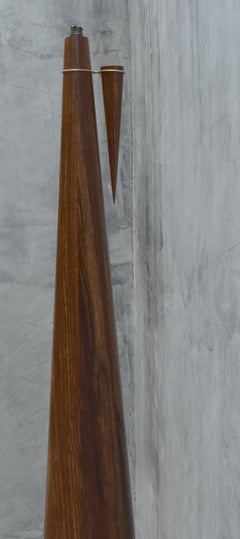
Con maza.
Mortar made of bronze with an enlarged mouth and a cone shaped body developed without discontinuity and with a decreasing diameter to the base; It has two handles or "pieces" towards the smooth decorative moldings that it has on the upper part. The piece presents, almost on the edge, an inscription (I AM FROM D GREGORIO OCANA ANO DE 1823) in capital letters and a date in roman with spaces between them; and the text (the other way around) “Mazon fecci”; both flanked by a simple molding above and another below.
This large-sized mortar is of the type that is usually known as "hospital" because it is usually used for medicines in environments with many patients or in important apothecaries. Typologically, it follows the usual line in these examples of the Spanish school during the 19th century: smooth, with moldings and, as a general rule, without those ribs (or derivatives thereof) that used to appear in the previous ones. Compare, for example, with the large pharmacy mortar in the Municipal Museum-Archive of Calella (with inscription, ribs and human heads as handles), a large pestle...
Category
1820s Neoclassical Revival Antique Spanish More Furniture and Collectibles