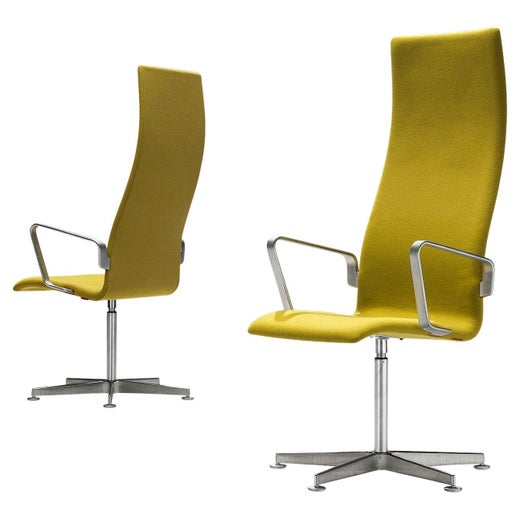
Series 7 By Arne Jacobsen chair for Fritz Hansen 1960s
By Arne Jacobsen
Located in Čelinac, BA
Arne Jacobsen Chair Series 7 for Fritz Hansen Denmark 1960s
Category
Vintage 1960s Danish Mid-Century Modern Chairs
Materials
Chrome
The eye-catching work of the Danish architect and designer Arne Jacobsen often introduces new collectors to mid-20th century furniture. With their fluid lines and sculptural presence, Jacobsen’s signature pieces — the elegant Swan chair and the cozy-yet-cutting edge Egg chair, both first presented in 1958 — are iconic representations of both the striking aesthetic of the designers of the era and their concomitant attention to practicality and comfort. Jacobsen designed furniture that had both gravitas and groove.
Though Jacobsen is a paragon of Danish modernism, his approach to design was the least “Danish” of those who are counted as his peers. The designs of Hans Wegner, Finn Juhl, Børge Mogensen and others grew out of their studies as cabinetmakers. They prized skilled craftsmanship and their primary material was carved, turned and joined wood. Jacobsen was first and foremost an architect, and while he shared his colleagues’ devotion to quality of construction, he was far more open to other materials such as metal and fiberglass.
Many of Jacobsen’s best-known pieces had their origin in architectural commissions. His molded-plywood, three-legged Ant chair (1952) was first designed for the cafeteria of a pharmaceutical company headquarters. The tall-backed Oxford chair was made for the use of dons at St. Catherine’s College, Oxford, whose Jacobsen-designed campus opened in 1962 (while still under construction). The Swan, Egg and Drop chairs and the AJ desk lamp were all created as part of Jacobsen’s plan for the SAS Royal Copenhagen Hotel, which opened in 1960. (The hotel has since been redecorated, but one guest room has been preserved with all-Jacobsen accoutrements.)
To Jacobsen’s mind, the chief merit of any design was practicality. He designed the first stainless-steel cutlery set made by the Danish silver company Georg Jensen; Jacobsen’s best-selling chair — the plywood Series 7 — was created to provide lightweight, stackable seating for modern eat-in kitchens. But as you will see from the objects on 1stDibs, style never took a backseat to function in Arne Jacobsen’s work. His work merits a place in any modern design collection.
Find authentic Arne Jacobsen chairs, tables, sofas and other furniture on 1stDibs.
When the Copenhagen-based furniture maker Fritz Hansen opened for business more than 140 years ago, the company — which today styles itself The Republic of Fritz Hansen — adhered to the traditional, time-honored Danish values of craftsmanship in woodworking and joinery. Yet thanks to the postwar innovations of Arne Jacobsen and others, Fritz Hansen would become the country’s leader in Scandinavian modern design using new, forward-looking materials and methods.
Fritz Hansen started his company in 1872, specializing in the manufacture of small furniture parts. In 1915, the firm became the first in Denmark to make chairs using steam-bent wood (a technique most familiar from birch used in the ubiquitous café chairs by Austrian maker Thonet). At the time, Fritz Hansen was best known for seating that featured curved legs and curlicue splats and referenced 18th-century Chippendale designs.
In the next few decades, the company promoted simple, plain chairs with slatted backs and cane or rush seats designed by such proto-modernist masters as Kaare Klint and Søren Hansen. Still, the most aesthetically striking piece Fritz Hansen produced in the first half of the 20th century was arguably the China chair of 1944 by Hans Wegner — and that piece, with its yoke-shaped bentwood back- and armrest, was based on seating manufactured in China during the Ming dynasty. (Wegner was moved by portraits he’d seen of Danish merchants in the Chinese chairs.)
Everything changed in 1952 with Arne Jacobsen’s Ant chair. The collaboration between the architect and Fritz Hansen officially originated in 1934 — that year, Jacobsen created his inaugural piece for the manufacturer, the solid beechwood Bellevue chair for a restaurant commission. The Ant chair, however, was the breakthrough.
With assistance from his then-apprentice Verner Panton, Jacobsen designed the Ant chair for the cafeteria of a Danish healthcare company called Novo Nordisk. The chair was composed of a seat and backrest formed from a single piece of molded plywood attached, in its original iteration, to three tubular metal legs. Its silhouette suggests the shape of the insect’s body, and the lightweight, stackable chair and its biomorphic form became an international hit.
Jacobsen followed with more plywood successes, such as the Grand Prix chair of 1957. The following year he designed the SAS Royal Hotel in Copenhagen and its furnishings, including the Egg chair and the Swan chair. Those two upholstered pieces, with their lush, organic frames made of fiberglass-reinforced polyurethane, have become the two chairs most emblematic of mid-20th-century cool. Moreover, the Egg and Swan led Fritz Hansen to fully embrace new man-made materials, like foam, plastic and steel wire used to realize the avant-garde creations of later generations of designers with whom the firm collaborated, such as Piet Hein, Jørn Utzon (the architect of the Sydney Opera House) and Verner Panton. If the Fritz Hansen of 1872 would not now recognize his company, today’s connoisseurs certainly do.
Find a collection of vintage Fritz Hansen tables, lounge chairs, sofas and other furniture on 1stDibs.
Series 7 By Arne Jacobsen chair for Fritz Hansen 1960s
By Arne Jacobsen
Located in Čelinac, BA
Arne Jacobsen Chair Series 7 for Fritz Hansen Denmark 1960s
Chrome
$295Sale Price / item|60% Off
H 30.5 in W 18.5 in D 19.5 in
1 Series 7 Chair by Arne Jacobsen for Fritz Hansen Multiple Available
By Arne Jacobsen, Fritz Hansen
Located in Pasadena, TX
Iconic chair of the Danish design movement, the Series 7 Chair was designed by Arne Jacobsen and produced by Fritz Hansen. Multiple available.
Steel
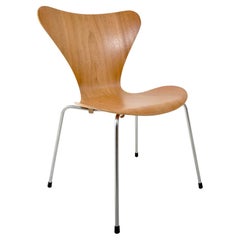
$480Sale Price / item|20% Off
H 30.5 in W 18.5 in D 19.5 in
1 Series 7 Chair by Arne Jacobsen for Fritz Hansen Multiple Available
By Arne Jacobsen, Fritz Hansen
Located in Pasadena, TX
Iconic chair of the Danish design movement, the Series 7 Chair was designed by Arne Jacobsen and produced by Fritz Hansen. Multiple available.
Steel
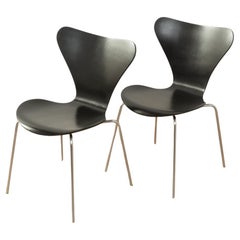
Dining chairs model 3107, Arne Jacobsen
By Fritz Hansen, Arne Jacobsen
Located in Neuss, NW
Classic chair model 3107 from Series 7 by Arne Jacobsen for Fritz Hansen. High-quality stainless steel frame with plywood seat shell in black. The offer includes two chairs. Quality...
Stainless Steel
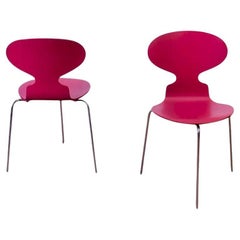
Arne Jacobsen "Ant" chairs for Fritz Hansen
By Arne Jacobsen
Located in Bridgewater, CT
Set of 6 Arne Jacobsen stained wood and chrome 'ANT' chairsfor Fritz Hansen
Plywood
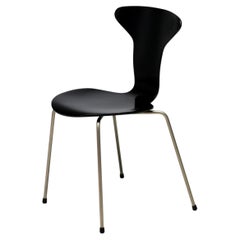
$2,250
H 30.71 in W 16.15 in D 19.69 in
Rare Early Model 3105 Chair by Arne Jacobsen for Fritz Hansen, Denmark, 1955
By Arne Jacobsen, Fritz Hansen
Located in Dronten, NL
A rare and highly collectible early Model 3105 chair designed by Arne Jacobsen in 1955 and produced by Fritz Hansen, Denmark. This very early example is finished in black and represe...
Steel
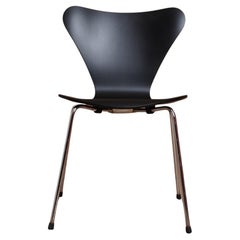
Series 7 By Arne Jacobsen Chair For Fritz Hansen 1960ss
By Arne Jacobsen
Located in Čelinac, BA
Arne Jacobsen Chair series 7 for Fritz Hansen Denmark 1960s
Chrome
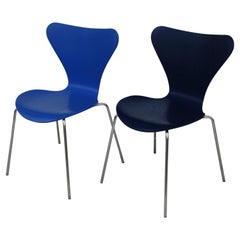
$320Sale Price / item|20% Off
H 31.75 in W 19.5 in D 20 in
1 Vintage Series 7 Chair by Arne Jacobsen for Fritz Hansen
By Arne Jacobsen
Located in Pasadena, TX
Arne Jacobsen Denmark (1902-1971) Arne Jacobsen bought a plywood chair designed by Charles Eames and installed it in his own studio, where it inspired one of the most commercially successful chair models in design history. The three-legged Ant chair (1951) sold in millions and is considered a classic today. It consists of two simple elements: tubular steel legs and a springy seat and back formed out of a continuous piece of plywood in a range of vivid colors. Vintage mid-century modern Series 7 chairs by Arne Jacobsen...
Wood
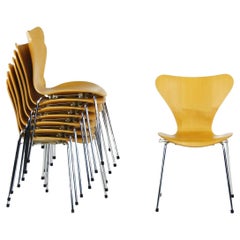
$550 / item
H 32.5 in W 22.5 in D 20 in
2001 Arne Jacobsen for Fritz Hansen Knoll Series 7 Stacking & Interlocking Chair
By Fritz Hansen, Arne Jacobsen
Located in Philadelphia, PA
Listed for sale is a series 7 chair designed by Arne Jacobsen and produced by Fritz Hansen in Denmark. The listing is for each individual chair, however, eight are available. These c...
Metal
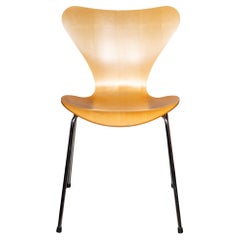
Fritz Hansen Series 7 Chair-Maple
By Arne Jacobsen, Fritz Hansen
Located in San Francisco, CA
ABOUT Contact us for a customized shipping quote. The Series 7 Chair (1955) features an ideal shape for the human body, with a back that offers a bit of give to keep your upper b...
Chrome
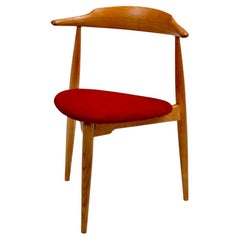
Hans J. Wegner Heart Chairs - Four Available
By Fritz Hansen, Hans J. Wegner
Located in Los Angeles, CA
Priced per item/chair. Designed by Hans J. Wegner and produced by Fritz Hansen circa 1950s. Stackable Model FH4103 dining chairs with solid oak construction and teak veneer seats in ...
Fabric, Beech
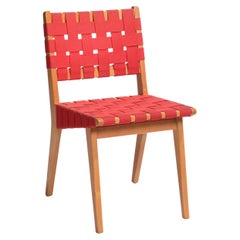
13 jens Risom Side Chairs for Knoll
By Knoll, Jens Risom
Located in Los Angeles, CA
Introducing the Knoll Risom Side Chair - A Timeless Icon of Modern Design! The Knoll Risom Side Chair is a true testament to the enduring legacy of modern furniture design. Created ...
Cotton, Wood
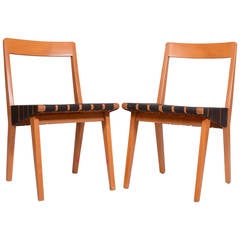
Pair of Jens Risom 666 Side Chairs for Knoll
By Jens Risom, Knoll
Located in Los Angeles, CA
Rare Jens Risom chairs made in the 1940s, model “666” of the 600 series from 1941.
Birch
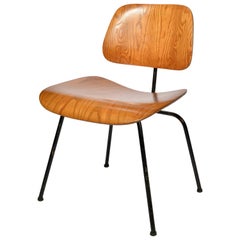
Early Charles & Ray Eames for Herman Miller DCM Chair in Oak, 1953
By Charles and Ray Eames, Herman Miller
Located in Los Angeles, CA
Early Charles Eames for Herman Miller Company molded plywood dining chair in oak with wonderful patina. The oak version is very rare, only one year in production.
Steel
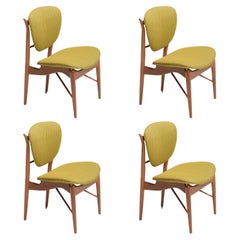
Finn Juhl 51 Chairs by Baker - Three Available
By Baker Furniture Company, Finn Juhl
Located in Los Angeles, CA
Beautiful Finn Juhl Model 51 chairs by Baker Furniture circa 1952 for the Baker Modern line. Priced per chair. One chair displayed in our Los Angeles showroom.
Walnut
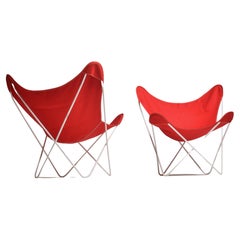
Vintage Mid-Century BKF Hardoy Butterfly Chair for Knoll
Located in Los Angeles, CA
BKF Hardoy butterfly chairs for Knoll. New powder coat white finish, for indoor or outdoor use. New canvas slings. Priced per chair. 4 chairs in stock.
Steel
You know the designs, now get the stories about how they came to be.
The curvaceous Egg was designed to cradle the body and offer privacy. Later, it became the seat of choice for bosses in movies, too.