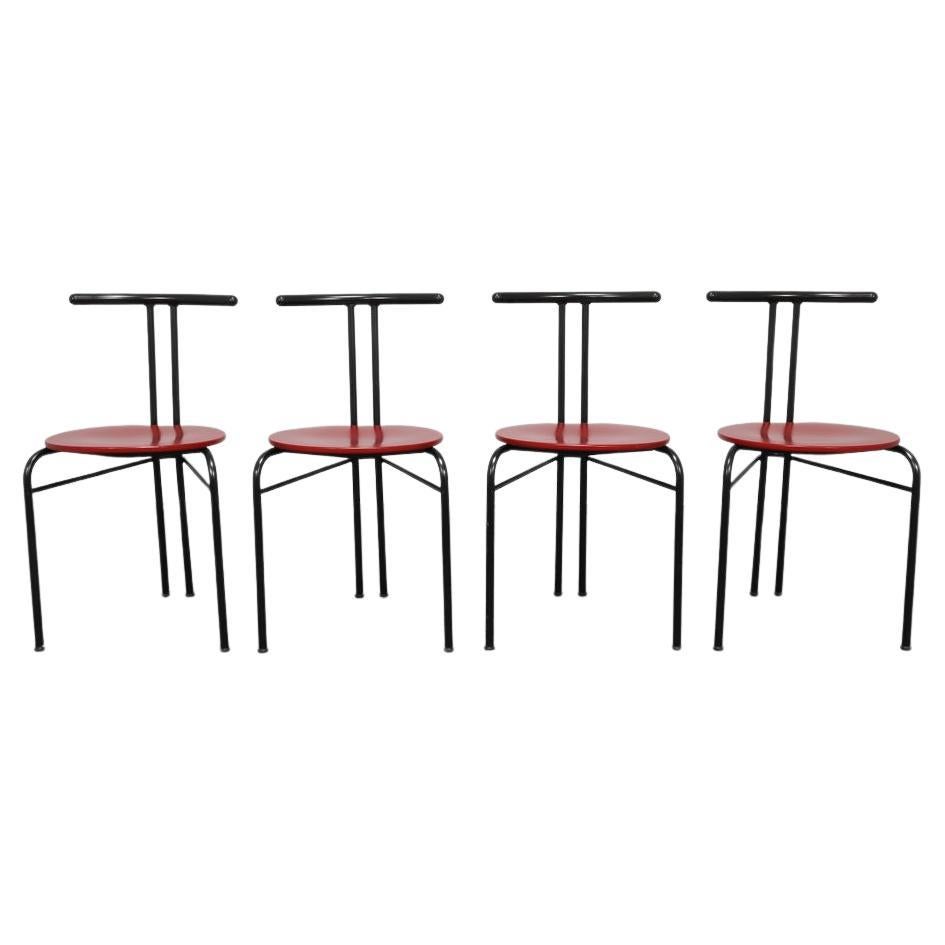
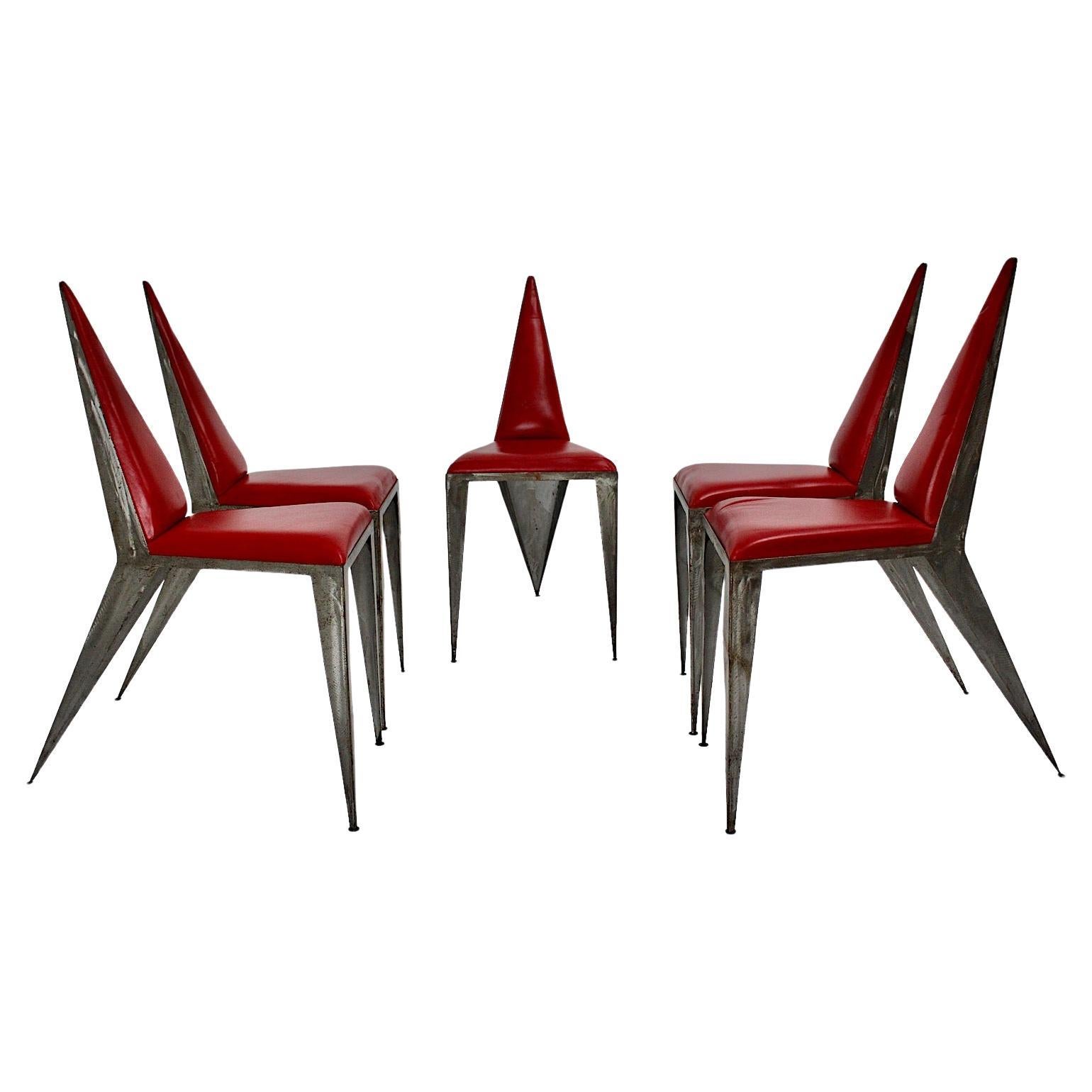
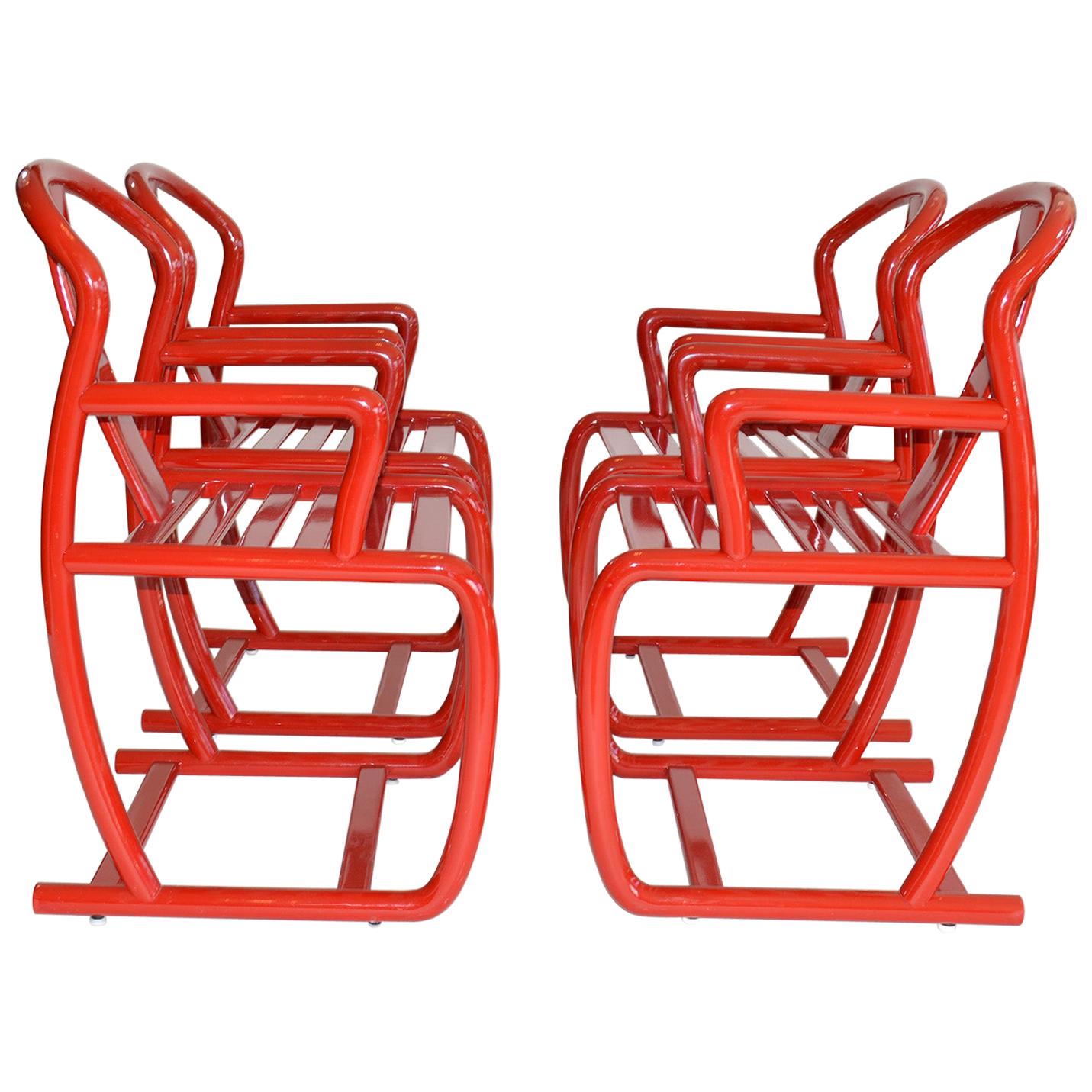
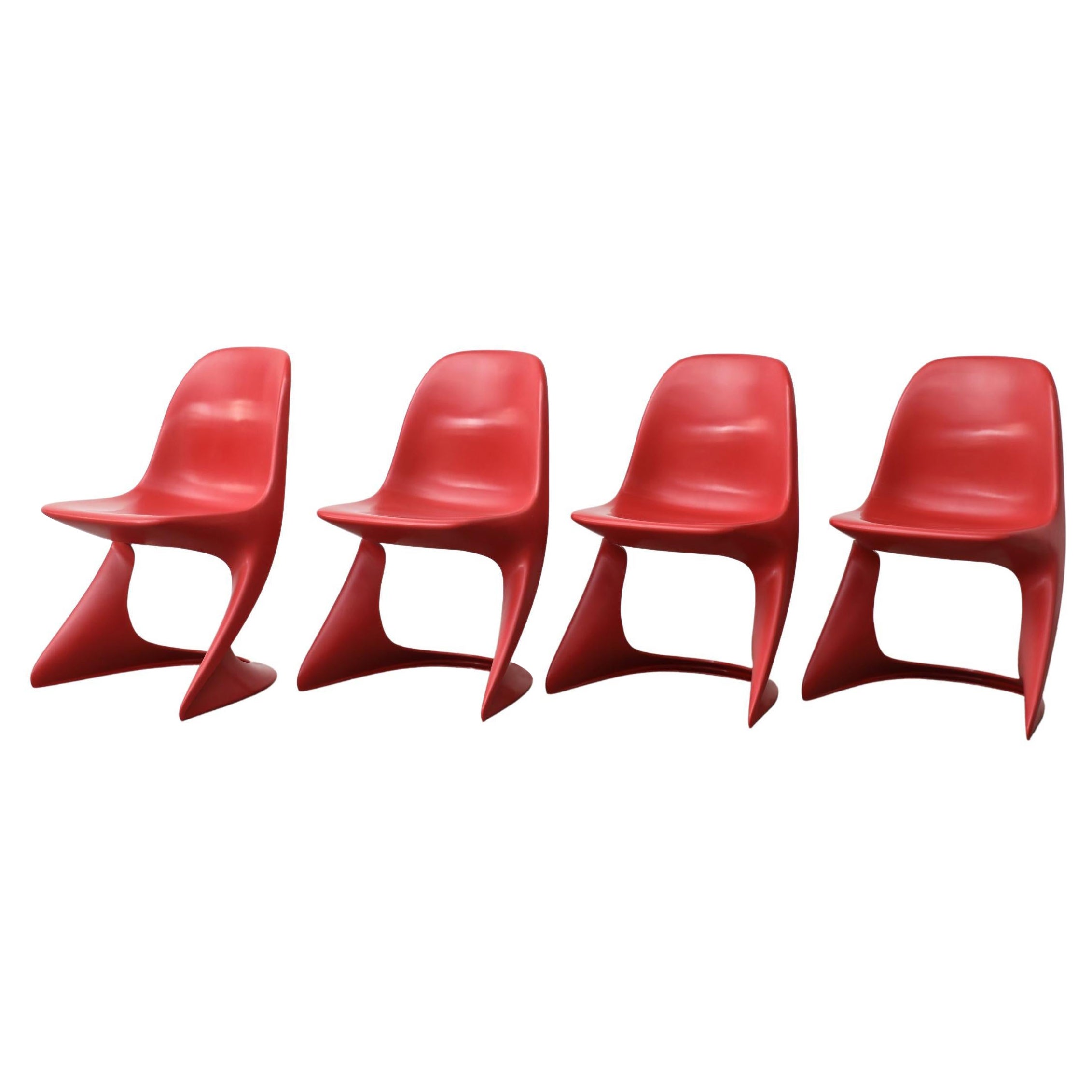
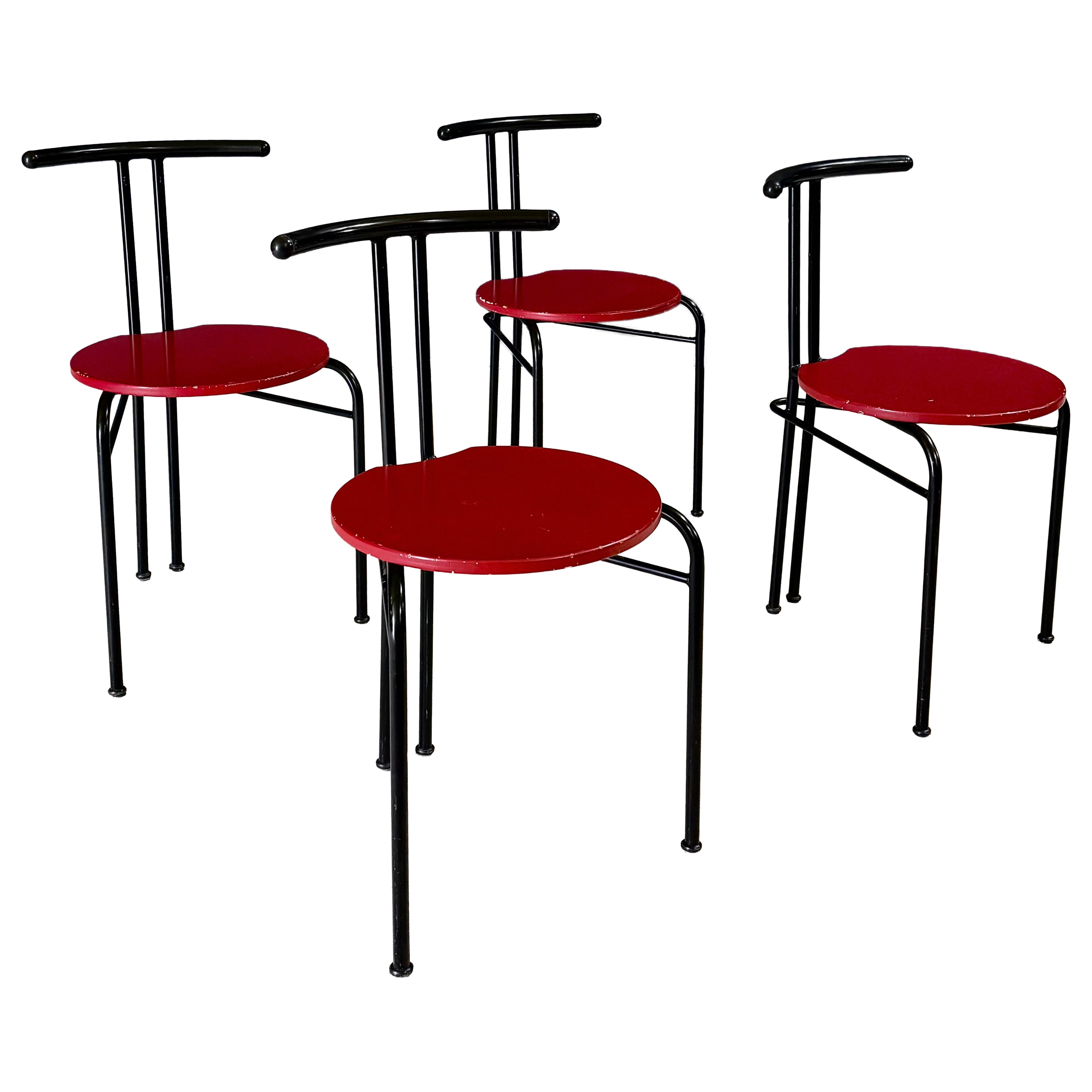
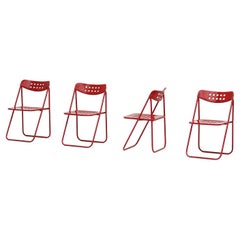
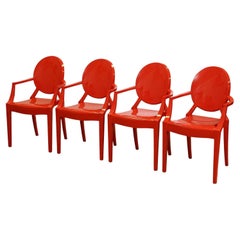
Postmodern Folding Chairs, Red Triangular Seats, Set of Four, Circa 1985
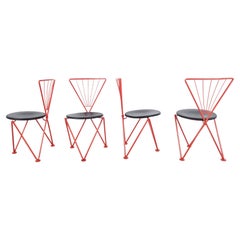
Each of these four folding chairs is built from two triangles and a black line. The seat is a broad triangle of scarlet laminate, its apex projecting forward, notched at the back edge where the uprights pass through it; above and behind, a smaller triangle of the same laminate is set point-downward as a back rest, carried at the head of two slender parallel uprights. The laminate is finished with a fine black edge, so that every panel is drawn in outline against the red.
The frame is of slim flat metal bar lacquered black, arranged as a scissor action and pivoting on exposed bolts, with plain T-shaped bars front and back for feet, laid flat on the floor rather than fitted with glides. A tubular catch at the back locks the chair open, and released, the whole folds down absolutely flat, the two triangles closing against the frame so that the folded chair is a single flat object a couple of inches thick.
The design has the graphic economy of the best postmodern furniture of the period. There is no color but red and black, no curve anywhere, and no detail that is not doing structural work; seen from the front the chair reads as an arrow standing on a stem, and from the side as a pair of crossed diagonals. Standing in a row, the four make a considerable effect for chairs that will stack flat in a closet.
Folding chairs of this kind belong to the wave of geometric, primary-colored furniture that followed the founding of Memphis in Milan at the turn of the 1980s, when designers turned decisively away from the functionalist grammar of the previous generation toward strong color, flat planes, and forms chosen for how they read rather than how they sit. Laminate, cheap and available in saturated color, became the characteristic material of the moment, and the folding chair, a type with a long utilitarian history, was a natural subject for redesign along those lines.
The chairs are unmarked, though each retains the outline of a rectangular paper label formerly applied to the frame, so that they left the factory labeled and the label has simply been lost. On the evidence of the type, the construction, and the palette they are most likely Italian, or made for the Italian market, and datable to the middle or later 1980s; no designer or manufacturer has been established.
Dimensions
Height: 28 inches (71.1 cm)
Width: 16⅝ inches (42.2 cm)
Depth: 17 inches (43.2 cm)
Seat height: 18¼ inches (46.4 cm)