1 of 10

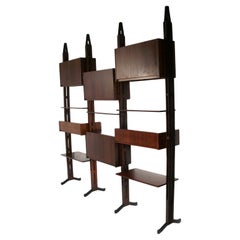
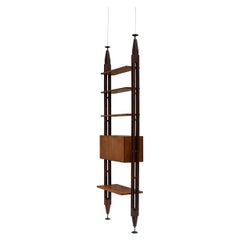
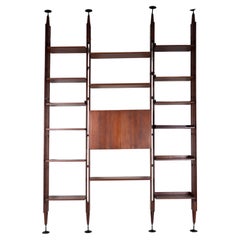
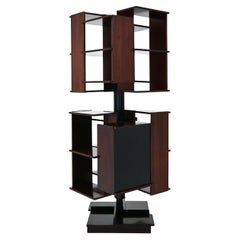
Library or Room Divider "LB7, " in Rosewood by Franco Albini for Poggi, 1956

$11,222.40List Price

You May Also Like

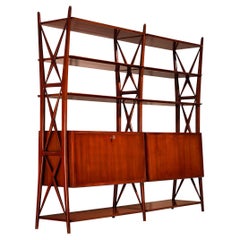
Franco Albini Italian Bookcase in Rosewood for Poggi Mid Century circa 1950s

Franco Albini Italian Bookcase in Rosewood for Poggi Mid Century circa 1950s

By Franca Helg, Poggi, Franco Albini

Located in Atlanta, GA

Modernist Italian Bookcase, designed by Franco Albini and Franca Helg for Poggi, Italy, circa 1950s. This library is believed to be Model LB7 or LB8 and is comprised of four uprights...

Category

Vintage 1950s Italian Mid-Century Modern Shelves

Materials

Metal

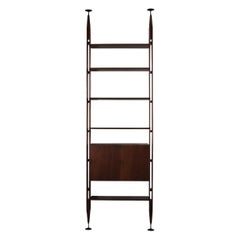
Midcentury LB7 modular bookcase designed by Franco Albini for Poggi, Italy 1957

Midcentury LB7 modular bookcase designed by Franco Albini for Poggi, Italy 1957

By Franco Albini, Poggi

Located in Piacenza, Italy

Modular bookcase model LB7 designed by Franco Albini for Poggi. Marked Poggi Pavia. An extremely flexible bookcase, with different modular options, suited to being against a wall or...

Category

Vintage 1950s Italian Mid-Century Modern Bookcases

Materials

Wood

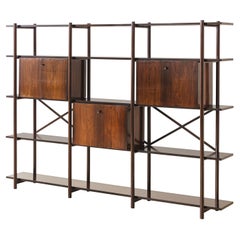
Franco Albini Rosewood Mid-Century Modern “LB7” Modular Bookcase for Poggi, 1957

Franco Albini Rosewood Mid-Century Modern “LB7” Modular Bookcase for Poggi, 1957

By Poggi, Franco Albini

Located in Vicenza, IT

LB7 bookcase, designed by Franco Albini and manufactured by Poggi in 1957. Modular bookstore composed by upholds, containers with flying and doors, shelve. The industrial standard for every product component allows permanent and different solutions, from the bearing structures to the elements. The structure does not need anchorages to the wall and can be placed in the middle of the space. This set is composed of 3 modules, ten shelves, and three containers. It is made of Rosewood, iron, and brass. Excellent vintage condition. Franco Albini was born in Robbiate in 1905, and after his childhood and part of his youth, he moved to Milan. He graduated at Politecnico of Milan, Faculty of Architecture, in 1929, and He collaborated for three years in Giò Ponti and Emilio Lancia’s office. He probably had his international contacts here, at The International Exposition of 1929 in Barcelona and Paris, where he visited le Corbusier’s office, as Franca Helg used to tell. Throughout these first three years, his works were undoubtedly related to XIXth Century. His meeting with Edoardo Persico marks an evident turnover towards rationalism and writers for “Casabella” magazine. Persico’s thoughtful and ironical comments on some of Albini’s drawings for office furniture caused him deep upsetting. “I spent days of real anxiety – tells Albini – I had to answer all questions. I had a long fever”. The new phase that the meeting provoked begins with opening his own first office at Via Panizza with Renato Camus and Giancarlo Palanti. The group of Architects starts taking care of social housing, participating in the competition for the Baracca neighborhood in 1932, and then realizing the Ifacp neighborhood: Fabio Filzi (1936/38), Gabriele D’Annunzio, and Ettore Ponti (1939). During those years, He also worked for his first private villa (Pestarini). It is mainly in the context of exhibitions that the Italian architect experiments the compromise between rigor and poetic fantasy that Pagano was talking about; He conceived all the elements that would become recurrent in all types of his work – Architecture, Interiors, Design. The 1933 opening of the new Triennale of Milano, in Palazzo dell’Arte, becomes an occasion to express the highly innovative character of rationalist thinking. In this place, to experiment with new materials and solutions, but most of all a “method”. Young rationalist architects cultivated the art of exhibiting as a communication lab, an open field to space solutions. Albini, with Giancarlo Palanti, sets the steel structure house (with R. Camus, G. Mazzoleni, G. Minoletti and coordination by G. Pagano) designing also its furniture. For the next Triennale in 1936, marked by Persico’s early death, Franco Albini, together with a group of young architects around Pagano, takes care of the exhibition of Dwelling, where he presented 3 types of lodgings. In the same year, Albini and Romano design the exhibition for Ancient Italian jewelry: vertical uprights, simple linear poles design space. This element is recurring in other works, like the Scipione exhibition (1941), Vanzetti stand (1942), and Olivetti shop in Paris (1956). The architectural space is readable through a grid, introducing a third dimension, the vertical one, with a sense of lightness and transparency. Upright is also used in design objects, such as the Veliero bookcase...

Category

Vintage 1950s Italian Mid-Century Modern Shelves
Materials

Brass, Iron

Brazilian Modern Modular Bookshelf in Rosewood, Ernesto Hauner, Rosewood, 1960s

Brazilian Modern Modular Bookshelf in Rosewood, Ernesto Hauner, Rosewood, 1960s

By Ernesto Hauner

Located in New York, NY

Designed in Brazil in the 1960s, this modular bookshelf by Ernesto Hauner exemplifies the disciplined elegance and material sophistication that define Brazilian mid-century modern de...

Category

Mid-20th Century Brazilian Mid-Century Modern Bookcases

Materials

Brass

Rare Mid-Century Modern Walnut Bookcase by Pierluigi Spadolini, 1970s

Rare Mid-Century Modern Walnut Bookcase by Pierluigi Spadolini, 1970s

By Pierluigi Spadolini

Located in Byron Bay, NSW

RARE Pierluigi Spadolini was a renowned Italian architect and designer, known for his contributions to modern architecture and industrial design. One of his notable designs includes ...

Category

Vintage 1970s Italian Mid-Century Modern Bookcases

Materials

Walnut

LB7 three-bay bookcase, Franco Albini for Poggi 1950

LB7 three-bay bookcase, Franco Albini for Poggi 1950

$37,801

H 118.12 in W 79.93 in D 14.18 in

LB7 three-bay bookcase, Franco Albini for Poggi 1950

By Franco Albini

Located in Milano, Lombardia

Three-bay bookcase model “LB7”, designed by Franco Albini for Poggi around 1950. The system is part of the Milanese architect’s research on the theme of furniture as a light architec...

Category

Vintage 1960s Italian Mid-Century Modern Bookcases

Materials

Metal

Silvio Cavatorta Elegant Library in Mahogany

Silvio Cavatorta Elegant Library in Mahogany

$24,500

H 70.87 in W 78.75 in D 15.56 in

Silvio Cavatorta Elegant Library in Mahogany

By Silvio Cavatorta

Located in Waalwijk, NL

Silvio Cavatorta bookcase and storage unit, mahogany, brass, Italy, 1940s This elegant library is a striking example of Italian design, crafted by designer Silvio Cavatorta in the l...

Category

Vintage 1940s Italian Mid-Century Modern Bookcases

Materials

Brass

Joaquim Tenreiro Bookshelf, Rosewood Veneers, Brazilian Mid-Century Modern, 1950

Joaquim Tenreiro Bookshelf, Rosewood Veneers, Brazilian Mid-Century Modern, 1950

By Joaquim Tenreiro

Located in New York, NY

Designed by Joaquim Tenreiro in the 1950s, this bookshelf is a rare example of his refined approach to proportion and material. Recently restored according to its original specificat...

Category

Vintage 1950s Brazilian Mid-Century Modern Bookcases

Materials

Metal

Franco Albini LB7 Bookcase in Teak Wood by Poggi Pavia 1950s Italy

Franco Albini LB7 Bookcase in Teak Wood by Poggi Pavia 1950s Italy

By Franco Albini, Poggi

Located in Cascina, Pisa

LB7 bookcase composed of a single module with shelves and a storage unit with two doors, made in veneered solid teak wood, and black lacquered metal details. Designed by Franco Alb...

Category

Vintage 1950s Italian Mid-Century Modern Bookcases

Materials

Metal

Bookcase "Centro" by Claudio Salocchi for Sormani, 1960s

Bookcase "Centro" by Claudio Salocchi for Sormani, 1960s

$26,579

H 83.86 in W 31.11 in D 31.11 in

Bookcase "Centro" by Claudio Salocchi for Sormani, 1960s

By Sormani, Claudio Salocchi

Located in bruxelles, BE

Bookcase in wood and metal designed by Claudio Salocchi in the 60s. Model: Centro. The bookcase turns on itself. Wear due to time and age FOR SHIPPING, REQUEST US FOR RECEIVE THE BES...

Category

Vintage 1960s Italian Mid-Century Modern Bookcases

Materials

Metal