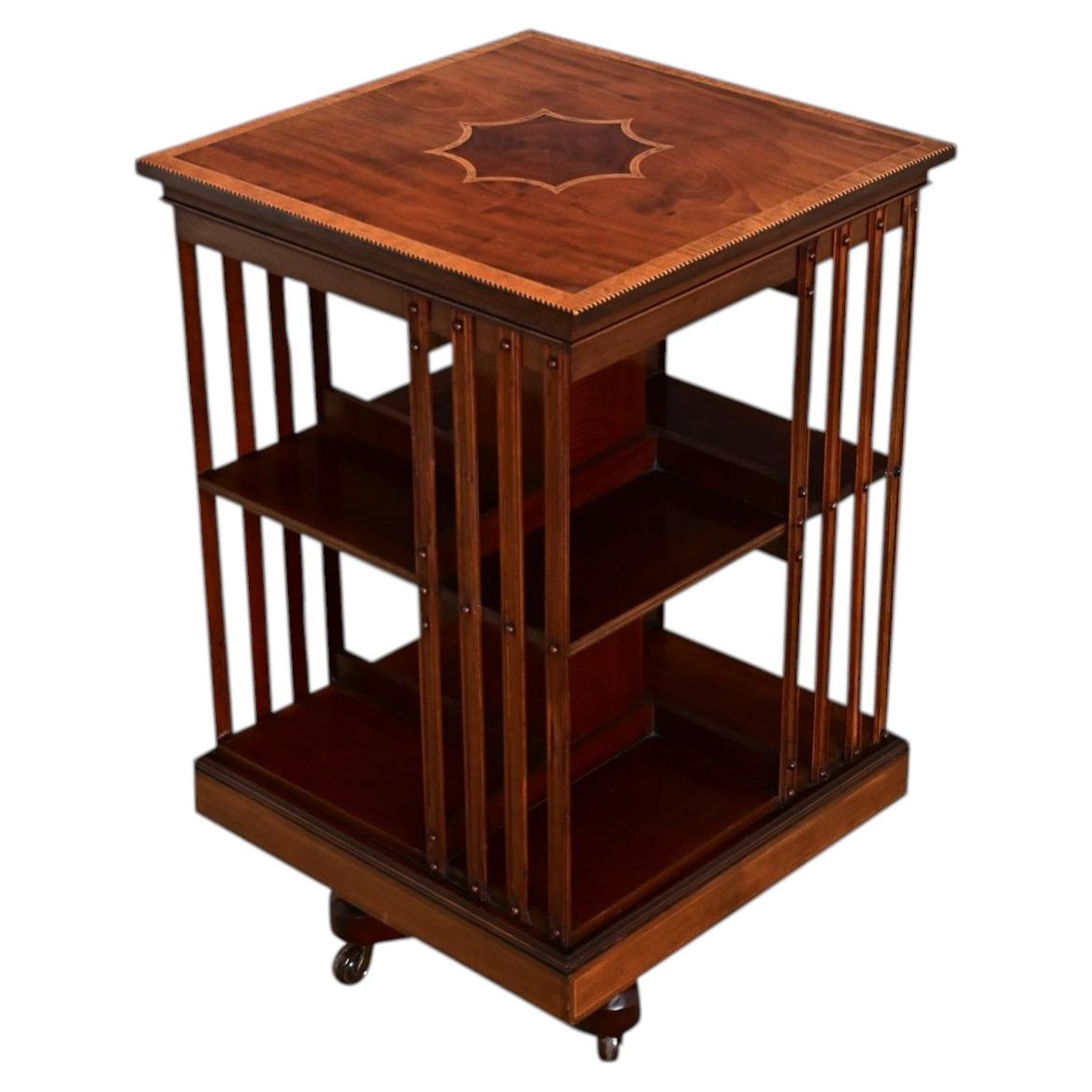
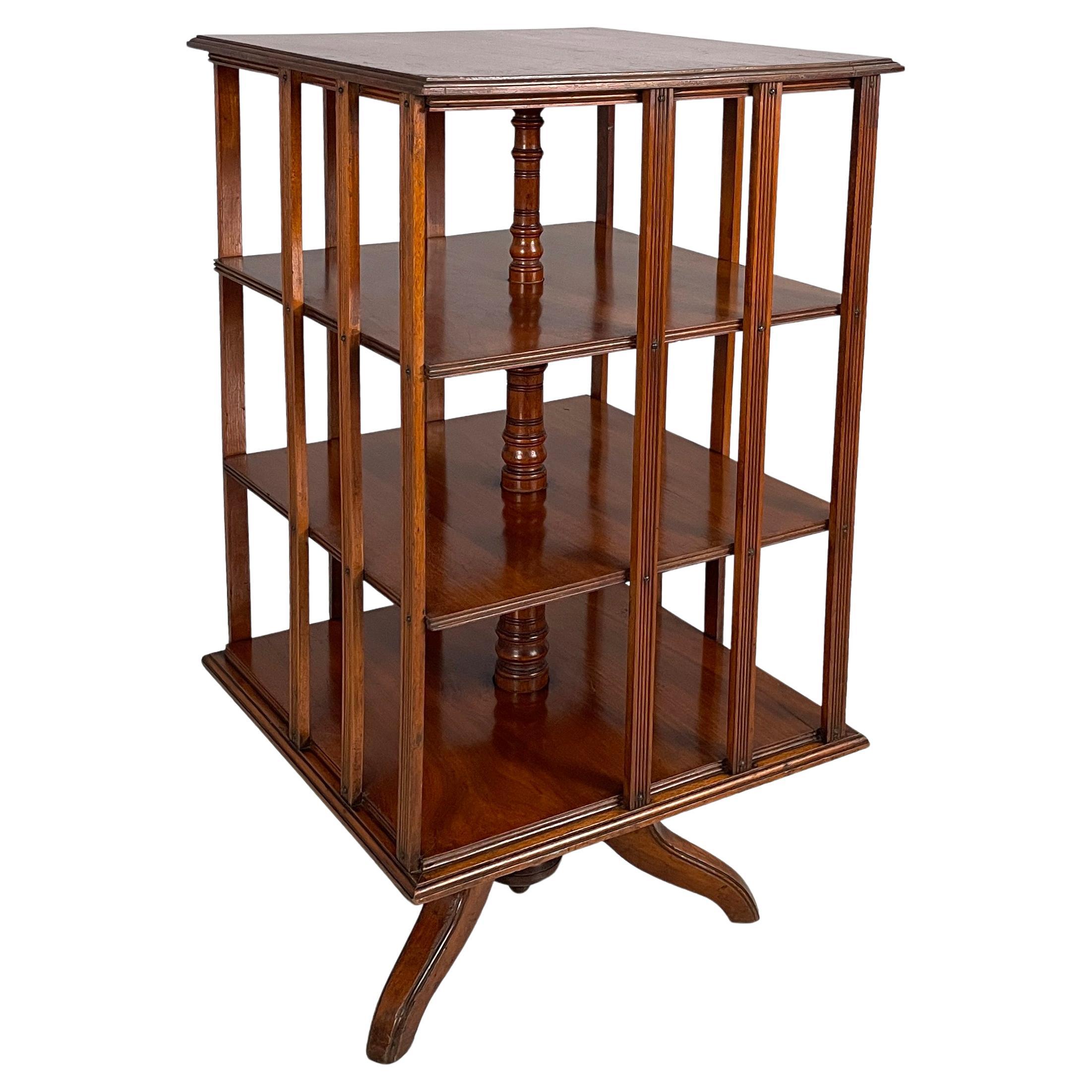
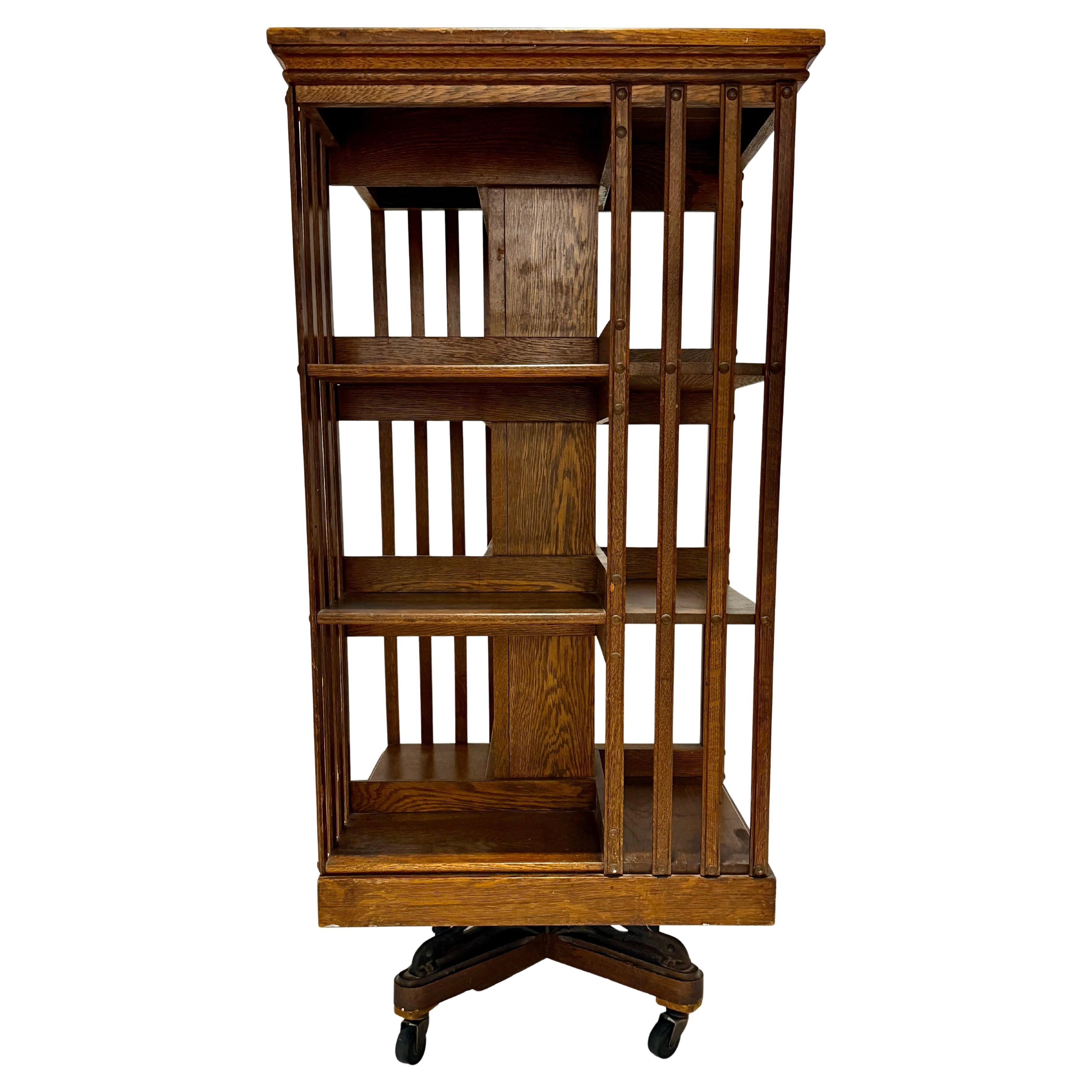
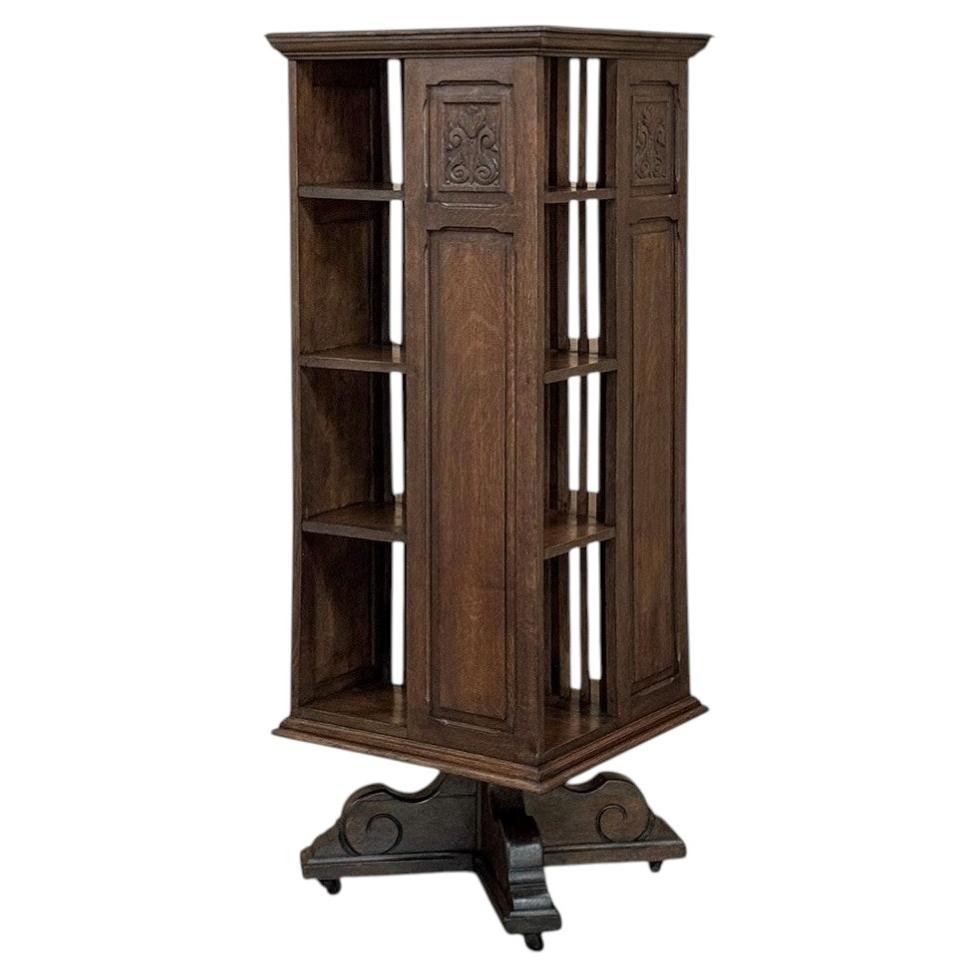
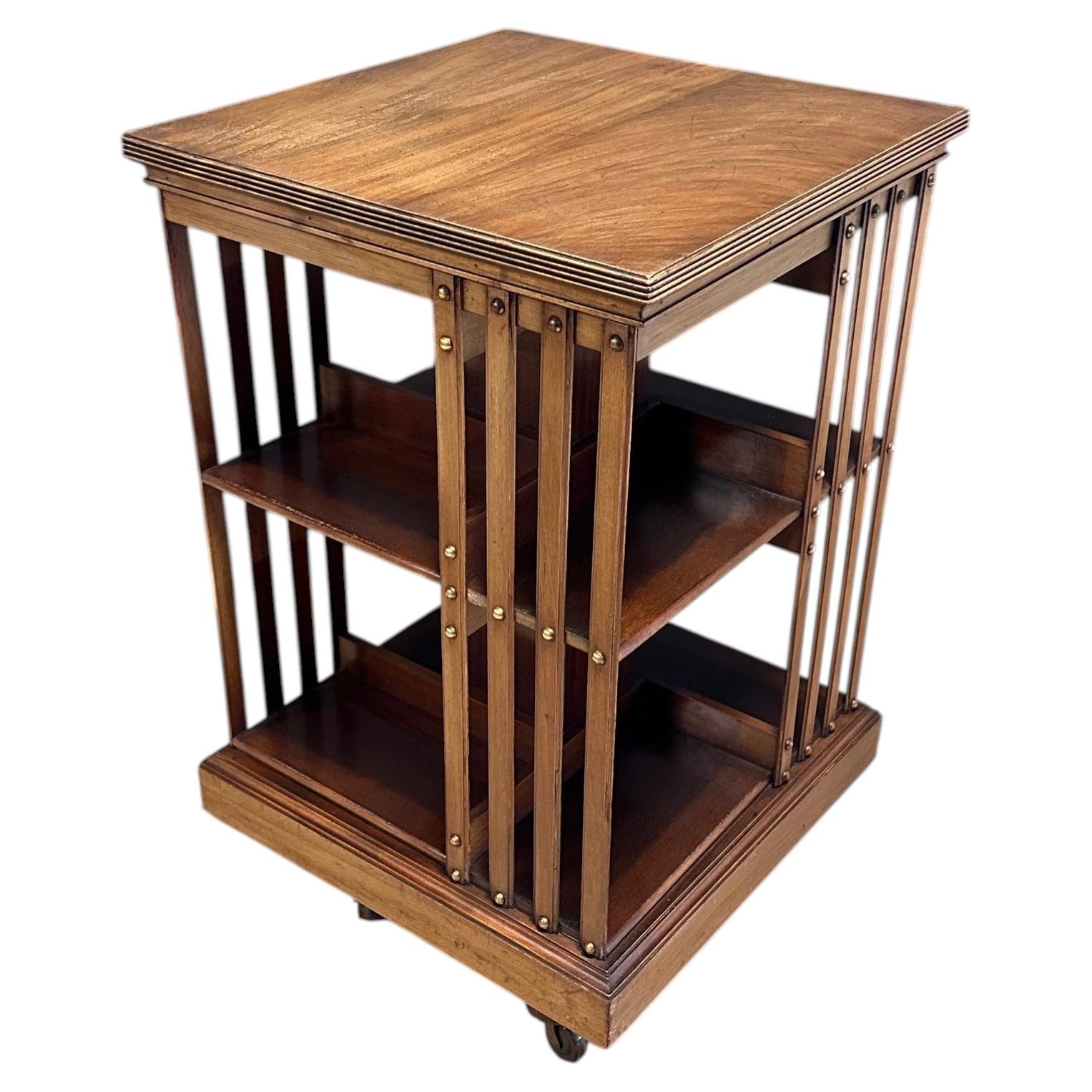
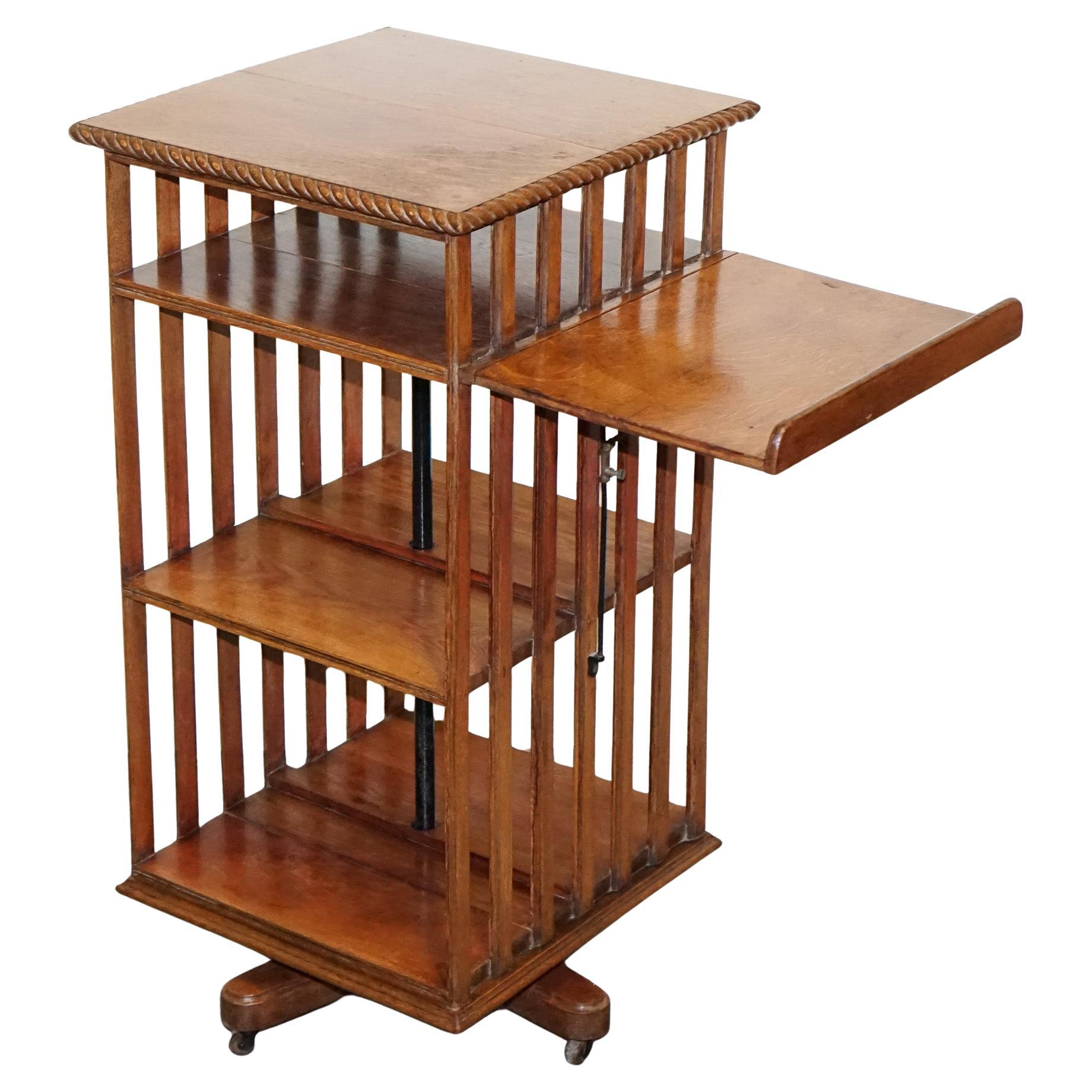
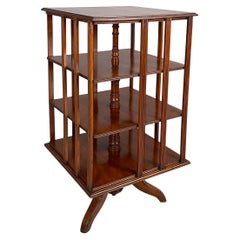
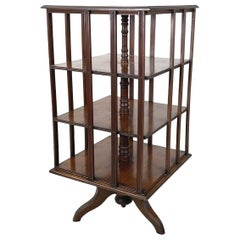
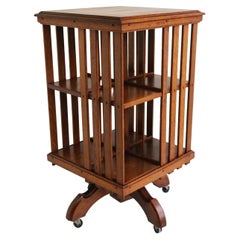
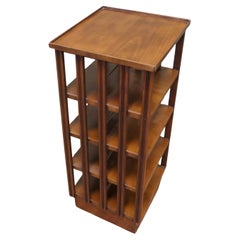
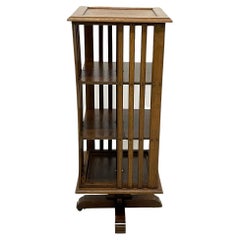
This fine and small revolving bookcase was made by the Manchester-based firm of Goodall, Lamb and Heighway c.1899 from salvaged materials taken from Lord Nelson’s former flagship the Foudroyant which had been smashed to pieces in a storm off of Blackpool beach in 1897. Lambs managed to acquire much of the salvageable material from the wreck and by 1900 they were advertising this widely in the newspapers, producing a Book of Foudroyant to explain this new line. The present piece has a plaque on it which reads:
‘Made by Goodall, Lamb and Heighway Ltd, Manchester. This bookcase is made from the oak and pine salved (sic) from the “Foudroyant”, Nelson’s Flagship, of which this disc of copper formed a part’.
We have handled many pieces of Foudroyant timber furniture over the years, as well as smaller items such as snuff boxes or napkin rings, but the present piece is a rare and unusual design which has a particularly appealing story. In an advert in the Evening News, 4th of August 1899, the full story of these remarkable bookcases was revealed:
‘NELSON’s FLAGSHIP H. M. S. FOUDROYANT
Messrs. Harmsworth Brothers have made arrangements with Messrs. Goodall, Lamb and Heighway, Limited, of Manchester, the well-known manufacturers of furniture, whereby EXCLUSIVE CONTROL of the Foudroyant’s timbers and copper has been obtained for the supply of Foudroyant bookcases in connection with the 100 Best Books. Of necessity the supply is limited, and intending subscribers should not delay in sending orders for this, the only possible relic of Nelson and his times! In a few years the value of the Foudroyant book-case as an heirloom will be many times the cost of this case and the books together. Every book-case will be made ENTIRELY FROM THE TIMBERDS SALVED FROM THE FOUDROYANT and a disc made from the Foudroyant’s bolts is affixed to the book-case, with a legend declaring this fact. A bond has been given by the manufacturers, guaranteeing, under a £500 penalty, that all the wood and copper in the cases was salved from Nelson’s ship. Each purchaser with receive a copy of this bond.
The oak of the Foudroyant is of the most beautiful description, exquisite in grain and texture, a superb realisation of what helped our boats about “Hearts of Oak” and the “Wooden Walls of England”. The book cases into which the wood has been made, the back and shelves being of Foudroyany pine, are thoroughly well made and artistic. They are built to contain the 100 Best Books and are in two styles: a wall book case or a revolving book case. The revolving book case stands into a corner out of the way when not in use. It is 3ft high by 1ft 8in square. The wall book case is 3ft 1in long, 10.5 in deep, and 3ft 8.5 in high.
These Foudroyant book cases, souvenirs of Nelson, are offered in connection with the 100 Best Books, Sir John Lubbock’s List, as published by Messrs Harmsworth. These books are the finest collection for an English home that can be had and the first hundred books in the whole world of literature. An illustrated forty-page pamphlet telling all about them will be forwarded free on application. The books are bound in three styles: dark green cloth at £9; half bound in dark-red Morocco with gilt top, at £12; or in superb full red Morocco, full gilt, at £18…..
The Foudroyant book-cases-either pattern-are supplied for £2 10s for cash or £2 12s 6d on the instalment plan in connection with orders for the books. Subscribers should understand that these PRICES ARE ONLY POSSIBLE IN CONNECTION WITH THE 100 BEST BOOKS. All applications and inquiries should be addressed to “E. N.,” Room 12, Harmsworth Buildings, E. C., London.
Intending subscribers are advised to order at once-orders will be filled in strict rotation-as there is only a given quantity of the wood and copper. Never before has such an offer been made, and it never can be repeated. A number have already availed themselves of the opportunity to possess a souvenir of the greatest fighting ship in English Naval History. Many Museums have secured these souvenirs, and among those who have acquired relics of Nelson’s Foudroyant are:
R. H. The Duke of York
Sir Matthew White-Ridley
The Hon. A. Nelson Hood
The Emperor Menelik’
HMS Foudroyant
HMS Foudroyant was an 80-gun third-rate ship of the line of French origin, captured by the Royal Navy from the French in 1798 during the Battle of the Nile. Originally launched by France in 1798, she was taken into British service after her capture and quickly became known as one of the finest ships in the Royal Navy. Between 1799 and 1801, she served as the flagship of Vice Admiral Horatio Nelson in the Mediterranean, carrying him during the campaigns that followed his victory at the Nile. It was from her quarterdeck that Nelson directed naval operations, supported the Kingdom of Naples, and continued the blockade of French forces, cementing Foudroyant’s place in British naval history as one of his most celebrated command ships.
Following her active naval career, Foudroyant served in a variety of roles before being retired from frontline service in the nineteenth century. Saved from scrapping in 1891 through a public campaign led by the philanthropist Wheatley Cobb, she became a training ship for boys and a symbol of Britain’s maritime heritage. Tragically, while being towed to Blackpool in June 1897 as a public attraction, Foudroyant was driven ashore by a violent storm at Blackpool Sands. Despite determined efforts to refloat her, the damage proved irreparable, and the ship was broken up on the beach. Although she no longer survives, HMS Foudroyant remains remembered as Nelson’s beloved flagship and one of the most famous ships of the age of sail.