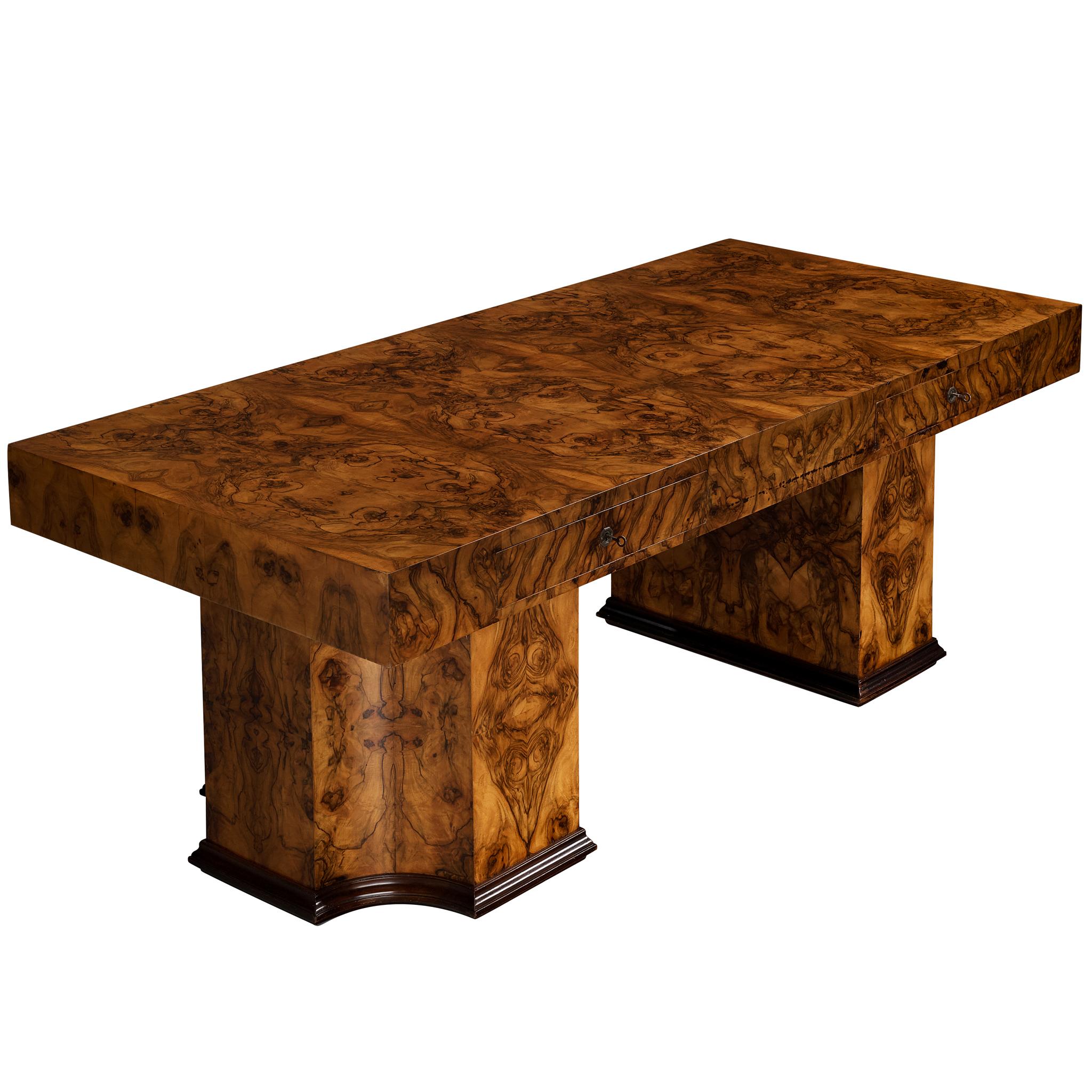
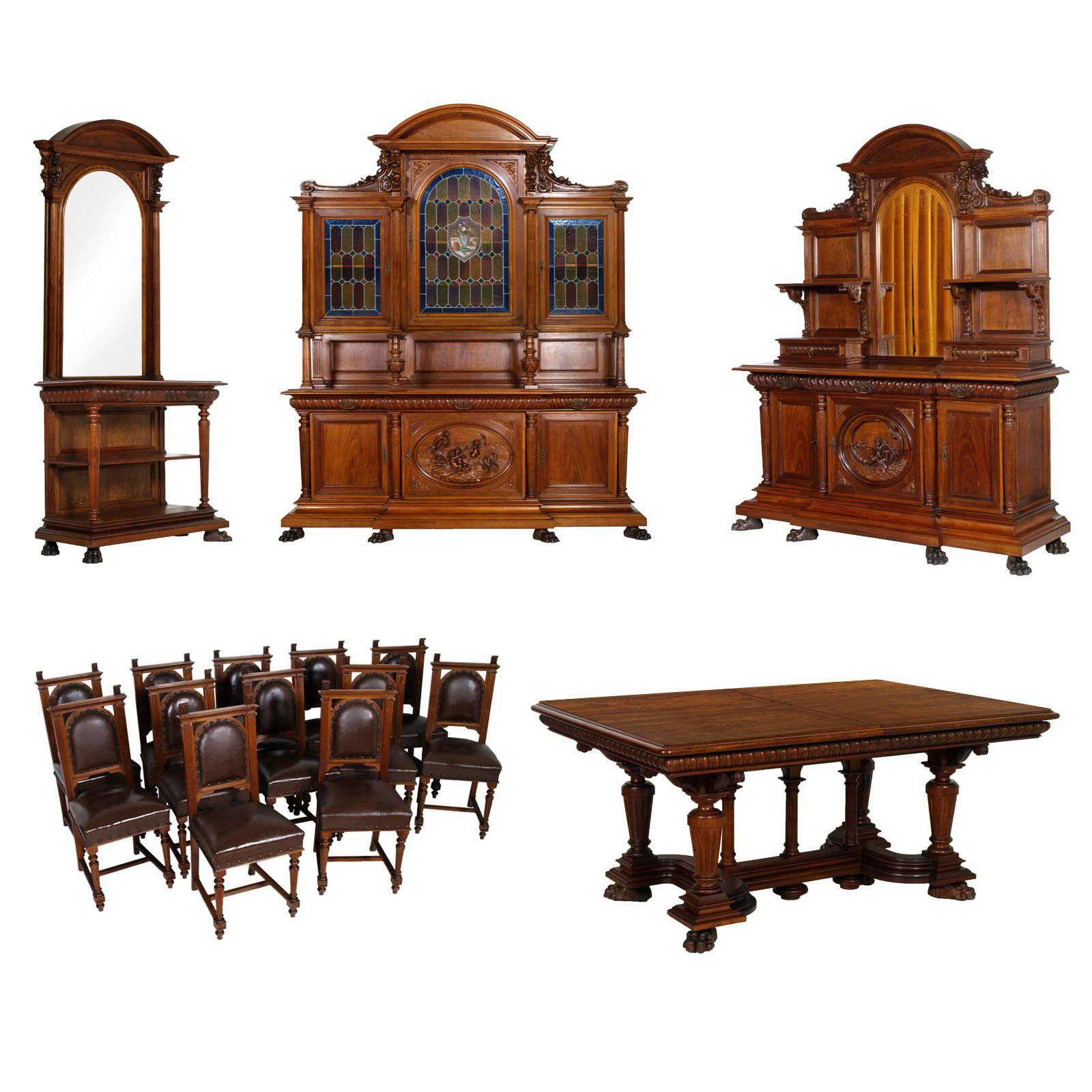
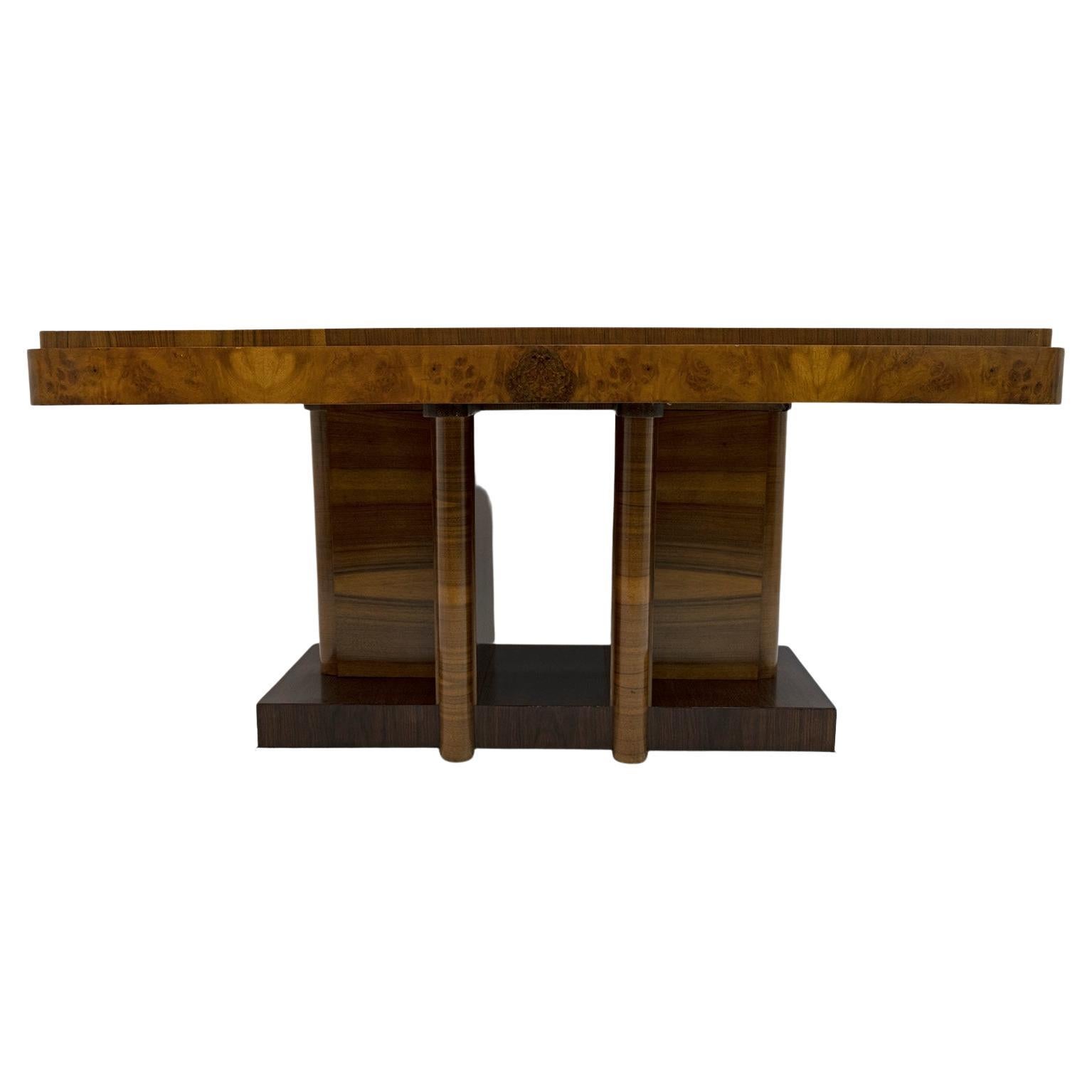
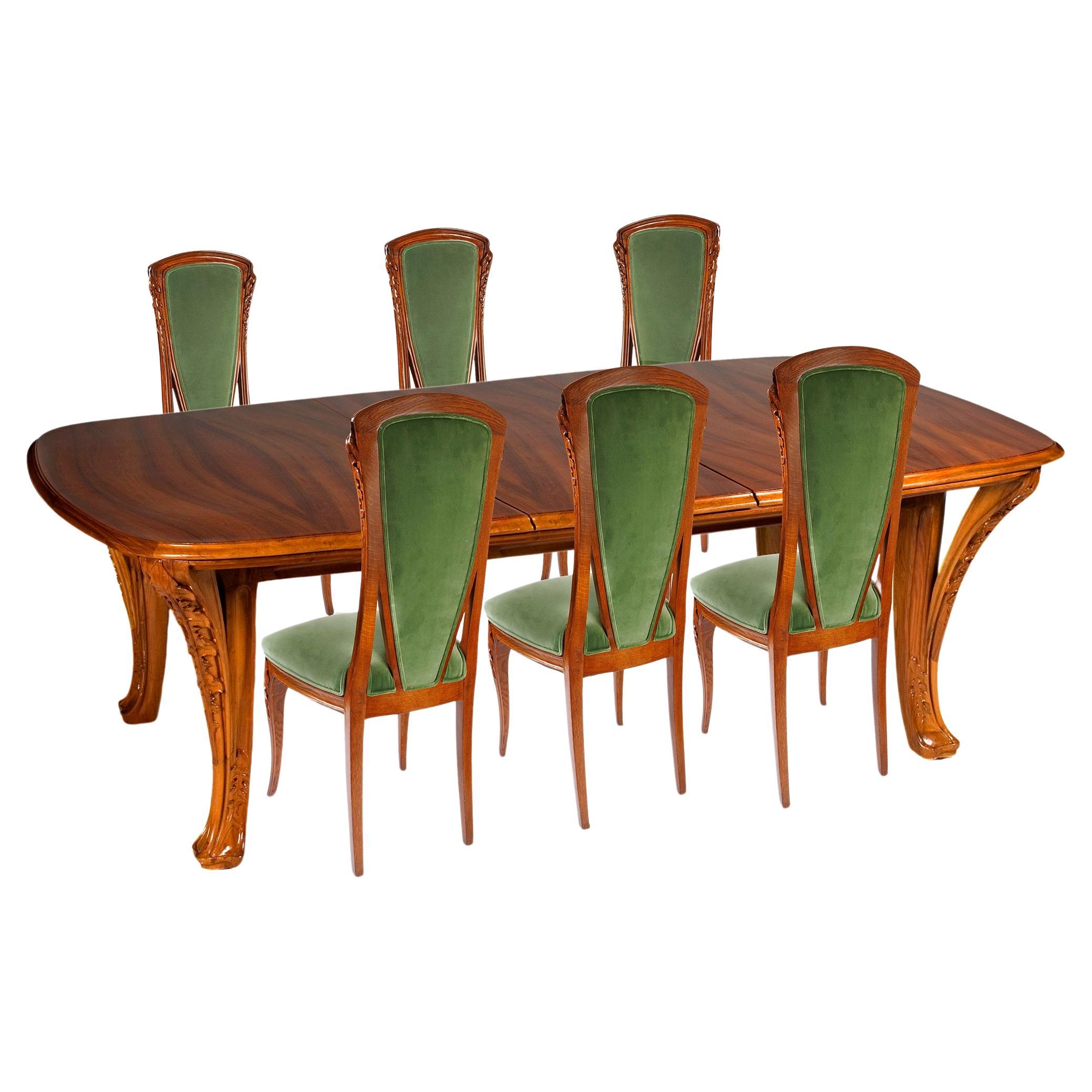
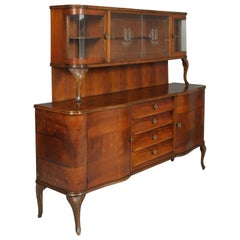
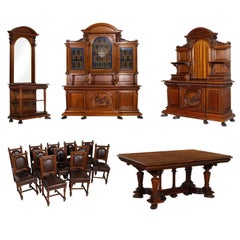
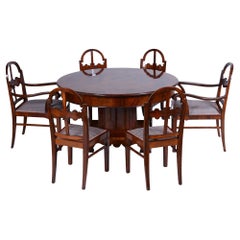
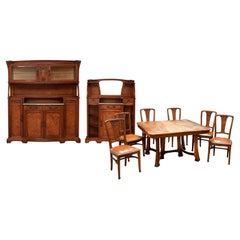
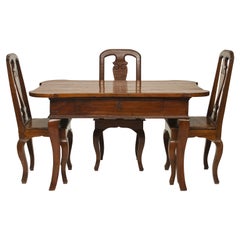
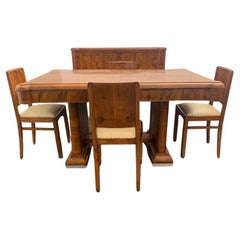
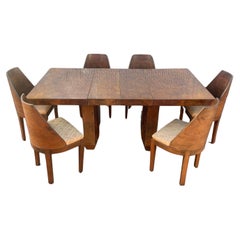
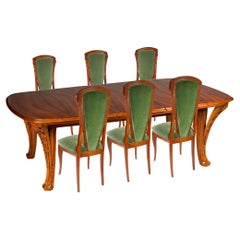
Extraordinary and highly elegant Venetian Art Deco dining room set, attributed to or produced by Fratelli Testolini, Venice, dating from the early 20th century.
The ensemble comprises an extendable dining table, four matching chairs, a sideboard with mirror, and a display cabinet. It is crafted in walnut and richly figured burl walnut, with beautifully warm tones and striking natural grain patterns throughout. The design combines the refined decorative tradition of Venetian cabinetmaking with the more modern, sinuous language of the Art Deco period.
The sideboard is particularly impressive, with a gently shaped front, central drawers, side compartments, elegant brass hardware, and sculptural carved details at the ends. The mirror above, with its stylized decorative side elements, gives the piece a theatrical yet refined Venetian presence. The display cabinet follows the same formal vocabulary, with glass doors, shaped supports, and a lower stretcher shelf. The table is generous and architectural, with a richly figured top, curved supports, and a shaped lower shelf. The four chairs complete the set with shaped backs, upholstered seats and backs, and elegant carved legs.
This dining room set is remarkable for its decorative unity, quality of execution, and strong visual identity. It represents a sophisticated example of Venetian Art Deco furniture, where craftsmanship, luxury materials, and sculptural design come together in a highly distinctive ensemble.
Provenance: from the Venetian family of Giovanni Chiesura and Placida Baldan; in the A&MYART Collections since the 1980s.
Measures
Four chairs: H 95 cm, seat H 50 cm, W 50 cm, D 44 cm
Table: H 81 cm, W 145 cm, extendable up to 225 cm, D 100 cm
Sideboard: H 105 cm, W 176 cm, D 56 cm
Mirror: H 50 cm, W 158 cm, D 7 cm
Display cabinet: H 173 cm, W 100 cm, D 42 cm
"From OADI, observatory for the decorative arts in Italy. N. 14 December 2016"
The Testolini Brothers saw their birth in Venice in 1847. The company grew and became strong their position in the market in a period of enormous cultural and productive ferment for the lagoon capital VENICE
The reputation of the company grew thanks to the partnership established with the company since the dawn Antonio Salviati, founded in London in 1866 by Antonio Salviati, the diplomat Sir Austen Henry Layard and the historian William Drake8. This bond was further strengthened in 1896, when for a period of economic stagnation the Salviati, the Testolini, the Jesurum and other smaller companies operating in Venice, decided to merge under the name of Salviati & Co. Jesurum Important to note is that, although formally Testolini the Brothers see disappear from the header your name, the latter from that year is still reported in all commercial guides just below the principal name, with the specification of their production of artistic furniture, given that further shows how the company and its activities were important.
As we have said before, the Testolini creations were also spread globally, and such furnishings have a certain success among the most visible audience: a flashy example is the pair of chairs of our interest once present, along with Other furnishings of Testolini, in the castle of Moulbaox in Belgium, owned by the important family of Counts of Ursel and although purchased when the Brother Testolini had ceased their activity, they had to have a huge resonance of the pair of armchairs chosen by Marilin Monroe for his Home of Los Angeles and immortalized with her by Allan Grant in July 1962, to accompany the article centred on her by Richard Meryman.