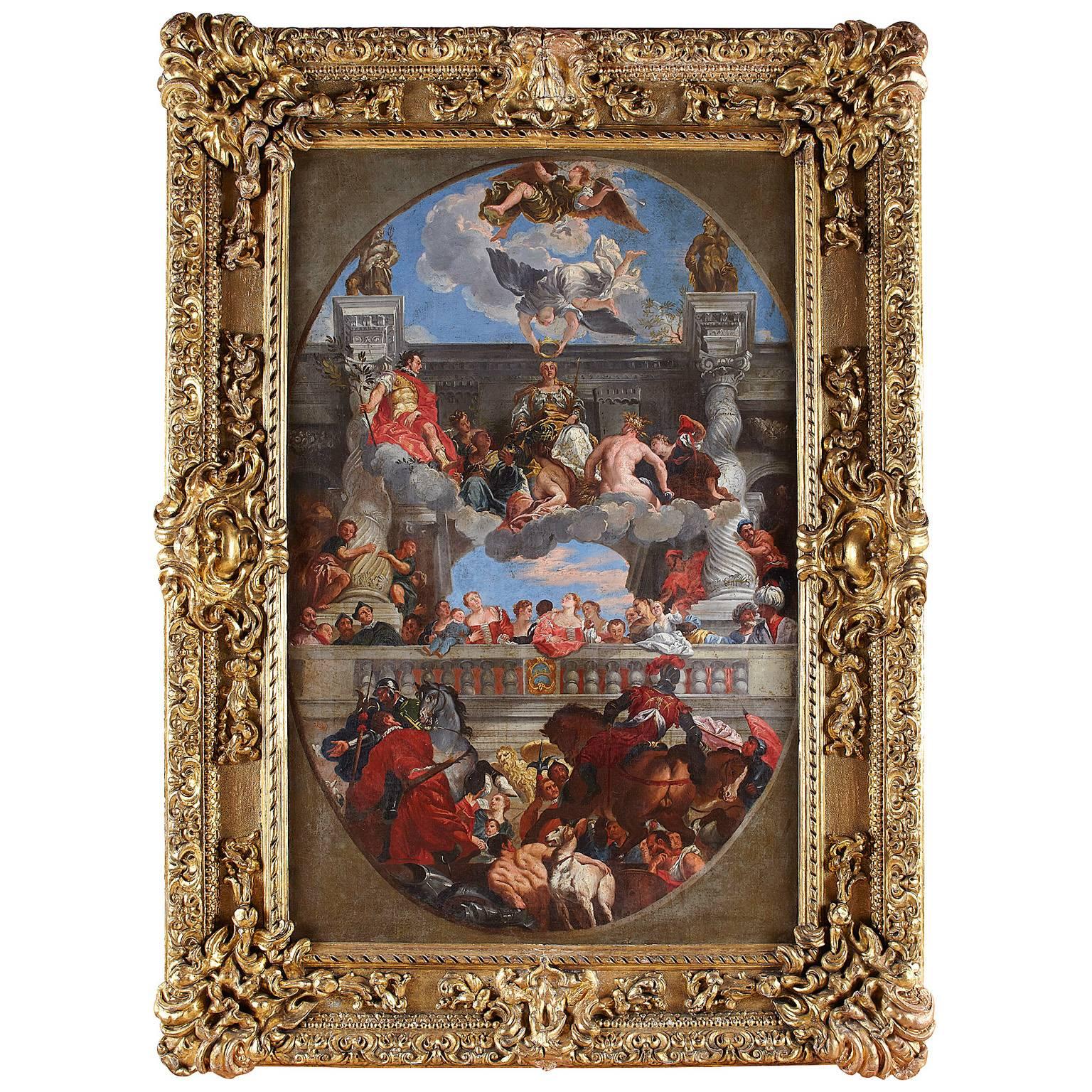
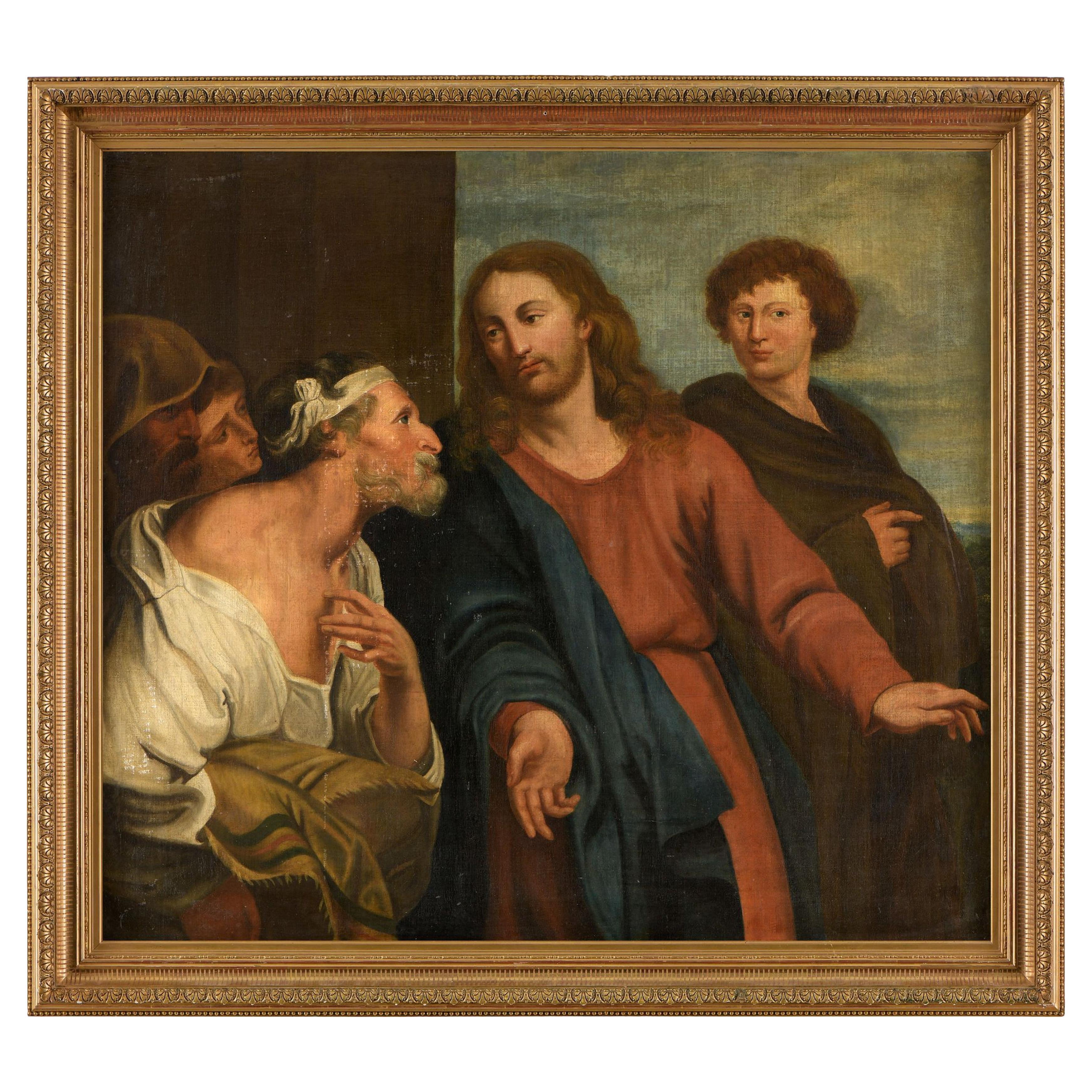
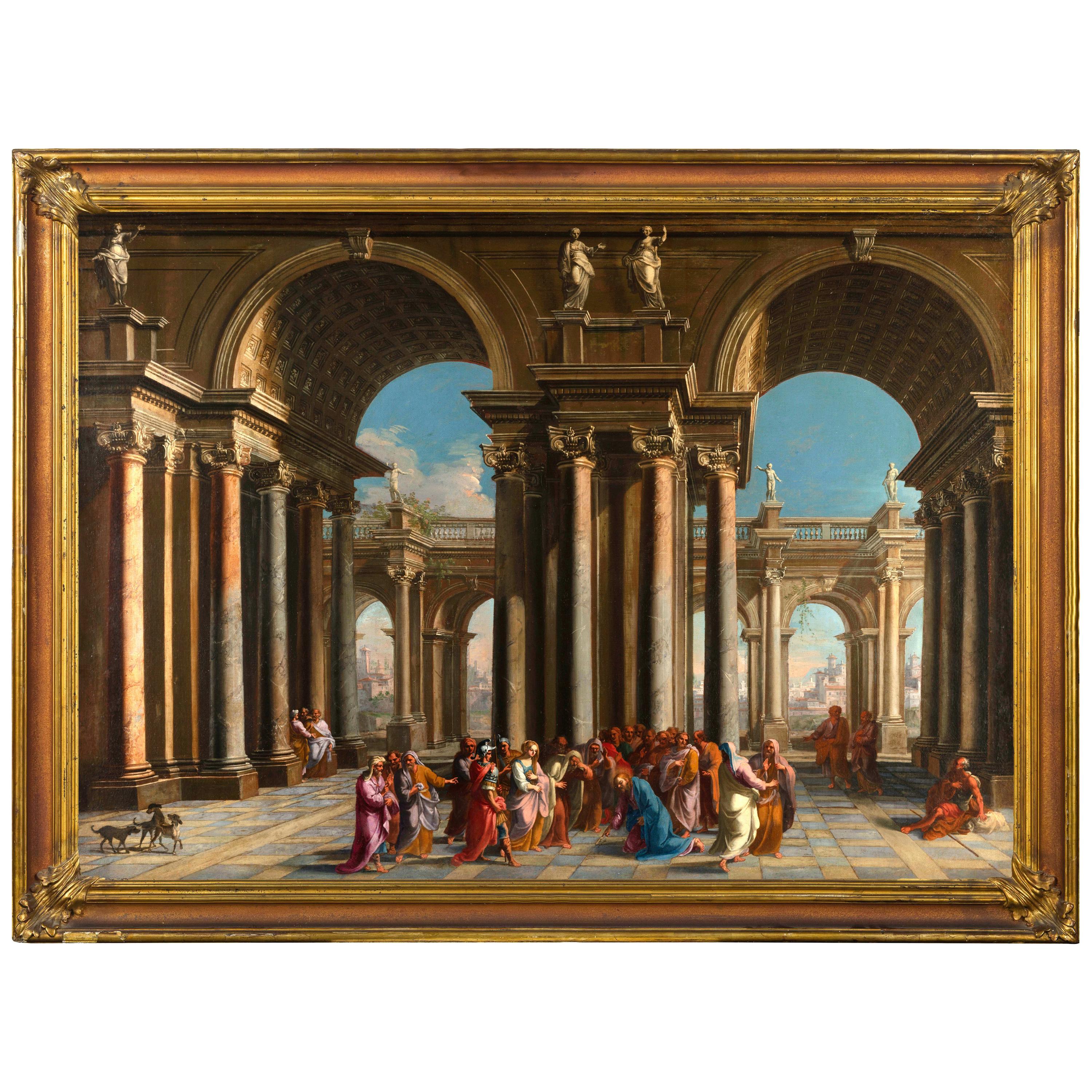
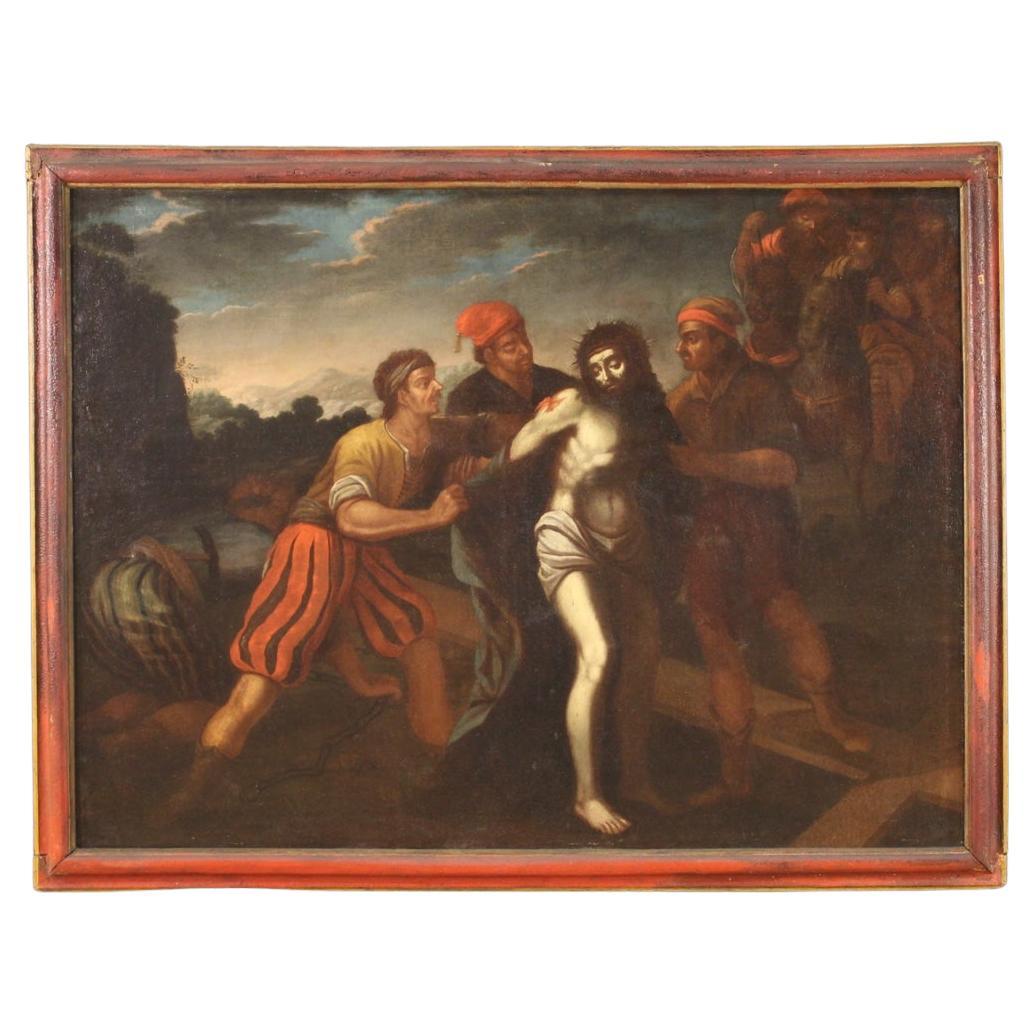
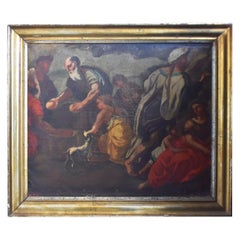
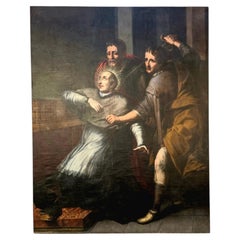
17th century, The condemnation and martyrdom of the four crowned saints by Giuliano Dinarelli
Mid-17th century, Italy, Bologna
Oil on canvas, frame 84 x 99 cm, only canvas 47 x 61 cm
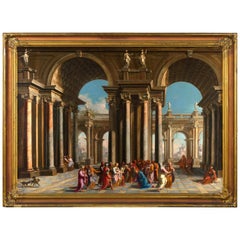
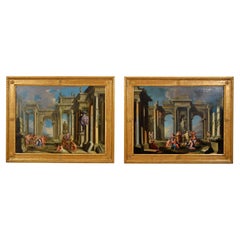
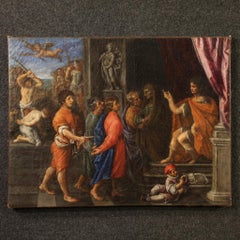
The painting depicts the condemnation and martyrdom of the four crowned saints: Claudius, Nicostratus, Castorius and Sinforian. In the foreground on the right, behind a curtain and raised by three stone steps, sits the figure of a king with an arm raised in the act of command: it is the Emperor Diocletian as he pronounces the judgment, indicating a classical sculpture of the god Apollo. In front of him are led two men with their arms tied. To the left of the king, two other men, perhaps part of the tribune, take part in the scene.
On the left, in the second floor, two men, kneeling and with their arms tied on their backs, are suffering martyrdom, as indicated by the ferocious gesture of the man who arms raised holds a long sword, just before the massacre. Next to it, a group of people and armed soldiers observe; in heaven a winged putto carries the palm of martyrdom. The subjects are depicted in historical clothes and the scene in the foreground is set inside a palace with marble floor. A jester sits on the steps, playing with a puppy.
Claudio, Nicostrato, Castorio and Sinforiano, represented in the work two in the presence of Diocletian and two during the martyrdom, were skilled stonemasons. According to hagiographic tradition (it is the Gregorian Sacramentary of the 7th century to offer some scanty news) they worked in the marble and porphyry quarries of Sirmium in Pannonia (the current Serbian city Sremska Mitrovica). Their skill led them to believe, by their fellow workers, magicians because, before starting a job, they traced signs of the cross, reciting hymns and prayers, exchanged for magic formulas. The Emperor Diocletian went to Pannonia to find marbles for his buildings, he admired the artistic quality and ordered their columns and decorative elements for his palace in Split, Dalmatia, which he built between 293 and 305 AD. However, one day he commissioned him, in addition to genie, victories and mythological figures, a statue of Aesculapius, the god of health. The four artists, being secretly Christians, performed all that was required of them, but not the statue of the pagan deity, which they refused to realize. Interrogated directly by the emperor, they confessed their religion. They were tried and scourged by the tribune Lampedio, so that they would abjure their faith. Faced with their refusal, they were locked up in lead crates and thrown into the waters of the Danube River. Simplician, a Christian and their fellow worker, recovered his remains trying to bury him. Surprised at the gesture, he was also sentenced to death. In the Middle Ages they became patrons of masons, stonemasons, sculptors and building corporations. The depiction of their condemnation and martyrdom is quite rare in painting. However, it is possible to outline its iconography, in which some characteristics are highlighted: the number of martyrs, the emperor who indicates the idol and the palm of martyrdom. The scene depicted in the work studied, therefore, portrays Diocletian in the act of showing the statue, in this case, of the god Apollo, which the stonemasons refuse to worship. On the right the real martyrdom takes place: two of the saints are scourged and ended with sword blows, while from heaven an angel hands the identifying palm of martyrdom. The statue depicted is to be identified with that of Apollo Citaredo, distinguished by the harp and the mantel (fireplace). There are several Greek Roman sculptures depicting him with different compositional variations, one of which may have been freely interpreted by the painter.
On the back of the canvas, is affixed to the frame a label bearing the inscription with ancient calligraphy “Giuliano Dinarelli Ping(eb)it”. The work is therefore already assigned to the Bolognese painter Giuliano Dinarelli (1614-1629). The stylistic comparison with the artist’s works suggests such a probable attribution, although the corpus of certain works attributed to Dinarelli is still very scarce today.
The information about the painter’s life, which we know to have been a very dear pupil of Guido Reni, is just as sparse. Dinarelli was born in Bologna, brother of Taddea Dinarelli, mother of Giovanni Girolamo Bonesi. The latter was trained in his uncle’s workshop, before finishing his studies in painting with Giovanni Maria Viani.
Lanzi counts Giuliano Dinarelli among the students of Guido Reni and in the inventory of Count Antonio Baglioni of 1680, are reported his works two octaangles with Sante. Among the known works there is also the painting depicting the guardian angel made circa 1660 and preserved in the pillar between the seventh and eighth chapel to the right of the Church of Santa Maria dei Servi, in Bologna. The work is remembered in all the historical sources and guides of the city and is, in the body of known works of the painter, the most famous. Dinarelli is remembered active in Bologna and specializes in religious scenes. The Diocese of Imola preserves some paintings by the painter depicting an Ecce Homo, a Madonna Addolorata, San Pietro and Santa Maria Maddalena. Through the letter of Ferdinando Cospi to Leopoldo de' Medici of 1675, we also learn of a portrait of a woman that the same Cospi offers for sale, claiming to be a work He was made by a master I knew a short time ago dead called Giuliano Dinarelli, one of the good students of Guido Reni who painted very well and imitated his master.
The existence of a painting by Dinarelli, portrait of Antonio Colonna, is evidence of a prestigious commission and, therefore, of an artistic recognition that the painter had with the nobility of the time.
The work, in good condition and recently restored, is enriched by an important coeval frame, carved and golden.
We apologize for any errors in translation from Italian.