Want more images or videos?
Request additional images or videos from the seller
1 of 20

18th Century French Oil Paintings, Religious Devotional, Signed Pair

$1,100.31
$1,375.3920% Off
£796
£99520% Off
€949.90
€1,187.3720% Off
CA$1,525.63
CA$1,907.0420% Off
A$1,549.57
A$1,936.9720% Off
CHF 892.98
CHF 1,116.2220% Off
MX$18,708.82
MX$23,386.0320% Off
NOK 10,372.75
NOK 12,965.9420% Off
SEK 10,459.30
SEK 13,074.1220% Off
DKK 7,100.79
DKK 8,875.9820% Off

About the Item

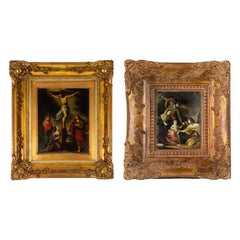
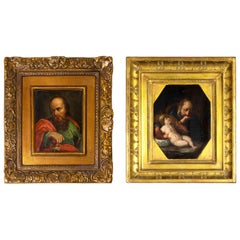
Fine Pair of 18th Century French Religious Devotional Oils This exquisite pair of oil on canvas paintings explores the central themes of divine intercession and monastic devotion. The First Work: Depicts a Bishop Saint in Glory, possibly Saint Nicholas or Saint Ambrose. He is rendered in full liturgical vestments, including a richly embroidered cope and mitre, flanked by adoring cherubim amidst ethereal clouds. The upward gaze and open-palm gesture signify his role as an intercessor between the earthly and the divine. The Second Work: Features a Monastic Saint, most likely Saint Anthony of Padua, depicted in the traditional brown habit of the Franciscan order. He is shown in a moment of profound spiritual intimacy, cradling the Infant Christ, who reaches out toward the viewer in a gesture of blessing. This specific iconography, Saint Anthony with the Christ Child, was among the most popular subjects for private devotion in 18th-century France and Italy. Mid-18th Century, circa 1750. Oil on canvas. Sourced from a private collection in France, these works belong to the tradition of "Cabinet Paintings"—smaller-scale works intended for close study and personal reflection. While the hands are those of skilled provincial masters rather than the grand Academicians of Paris, the quality of the drapery and the emotive expressions reflect the pervasive influence of masters like Murillo and Tiepolo, whose religious compositions dominated the European Catholic imagination throughout the 1700s. Dealer’s Comments "Religious pendants of this quality are becoming increasingly difficult to find. What makes this pair so compelling is the contrast between the ecclesiastical grandeur of the Bishop and the humble, tactile tenderness of the Monk with the Child. They possess a wonderful, 'dusty' authenticity—a soft, aged palette that only centuries in a quiet French interior can produce. The scale is perfect for a modern collector, offering significant historical gravitas without the imposing size of an altarpiece." Condition Report Both works remain on their original canvases (unlined), which is highly desirable for maintaining the texture of the brushwork. There is some stable craquelure throughout, consistent with 18th-century oils. Minor surface dirt present, which could be professionally cleaned to brighten the tones if desired, though many collectors prefer this 'as-found' state. Housed in period-style carved giltwood frames which show some minor losses to the gilding, adding to the antique charm. Measurement Height: 48 cm / 18.9 inch (each) Width: 38 cm / 15 inch (each) Depth: 3 cm / 1.2 inch (each) Weight: 0.9 k.g. / 2 lbs (each)
  • Dimensions:
    Height: 18.9 in (48.01 cm)Width: 15 in (38.1 cm)Depth: 1.2 in (3.05 cm)
  • Style:
    Baroque (Of the Period)
  • Materials and Techniques:
  • Place of Origin:
  • Period:
  • Date of Manufacture:
    1750
  • Condition:
    Wear consistent with age and use.
  • Seller Location:
    Lincoln, GB
  • Reference Number:
    Seller: 112981stDibs: LU7210248704522

More From This Seller

View All
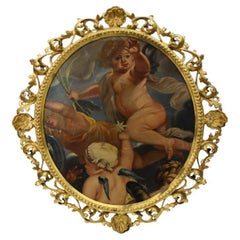
18th Century Italian Oil Painting on Canvas with Giltwood Frame

18th Century Italian Oil Painting on Canvas with Giltwood Frame

Located in Lincoln, GB

Italian Oil Painting on Canvas in a Giltwood Florentine Frame 18th Century This finely painted Italian oil on canvas, presented behind glass, dates from the 18th century and is belie...

Category

Antique 18th Century Italian Baroque Paintings

Materials

Giltwood, Paint

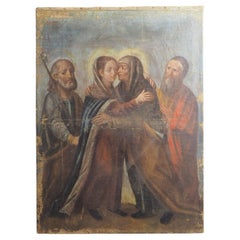
The Visitation Oil Painting, 17th Century Italian, Religious Scene

The Visitation Oil Painting, 17th Century Italian, Religious Scene

Located in Lincoln, GB

The oil painting composition “The Visitation” depicts the Virgin Mary dressed in a blue robe visiting her cousin Elizabeth just after the Annunciation (the announcement by the angel ...

Category

Antique 17th Century Paintings

Materials

Paint

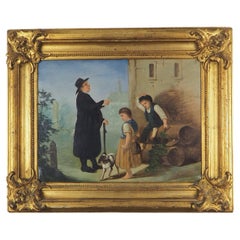
19th Century Oil Painting ‘Lessons to be Learnt’ – Signed

19th Century Oil Painting ‘Lessons to be Learnt’ – Signed

Located in Lincoln, GB

Antique Art Signed Oil Painting 'Lessons to be Learnt' 19th Century Oil Painting "Lessons to be Learnt" Signed by "K 87" (1887) Framed in a highly decorative classical frame Cont...

Category

Antique 19th Century Belgian Rococo Revival Paintings and Screens

Materials

Canvas

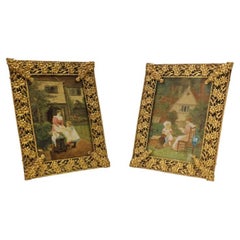
Victorian Aesthetic Movement Gilt-Bronze Frames with Prints, c. 1890

Victorian Aesthetic Movement Gilt-Bronze Frames with Prints, c. 1890

Located in Lincoln, GB

A Charming Pair of Late Victorian Aesthetic Movement Gilt-Bronze/Ormolu-Mounted Frames, Housing Hand-Coloured Prints/Watercolours, 'Fairy Tales' and 'Holiday Lesson' This delightful ...

Category

Antique 19th Century British Picture Frames

Materials

Ormolu

A Rare Set of Four Regency Putti Stipple Engravings

A Rare Set of Four Regency Putti Stipple Engravings

Located in Lincoln, GB

A Rare Set of Four Regency Putti Stipple Engravings Published by Rudolph Ackermann, Repository of Arts, 101 Strand, London Engraved by Anthony Cardon after designs by Richard Cosway ...

Category

Antique 18th Century British Regency Prints

Materials

Paper

Pair of Antique Carved Oak Panels  17th Century English Coffer Panels

Pair of Antique Carved Oak Panels 17th Century English Coffer Panels

Located in Lincoln, GB

A Pair of Antique Carved Oak Panels This is a magnificent pair of antique carved oak panels, rich in both detail and history. Dating from the late 17th or early 18th century, these p...

Category

Antique 17th Century British Wall-mounted Sculptures

Materials

Oak

You May Also Like

19th Century Oil Paintings of St. Francis Xavier & St. Carlo Borromeo

19th Century Oil Paintings of St. Francis Xavier & St. Carlo Borromeo

Located in Vancouver, British Columbia

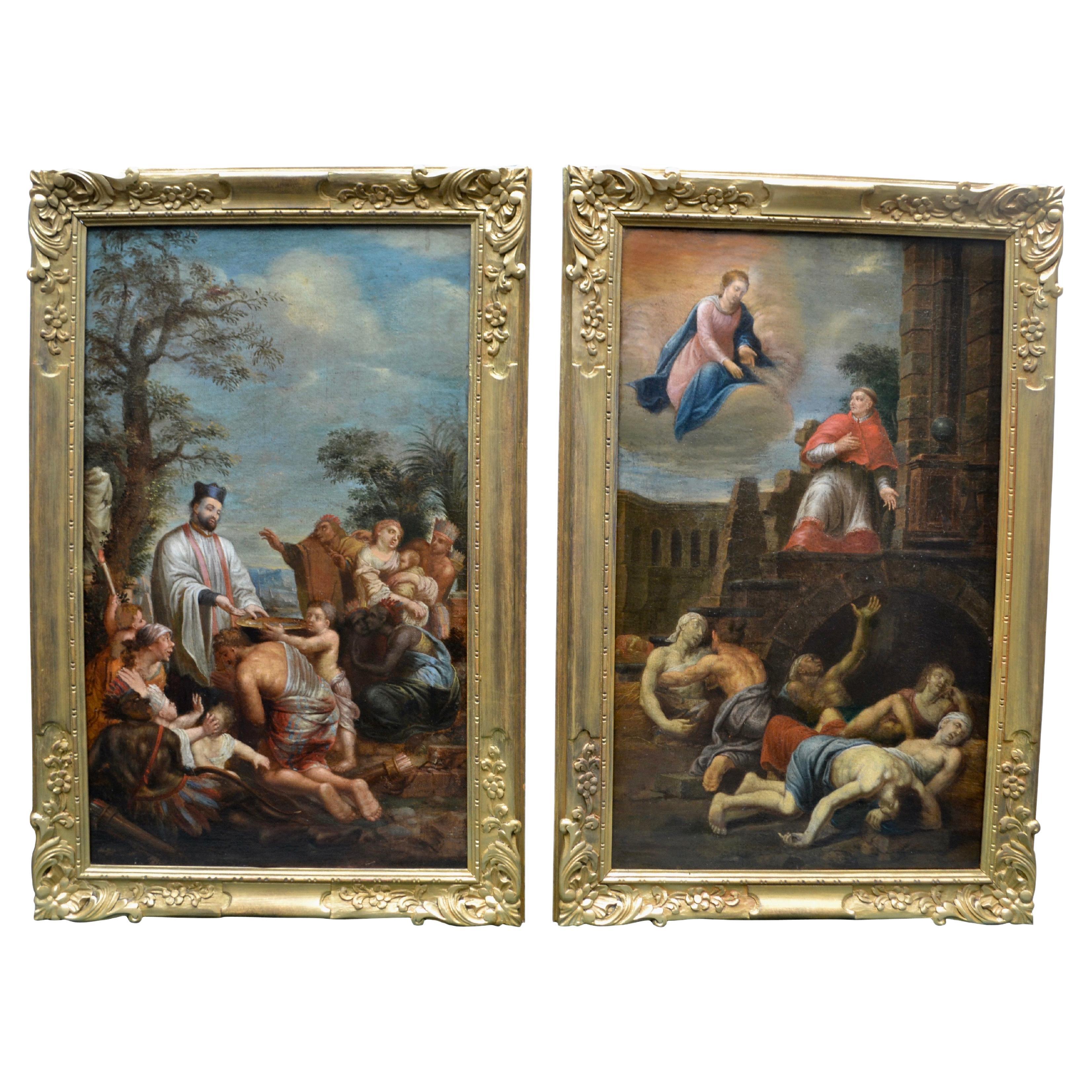
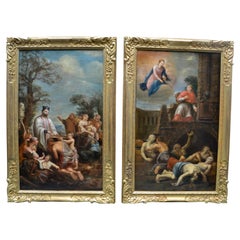
A beautifully executed and rare complementary pair of oil on canvas paintings depicting two of the moist famous and important counter reformation catholic saints St Francis Xavier and St Carlo Borromeo shown in scenes of what the respective saints are mostly famous for. St Francis Xavier for the conversion to Christianity of many S. E Asian countries notably India and St Carlo Borromeo shown asking the Virgin Mary to intercede for the cessation of the terrible plague of 1576. The paintings are presented in refreshed gilded carved wooden frames and are unsigned. St. Francis Xavier was born in Spanish Navarre in 1506 and in 1528, he met St. Ignatius of Loyola. He became one of the seven in 1534 who founded the Society of Jesus (Jesuit Order). In 1536, he left the University of Paris and joined St. Ignatius in Venice. He was ordained in 1537, and in 1540 after the Society was recognized by the Pope, he journeyed to the Far East. Francis Xavier first evangelized the Portuguese colony of Goa in India, then Travancore, Ceylon, Malacca, and the surrounding islands. From there he journeyed to Japan, where he gave Christianity such deep roots that it survived centuries of violent persecution. He died on Sancian Island in 1552, while he was seeking to penetrate into the great forbidden land of China. Despite language problems, lack of funds, resistance from the Europeans as well as the natives, he persevered. St. Francis converted more people in his life than anyone since the Apostle St. Paul. He baptized over 3 million people, converted the entire town of Goa in India, and he labored in India, Pakistan, Bangladesh, Sri Lanka, Malaysia, Indonesia, Singapore, and Japan. He was truly a missionary par excellence. St Carlo Borromeo (1538-1584), was a Cardinal of the Holy Roman Catholic Church and Archbishop of Milan from 1565 to 1583. He was described in the decree for his canonization, as “a man, even while the world smiles on him with the utmost flattery, he lives crucified to the world, spiritually, trampling earthly things, seeking continuously the things of heaven, emulating the life of the Angels on earth, in his thoughts and actions. The plague began in the month of August that year. Milan was celebrating joyfully the arrival of Don John of Austria, on his way to Flanders, where he had been appointed governor. The city authorities were abuzz with excitement in their desire to bestow the highest honours on the Spanish prince, but Charles, who had been Archbishop of the diocese for six years, was following with concern the news coming from Trento, Verona and Mantua, where the plague had begun claiming victims. The first cases exploded in Milan on August 11th, right at the moment when Don John of Austria arrived. The victor of Lepanto, followed by the governor, Antonio de Guzmán y Zuñiga, departed the city, while Carlo Borromeo, who was in Lodi for the Bishop’s funeral, returned in haste. Confusion and fear reigned in Milan and the Archbishop dedicated himself completely to assisting the sick and ordering public and private prayers. Dom Prosper Guéranger sums up his infinite charity in this way: “In the absence of local authorities, he organized the health service, founded or renewed hospitals, sought money and provisions, decreed preventive measures. Most importantly though, he took steps to ensure spiritual help, assistance to the sick and the burial of the dead. Unafraid of being infected, he paid in person, by visiting hospitals, leading penitential processions, being everything to everyone, like a father and true shepherd” St. Carlo was convinced that the epidemic was “a scourge sent by Heaven” as chastisement for the sins of the people and that recourse to spiritual measures was necessary to fight against it: prayer and penitence. He rebuked the civil authorities for having placed their trust in human measures rather than divine ones. “Hadn’t they prohibited all the pious gatherings and processions during the time of the Jubilee? For him, and he was convinced of it, these were the causes of the chastisement. The magistrates who governed the city continued to oppose public ceremonies, out of fear that the large gathering of people would spread contagion, but Charles “who was guided by the Divine Spirit” – recounts another biographer – convinced them by citing various examples, among which was the one regarding St. Gregory the Great who had halted the plague devastating Rome in 590. While the pestilence spread, the Archbishop then ordered three general processions to take place in Milan on the 3rd, 5th and 6th of October, “to placate the wrath of God”. On the first day, the Saint, despite it not being the Lenten season, placed ashes on the heads of the thousands gathered, exhorting them to penitence. Once the ceremony was over, the procession went to the Basilica of St. Ambrose. Charles put himself at the head of the people, dressed in a hooded purple robe, barefoot, penitential cord at his neck and large cross in his hand. The second procession led by the Cardinal headed towards the Basilica of San Lorenzo. The third day the procession from the Duomo headed for the Basilica of Santa Maria at San Celso. St. Carlo carried in his hands a relique of Our Lord’s Holy Nail, which had been given by the Emperor Theodosius to St. Ambrose in the 5th century. The plague didn’t show any signs of waning and Milan appeared depopulated, as a third of its citizens had lost their lives and the others were in quarantine or didn’t dare leave their homes. The Archbishop ordered about twenty stone columns with a cross at the top to be erected in the main squares and city crossroads, allowing the inhabitants from every quarter to take part in the Masses and public prayers - from the windows of their homes. One of Milan’s protectors was St. Sebastian, the martyr the Romans had recourse to during the plague in 672. St. Charles suggested that the magistrates of Milan reconstruct the sanctuary dedicated to him, which was falling into ruins, and to celebrate a solemn feast in his honour for ten years. Finally in July 1577, the plague ceased and in September the founding stone was laid in the civic temple of St. Sebastian, where on January 20th every year, even today a Mass is offered to recall the end of the scourge. St.Carlo Borromeo died on November 3rd 1584 and was buried in the Duomo of Milan. His heart was solemnly translated to Rome, in the Basilica of Saints Ambrose...

Category

Antique Late 19th Century French Baroque Paintings
Materials

Canvas

18th Century French Pair of Oils on Gold Leaf Panels

18th Century French Pair of Oils on Gold Leaf Panels

Located in North Miami, FL

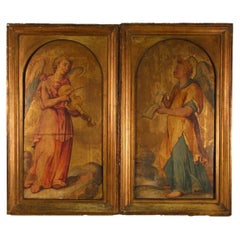
18th century French pair of oils on gold leaf panels. One is depicting an angel playing the violin, and the other one is holding the music book.

Category

Antique 18th Century French Baroque Paintings
Materials

Gold Leaf

Pair Of Baroque Paintings Of Christ, 17th Century, Italy

Pair Of Baroque Paintings Of Christ, 17th Century, Italy

Located in Lisbon, PT

A pair of Italian baroque paintings of Jesus Christ: - An 18th Century painting that depicts the Holy Family, Child Jesus, the Virgin Mary and the elderly Saint Joseph, with the An...

Category

Antique 17th Century Italian Baroque Paintings

Materials

Copper

Set Of Two Baroque Paintings Of Joseph And Paul, 18th Century

Set Of Two Baroque Paintings Of Joseph And Paul, 18th Century

Located in Lisbon, PT

A set of two Baroque paintings: - A Saint Paul of Tarsus Painting, also called Apostle Paul, Saul of Tarsus, Saint Paul the Apostle or Apostle of the Gentiles. The sword in Saint P...

Category

Antique 18th Century Italian Baroque Paintings

Materials

Copper

Pair of 18th Century Italian Mythological Oil Paintings in Carved Giltwood Frame

Pair of 18th Century Italian Mythological Oil Paintings in Carved Giltwood Frame

Located in Madrid, ES

Important and highly decorative pair of Italian oil on canvas paintings, dating from the 18th century, each depicting a richly symbolic mythological and allegorical scene in the gran...

Category

Antique 1730s Paintings

Materials

Fruitwood

18th Century, Pair of Italian Paintings by Follower of Alessandro Magnasco

18th Century, Pair of Italian Paintings by Follower of Alessandro Magnasco

Located in IT

18th Century, Pair of Italian Paintings by Follower of Alessandro Magnasco, Depicting Mary Magdalene in Penitence and Saint Jerome in the Desert Dimensions: Frames: cm H 46 x W 59.5 ...

Category

Antique Mid-18th Century Italian Baroque Paintings

Materials

Canvas