Circle of David Teniers (Antwerp, 1610 - Brussels, 1690)
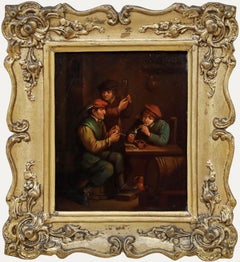
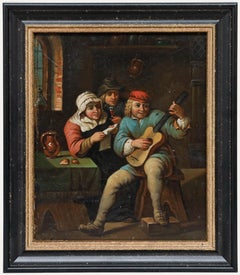
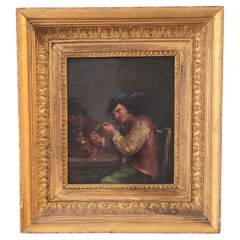
Interior with figures of commoners
Oil on canvas, 37 x 27 cm
Framed, 48 x 37 cm
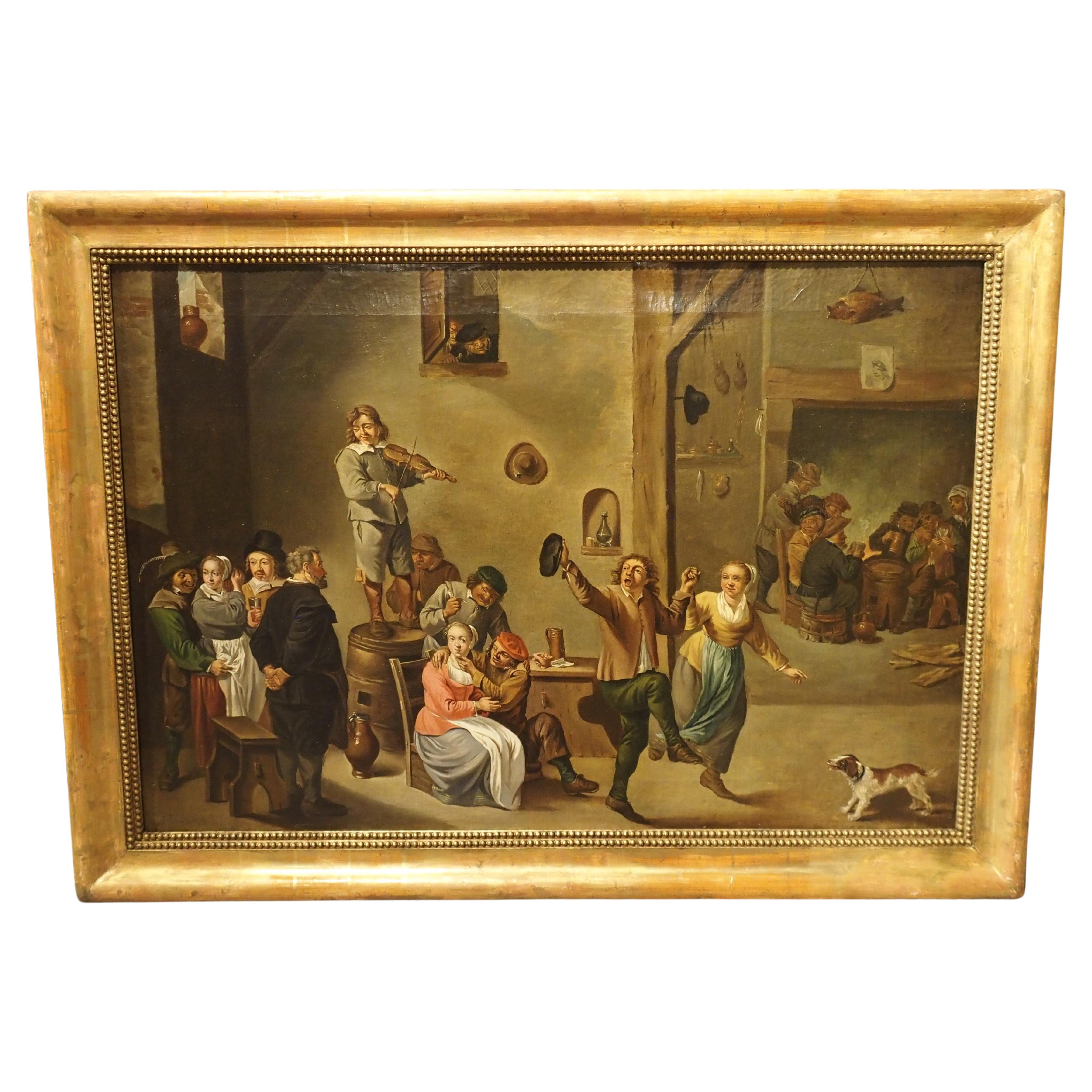
David Teniers the Younger (Antwerp, December 15, 1610 - Brussels, April 25, 1690) was a Flemish painter, known for his prolific output of genre scenes, landscapes, portraits, and religious and mythological scenes. The son of painter David Teniers the Elder, from whom he received his early artistic training, David the Younger soon became a prominent figure in the Antwerp painting scene. His career took off because of his ability to vividly and minutely depict daily life in 17th-century Flanders. His early works often focused on scenes of taverns, village festivals and markets, characterized by keen observation of detail and lively brushwork. A turning point in his career was his entry into the service of Leopold Wilhelm of Austria, governor of the Spanish Netherlands and avid art collector. From about 1651, Teniers became the curator of his extensive collection of Italian paintings, a role that allowed him to study closely the masterpieces of the Venetian Renaissance and other Italian masters. This experience influenced his style, leading him to greater refinement and the introduction of new subjects, such as art gallery scenes depicting the archduke's collection. Later, Teniers became court painter, working for Leopold Wilhelm and other members of the aristocracy. His versatility allowed him to range between different genres, also producing portraits and mythological and religious scenes, although his genre scenes remain the most famous. Teniers married Anna Brueghel, daughter of Jan Brueghel the Elder, thus joining an important dynasty of Flemish painters. His workshop was prolific and his influence spread widely among contemporary and later artists. David Teniers the Younger died in Brussels in 1690, leaving a vast body of work that testifies to his extraordinary powers of observation and technical mastery. His works are now housed in the world's most important museums and are a valuable record of the life and culture of Flanders in the 17th century.
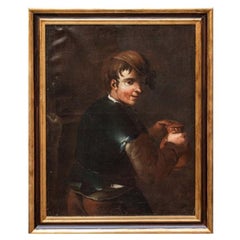
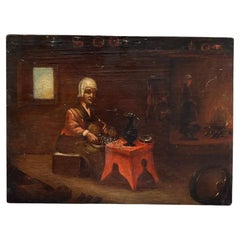
Members of the artist's circle inherited realism and lenticularism from the master in depictions of popular genre scenes, as is clearly visible in this painting. The painting captures an intimate, everyday scene, typical of works attributed to the circle of David Teniers the Younger, with its attention to detail and atmosphere of popular life. In the center of the composition, a young man is sitting on a simple stool within a rustic setting. He wears a bright red cap, a white shirt with the sleeves rolled up, a dark green vest and beige pants. His posture is concentrated: he is fiddling with a fireplace bellows, which he keeps resting on his legs, fully absorbed in his task. The surrounding environment is that of a modest and somewhat cluttered interior. Behind him an opening can be glimpsed that lets in soft light, partially illuminating the scene. Scattered on the floor in the foreground are several objects: some stacked shiny metal plates, a small metal kettle, and other indistinct utensils. Next to the young man on the left is a large reddish earthenware vase resting on the ground. A number of tools identifiable as work tools emerge from it. Above the vase, hanging on the bare wall, is a small framed drawing or engraving, depicting a male face in profile. The lighting in the painting is Caravaggio-inspired, with strong contrasts between lit areas, such as the young man's face and hands, and the darker areas of the background and corners of the room. This technique creates a sense of intimacy and focuses attention on the main action.
The color palette is earthy and warm, dominated by shades of brown, beige, dark green, and the lively touch of red cap. The brushwork appears loose and descriptive, typical of the style of Teniers and his circle, able to effectively render the textures of objects and clothing.