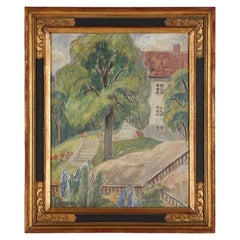
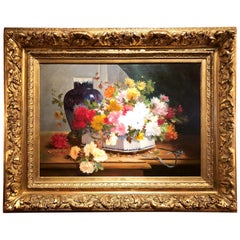
Gertrude Fiske (1879-1961)
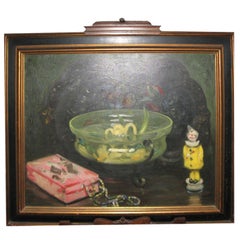
The Jade Bracelet, 1910
Signed LL
Measures: 17"x21"
Oil on Canvas.
Exhibited Robert Schoelkopf Gallery, 1968/1969, Illustrated in Exhibition Booklet
Exhibited Portsmouth, NH, "Gertrude Fiske: American Master", 2018, Illustrated in Exhibition Catalogue
Exhibited Ogunquit, ME, "Remember the Ladies", 2021, Illustrated in Exhibition Catalogue
Illustrated in American Art Review, Summer 2021, Page 138
Illustrated in Portland Press Herald article:
pressherald.
com/2021/05/16/
art-review-ogunquit-museum-opens-with-three-
thought-provoking-shows/
nationalacademy
emuseum.
com/people/112/gertrude-horsford-fiske
1879 - 1961
( COPIED FROM: The National and Academy Website)
Gertrude Fiske was born into a wealthy and socially prominent family that traced its ancestry to the colonial Massachusetts governor William Bradford. In about 1904, after obtaining a general education in private schools and making her formal debut, she entered the School of the Museum of Fine Arts, Boston, where she studied for six years with Frank Benson, Philip Hale, and Edmund Tarbell; she took the latter's advanced painting master's class in 1912-13. She spent summers in Ogunquit, Maine, in classes with Charles H. Woodbury, the teacher who perhaps had the strongest influence on her work. She would continue to make Ogunquit her favored summer resort throughout her life.
Fiske's first major success came when she was awarded a silver medal at the San Francisco Panama-Pacific International Exposition of 1915. She was given her first solo show the following year at the Guild of Boston Artists (of which she was a founding member). In 1917 both the Cleveland Museum of Art and the Rhode Island School of Design presented exhibitions of her work. By the mid-1920s, she was well established.
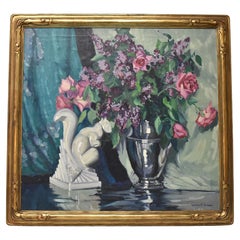
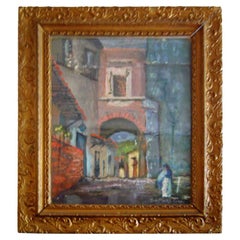
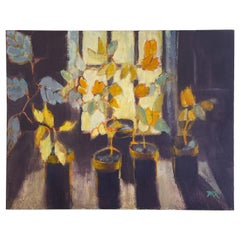
Commissioned portraits comprised Fiske's mainstay. Her subject interests ranged broadly, however: figure studies in both indoor and outdoor settings, landscapes, beach scenes, amusement parks, and the occasional still life. All were painted in vibrantly colored, simplified forms and powerful, free brushstrokes that attested to her affiliation with the Boston Museum School and Charles Woodbury. She also worked in etching and belonged to both the Chicago Society of Etchers and the Boston Society of Etchers.
She was regularly represented in Academy exhibitions and was awarded the Academy's Julia A. Shaw Memorial Prize in the winter exhibition of 1922, the Thomas B. Clarke Prize in the 1922 and 1925 annuals, the Thomas R. Proctor Prize in the winter exhibitions of 1929, and 1930; and the Shaw Prize again in the 1935 annual. Among her other distinctions was her appointment to the Massachusetts Art Commission in 1929; she was the first woman to serve on that body.