Want more images or videos?
Request additional images or videos from the seller
1 of 8

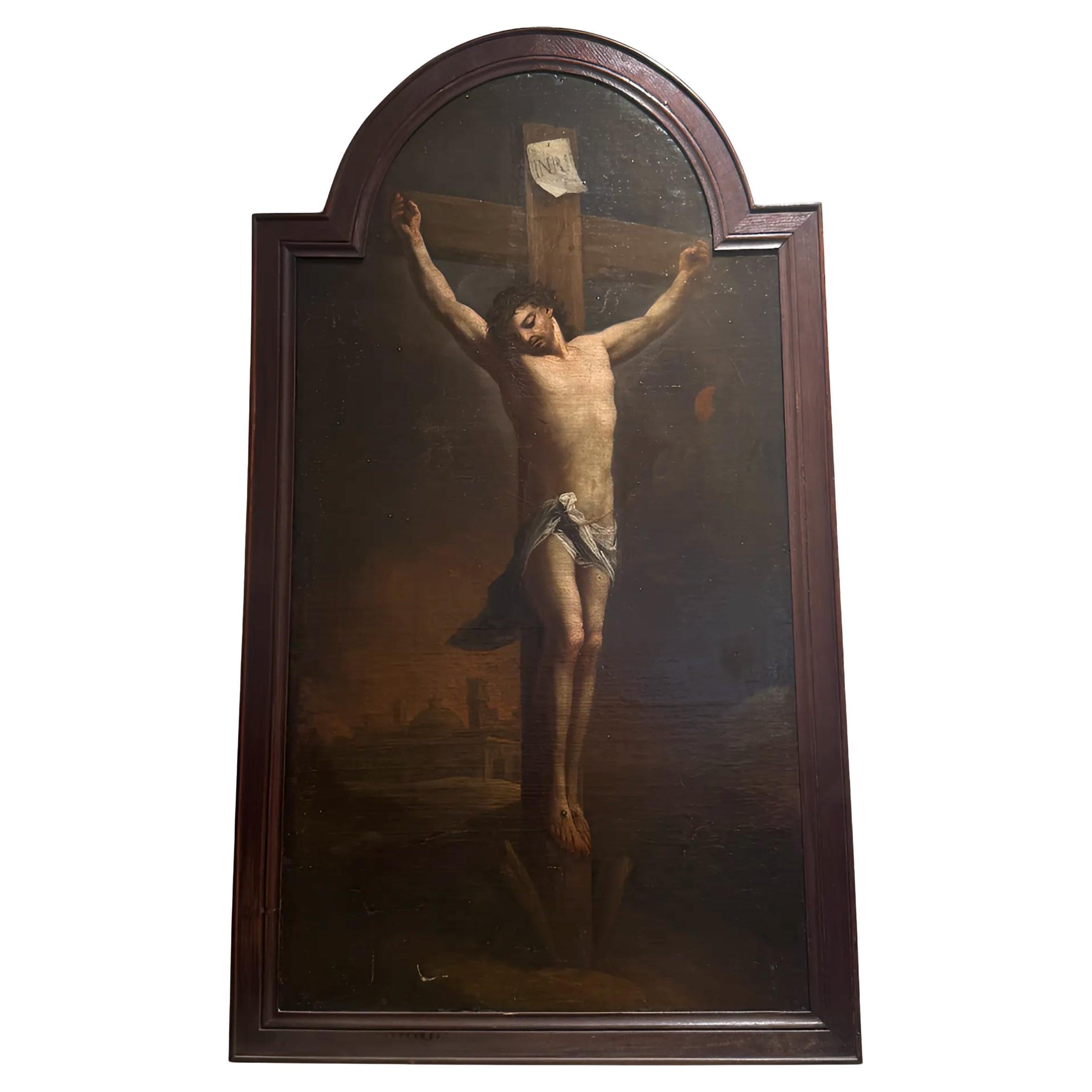
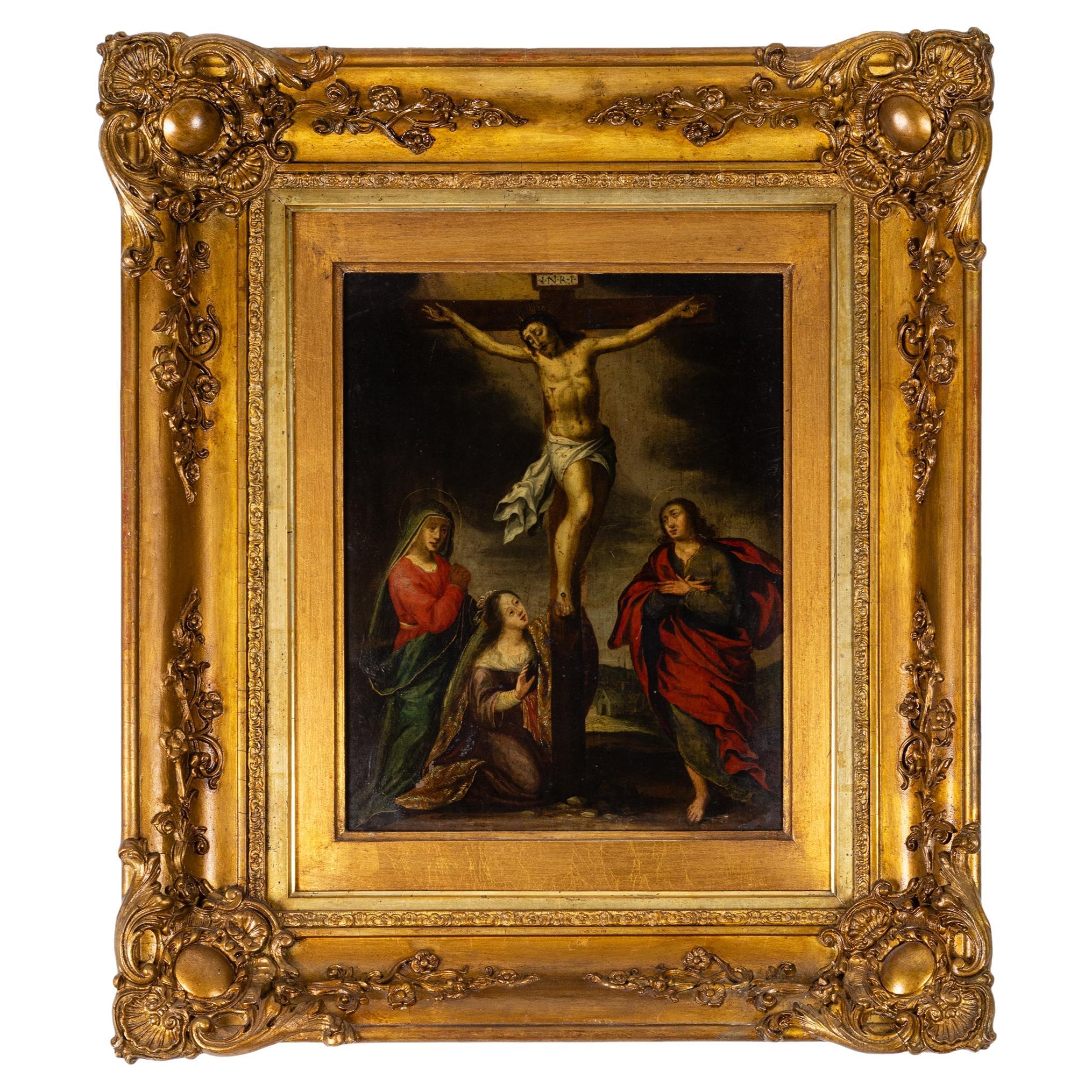
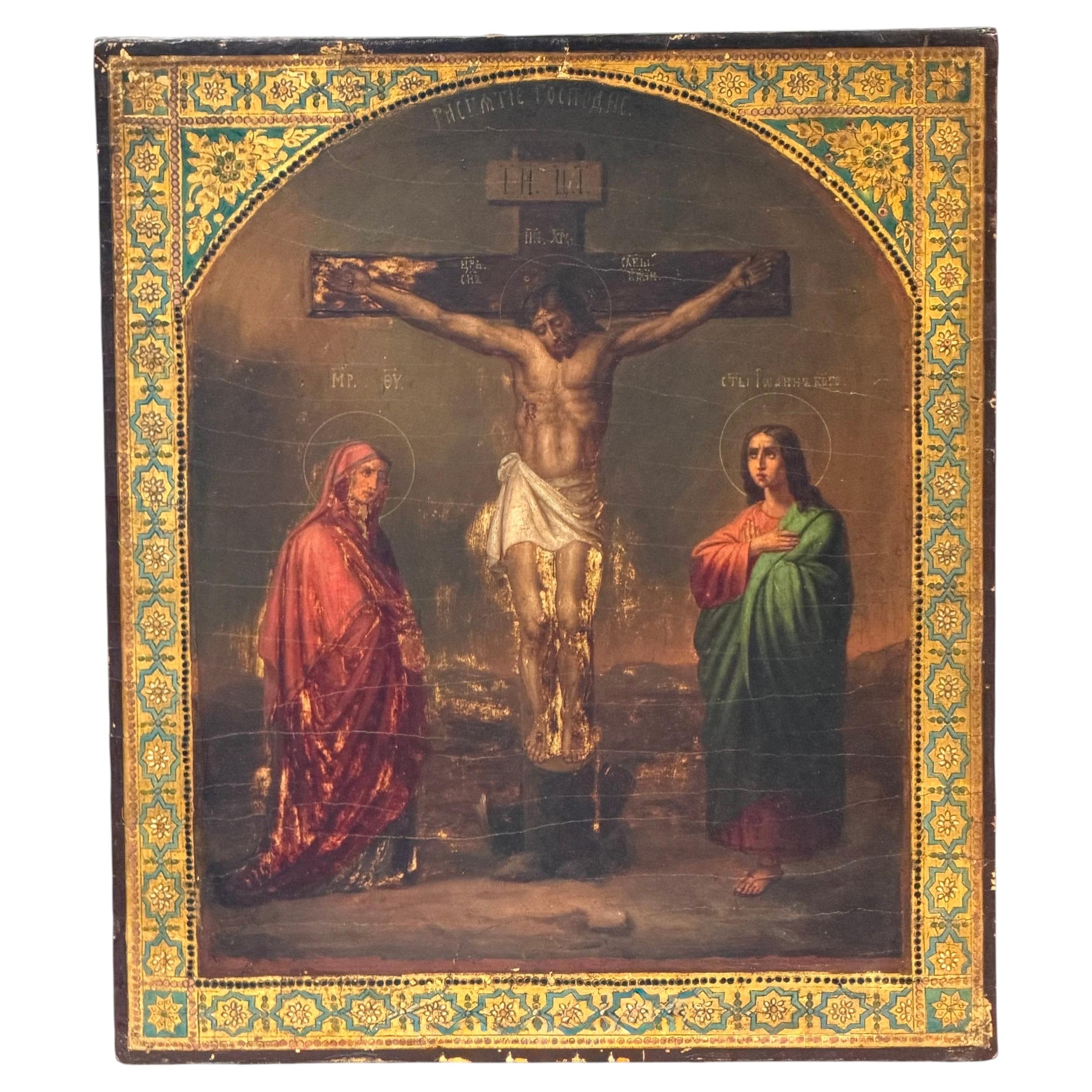
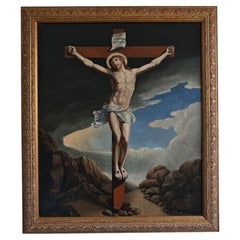
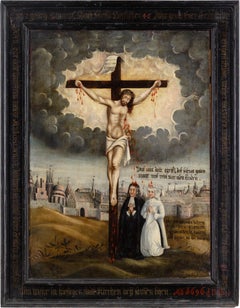
Religious 19th Century Oil Painting on Board Icon Titled "The Crucifixion"

$9,450
$14,95036% Off
£7,124.50
£11,271.0436% Off
€8,293.13
€13,119.8136% Off
CA$13,294.69
CA$21,032.3436% Off
A$13,372.52
A$21,155.4736% Off
CHF 7,791.79
CHF 12,326.7036% Off
MX$162,924.60
MX$257,748.4336% Off
NOK 89,610.75
NOK 141,765.1536% Off
SEK 91,922.66
SEK 145,422.6236% Off
DKK 61,985.56
DKK 98,061.8136% Off

About the Item

A Rare Hispano-Portuguese 19th century oil on board depiction of "The Crucifixion". The baroque icon style painting depicting the Crucifixion of Jesus Christ outside the city walls of Jerusalem, north of Mount Zion, the Virgin Mary and a saints praying below. Withing a stained wood frame, circa 1870-1880. The crucifixion of Jesus occurred in 1st-century Judea, most likely between AD 30 and 33. Jesus' crucifixion is described in the four canonical gospels, referred to in the New Testament epistles, attested to by other ancient sources, and is established as a historical event confirmed by non-Christian sources, though there is no consensus among historians on the exact details. According to the canonical gospels, Jesus, the Christ, was arrested and tried by the Sanhedrin, and then sentenced by Pontius Pilate to be scourged, and finally crucified by the Romans.Jesus was stripped of his clothing and offered wine mixed with myrrh or gall to drink before being crucified. He was then hung between two convicted thieves and according to Mark's Gospel, died some six hours later. During this time, the soldiers affixed a sign to the top of the cross stating "Jesus of Nazareth, King of the Jews" which, according to the Gospel of John, was written in three languages. They then divided his garments among themselves and cast lots for his seamless robe, according to the Gospel of John. After Jesus' death, according to the Gospel of John one soldier pierced his side with a spear to be certain that he had died. The Bible describes seven statements that Jesus made while he was on the cross, as well as several supernatural events that occurred. Collectively referred to as the Passion, Jesus' suffering and redemptive death by crucifixion are the central aspects of Christian theology concerning the doctrines of salvation and atonement. This painting may actually be earlier than dated. Board height: 26 1/4 inches (66.7 cm) Board width: 29 3/8 inches (74.6 cm) Frame height: 32 inches (81.3 cm) Frame width: 35 1/2 inches (90.2 cm) Frame depth: 3 1/2 inches (8.9 cm).
  • Dimensions:
    Height: 32 in (81.28 cm)Width: 35.5 in (90.17 cm)Depth: 3.5 in (8.89 cm)
  • Style:
    Baroque Revival (In the Style Of)
  • Materials and Techniques:
  • Place of Origin:
  • Period:
  • Date of Manufacture:
    circa 1870-1880
  • Condition:
    Repaired: Touch ups. Wear consistent with age and use. Minor losses. Minor fading. A striking painting, probably for export to a church in the Americas. Some stress hairlines on board, in paint and minor paint losses and restorations. Vibrant colors and fine attention to details. The stretcher cradle on back prevents worping.
  • Seller Location:
    Los Angeles, CA
  • Reference Number:
    Seller: Ref.: A23051stDibs: LU1796210798333

More From This Seller

View All
Italian 19th Century Renaissance Oil on Board Representing a "Mother and Child"

Italian 19th Century Renaissance Oil on Board Representing a "Mother and Child"

Located in Los Angeles, CA

An Italian mid-19th century Renaissance oil on board representing a "Mother and Child". The Renaissance revival style painting in the manner of a Raphaelite Madonna and Child, of a s...

Category

Antique Mid-19th Century Italian Renaissance Revival Paintings

Materials

Wood, Giltwood

After Raffaello Sanzio 1483-1520 Raphael La Madonna della Seggiola Oil on Canvas

After Raffaello Sanzio 1483-1520 Raphael La Madonna della Seggiola Oil on Canvas

By (after) Raphael (Raffaello Sanzio da Urbino)

Located in Los Angeles, CA

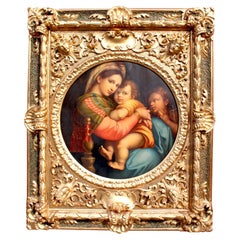
A Fine Italian 19th Century Oil Painting on Canvas "La Madonna della Seggiola" after Raphael (Raffaello Sanzio da Urbino 1483-1520). The circular painted canvas depicting a seated Madonna holding an infant Jesus Christ next to a child Saint John the Baptist, all within a massive carved two-tone gilt wood, gilt-patinated and gesso frame, which is identical to the frame on Raphael's original artwork. This painting is a 19th Century copy of Raphael's Madonna della Seggiola painted in 1514 and currently exhibited and part of the permanent collection at the Palazzo Pitti, Galleria Palatina, Florence, Italy. The bodies of the Virgin, Christ, and the boy Baptist fill the whole picture. The tender, natural looking embrace of the Mother and Child, and the harmonious grouping of the figures in the round, have made this one of Raphael's most popular Madonnas. The isolated chair leg is reminiscent of papal furniture, which has led to the assumption that Leo X himself commissioned the painting. Circa: 1890-1900. Subject: Religious painting Painting diameter: 28 inches (71.1 cm) Frame height: 55 1/8 inches (140 cm) Frame width: 46 inches (116.8 cm) Frame depth: 5 1/8 inches (13 cm) Raffaello Sanzio da Urbino (Italian, March 28 or April 6, 1483 - April 6, 1520), known as Raphael, was an Italian painter and architect of the High Renaissance. His work is admired for its clarity of form, ease of composition, and visual achievement of the Neoplatonic ideal of human grandeur. Together with Michelangelo and Leonardo da Vinci, he forms the traditional trinity of great masters of that period. Raphael was enormously productive, running an unusually large workshop and, despite his death at 37, leaving a large body of work. Many of his works are found in the Vatican Palace, where the frescoed Raphael Rooms were the central, and the largest, work of his career. The best known work is The School of Athens in the Vatican Stanza della Segnatura. After his early years in Rome much of his work was executed by his workshop from his drawings, with considerable loss of quality. He was extremely influential in his lifetime, though outside Rome his work was mostly known from his collaborative printmaking. After his death, the influence of his great rival Michelangelo was more widespread until the 18th and 19th centuries, when Raphael's more serene and harmonious qualities were again regarded as the highest models. His career falls naturally into three phases and three styles, first described by Giorgio Vasari: his early years in Umbria, then a period of about four years (1504–1508) absorbing the artistic traditions of Florence, followed by his last hectic and triumphant twelve years in Rome, working for two Popes and their close associates. Raphael was born in the small but artistically significant central Italian city of Urbino in the Marche region, where his father Giovanni Santi was court painter to the Duke. The reputation of the court had been established by Federico III da Montefeltro, a highly successful condottiere who had been created Duke of Urbino by the Pope - Urbino formed part of the Papal States - and who died the year before Raphael was born. The emphasis of Federico's court was rather more literary than artistic, but Giovanni Santi was a poet of sorts as well as a painter, and had written a rhymed chronicle of the life of Federico, and both wrote the texts and produced the decor for masque-like court entertainments. His poem to Federico shows him as keen to show awareness of the most advanced North Italian painters, and Early Netherlandish artists as well. In the very small court of Urbino he was probably more integrated into the central circle of the ruling family than most court painters. Federico was succeeded by his son Guidobaldo da Montefeltro, who married Elisabetta Gonzaga, daughter of the ruler of Mantua, the most brilliant of the smaller Italian courts for both music and the visual arts. Under them, the court continued as a centre for literary culture. Growing up in the circle of this small court gave Raphael the excellent manners and social skills stressed by Vasari. Court life in Urbino at just after this period was to become set as the model of the virtues of the Italian humanist court through Baldassare Castiglione's depiction of it in his classic work The Book of the Courtier, published in 1528. Castiglione moved to Urbino in 1504, when Raphael was no longer based there but frequently visited, and they became good friends. He became close to other regular visitors to the court: Pietro Bibbiena and Pietro Bembo, both later cardinals, were already becoming well known as writers, and would be in Rome during Raphael's period there. Raphael mixed easily in the highest circles throughout his life, one of the factors that tended to give a misleading impression of effortlessness to his career. He did not receive a full humanistic education however; it is unclear how easily he read Latin. Early Life and Works His mother Màgia died in 1491 when Raphael was eight, followed on August 1, 1494 by his father, who had already remarried. Raphael was thus orphaned at eleven; his formal guardian became his only paternal uncle Bartolomeo, a priest, who subsequently engaged in litigation with his stepmother. He probably continued to live with his stepmother when not staying as an apprentice with a master. He had already shown talent, according to Vasari, who says that Raphael had been "a great help to his father". A self-portrait drawing from his teenage years shows his precocity. His father's workshop continued and, probably together with his stepmother, Raphael evidently played a part in managing it from a very early age. In Urbino, he came into contact with the works of Paolo Uccello, previously the court painter (d. 1475), and Luca Signorelli, who until 1498 was based in nearby Città di Castello. According to Vasari, his father placed him in the workshop of the Umbrian master Pietro Perugino as an apprentice "despite the tears of his mother". The evidence of an apprenticeship comes only from Vasari and another source, and has been disputed—eight was very early for an apprenticeship to begin. An alternative theory is that he received at least some training from Timoteo Viti, who acted as court painter in Urbino from 1495.Most modern historians agree that Raphael at least worked as an assistant to Perugino from around 1500; the influence of Perugino on Raphael's early work is very clear: "probably no other pupil of genius has ever absorbed so much of his master's teaching as Raphael did", according to Wölfflin. Vasari wrote that it was impossible to distinguish between their hands at this period, but many modern art historians claim to do better and detect his hand in specific areas of works by Perugino or his workshop. Apart from stylistic closeness, their techniques are very similar as well, for example having paint applied thickly, using an oil varnish medium, in shadows and darker garments, but very thinly on flesh areas. An excess of resin in the varnish often causes cracking of areas of paint in the works of both masters. The Perugino workshop was active in both Perugia and Florence, perhaps maintaining two permanent branches. Raphael is described as a "master", that is to say fully trained, in December 1500. His first documented work was the Baronci altarpiece for the church of Saint Nicholas of Tolentino in Città di Castello, a town halfway between Perugia and Urbino. Evangelista da Pian di Meleto, who had worked for his father, was also named in the commission. It was commissioned in 1500 and finished in 1501; now only some cut sections and a preparatory drawing remain. In the following years he painted works for other churches there, including the Mond Crucifixion (about 1503) and the Brera Wedding of the Virgin (1504), and for Perugia, such as the Oddi Altarpiece. He very probably also visited Florence in this period. These are large works, some in fresco, where Raphael confidently marshals his compositions in the somewhat static style of Perugino. He also painted many small and exquisite cabinet paintings in these years, probably mostly for the connoisseurs in the Urbino court, like the Three Graces and St. Michael, and he began to paint Madonnas and portraits. In 1502 he went to Siena at the invitation of another pupil of Perugino, Pinturicchio, "being a friend of Raphael and knowing him to be a draughtsman of the highest quality" to help with the cartoons, and very likely the designs, for a fresco series in the Piccolomini Library in Siena Cathedral. He was evidently already much in demand even at this early stage in his career. Influence of Florence Raphael led a "nomadic" life, working in various centres in Northern Italy, but spent a good deal of time in Florence, perhaps from about 1504. Although there is traditional reference to a "Florentine period...

Category

Antique Early 1900s Italian Baroque Paintings

Materials

Canvas, Giltwood

You May Also Like

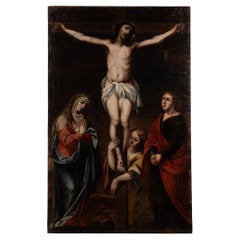
18th Century Oil on Canvas Painting of Crucifixion of Christ with Mother Mary

18th Century Oil on Canvas Painting of Crucifixion of Christ with Mother Mary

Located in Round Top, TX

Large original oil on canvas painting of the crucifixion of Christ hanging on the cross, with his Mother Mary and two other female figures. Unframed, just over 4.5' tall. Beautifully...

Category

Antique Early 18th Century Spanish Paintings

Materials

Canvas, Wood, Paint

Christ on Cross, oil on canvas, 19th Century Northern Italy

Christ on Cross, oil on canvas, 19th Century Northern Italy

Located in Beograd, RS

In this listing you will find a stunning depiction of Crucifixion. The painting follows academic religious realism, typical for Catholic devotional art produced in the late 19th cent...

Category

Antique Late 19th Century Italian Baroque Revival Paintings

Materials

Canvas, Wood

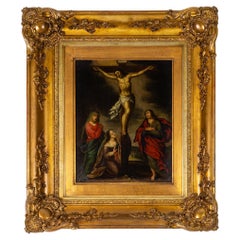
Crucifixion of Christ Oil on Copper Painting, 17th Century Baroque, Religious

Crucifixion of Christ Oil on Copper Painting, 17th Century Baroque, Religious

Located in Lisbon, PT

This 17th Century Italian Baroque painting, executed in oil on copper, depicts the Crucifixion of Christ with remarkable depth and dramatic composition. Christ is shown on the cros...

Category

Antique 17th Century Italian Baroque Paintings

Materials

Copper

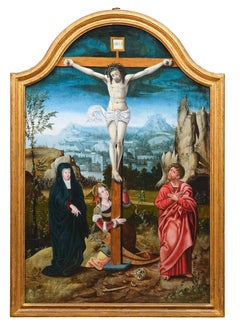
Crucifixion, Antwerp, Flemish 16th century, oil on panel

Crucifixion, Antwerp, Flemish 16th century, oil on panel

Located in PARIS, FR

Crucifixion, studio of the Master of the Half-Figures (Antwerp, active 1500-1550), not signed Antwerp School, mid-16th century Oil on oak panel , h. 88 cm, w. 59 cm Original frame, framed: h. 98 cm, w. 68 cm A rare example of Antwerp painting from the first half of the 16th century, our Crucifixion captivates as much by the quality of its expansive river landscape as by the delicacy of its figures and the brilliance of its palette. The richness of the colors, the balance between devotion and narrative, and the subtlety of the atmospheric effects make it a particularly representative work of the artistic refinement developed in the workshop of the Master of the Half-Figures. Through its remarkable synthesis of the world-landscape inherited from Patinir and the expressive gentleness characteristic of the Master of the Half-Figures, this composition stands out as a particularly accomplished example of the Antwerp Flemish Renaissance. Our painting of the Crucifixion is organized around the central figure of Christ nailed to a high cross erected atop Golgotha. His slender, pale body stands out against a blue-green sky that lightens towards the horizon, creating an atmospheric depth characteristic of Flemish painting of this period. The bowed head, encircled by the crown of thorns, expresses agony in a restrained pose. The white loincloth, tied at the front according to a recurring motif in the work of the Master of the Half-Figures, has one end drawn between the legs before billowing outwards in a movement lifted by the wind, subtly animating Christ's silhouette. At the foot of the cross, a skull and a few bones evoke Adam and the redemption of humanity through Christ's sacrifice. To the left stands the Virgin Mary, enveloped in a flowing blue-green mantle whose heavy folds accentuate her contemplative posture. Her pale face, framed by a white veil, expresses silent sorrow. Kneeling at the center of the composition, Mary Magdalene embraces the cross in a gesture of fervent devotion, while to the right, Saint John, clad in a richly textured red cloak, gazes up at Christ, his hands folded across his chest. Contrary to the iconography typically found in 16th-century Antwerp workshops, he appears here as a bearded, middle-aged man. This relatively rare characteristic, however, is found in several works by the Master of the Half-Figures. The Virgin's face displays the typical characteristics of the Master of Half-Figures' repertoire : a high forehead, full cheeks, a rounded chin, and a gentle expression tinged with restrained melancholy. This youthful, feminine physiognomy is found in numerous depictions of Virgins, Magdalenes, and other saints from his workshop. The figures are also distinguished by their smooth complexions, elegant proportions, and attention to the richness of the fabrics, favoring formal refinement over dramatic expressiveness. The background unfolds according to the world-landscape formula inherited from Joachim Patinir. A vast panorama, blending a fortified city, estuary, winding paths, rocky outcrops, and bluish hills, stretches behind the sacred figures. At the heart of this lively river landscape, a small port, quays, and several boats also appear, their silhouettes punctuating the waterway and testifying to the attention paid by Antwerp painters to the commercial and maritime activities that ensured the city's prosperity. The composition is structured by a succession of narrative planes that invite the viewer's eye to move through the image as a continuous story, a technique characteristic of Antwerp painting in the first half of the 16th century. Behind the main scene appears the episode of the Carrying of the Cross, depicted by a group of soldiers and horsemen, with Golgotha rising on the mountain to the left, while to the right, in a grotto carved into the rocks, unfolds the Entombment of Christ. This multifaceted narrative, integrated into the landscape, enriches the meditative dimension of the work while highlighting its kinship with the inventions of Patinir. The attribution to the workshop of the Master of the Half-Figures seems all the more plausible given that several art historians, notably Robert Koch and Walter Gibson...

Category

16th Century Old Masters Figurative Paintings

Materials

Oil, Wood Panel

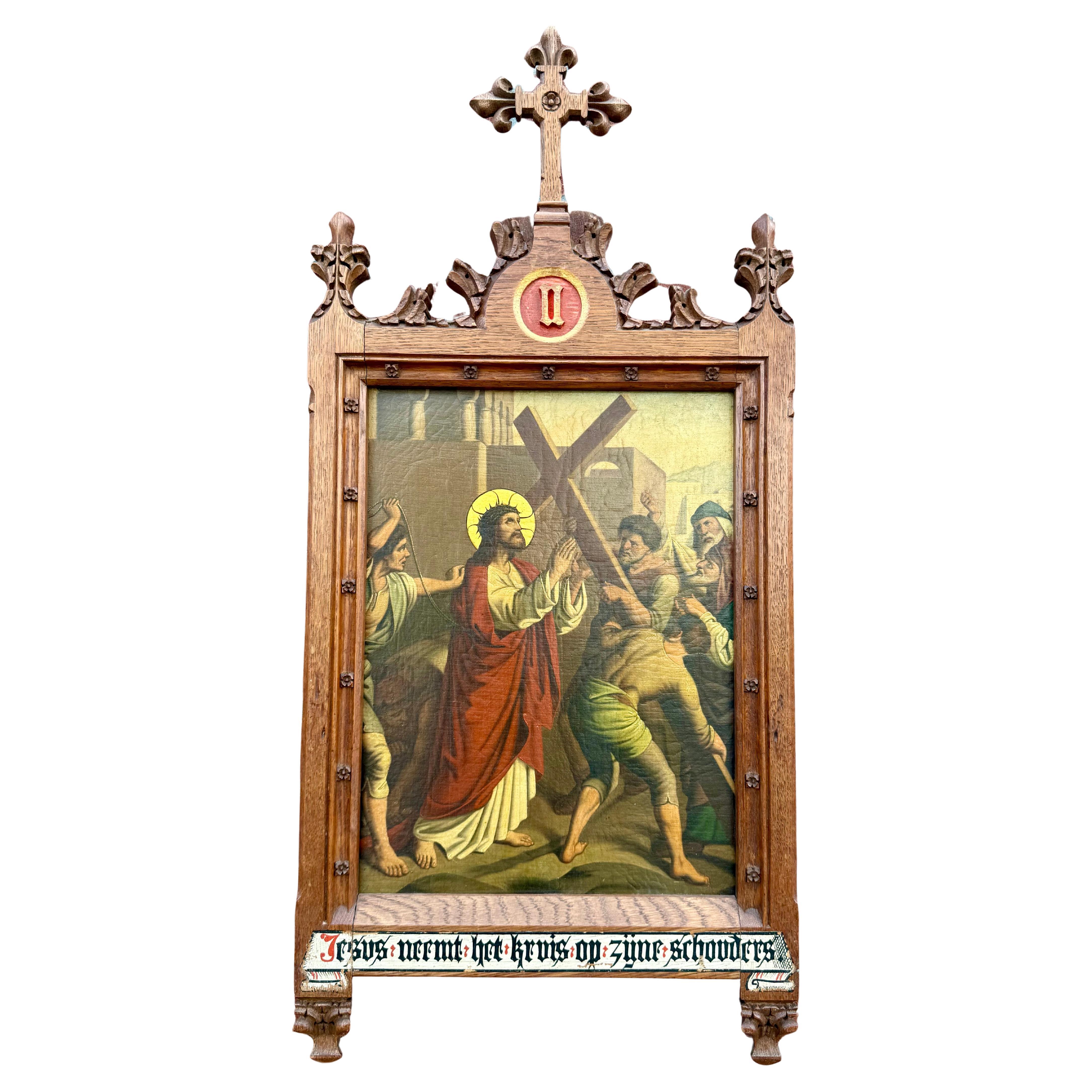
Fine Gothic Painting / 2nd Station Crucifixion, Jesus Takes Up His Cross

Fine Gothic Painting / 2nd Station Crucifixion, Jesus Takes Up His Cross

Located in Lisse, NL

Another stunning hand-painted oil on canvas work of religious art. This antique oil painting was first hand-painted on canvas and later mounted onto a zinc backplate .. a traditiona...

Category

Antique Early 19th Century European Gothic Revival Religious Items

Materials

Iron, Zinc

Late 17th-Century Hessian School, Crucifixion With Donors, Lutheran Painting

Late 17th-Century Hessian School, Crucifixion With Donors, Lutheran Painting

Located in Cheltenham, GB

This late 17th-century German oil painting depicts the Crucifixion of Christ with kneeling donors, conceived as a complete memorial ensemble within its original inscribed frame. At...

Category

1690s Landscape Paintings

Materials

Canvas, Oil