Want more images or videos?
Request additional images or videos from the seller
1 of 5

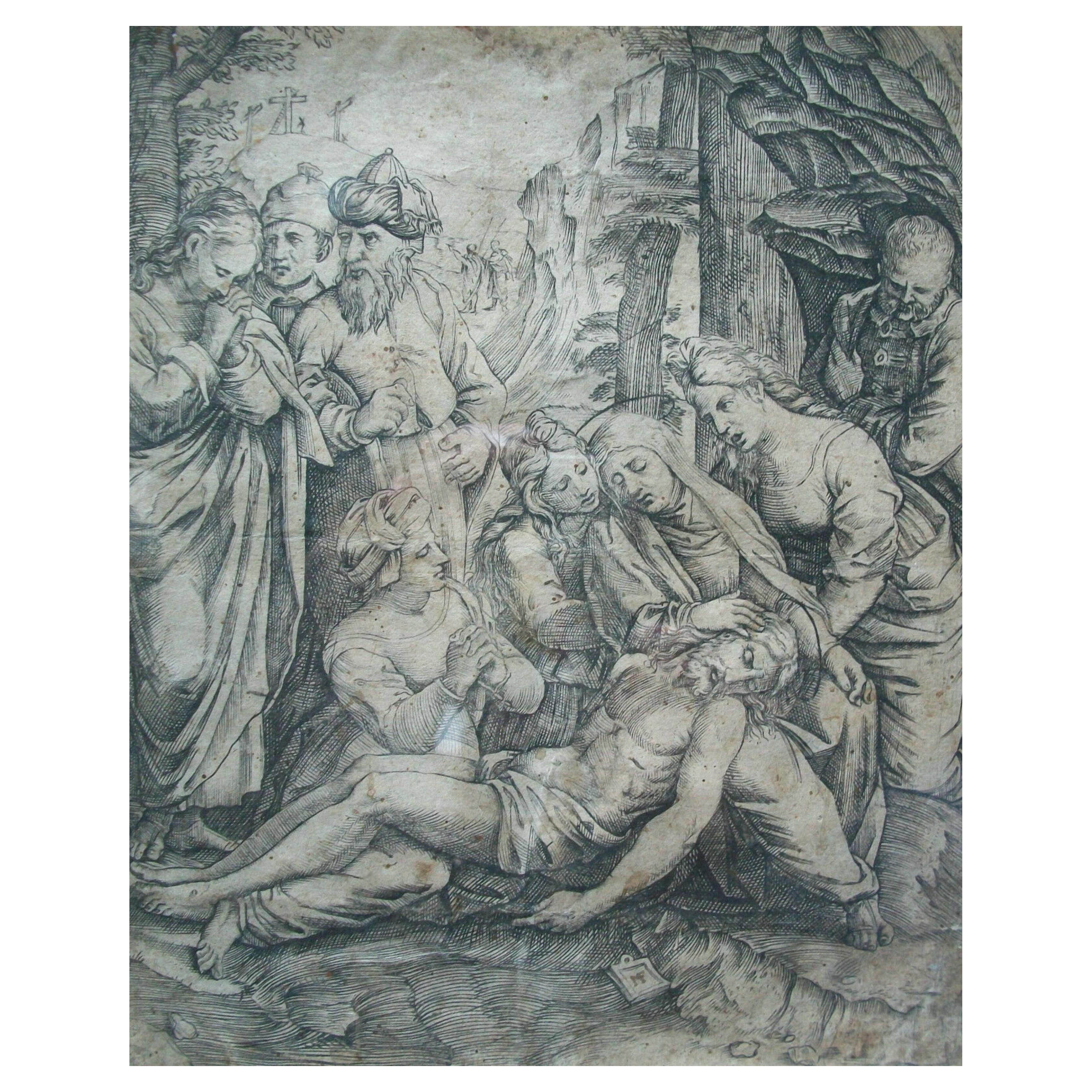
16th Century School of Fontainebleau Engraving

$4,500
£3,401.21
€3,978.38
CA$6,389.63
A$6,500.46
CHF 3,735.26
MX$78,168.59
NOK 43,608.51
SEK 43,869.57
DKK 29,740.45

About the Item

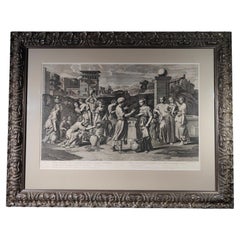
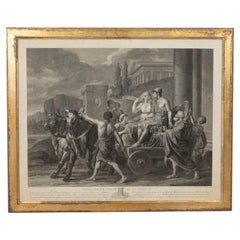
This 16th century French engraving illustrates an episode in the Trojan War – although the actual one illustrated is in question. According to recent scholarship, it depicts the corpse the hoary Trojan warrior Hector being carried into the walled city of Troy. But according to tradition, it depicts the wounded Trojan princeling Paris (who started the war) being carried back in. Favoring the former interpretation is that the episode appears in Homer’s Iliad. Favoring the later is that the comely young man seems very much alive. The scene is presented theatrically. Feet scuffle along the edge of a stage, and the leading man looks at us with bedroom eyes through tousled locks. Dead or alive, his dead weight is shouldered by a warrior with an improbably balletic lift of leg -- one that should send both crashing to the ground. Such archness is typical of Mannerism, or the late Renaissance. In any case, the print bears the engraver’s initials “GR.F”, and the inscription “a Fontana.Bleo. Bol.”, which a 16th century viewer would take to mean that the image depicted was painted “at Fontainebleau,” after the work of the “Bolognese” painter Francesco Primaticcio, the Italian artist from that Italian city, who found fame and fortune at the court of Fountainebleau, the seat of King Francis I of France. Francis summoned Primaticcio there in 1534. Between 1541 and 1544 the artist frescoed the barrel-vaulted ceiling of the Porte Dorée, the ceremonial entrance to palace’s courtyard, where he painted this scene, and a few others, including Hercules being dressed as a woman (the taste at court was nothing if not kinky). All of the scenes conformed to an obscure iconographic program that promoted the king, and celebrating his reign. Not incidentally, at the time, a legend gained traction that Frankus, a mythological warrior, had established the French kingdom after fleeing fallen Troy. Who engraved Primaticcio’s scene is a mystery. In the 19th century a group of stylistically related prints, bearing the initials R G F, were identified as the work of an engraver who was then christened Master F. G. It was posited that he may have been Francois Gentil, a Frenchman who worked at Fontainebleau, and to whom no paintings or drawings could be attributed. Then it was pointed out that the F isn’t an initial but an abbreviation for fecit, which is Latin for “he made it.” That would suggest his initials were G R. Then it was posited that he was Guido Ruggieri, an Italian who also worked there, and to whom no other works could be attributed. And so the jury remains out, on both the subject of the print, and the identity of the engraver.
  • Creator:
    Master F.G. (Artist)
  • Dimensions:
    Height: 12.5 in (31.75 cm)Width: 17.5 in (44.45 cm)Depth: 2 in (5.08 cm)
  • Style:
    Renaissance (Of the Period)
  • Materials and Techniques:
  • Place of Origin:
  • Period:
  • Date of Manufacture:
    circa 1550
  • Condition:
    Wear consistent with age and use.
  • Seller Location:
    New York, NY
  • Reference Number:
    1stDibs: LU1061422878072

More From This Seller

View All
French 18th Century Trompe l'Oeil Painting

French 18th Century Trompe l'Oeil Painting

By Piat Joseph Sauvage 1

Located in New York, NY

This neoclassical trompe l'oeil painting is an allegory of summer. It would have been hung with allegories of the other three seasons over the doors of a salon. Ceres, Roman goddess...

Category

Antique Late 18th Century French Neoclassical Paintings

Materials

Canvas
French Trompe L'oeil Drawing Circa 1800

French Trompe L'oeil Drawing Circa 1800

Located in New York, NY

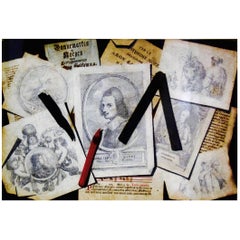
This trompe l'oeil drawing depicts the artist's tools -- a black and a red crayon, and a folding steel ruler that was painted with silver pigments, which have blackened with age. They're shown on a sheaf of papers that include a medieval manuscript page, a musical score, and a group of prints. The unifying theme is the artistic patronage of the Medici, the Grand Dukes of Tuscany, who intermarried with the Habsburgs, who were the Holy Roman Emperors. Among the papers are prints by Stefano Della Bella, the Florentine artist who worked for the Medici. They depict a negro page with a horse, and portraits of Lorenzo Lippi...

Category

Antique Early 1800s French Empire Drawings

Materials

Paint, Paper

17th Century Rosa di Tivoli Painting on Slate

17th Century Rosa di Tivoli Painting on Slate

By Philipp Peter Roos (Rosa di Tivoli)

Located in New York, NY

A ram lowers its horns in a face off with a barking dog that rises on its haunches. An ox turns its head to watch the row. An annoyed ewe glances over its shoulder, but the two behin...

Category

Antique 1680s Italian Baroque Paintings

Materials

Slate

Italian, 18th Century Decorative Panel

Italian, 18th Century Decorative Panel

By Bonzanigo

Located in New York, NY

A neoclassical painted and gilded overdoor panel in the manner of Giuseppe Maria Bonzanigo, circa 1790.

Category

Antique 1790s Italian Neoclassical Decorative Art

Materials

Wood

Emilio Terry 1930s "Louis XVII Style" Bed

Emilio Terry 1930s "Louis XVII Style" Bed

By Emilio Terry

Located in New York, NY

Emilio Terry -- architect, interior, and furniture designer -- was the inventor and sole-practitioner of what was drolly referred to as his “Louis XVII style...

Category

Vintage 1930s French Neoclassical Revival Drawings

Materials

Paper

Superbly Carved Fire Screen by Francois Linke

Superbly Carved Fire Screen by Francois Linke

Located in New York, NY

This painted-and-gilded fire screen in the Louis XVI style was made by Francois Linke (1855 - 1946), the greatest maker of furniture in Belle Epoque Paris...

Category

Antique 1890s French Louis XVI Screens and Room Dividers

Materials

Wood

You May Also Like

Old Engraving from the xvii Century: Nicolas Paussin, 1677

Old Engraving from the xvii Century: Nicolas Paussin, 1677

Located in Madrid, ES

Old engraving from the 17th century: Nicolas Paussin 1677 Large seventeenth century engraving dated 1677. With very decorative back frame total measures: 91x71 cm and only the engra...

Category

Antique 17th Century Drawings

Materials

Paper

18th Century French Penelope and Ulysess Engraving

18th Century French Penelope and Ulysess Engraving

Located in Gloucestershire, GB

'Pénelope et Ulysse' - an original late 18th Century French, large scale, monochrome engraving by Jean Jacques Avril after a painting by Jean Jacques Francois Le Barbier. Depicting ...

Category

Antique 18th Century French Prints

Materials

Paper

Antique Classical Wall Engraving – Roman Mythology, Montfaucon 1721

Antique Classical Wall Engraving – Roman Mythology, Montfaucon 1721

Located in Langweer, NL

Antique Classical Mythological Engraving after Roman Sculpture – Montfaucon 1721 An elegant classical engraving depicting a mythological sculptural subject after ancient Roman model...

Category

Antique 1720s British Prints

Materials

Paper

Charles Audran The Education of Jupiter Engraving After Andrea Sacchi

Charles Audran The Education of Jupiter Engraving After Andrea Sacchi

Located in Wormelow, Herefordshire

A Charles Audran (1594-1674) the education of Jupiter engraving after Andrea Sacchi (1599-1661) presented in a modern frame. Also known as “The Allegory of the birth of Maffeo Barbe...

Category

Antique 17th Century Italian Grand Tour Paintings

Materials

Wood

18th Century French Study for a Painting in Gold Giltwood Frame

18th Century French Study for a Painting in Gold Giltwood Frame

Located in Sheffield, MA

18th century French study of a painting of an allegory. Gold giltwood frame with salmon color moiré fabric around matting. Drawing measures 6" H x 8.5" W. Much of the white you see ...

Category

Antique 18th Century French Paintings

Materials

Wood, Paper