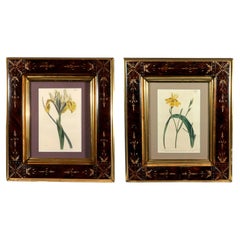
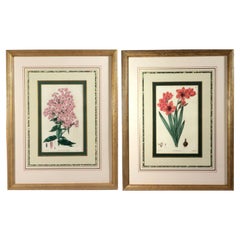
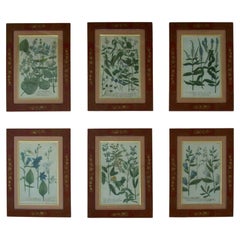
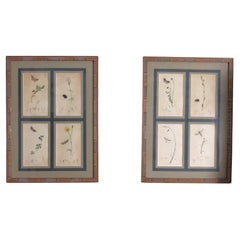
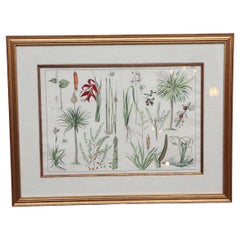
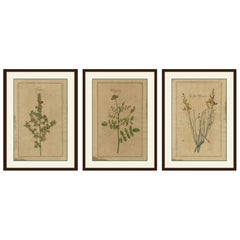
This pair of hand-colored copperplate engravings comprises the two final plates of John Hill’s The British Herbal, published in London in 1756. Plate 74 sets out the ferns and their allies, among them the common hart’s-tongue, polypody, rough and smooth spleenworts, six maidenhairs, osmund royal, adder’s tongue and moonwort, the duckweeds, and the great water and wood horsetails. Plate 75 gathers the mosses, lichens, fungi, and seaweeds, from the yellow dusty byssus and the oyster ulva at the head of the sheet to the common cup moss, the great marsh sphagnum, the reticulated and phalloid mushrooms, the oak lungwort, and, along the lower edge, the common coralline, sea fucus, sea ragged staff, and grassy alga.
Each plate is numbered upper right and signed in the plate at the lower right, A. Smith sculp. The coloring is delicate and carefully graded, the fern fronds worked in cool blue-greens against the warmer yellow-greens of the mosses, and the fungi in soft mauve and gray, and it shows the plates to considerable advantage. The two are handsomely framed in burl veneer with a gilt beaded inner slip, over linen mats with burl-veneered fillets.
John Hill (1716–1775) was an apothecary, botanist, and prolific author, and one of the most combative literary figures of his day. The British Herbal was issued in parts between 1756 and 1757 by a consortium of London booksellers, and ran to seventy-five engraved plates. It was among the earliest English floras to adopt a systematic arrangement of the native plants, and its plates, each crowded with many species to the sheet, were designed to make the whole range of British vegetation legible at a glance.
The two plates offered here close the work, and their subjects are the reason for their appeal. The cryptogams, the plants that reproduce without flowers, were the least understood and the least often illustrated part of the flora, and eighteenth-century botany was only beginning to bring order to them. Plates devoted to mosses, lichens, fungi, and seaweeds are correspondingly scarce in the botanical print market, and their dense, decorative arrangement of small forms across the sheet has made them among the most sought-after images from the book. Hung as a pair, the two sheets balance one another closely, and the cool greens read particularly well against a strong wall color.
Dimensions
Framed height: 26 inches (66.0 cm)
Framed width: 20¾ inches (52.7 cm)
Sight height: 15¼ inches (38.7 cm)
Sight width: 9½ inches (24.1 cm)