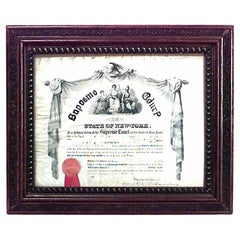
American Victorian Diploma Plaque, Oak Framed, 19th Century Wall Art
Located in Queens, NY
American Victorian oak framed wall plaque of a diploma.
Category
Antique 19th Century American Victorian Prints
Materials
Oak
American Victorian Diploma Plaque, Oak Framed, 19th Century Wall Art
Located in Queens, NY
American Victorian oak framed wall plaque of a diploma.
Oak
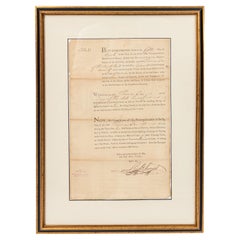
18th Century Inn License in a Gilt Frame
Located in Queens, NY
Original 1790 NY state inn license letterpressed in a faux gilt and lacquer frame.
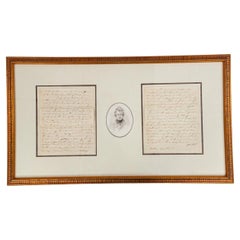
19th Century Federal Print of Letters with Oval Portrait in Gold Frame
Located in Queens, NY
American (19th Century) copy collection of two letters from the 1830s in a white mat with a central oval printed portrait of a gentleman (Otis Cafron) in a gold wooden frame.
Gold
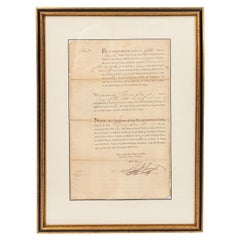
Late 19th Century Rustic Inn License in Gilt Lacquer Frame, USA
Located in Queens, NY
Original 1790 NY state inn license letterpressed in a faux gilt and lacquer frame
Lacquer
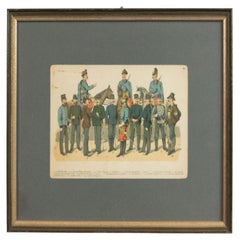
Continental Austrian Military Battalion Prints
Located in Queens, NY
13 Continental Austrian (19th Cent) colored prints of various military battalions in grey & silver trimmed frames (Militar Album aller Lander Die Oesterreich. Ungarische Armee) (...
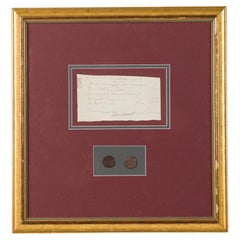
19th Century American Letter Fragment and Copper Coins, Federal Style
Located in Queens, NY
American (19th Cent) fragment of antique paper with handwritten script and numerical calculations framed in a burgundy mat above two copper coins in a blue mat mounted in a gold wood...
Copper
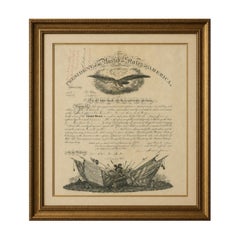
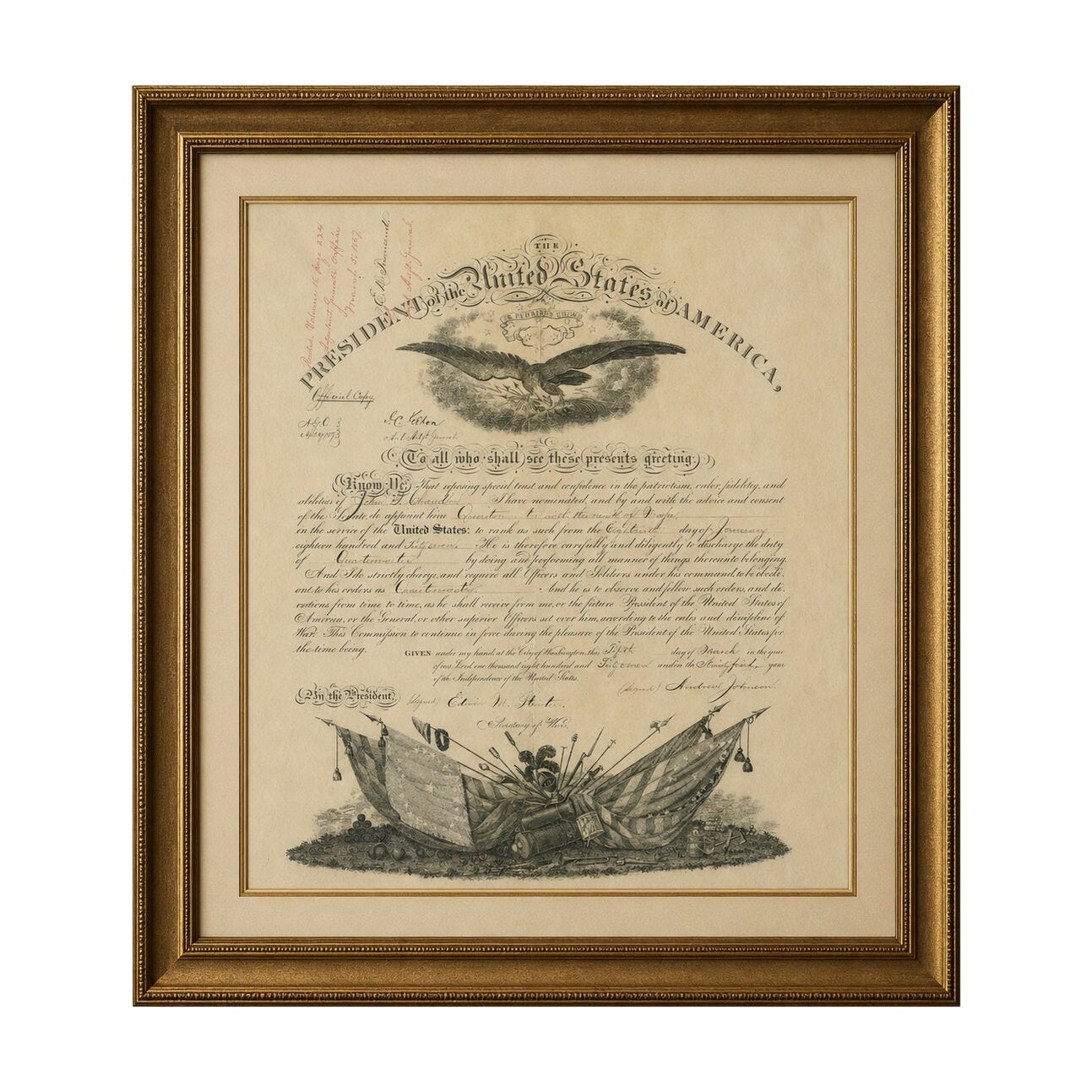
Andrew Johnson Military Commission 1867 – Quartermaster Appointment Civil War
Located in Langweer, NL
Title: Andrew Johnson Military Commission 1867 – Quartermaster Appointment, Civil War Era This impressive and highly decorative United States presidential commission, issued under A...
Paper
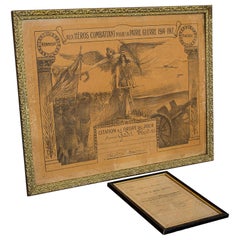
Antique Pair of Framed Certificates, French, Award of Honour, WW1, circa 1920
Located in Hele, Devon, GB
This is an antique pair of framed certificates. A French, large award of posthumous honour from WWI and a smaller plaque of good conduct, dating to the early 20th century, circa 1920. Rare, French antique certificates...
Paper
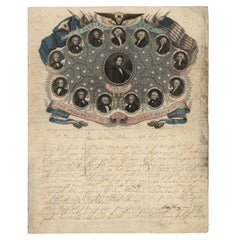
Mid-19th Century American Stationary with Manuscript Letter, Signed 1854
Located in Langweer, NL
American stationery with in the top the following text printed: E pluribus unum – Latin for "Out of many, one" (also translated as "One out of many" or "One from many") – is a traditional motto of the United States, appearing on the Great Seal along with Annuit cœptis (Latin for "he approves the undertaking [lit. 'things undertaken']") and Novus ordo seclorum (Latin for "New order of the ages"); its inclusion on the seal was approved by an Act of Congress in 1782. While its status as national motto was for many years unofficial, E pluribus unum was still considered the de facto motto of the United States from its early history. Eventually, the United States Congress passed an act (H. J. Resolution 396), adopting "In God We Trust" as the official motto in 1956. The thirteen letters of E PLURIBUS UNUM makes its use symbolic of the thirteen original states like the thirteen stripes on the US flag. The meaning of the phrase originates from the concept that out of the union of the original Thirteen Colonies emerged a new single nation. It is emblazoned across the scroll and clenched in the eagle's beak on the Great Seal of the United States. (Source: wikipedia) Text below the portraits: "The Presidents of our Great Republic." Letter paper with hand-colored engraving showing the portraits of the 14 presidents of the USA from George Washington up to Franklin Pierce...
Paper
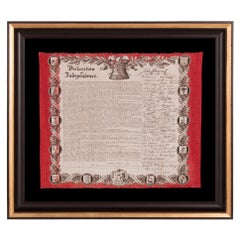
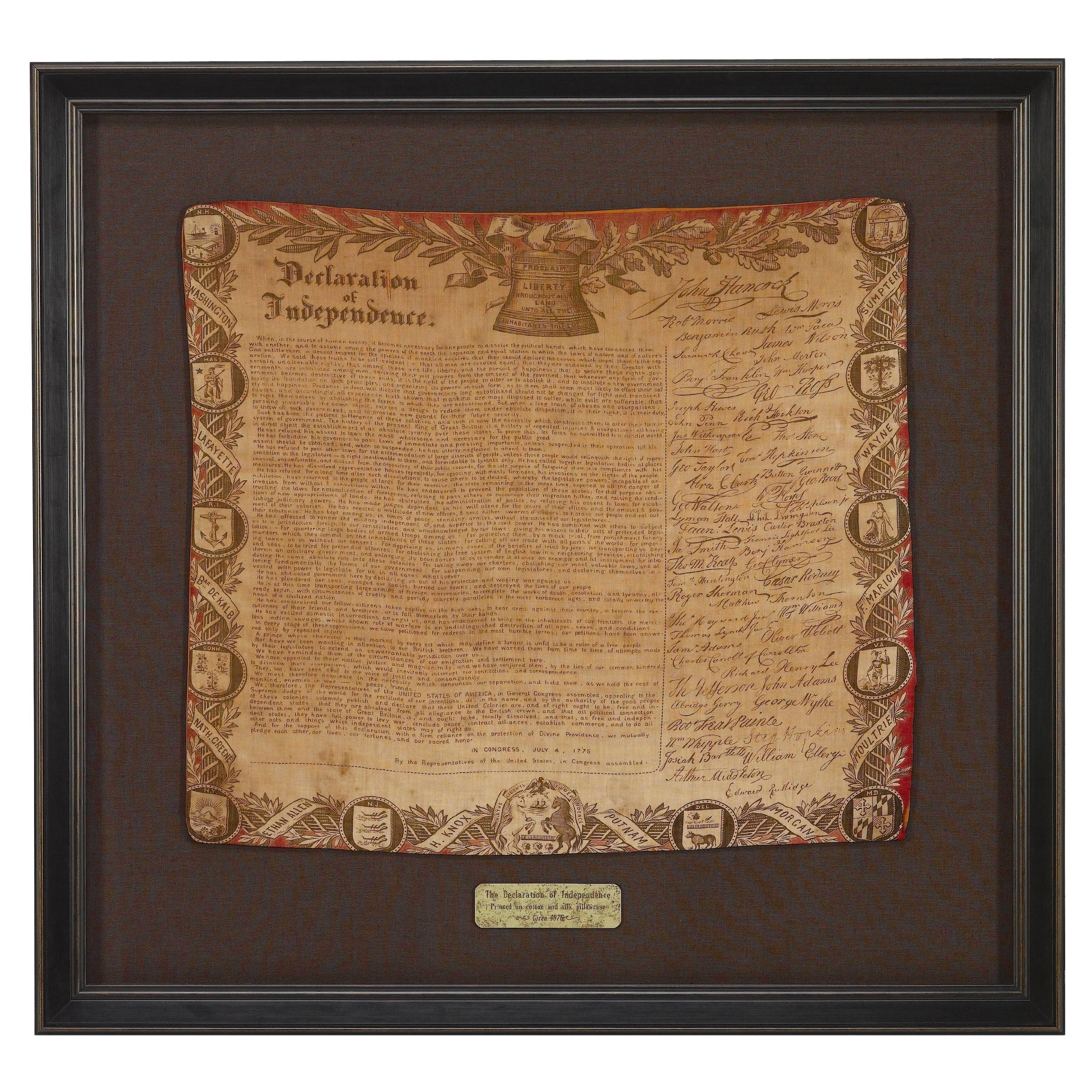
The Declaration of Independence, Printed on Cotton, ca 1876
Located in York County, PA
PRINTED COTTON KERCHIEF GLORIFYING THE DECLARATION OF INDEPENDENCE, WITH TEXT AND REPRODUCED SIGNATURES, MADE FOR THE 1876 CENTENNIAL INTERNATIONAL EXPOSITION IN PHILADELPHIA Printed on cotton, this beautiful kerchief pays homage to the Declaration of Independence, through the reproduction of its text and 56 signatures, surrounded by a fanciful border. The latter contains the 13 state seals, which are dispersed around the perimeter in small medallion images. Note how Pennsylvania is highlighted among them, larger and in the bottom center, both because it served as the meeting place of the Second Continental Congress, and played host to the 1876 Centennial International Exposition, the six-month long World’s Fair event that was held in honor of our nation’s 100-year anniversary of independence. The names of twelve Revolutionary War generals are spread out between each crest, on each forward-facing turn of a scroll, that wraps around the pillar and leaf border on the right, left, and bottom. These include Washington, Lafayette, Johann de Kalb, Nathiel Greene, Ethan Allen, Henry Knox, Israel Putnam, Daniel Morgan, William Moultrie, Francis Marion...
Cotton
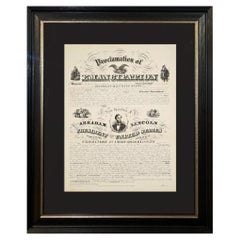
1864 Engraving of Lincoln's "Proclamation of Emancipation" by Charles Shober
Located in Colorado Springs, CO
This 1864 engraving features the Emancipation Proclamation in elaborate calligraphic text, with five patriotic vignettes and a small portrait of Lincoln. This is the second issue of ...
Paper
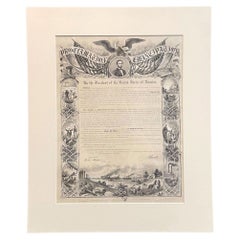
1864 Abraham Lincoln's Emancipation Proclamation, Antique Engraving by W Roberts
Located in Colorado Springs, CO
Presented is a Proclamation of Emancipation wood engraving by W. Roberts. The engraving was published in 1864, just one year after President Abraham Lincoln signed the original Proclamation. W. Roberts was the artist and engraver and Corydon Alexis Alvord was the printer. The engraving was published by R. A Dimmick, in New York, 1864. The text of the Proclamation is set in a variety of typefaces, which is encased in a pictorial border. The border is decorated with a portrait of Abraham Lincoln and seven other vignettes, including the horrors of slavery at left, the bombardment of Fort Sumter at bottom, and scenes from a prosperous and united nation at right. On September 22, 1862, five days after the Union victory at the Battle of Antietam, Lincoln issued a preliminary decree stating that, unless the rebellious states returned to the Union by January 1, freedom would be granted to slaves within those states. No Confederate states took the offer, and on January 1, 1863 Lincoln presented the Emancipation Proclamation...
Paper