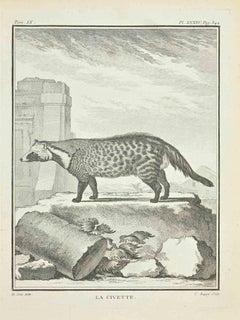
Title: Antique Asian Civets & Kopi Luwak Natural History Engraving – Bertuch
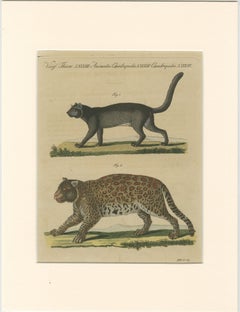
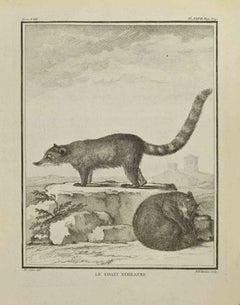
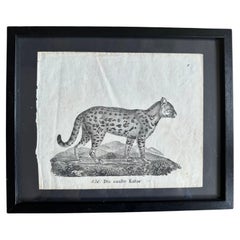
Original antique hand-colored copper engraving depicting two exotic civet-like mammals from Asia, published in Friedrich Justin Bertuch’s celebrated “Bilderbuch für Kinder” in the early 19th century.
The plate is headed “Säugethiere CVIII / Mammifères CVIII” and presents two unusual members of the civet family, a group of mammals strongly associated with tropical Asia and particularly interesting in relation to the natural and cultural history of Indonesia.
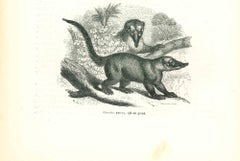
Fig. 1 – Palm Civet / Paradoxure Type
The upper animal is a palm-civet or paradoxure type, characterized by its elongated body, pointed muzzle, short legs and remarkable tightly curled tail.
Palm civets are predominantly nocturnal mammals native to tropical Asia. Excellent climbers, they spend considerable time in trees and feed on fruit as well as insects and small animals.
Several species of palm civet occur throughout Southeast Asia and the Indonesian archipelago. In Indonesia, civets are commonly known as “luwak” or “musang.”
Because the exact historical species represented by Bertuch in Fig. 1 has not been established with certainty, it is described here conservatively as a palm-civet or paradoxure type rather than assigning it a definitive modern scientific name.
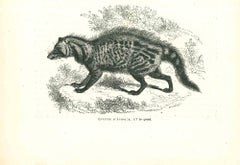
Fig. 2 – Banded Civet / Banded Palm Civet Type
The lower animal is a striking Asian civet characterized by its elongated body, pointed muzzle, long banded tail and extraordinary dark markings across its back and flanks.
Its appearance is closely associated with the beautifully patterned civets of Southeast Asia, including species occurring historically across the Malay Peninsula, Sumatra, Borneo and neighboring regions.
The elaborate pattern of stripes, bands and irregular markings makes this animal particularly decorative and is beautifully emphasized by the original hand coloring.
The Civet and Indonesia’s Famous Kopi Luwak
Civets have an especially fascinating place in Indonesian culture because of their association with Kopi Luwak, one of the world’s most unusual and famous coffees.
In Indonesia, the Asian Palm Civet is commonly called the “luwak.”
The animal naturally feeds on ripe coffee cherries, selecting the fruit as part of its varied diet. The fruit surrounding the coffee beans is digested, while the beans themselves pass through the civet’s digestive system.
Traditionally, these beans were collected from the animal’s droppings, thoroughly cleaned, dried and roasted to produce Kopi Luwak.
During their passage through the civet’s digestive tract, the beans undergo fermentation and enzymatic processes that can alter their chemical composition and flavor characteristics.
Kopi Luwak became particularly associated with the coffee-growing regions of the Indonesian islands of Java and Sumatra and is closely connected with the colonial history of coffee cultivation in the former Dutch East Indies.
According to the commonly told history of Kopi Luwak, local plantation workers during the Dutch colonial period were restricted from harvesting coffee for their own consumption. They discovered that coffee beans could be recovered from the droppings of wild civets that had eaten ripe coffee cherries, then cleaned and roasted.
The resulting coffee eventually developed an international reputation for its unusual production method and rarity.
Today, Kopi Luwak remains one of Indonesia’s most internationally recognized specialty coffees. Modern commercial production has, however, raised animal-welfare concerns where civets are confined and force-fed coffee cherries. Traditionally collected beans from genuinely wild civets are therefore generally considered both more authentic and preferable from an animal-welfare perspective.
It should be noted that the precise species illustrated in Fig. 1 has not been definitively established as the Asian Palm Civet used in Kopi Luwak production. The Kopi Luwak story is included as fascinating cultural context concerning the close relationship between civets and Indonesian history.
Civets and the East Indies
Civets belong to the family Viverridae and related groups of predominantly tropical Old World mammals.
To European naturalists of the late 18th and early 19th centuries, these unusual animals were associated with Africa, India and the East Indies. Their elongated bodies, distinctive markings, long tails and nocturnal habits made them particularly interesting subjects for illustrated natural-history publications.
The Indonesian archipelago – then generally known to Europeans as part of the East Indies – was an extraordinarily important source of zoological discoveries. Java, Sumatra, Borneo, the Moluccas and surrounding islands supported an exceptional diversity of animals that were still little known in Europe.
Friedrich Justin Bertuch
Friedrich Justin Bertuch (1747–1822) was a German publisher, writer and patron of the arts. His monumental “Bilderbuch für Kinder” (Picture Book for Children), first published in Weimar in 1790, became one of the great illustrated educational encyclopedias of the late 18th and early 19th centuries.
Its hundreds of engraved and hand-colored plates introduced European readers to animals, plants, geography, science, technology, antiquity and cultures from around the world.
The engraving is signed at lower left:
“L. Rieder sc.”
This is an especially appealing Southeast Asian natural-history plate. The extraordinary curled tail of the upper animal and the dramatic striped and spotted coat of the lower civet create a highly decorative composition.
Its connection with Southeast Asian wildlife, the Indonesian archipelago and the fascinating cultural history of civets and Kopi Luwak makes the engraving particularly suitable for an Indonesian, tropical, colonial, natural-history or coffee-inspired interior.
Technique: Original hand-colored copper engraving
Publisher: Friedrich Justin Bertuch / Industrie-Comptoir
Publication: Bilderbuch für Kinder
Place: Weimar, Germany
Date: Early 19th century, circa 1820
Plate: Säugethiere CVIII / Mammifères CVIII
Engraver: L. Rieder
Subjects: Asian Civets / Palm Civet / Banded Civet
Geographical association: Southeast Asia / East Indies
Cultural association: Indonesia / Kopi Luwak / Coffee History
Condition:
Good antique condition with overall age-related toning, scattered foxing and spotting and some visible show-through or offsetting from printed text. Minor marks and imperfections are present consistent with the age of the engraving. The original hand coloring remains attractive, particularly the warm brown tones of the upper animal and the striking dark pattern of the lower civet.
The engraving is loosely inserted in an acid-free matting board.
Please study the photographs carefully as they form part of the condition description.
Please note: This is an original antique hand-colored copper engraving from the early 19th century, not a modern reproduction. The print is sold unframed. Framed images or interior views, if shown, are for presentation and inspiration only.
Other companion mammal and natural-history plates from Bertuch’s “Bilderbuch für Kinder” are also available separately.
Keywords: Friedrich Justin Bertuch, Bilderbuch für Kinder, civet, Asian civet, palm civet, banded civet, banded palm civet, Viverridae, luwak, musang, Kopi Luwak, civet coffee, Indonesian coffee, coffee history, Java coffee, Sumatra coffee, Dutch East Indies, Indonesia, Indonesian wildlife, Sumatra, Borneo, Java, Malay Peninsula, East Indies, Southeast Asian animals, tropical mammals, antique civet print, antique Indonesian print, natural history illustration, antique zoology, L Rieder, hand-colored copper engraving, German engraving, Weimar, early 19th century, original antique print