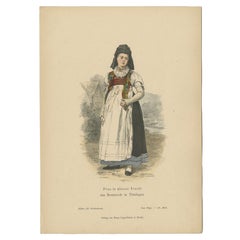
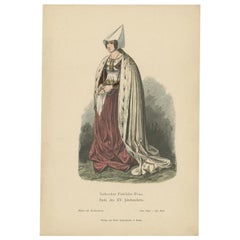
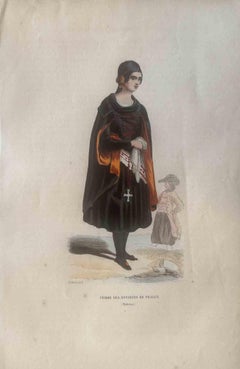
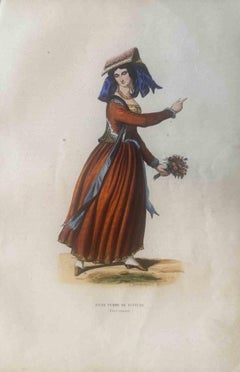
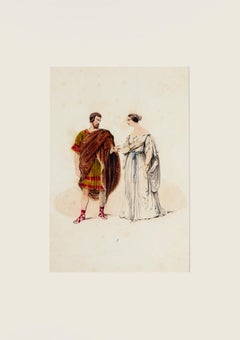
Antique costume print titled 'Slovakin aus der Gegend von Kaschau'. Old print showing a Slovakin from the area of Košice. This print originates from 'Blätter für Kostümkunde'.
The Slovaks (Slovak: Slováci, singular: Slovák, feminine: Slovenka, plural: Slovenky) are a West Slavic ethnic group and nation native to Slovakia who share a common ancestry, culture, history and speak Slovak. Košice is currently the largest city in eastern Slovakia. It is situated on the river Hornád at the eastern reaches of the Slovak Ore Mountains, near the border with Hungary. With a population of approximately 240,000, Košice is the second-largest city in Slovakia, after the capital Bratislava.
Being the economic and cultural centre of eastern Slovakia, Košice is the seat of the Košice Region and Košice Self-governing Region, the Slovak Constitutional Court, three universities, various dioceses, and many museums, galleries, and theatres. In 2013 Košice was the European Capital of Culture, together with Marseille, France. Košice is an important industrial centre of Slovakia, and the U.S. Steel Košice steel mill is the largest employer in the city. The town has extensive railway connections and an international airport.
The city has a preserved historical centre which is the largest among Slovak towns. There are heritage protected buildings in Gothic, Renaissance, Baroque, and Art Nouveau styles with Slovakia's largest church: the St. Elisabeth Cathedral. The long main street, rimmed with aristocratic palaces, Catholic churches, and townsfolk's houses, is a thriving pedestrian zone with boutiques, cafés, and restaurants. The city is known as the first settlement in Europe to be granted its own coat-of-arms. (Source: Wikipedia)
Artists and Engravers: Published by Franz Lipperheide, a German publisher of fashion magazines.
Condition: Good, general age-related toning. Some offset of text visible on left top. Some wear, please study image carefully.
Date: c.1880
Overall size: 19.9 x 28.6 cm.
Image size: 11.2 x 16.4 cm.
We also offer thousands of antique prints covering fields of interest as diverse as architecture, natural history, religion, ethnology and many more. Antique prints have long been appreciated for both their aesthetic and investment value. They were the product of engraved, etched or lithographed plates. These plates were handmade out of wood or metal, which required an incredible level of skill, patience and craftsmanship. Whether you have a house with Victorian furniture or more contemporary decor an old engraving can enhance your living space.