Max Beckmann (German, 1884-1950)
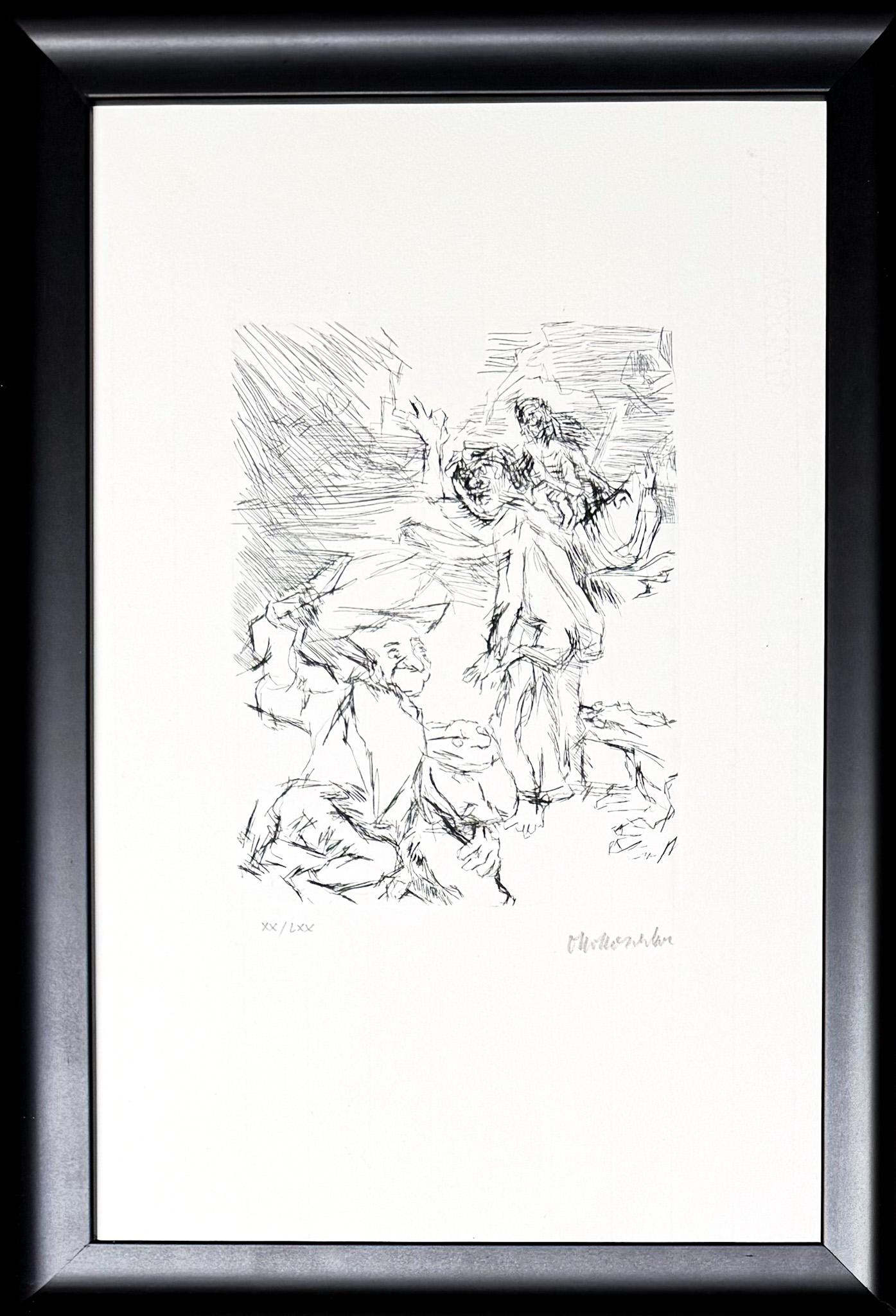
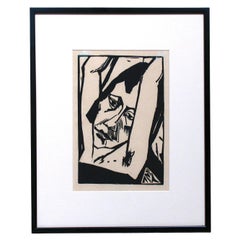
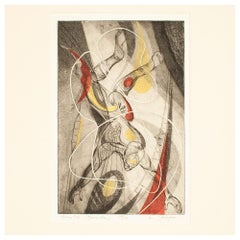
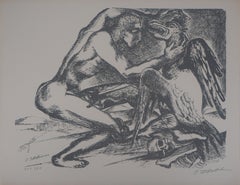
Jacob wrestling with the Angel (Jakob ringt mit dem Engel), 1920.
Drypoint etching on tissue-thin Japan paper.
Plate 22 from Rembrandt: Religiöse Legenden,1920, pencil signed bottom right, from the edition of 65 in this first state (Hofmaier's state I.B. of II.), with wide margins, Verlag der Marées Gesellschaft, R. Piper & Co., Munich, publisher.
The subject is taken from Genesis 32, but Beckmann has mysteriously incorporated in the image the ladder, from the earlier vision of Jacob in which he saw a ladder from earth to heaven with angels moving up and down in Genesis 28. The result is a complex composition, highly expressive and dramatic but hardly idealized, that resembles no other depiction of the story.
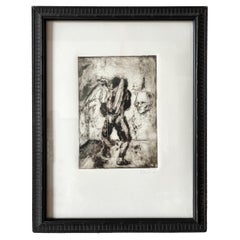
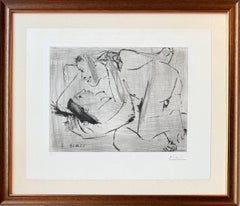
Older gold leafed carved wood square frame in the style of the period, mat board replaced with acid free rag board mat and non glare UV protected “Optium” acrylic in 2021 by 14th Street Framing Gallery, NYC.
Condition: The sheet is lightly toned. There is a diagonal crease in the upper right corner, approximately 4 inches in length. There are soft diagonal ripples in the lower left corner of the image. The sheet is double hinged along the top edge with remnants of previous mounting in bottom left corner verso. The sheet is inscribed on verso '49.,' '3222,' 'Max Beckmann', and 'Ovis Rad' in pencil along extreme bottom edge. In overall fair condition.
Frame: 19 x 17 in.
Image: 10 7/8 x 8 3/4 in. (28.7 x 22.2cm)
Sheet: 16 7/8 x 12 in. (42.8 x 30.5cm)
Catalog Raisonné: Hofmaier 179, I.B.
Provenance:
Property from the Estate of Gabriele Lee, Philadelphia, PA
Freeman’s Philadelphia, Art & Design, September 15, 2021, lot 15.
L'Asie Exotique, Palm Springs, CA
Collections:
Mead Art Museum at Amherst College AC 1970.17
Portland Art Museum 80.122.391
Stiftung Christliche Kunst Wittenberg B/MBe/1920/1
Relevant Bible passages (Revised Standard Version):
Genesis 28:12
He had a dream in which he saw a ladder resting on the earth, with its top reaching to heaven, and the angels of God were ascending and descending on it.
Genesis 32:24–29
24And Jacob was left alone; and a man wrestled with him until the breaking of the day. 25When the man saw that he did not prevail against Jacob, he touched the hollow of his thigh; and Jacob’s thigh was put out of joint as he wrestled with him. 26Then he said, “Let me go, for the day is breaking.” But Jacob said, “I will not let you go, unless you bless me.” 27And he said to him, “What is your name?” And he said, “Jacob.” 28Then he said, “Your name shall no more be called Jacob, but Israel, for you have striven with God and with men, and have prevailed.” 29Then Jacob asked him, “Tell me, I pray, your name.” But he said, “Why is it that you ask my name?” And there he blessed him.
Interpretation Translated from the German:
Anne Koch, Intermediäre Leitern Religionsästhetische Deutung eines Bildmotivs bei E. Schuhmacher, M. Beckmann, G. Segal, A. Kiefer, 2004.
Intermediarity as Suspension: Beckmann's Jacob wrestles with the angel.
Beckmann designed an etching in 1920, one year after the First World War. He blends the Jacob's dream at Betel (Gen 28) and the Jacob's fight in the ford of the Wadi Jabbok (Gen 32) into one another. The first episode stands at the break point of Jacob's flight and the second at the border crossing into the territory of his brother when returning from Mesopotamia over 20 years later. Jacob's struggle for a blessed life has remained the same….Beckmann's scene takes place exactly at dawn: the moon is still in the sky, the sun is just rising over the horizon. In between, the ladder is placed from the ground to the sky, cut off at the top and bottom, as a stage for the fight. From behind the head of the angelic facing figure, the sun shines as a wreath of light around his head. This figure has raised his hands, unclear whether the gesture is of surrender or blessing. Jacob is clinging to the angel’s stomach. Is Jacob hugging or wrestling? In this he is just as ambivalent as the angel. The scene is focused. Sharp shapes point them to a center point. The whole middle picture is filled with the pair of figures. A foreground is missing, the entire left edge of the picture is shifted by a triangular wedge and thus cut off from the past direction of the scene. These agents increase the couple's tightness and intimacy. It is this aspect in particular that Thomas Mann unfolds in his literary revision in the Joseph novel as a sweaty, homoerotic touch. Jacob's struggle for success, survival and founding a new existence floats in the air in the truest sense of the word. It takes place outdoors on the ladder. In the living space of existence, struggle and long wanderings are not spared. The encounter with the promising or challenging counterpart leaves it undecided whether Jacob is the winner or a pathetically clinging creature. The gift of blessing brings happiness, but cannot prevent errors. It is a dodgy gift without specifying the time when it was valid and without any radical relief from other equally noticeably difficult living conditions. A blessing is double edged support. Often it is not clear whether it is not achieved by oneself rather than given. Beckmann draws our earthly phase of life incredibly clearly as that intermediate state. Nor has it been satisfactorily clarified on the part of the deity.