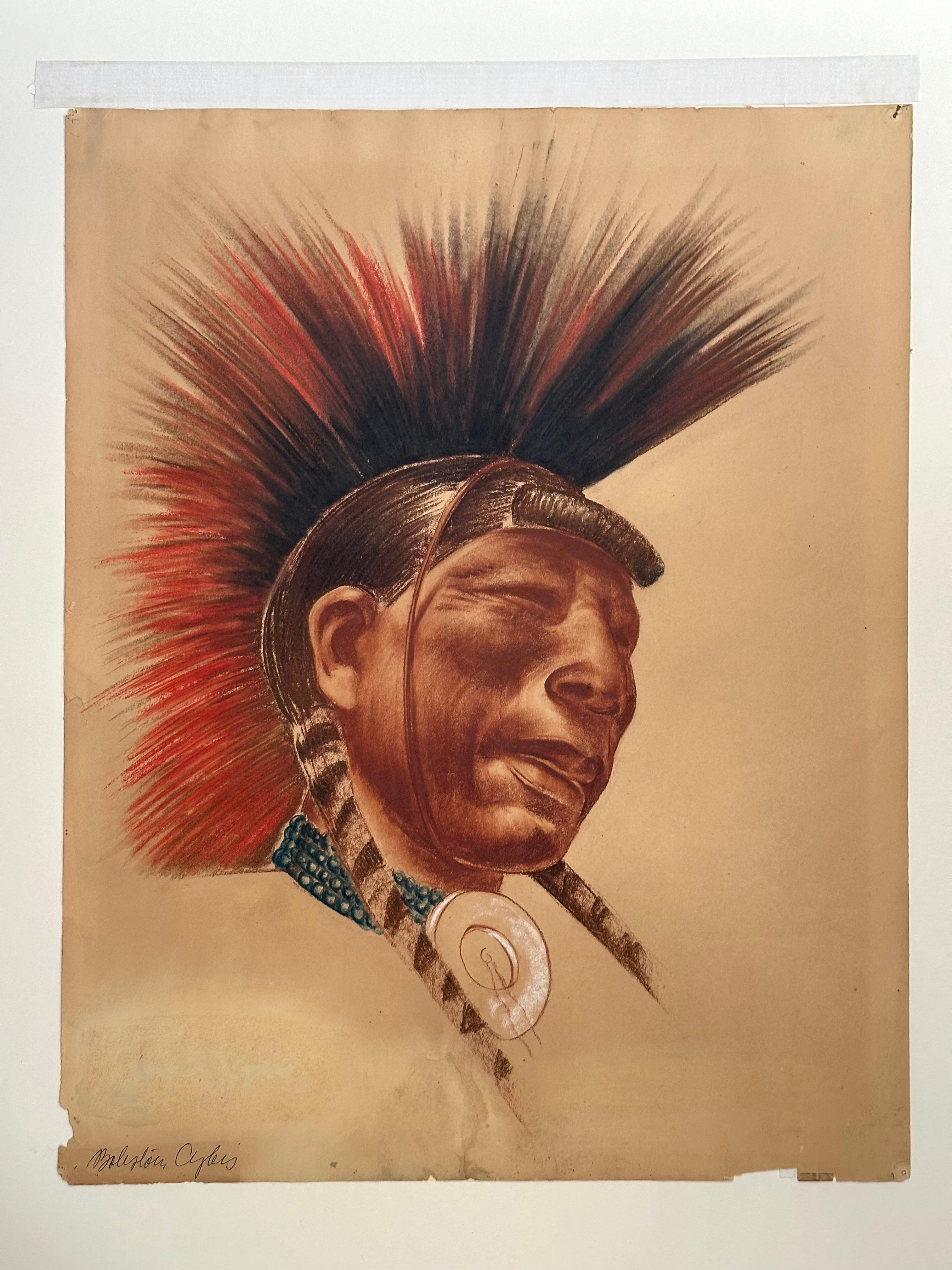
Boleslaw Cybis (1895-1957).
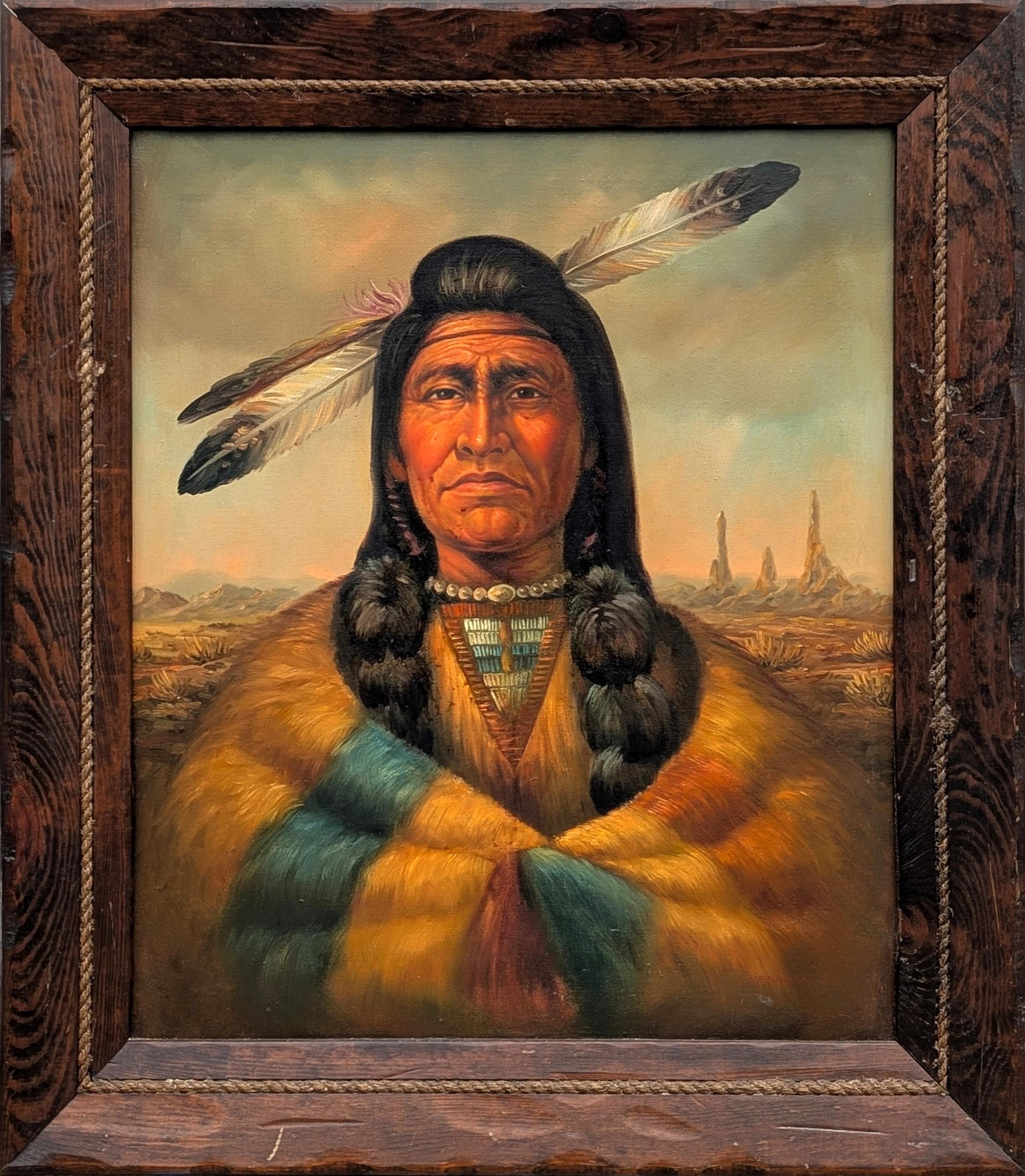
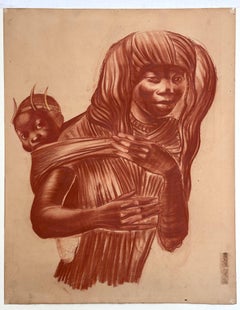
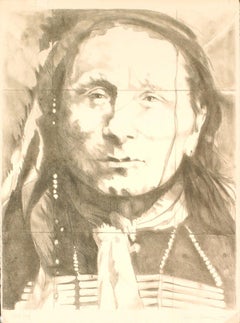
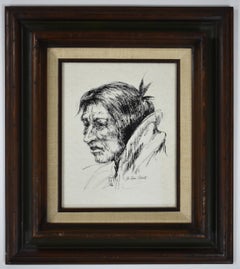
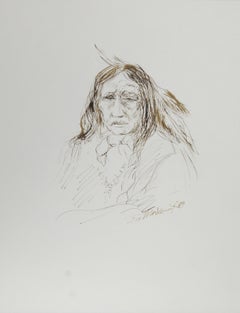
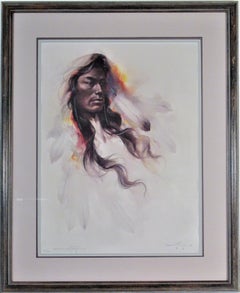
Comanche (Indomitable Spirit) Indian Negro Series, image #8 of 18 unique image that comprise the drawing series.
Conte on paper, sheet measures 18 x 23 inches.
Signed by the artist some years after its creation in blue ink, lower left, ca. 1950's.
The sheet is hinged at top margin, not glued down to backing board.
The sheet has an encircled 1 notation on back signifying that it is the first of 9 images selected for the lithographic series.
Provenance: Cybis Archive.
This original drawing was created in 1939-40 during an extensive visit to the Southwest US. The artist created 18 portraits and titled the series "Indian Negro Serie".
Of the 18 images, only 9 were selected to be included in a limited edition lithographic series some 30 years after creation. 1000 editions were printed. This is the original drawing upon which one of the images is based, and is thus unique.
Of the 18 original drawings, 2 are owned by the polish government, 5 are in our collection and the other 11 are whereabouts unknown.
The artist and his wife opened a porcelain factory in the 1950's, Cybis Studios.
The only non-porcelain retail offering from the Cybis studio was a 1970s art issue called the Folio One. This was a limited edition reproduction series taken from nine conté drawings of Native Americans made by Boleslaw Cybis in 1939. Conté is the name of a type of crayon made of compressed charcoal or graphite mixed with wax or clay. The artist Georges Seurat was particularly fond of using conté for his drawings.
Boleslaw Cybis was fascinated by the Native American (then typically referred to as American Indian) culture and peoples. This may seem odd when you consider that much of his ceramic-based works were distinctly Rococo and/or Old World European in style….a pretty stark contrast, I’d say! But Cybis was nothing if not eclectic in his tastes.
The originals were reproduced as color lithographs, in an edition of 1000, in 1970. This meant “1000 of each individual print.” At present its original issue pricing is unknown, but a Spring 1972 dealer price list shows the full set of nine at $500. Individual prints could also be purchased at either $50 (for Comanche, Shoshone, or Apache) or $65 (for any of the other six)… representing a $40 savings when buying the entire folio at once versus singly. The Spring 1981 price list is the final one that shows the Folio One set for sale, still at the same price ($500) as it was a decade earlier. Individual prints are not available on that list.
According to the 1979 Cybis catalog text “Each of the 12″ x 20″ prints is hand-numbered on heavy Beckett rag-content paper, with a specially designed validating hallmark in the lower right-hand corner, and carries an accompanying page with a brief tribal history.” The hallmark is blind-embossed, not surface printed.
However, the Spring 1972 dealer price list cited above described the prints as being 17″ x 23″ in size. Checking past auction listings for the set, the actual prints are indeed 17″ x 23″, which means that the 12″ x 20″ size probably refers to the image area. The overall size of the set’s burlap-covered box is 18.5″ x 24.5″.
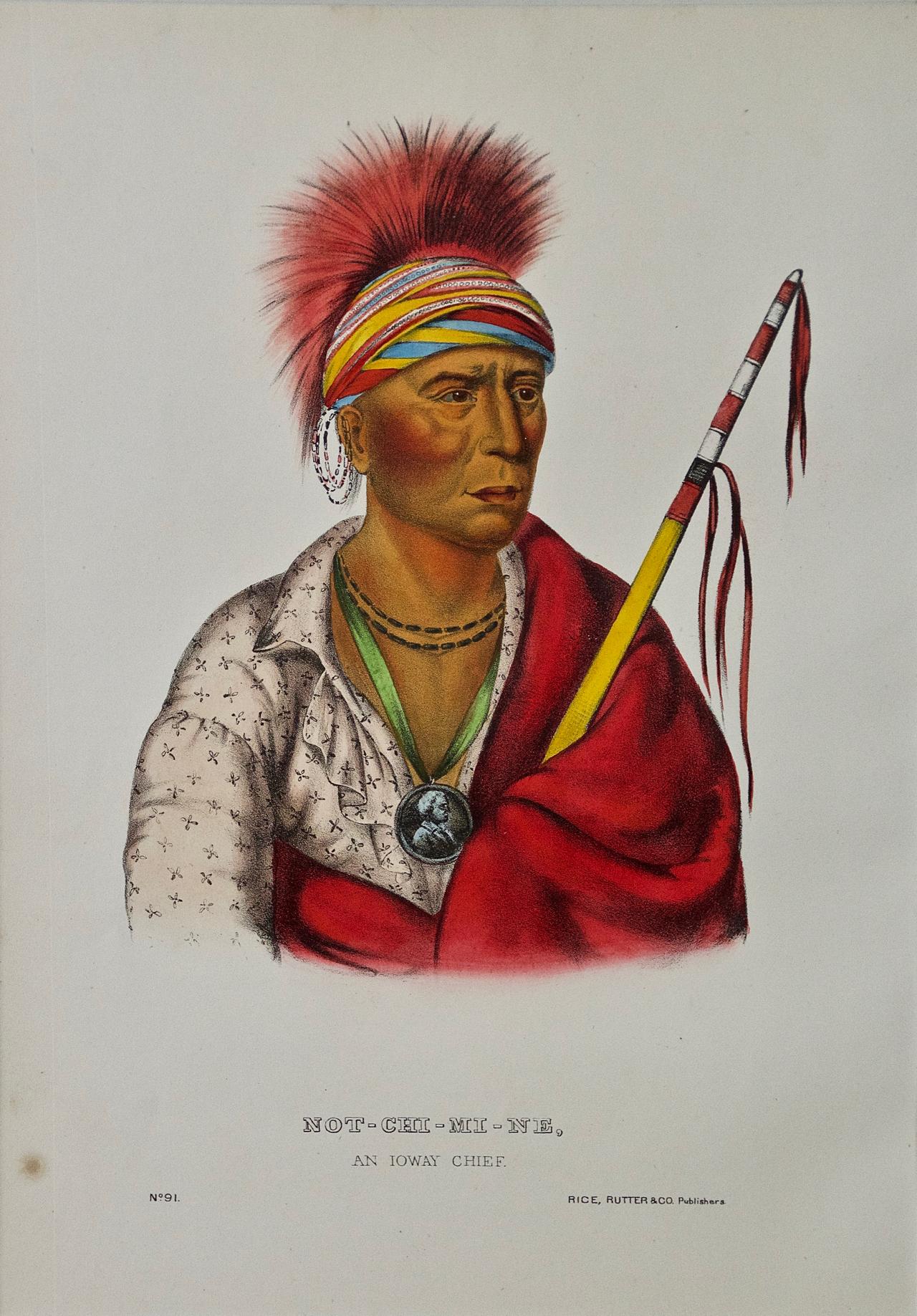
These nine portraits represent seven different tribes: the Comanche, Shoshone, Taos, Apache, Hopi, Mohave, and Yuma. A bit of trivia is that only two of those tribes (Apache and Shoshone) were featured within the modern studio’s North American Indians porcelain series. The images below are identified exactly as they are within the set.
INDOMITABLE SPIRIT Comanche chief portrait by Cybis Folio OneComanche ‘Indomitable Spirit’ was also used as the design for the porcelain medallion that adorns the set’s cover page.
SILENT THOUGHTS Shoshone chieftain portrait by Cybis Folio OneThis chieftain is Shoshone ‘Silent Thoughts’ whose expression reflects the heavy burden of responsibility than always accompanies being a true leader.
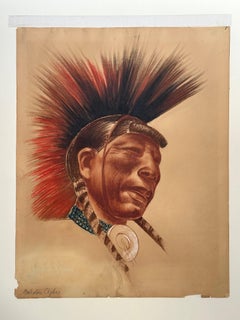
TIMELESS RITUAL Taos warrior portrait by Cybis Folio OneTaos ‘Timeless Ritual’ displays a traditional “roach” headdress.
PRIDE RUNS DEEP Apache warrior portrait by Cybis Folio OneApache ‘Pride Runs Deep’ exhibits the strength and dignity of this famous tribe.
THE FAREWELL Hopi portrait by Cybis Folio OneHopi ‘The Farewell’ has an aura of ineffable sadness. The Hopi are one of the oldest surviving cultures anywhere in the world.
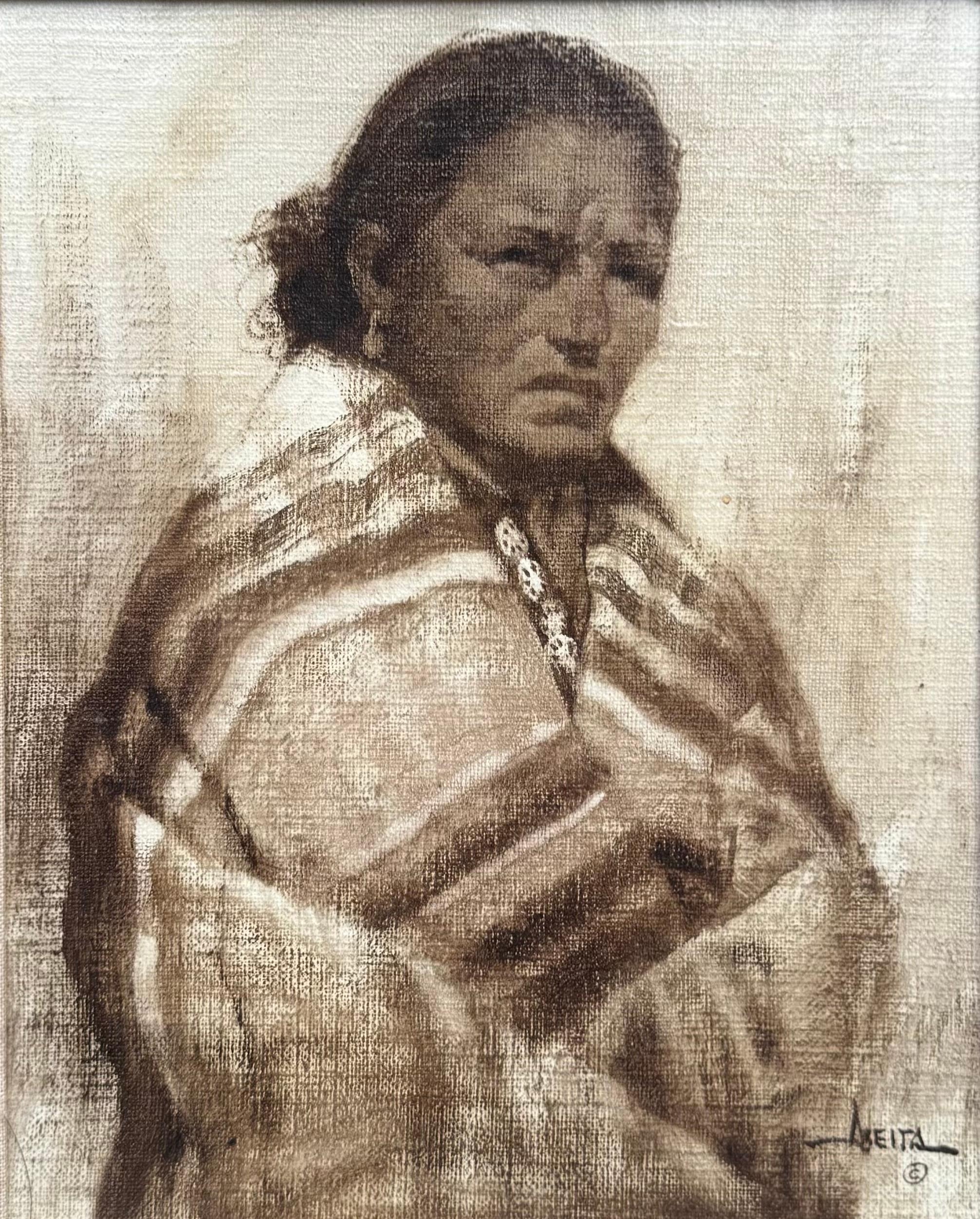
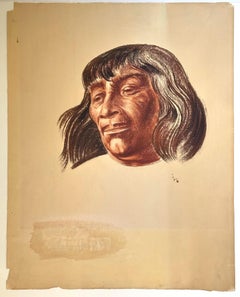
EYES OF AMBER Mohave woman portrait Cybis Folio OneMojave ‘Eyes of Amber’ is sometimes altered to ‘Amber Eyes’ by resellers, but the copyrighted Cybis title is as given here.
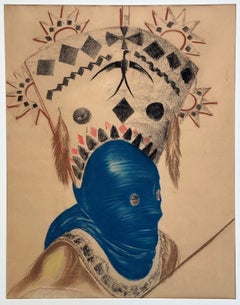
IMAGE MAKERS Apache portrait by Cybis Folio OneThis very unusual portrait is titled Apache ‘Image Makers’ and depicts the ritual Devil Dancer or Spirit Dancer headdress and fully-swathed face. In Apache culture and legend, the Devil Dancer is a somewhat mischievous although benevolent spirit.
OLD WOMAN Hopi portrait by Cybis Folio OneHopi ‘Old Woman’ evokes the calmness, wisdom and acceptance of old age.
VANISHED DREAMS Yuma portrait by Cybis Folio OneYuma ‘Vanished Dreams’ reflects the history of this West Coast tribe which suffered 100 years of almost continual warfare from various sources starting in 1775.
Each portrait was accompanied by an information text page.
During President Richard Nixon’s trip to the Moscow Summit in May 1972 during which the Cybis Chess Set was presented as a Gift of State, he also brought additional gifts for the other legs of his trip. Upon visiting Poland after the Summit, the Nixons presented two of the original Folio One drawings to the People of Poland; the Cybis brochure that describes the 1972 Chess Set also contains this information about the drawings:
Each is beautifully framed in a velvet lined, hand hewn walnut case with the full color Presidential Seal in porcelain set into the cover, and carries the inscription “Presented to the People of the Polish People’s Republic from President and Mrs. Richard Nixon and the People of the United States.”
According to a news article in the Spokane Daily Chronicle on April 11, 1973, “All original plates for Folio One have been destroyed in the presence of James Mitchell, assistant curator of Americana at the New Jersey State Museum in Trenton.” The purpose of the newspaper article (entitled, rather awkwardly, “Prints Party Gifts”) was to publicize the presence of a Folio One set in an upcoming local auction: “North American Indian prints – Folio One — …have been presented to the Wampum auction May 13 by Cybis Graphics of Trenton, NJ.” Another full Folio set was donated, along with nine Cybis sculptures, by Joseph Chorlton to Alfred University (NY State College of Ceramics) in June 1980 for their permanent study collection.
Artist Biography:
Bolesław Cybis (1895–1957) was a Polish painter, sculptor, and muralist.
Early life
Bolesław Cybis was born on July 23, 1895, in Vilnius, a part of the Russian Empire at that time. He received various athletic awards for gymnastic excellence during his school days in Warsaw. In 1915, he attended St. Petersburg Academy of Fine Arts while his father, a noted architect and engineer (said to have designed Peterhoff, the summer palace of the mother of Czarina Maria Feodorovna) was designing and building in Russia.
In 1921, the White Russian cause collapsed and Cybis took refuge in Constantinople where he lived and worked with artists Constantin Alajalov and Pavel Tchelitchev. He supported himself by sketching portraits in cafes, painting sidewalk advertisements for theatres, painting murals in nightclubs and cafes, painting and designing stage backdrops for the ballet, and fashioning clay pipes in ornate designs from native clays. One of his first "paid jobs" was a gigantic billboard advertising Nestle's chocolate.
By 1923 he had saved enough money for transportation home to Warsaw, where he entered the Warsaw School of Fine Arts [pl]. Upon graduation, he was appointed a professor at the academy and traveled extensively throughout Europe recording his experiences in his art while studying the Old Masters and emulating their techniques. In 1926 he married Marja Tym, a fellow artist and student at the academy.
Painting career
Cybis' paintings, sculptures, and murals won him recognition in Paris, Geneva, Munich, Frankfurt, Moscow, St. Petersburg, Bucharest and Vienna. From 1926 to 1930 he was fascinated by the peasants of the country side whom he likened to 15th century medieval portraits of the masters. Over the next four years he painted a series of peasant portraits now in various museum collections. During the 1930s his work first appeared by invitation in fine art exhibits and museums in the United States, where Studio Magazine (Contemporary... Masters," April 1934) found his paintings "a striking example... reminiscent of Leonardo da Vinci." In 1932 he lived in Tripoli, where some of his finest canvases were painted, and where he painted experimentally with cement. Over the next few years he exhibited paintings at the Brooklyn Museum of Art and at museums in Chicago and Dayton, Ohio, as well as in the International Exhibition of Paintings at the Carnegie Institute, Pittsburgh and the Albright-Knox Art Gallery in Buffalo, NY. His ceiling mural was awarded the Grand Prix at the International "Art and Technique" in Paris.
In 1939 Cybis and his wife, Marja, an accomplished artist in her own right came to the United States to paint a series of murals commissioned by their government in the "Hall of Honor" at the 1939 New York World's Fair. Here he completed two frescos: "Poles Fighting for American Independence" and "Central Industrial District and Gdynia." Also shown at the fair was a textured tapestry rug, "Walking through a Park", designed by Cybis and his wife. He then toured the U.S., sketching and painting Native American Indians.
Sculpture career
Unable to return to their homeland after the outbreak of World War II, the Cybises chose to become citizens of the United States. Although he had spent many years as a painter, Cybis was also fascinated with three-dimensional porcelain art, and the couple soon established Cybis Studio at the Steinway Mansion in Astoria, New York, in 1940. Here they created cold cast chalk ware sculptures known as Papka in the fashion of the great European Studios they had known during their youth.
After relocating to Trenton, New Jersey, Cybis turned his attention fully to china and porcelain sculpture using techniques derived from his study of the Old Masters in Europe. "Concept,...training, direction and execution -- Cybis knew that not one of these elements can be neglected in the complex process which ends as fine porcelain sculpture: for he was not a man to be tolerant of less than perfection. That his instincts were correct was quickly proven: in less than two years, Cybis achieved recognition as a leader in the field of porcelain art." In 1942 Cybis along with two investors, Harry Wilson and Harvey Greenburg, founded the Cordey China Company and in 1953 Cybis founded the Cybis Studio. The studio produced porcelain works at 65 Norman Avenue in Trenton until closing it doors to the public in the early 2000s. A website was online for several years advertising items for sale by special order but that was removed mid 2019. The company is now closed.