Want more images or videos?
Request additional images or videos from the seller
1 of 3

Henry Moore
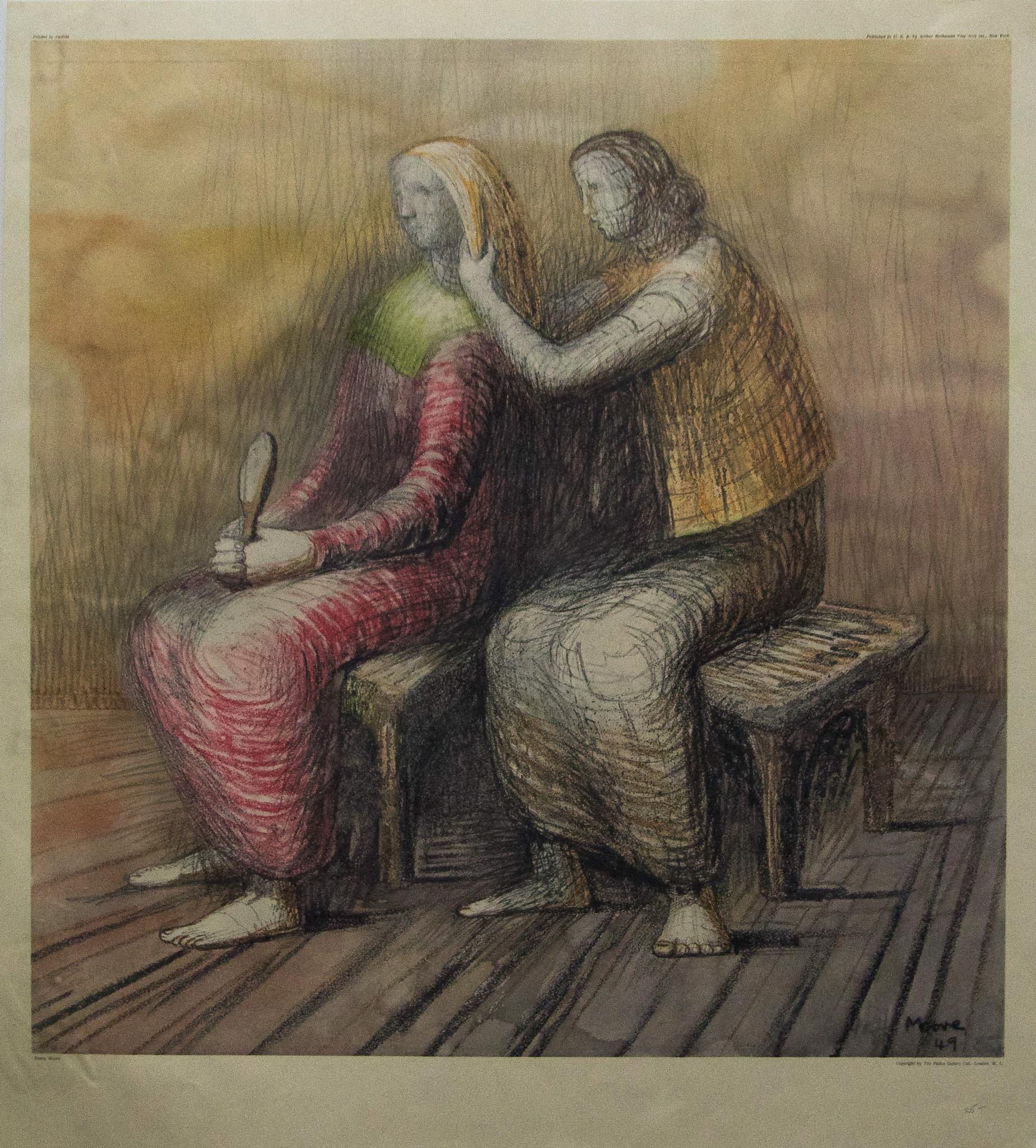
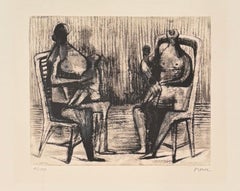
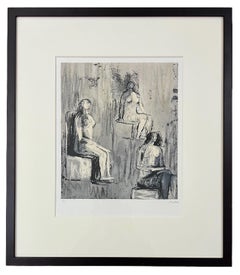
Two seated women in an interior by Henry Moore - Work on paper

1983

$47,932.27
£42,000VAT Included
€41,642.21
CA$67,314.88
A$68,288.76
CHF 38,842.06
MX$829,638.08
NOK 456,811.66
SEK 458,395.10
DKK 311,351.51

About the Item

Two seated women in an interior by Henry Moore (1898-1986) Charcoal, ballpoint pen, pencil and white chalk on paper 17.8 x 21.3 cm (7 x 8 ³/₈ inches) Signed lower right, Moore Executed in 1983 Provenance: Raymond Spencer Company, England Dominion Gallery, Montreal, acquired in 1983 George J. Rosengarten, Montreal Private collection, Montreal, acquired from the above Private collection, acquired from the above Sotheby's London, 2007 Sotheby's New York, 2009 Private collection, acquired from the above sale Literature: Ann Garrould, ed., Henry Moore Complete Drawings 1982-1983, vol. VI, London, 1994, no. AG 83.90, p. 145 (illustrated) Biography: Henry Spencer Moore O.M. C.H. F.B.A. R.B.S. was an English semi-abstract sculptor whose monumental bronze works are located in public parks and natural settings around the world. Moore was born at Castleford, Yorkshire, to Mary Baker and Raymond Spencer Moore, an Irish coal miner. He was the seventh of eight children in a family often struggling with poverty. In elementary school he began modelling in clay and carving in wood. In 1916, Moore became a teacher at Castleford Grammar School. He served in the army 1917–19, the youngest man in the Prince of Wales's Own Civil Service Rifles regiment. In 1919 Moore continued his education at Leeds School of Art, where he met Barbara Hepworth and had access to modernist works in the collection of Sir Michael Sadler, the University Vice-Chancellor, profoundly effecting his artistic development. Moore received a scholarship to the Royal College of Art which he attended 1921–4. While in London, he expanded his knowledge of primitive sculpture and art. Fused with the influence of Constantin Brâncuși, Jacob Epstein, Henri Gaudier-Brzeska and Frank Dobson, this led him to the method of direct carving, in which imperfections in the material and marks left by tools became part of the finished sculpture. In 1924, Moore spent six months travelling in Northern Italy and Paris. On returning to London, he undertook a seven-year teaching role at the R.C.A. and fulfilled his first public commission for London Underground’s headquarters, West Wind (1928-9), carved from Portland stone. In July 1929, Moore married Irina Radetsky, and the couple moved to Hampstead, where a small colony of avant-garde artists – Hepworth, Cecil Stephenson and Herbert Read – were taking root. Moore took up a post as Head of the Department of Sculpture at Chelsea School of Art in 1932. Along with Hepworth, Moore was part of 'The Seven and Five Society', who developed toward abstract art, influenced by their contact with Pablo Picasso, Georges Braque, Jean Arp and Alberto Giacometti. Moore flirted with Surrealism, joining Paul Nash’s modern art movement, 'Unit One', in 1933. The two men helped organise the International Surrealist Exhibition, which took place in London in 1936. At the outbreak of the Second World War, Moore resigned his teaching post and started producing drawings commissioned by the War Artists’ Advisory Committee. Moore and Radetsky moved out of London to live in a farmhouse called Hoglands in Hertfordshire, after bomb shrapnel hit their Hampstead home in September 1940. Despite this, Moore's sense of England emerging undefeated from siege led to his focus on pieces characterised by endurance and continuity. In 1943, Moore received a commission to carve a Madonna and Child for the Church of St. Matthew, Northampton, which was the first in an important series of family-group sculptures. Radetsky gave birth to their daughter, Mary Moore, in March 1946, and Moore had a retrospective at the Museum of Modern Art in New York in the same year. Family Group of 1950, was commissioned for a secondary school in the town of Stevenage, became his first large-scale public bronze. Moore began to receive increasingly significant commissions in the 1950s, including a Reclining Figure for the UNESCO building in Paris in 1958. On the campus of the University of Chicago in December 1967, 25 years to the minute after the team of physicists led by Enrico Fermi achieved the first controlled, self-sustaining nuclear chain reaction, Moore's Nuclear Energy was unveiled in the rackets court beneath which the experiments had taken place. Although often interpreted as a mushroom cloud, Moore intended that viewers "go around [the sculpture], looking out through the open spaces, and that they may have a feeling of being in a cathedral." Moore’s forms are usually abstractions of the human figure, typically depicting mother-and-child or reclining bodies, pierced or containing hollow spaces. His works are usually suggestive of the female body, apart from his phase in the 1950s when he sculpted family groups. Many interpreters liken the undulating form of his reclining figures to the landscape and hills of his birthplace. Seen as the voice of British Modernism and sculpture, Moore has been celebrated in major retrospectives around the world, notably a prominent exhibition in summer 1972 overlooking Florence. He won prizes at Venice 1948, São Paulo 1953 and Pittsburgh 1958, receiving Hon. A.R.I.B.A. 1948 and many similar honours; C.H. 1955, O.M. 1963. By the late 1970s, there were some forty exhibitions a year featuring his work, and commissions, including Knife Edge Two Piece (1962) near the Houses of Parliament and Large Two Forms in the forecourt of the German Chancellery in Bonn, Germany. Moore died at 88 in his home of Much Hadham, Hertfordshire.
More From This Seller

View All
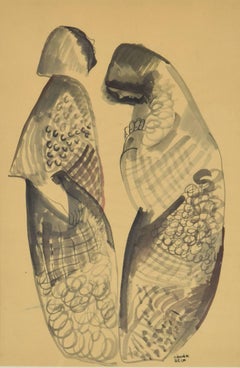
Two Figures by Béla Kádár - Hungarian artist, works on paper, Hungarian folklore

Two Figures by Béla Kádár - Hungarian artist, works on paper, Hungarian folklore

By Bela Kadar

Located in London, GB

Two Figures by Béla Kádár (1877–1956) Ink wash on paper 52 x 35 cm (20 ½ x 13 ¾ inches) Signed lower right, KÁDÁR BÉLA Provenance: Susie Kádár, daughter of the artist Artist biogra...

Category

20th Century Post-Impressionist Figurative Drawings and Watercolors

Materials

Ink, Paper

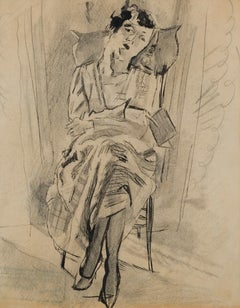
Femme assise by Jules Pascin - Mixed media, work on paper, portrait

Femme assise by Jules Pascin - Mixed media, work on paper, portrait

By Jules Pascin

Located in London, GB

Femme assise by Jules Pascin (1885-1930) Ink and brush, pen and pencil on paper 25 x 20.1 cm (9 ⁷/₈ x 7 ⁷/₈ inches) Stamped with the estate stamp on the reverse Provenance: Estate o...

Category

1920s Portrait Drawings and Watercolors

Materials

Paper, Ink, Pen, Pencil

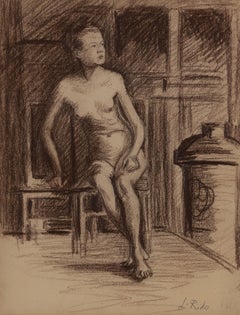
Nu Assise by Ludovic-Rodo Pissarro - Nude drawing

Nu Assise by Ludovic-Rodo Pissarro - Nude drawing

By Ludovic-Rodo Pissarro

Located in London, GB

Nu Assise by Ludovic-Rodo Pissarro (1878-1952) Charcoal on paper 31.3 x 24.2 cm (12 ⅜ x 9 ½ inches) Signed lower right, L.Rodo This work of art is accompanied by a certificate of authenticity signed and dated by Lélia Pissarro. Artist biography: Ludovic-Rodolphe Pissarro, born in Paris in 1878, was Camille Pissarro’s fourth son. Encouraged by his father, he began drawing from nature at an early age. He was familiarly known as “Rodo” and generally signed his works "Ludovic-Rodo", or early on in his career simply "Rodo". The impact of Camille’s art and teaching on Rodo was considerable. His artistic production encompassed a wide range of media, including oil painting, tempera, watercolour, gouache, wood engraving, drawing and lithography. Rodo exhibited regularly at the Salon des Indépendants over a forty-year period. In 1894, at the age of sixteen, Rodo published his first wood engravings in the anarchist journal, Le Père Peinard. When Camille left France for the safety of Belgium during the anarchist upheavals of the same year, Rodo joined him there. Rodo moved into his first studio in Montmartre with his brother Georges in 1898. Works of this early important period until just after the death of his father in 1903 were post-impressionist and clearly painted under the influence of his father. By 1904 living in Paris, he found the nightlife and the habitués of the cafes, theatres, circuses and cabarets compelling subjects for his work and changed dramatically the style of his painting, affiliating himself to the Fauve artists. Rodo became close to artists such as Kees Van Dongen, Maurice de Vlaminck and Raoul Dufy. In 1905 he participated in the first Fauve exhibition at the Salon des Indépendants. In 1907 he visited Van Dongen in Rotterdam and the two artists continued to paint together, something they often did in Paris. In 1914 he married, though he never had children. Later that year at the outbreak of the War Rodo moved to England. Over the next seven years he lived mainly in and around West London. He worked closely with his brother Lucien to establish in 1915 the Monarro Group, formed with the aim of exhibiting work by contemporary artists inspired by Impressionism. Many of the works produced by Rodo while he was in England were of London landmarks but, he was also interested in the urbanisation of West London. After 1921, when Rodo had already returned to France, he divided his time between Paris and Les Andelys in Normandy, living and working closely with his elder brother Georges Manzana. Despite his rich artistic heritage and his achievements as an artist, Rodo is perhaps best remembered for his contribution to art history. For ten years he researched and compiled a catalogue of his father’s paintings...

Category

Early 1900s Post-Impressionist Figurative Drawings and Watercolors

Materials

Charcoal, Paper

Nude Reading by LUDOVIC-RODO PISSARRO -Figurative work on paper, School of Paris

Nude Reading by LUDOVIC-RODO PISSARRO -Figurative work on paper, School of Paris

By Ludovic-Rodo Pissarro

Located in London, GB

*UK BUYERS WILL PAY AN ADDITIONAL 20% VAT ON TOP OF THE ABOVE PRICE Nude Reading by LUDOVIC-RODO PISSARRO (1878-1952) Black and colour pencil on paper 3...

Category

Early 1900s Post-Impressionist Nude Drawings and Watercolors

Materials

Color Pencil, Paper, Pencil

Two Figures by the Sea, Work on paper by Georges Manzana Pissarro

Two Figures by the Sea, Work on paper by Georges Manzana Pissarro

By Georges Manzana Pissarro

Located in London, GB

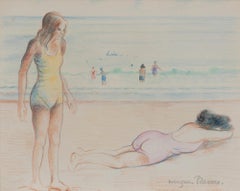
Two Figures by the Sea by Georges Manzana Pissarro (1871 - 1961) Colour crayon and pencil on paper 20.3 x 26 cm (8 x 10 ¼ inches) Signed lower right, Manzana Pissarro Executed in Mo...

Category

1940s Post-Impressionist Drawings and Watercolor Paintings

Materials

Paper, Crayon, Pencil

You May Also Like

Two Women Bathing Child II

Two Women Bathing Child II

By Henry Moore

Located in New York, NY

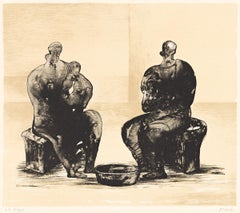
A very good impression of this color lithograph. One of 25 numbered artist's proofs, aside from the edition of 50. Signed, inscribed "AP" and numbered X/XXV in pencil by Moore. Print...

Category

1970s Modern Abstract Prints

Materials

Color, Lithograph

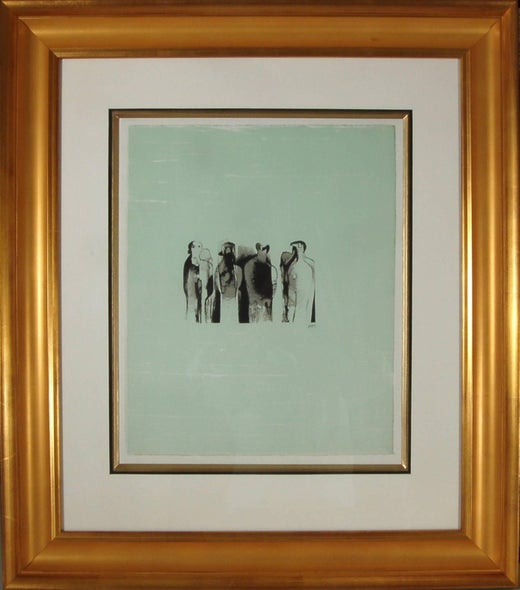
Henry Moore - Three Seated Figures

Henry Moore - Three Seated Figures

By Henry Moore

Located in London, GB

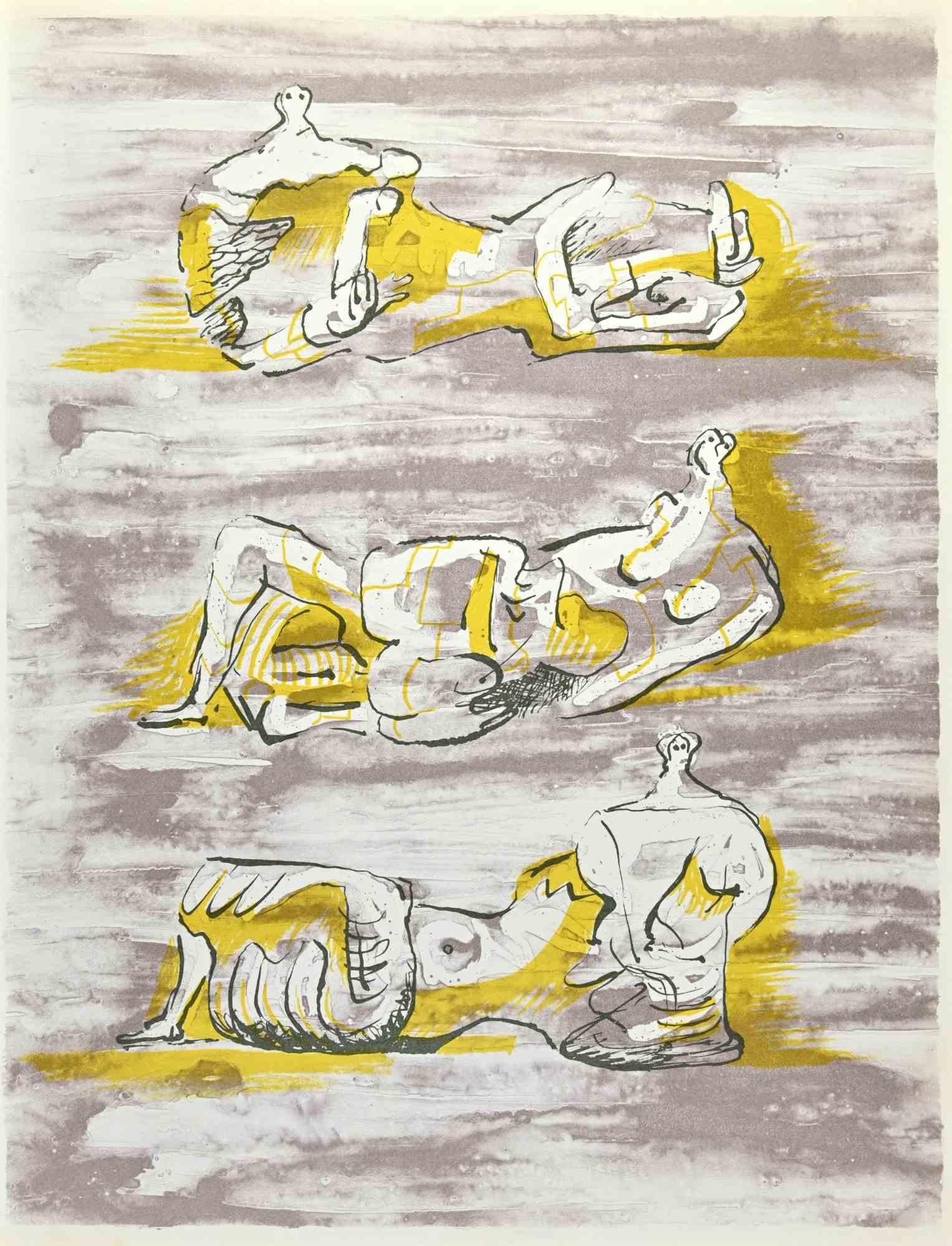
Three Seated Figures, 1981 Colour lithograph on paper. Hand-signed and numbered by the artist. 55.9 x 44.8 cm - sheet size H.C. aside from an edition of 50 Henry Moore's (1898-1986)...

Category

1980s Modern Figurative Prints

Materials

Lithograph

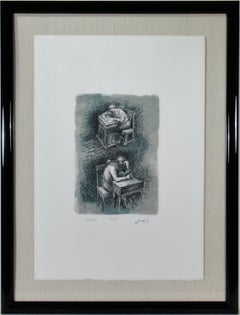
Girls Seated at Desk IX

Girls Seated at Desk IX

By Henry Moore

Located in San Francisco, CA

Artist: Henry Moore (British, 1898-1986) Title: Girls Seated at Desk IX Year: 1974 Medium: Color lithograph Edition: Numbered 40/50 in pencil Paper: Wove Paper size: 20.25 x...

Category

Late 20th Century Modern Figurative Prints

Materials

Lithograph

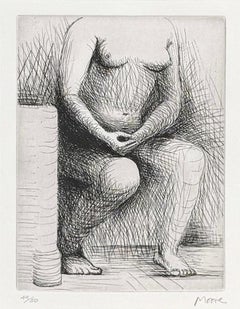
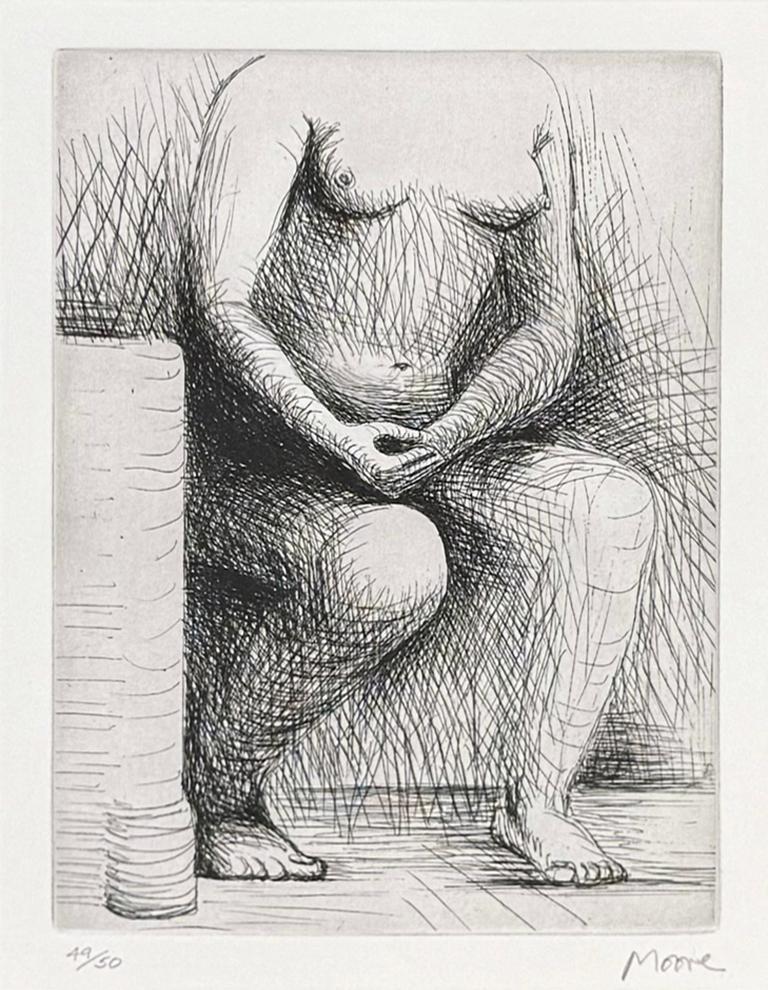
Seated Figure Etching on Paper, Hand Signed, Framed, 1979, 49/50

Seated Figure Etching on Paper, Hand Signed, Framed, 1979, 49/50

By Henry Moore

Located in Aventura, FL

Etching on paper. Hand signed lower right by Henry Moore. Hand numbered 49/50 lower left. Sheet size 18.5 x 15 inches. Image size 8.625 x 6.5 inches. Frame size: approx. 24 x 2...

Category

1970s Modern Nude Prints

Materials

Paper, Etching

Seated Pair, Framed Pastel on Paper by Francisco Zuniga

Seated Pair, Framed Pastel on Paper by Francisco Zuniga

By Francisco Zúñiga

Located in Long Island City, NY

Artist: Francisco Zuniga, Costa Rican / Mexican (1912 - 1998) Title: Seated Pair Year: 1964 Medium: Pastel on Paper, signed and dated l.r. Size: 15.5 x 25 inches Frame: 24 x 33 inche...

Category

1960s Expressionist Figurative Drawings and Watercolors

Materials

Pastel