Henry Moore

British, 1898-1986

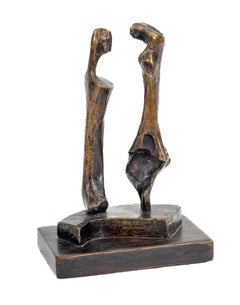
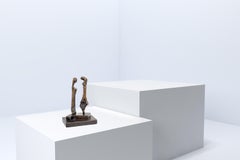
Henry Spencer Moore OM CH FBA was an English artist. He is best known for his semi-abstract monumental bronze sculptures, which are located around the world as public works of art. As well as sculpture, Moore produced many drawings, including a series depicting Londoners sheltering from the Blitz during the Second World War, along with other prints and graphic works on paper.

His forms are usually abstractions of the human figure, typically depicting mother-and-child or reclining figures. Moore's works are usually suggestive of the female body, apart from a phase in the 1950s when he sculpted family groups. His forms are generally pierced or contain hollow spaces. Many interpreters liken the undulating form of his reclining figures to the landscape and hills of his Yorkshire birthplace.

Moore became well known through his carved marble and larger-scale abstract cast bronze sculptures, and was instrumental in introducing a particular form of modernism to the United Kingdom. His ability in later life to fulfil large-scale commissions made him exceptionally wealthy. Despite this, he lived frugally; most of the money he earned went toward endowing the Henry Moore Foundation, which continues to support education and promotion of the arts.

Find original Henry Moore art on 1stDibs.

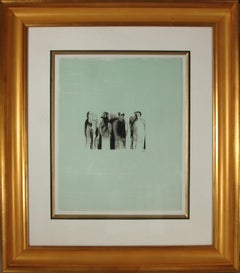
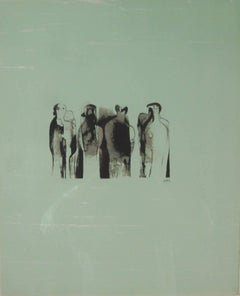
Three Standing Figures

Henry MooreThree Standing Figures, 1976

$2,380

H 32.75 in W 28.5 in D 2.25 in

Three Standing Figures

By Henry Moore

Located in San Francisco, CA

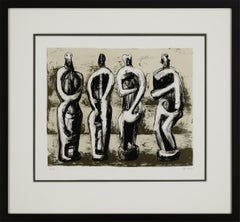
This artwork, titled "Three Standing Figures," 1976, in an original color lithograph on Arches paper by British artist Henry Moore, 1898-1986. It is hand signed with initials in pencil. It was published by Association de Bibliophiles Art et Poesie, and printed by Curwen Studio, London. From the suite, La Poesie, Les Poetes. From the edition of 110. Catalogue raisonne by Cramer, plate #323. In excellent condition. It is beautifully framed in a custom wooden gold frame with gold color bevel and fabric matting. Henry Spencer Moore...

Category

1970s Abstract Henry Moore

Materials

Lithograph

Henry Moore, Three Heads, from Ediciones Poligrafa, 1979

Henry Moore, Three Heads, from Ediciones Poligrafa, 1979

By Henry Moore

Located in Southampton, NY

This exquisite lithograph by Henry Moore (1898–1986), titled Three Heads (Three Heads), from the album Ediciones Poligrafa, Barcelona - Redfern Gallery, London, originates from the 1...

Category

1970s Modern Henry Moore

Materials

Lithograph

Figures Allongées - Lithograph by Henry Moore - 1971

Figures Allongées - Lithograph by Henry Moore - 1971

By Henry Moore

Located in Roma, IT

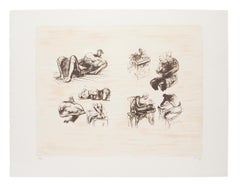
Figures allongées is an print by the British artist  Henry Moore  (Castleford, 1898 - Much Hadham, 1986). This color lithograph on paper was edited by the French magazine XXe Siécle...

Category

1970s Contemporary Henry Moore

Materials

Lithograph

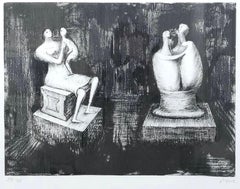
Sculptures: Dark Interior

Sculptures: Dark Interior

By Henry Moore

Located in London, GB

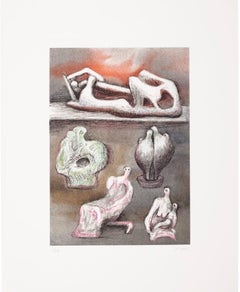
Lithograph on paper. Hand-signed and numbered by the artist.
 Paper size: 43 x 52 cm Framed 48.3 x 57.4 cm Edition of 75 Henry Moore’s prints are a vital aspect of his artistic lega...

Category

1970s Modern Henry Moore

Materials

Lithograph

Figures and Shadows - Original lithograph (Catalog raisonne Cramer #36)

Figures and Shadows - Original lithograph (Catalog raisonne Cramer #36)

By Henry Moore

Located in Paris, IDF

Henry MOORE Figures and Shadows, 1951 Original lithograph (Printed in Desjobert Workshop) Printed signature in the plate On wove paper 31 x 24 cm (c. 12 x 10 in) REFERENCES : Henry...

Category

1970s Modern Henry Moore

Materials

Lithograph

Mother and Child: Petal Skirt - Henry Moore, sculpture, modern, british, small

Mother and Child: Petal Skirt - Henry Moore, sculpture, modern, british, small

By Henry Moore

Located in London, GB

Henry Moore (1898-1986) Mother and Child: Petal Skirt conceived in 1955; cast in 1955 bronze; edition 4 of 6 plus 1 artist’s proof by the Fiorini foundry, London 19 x 9 x 15.5 cm (in...

Category

1950s Modern Henry Moore

Materials

Bronze
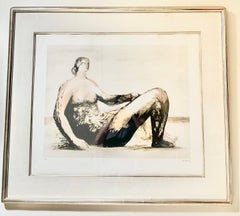
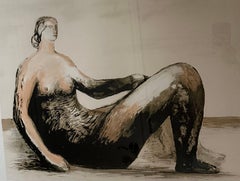
Henry Moore, Reclining Figure, from San Lazzaro et ses Amis, 1975

Henry Moore, Reclining Figure, from San Lazzaro et ses Amis, 1975

By Henry Moore

Located in Southampton, NY

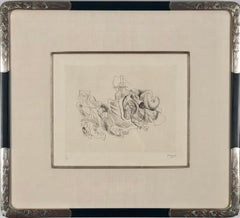
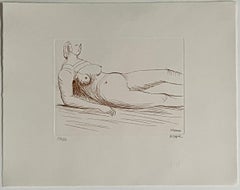
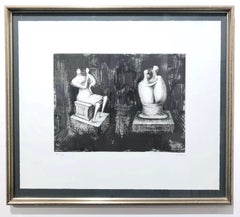
This exquisite lithograph by Henry Moore (1898–1986), titled Reclining Figure, from the album San Lazzaro et ses Amis, Hommage au fondateur de la revue XXe siecle (San Lazzaro and His Friends, Tribute to the Founder of the Journal XXe Siecle), originates from the 1975 edition published by XXe siecle, Paris, and printed by Curwen Studio, London, October 1975. Reclining Figure embodies Moore’s lifelong fascination with the human form in repose—a theme that became central to his sculptural and graphic work. Through elegant contours and balanced abstraction, the composition captures the harmony between body, landscape, and spirit that defined Moore’s artistic vision. Executed as a lithograph on velin d'Arches paper, this work measures 10.5 x 14 inches (26.67 x 35.56 cm). Unsigned and unnumbered as issued. The edition exemplifies the exceptional craftsmanship of the Curwen Studio in London, a distinguished atelier celebrated for its collaborations with the leading modern artists of the postwar period. Artwork Details: Artist: Henry Moore (1898–1986) Title: Reclining Figure, from San Lazzaro et ses Amis, Hommage au fondateur de la revue XXe siecle, 1975 Medium: Lithograph on velin d'Arches paper Dimensions: 10.5 x 14 inches (26.67 x 35.56 cm) Inscription: Unsigned and unnumbered as issued Date: 1975 Publisher: XXe siecle, Paris Printer: Curwen Studio, London Catalogue raisonne references: Moore, Henry, et al. Henry Moore, Catalogue of Graphic Work. Gerald Cramer, 1986, illustration 366. Condition: Well preserved, consistent with age and medium Provenance: From the album San Lazzaro et ses Amis, Hommage au fondateur de la revue XXe siecle, published by XXe siecle, Paris, October 1975 Notes: Excerpted from the folio (translated from French), Finished printing in Paris in October 1975. This album has been printed on velin d'Arches in DLXXV numbered examples. The LXXV original examples include a series of VIII original lithographs, signed and numbered by the artists. In addition, LV examples were printed for artists, authors, friends and collaborators of XXe siecle. The typography is from l'Imprimerie Union in Paris; the lithographs of Max Bill, Marc Chagall, Hans Hartung, Braque, Fontana, Magnelli, Picasso, Magritte and Poliakoff were printed by Fernand Mourlot in Paris; those of Alexander Calder and Joan Miro by l'imprimerie Arte in Paris; that of Max Ernst by Pierre Chave in Vence; that of Zao Wou-Ki by ateliers Bellin in Paris; and that of Henry Moore by the Curwen Studio in London. About the Publication: San Lazzaro et ses Amis, Hommage au fondateur de la revue XXe siecle (San Lazzaro and His Friends, Tribute to the Founder of the Journal XXe Siecle), published in 1975 by XXe siecle, Paris, represents one of the most significant collaborative tributes in modern art publishing. Created in honor of Gualtieri di San Lazzaro, the visionary editor and founder of the journal XXe Siecle, the folio unites original lithographs by the greatest modern masters—Picasso, Chagall, Miro, Calder, Hartung, Moore, and others. Printed by premier ateliers such as Mourlot, Arte, Bellin, and Curwen, the portfolio celebrates the spirit of artistic collaboration and innovation that defined mid-20th-century modernism. About the Artist: Henry Moore (1898–1986) was a British sculptor, draftsman, and modernist pioneer whose monumental bronzes and organic abstractions revolutionized 20th-century sculpture and made him one of the most influential artists of his time. Renowned for his reclining figures, mother-and-child compositions, and pierced biomorphic forms inspired by nature, Moore transformed traditional carving into a universal language of rhythm, balance, and humanity. Born in Castleford, Yorkshire, he studied at the Leeds School of Art and the Royal College of Art in London, absorbing the influences of classical sculpture, African and Pre-Columbian art, and the radical innovations of the European avant-garde. Inspired by Pablo Picasso’s Cubist fragmentation of form, Joan Miro’s lyrical biomorphism, Wassily Kandinsky’s spiritual abstraction, and Constantin Brancusi’s purity of shape, Moore developed a style rooted in the harmony between mass and void, structure and space. During the interwar years, he became part of an international circle that included Alexander Calder, Alberto Giacometti, Salvador Dali, Marcel Duchamp, and Man Ray—artists who, like Moore, expanded art’s boundaries through abstraction, surrealism, and conceptual experimentation. Like Calder, Moore explored balance and movement; like Giacometti, he sought the spiritual essence of humanity; and like Dali and Duchamp, he challenged perception and redefined modern form. His sculptures, carved in stone or cast in bronze, evoke both ancient and modern sensibilities—forms that appear to breathe with natural vitality while engaging directly with their surrounding landscapes. Moore’s “Shelter Drawings” (1940–41), created during the London Blitz, revealed his deep empathy for the human condition, marking a pivotal moment in his exploration of resilience and vulnerability. By the mid-20th century, Moore’s monumental bronzes had become landmarks around the world, from the Lincoln Center in New York to the UNESCO headquarters in Paris, embodying timeless symbols of endurance, renewal, and unity. His synthesis of organic abstraction and humanism influenced generations of sculptors including Barbara Hepworth, Isamu Noguchi, Eduardo Paolozzi, Antony Gormley, Anish Kapoor, and Rachel Whiteread. Like Kandinsky and Miro, he believed abstraction could transcend culture and time, while like Duchamp and Man Ray, he embraced experimentation as a pathway to new truths. Moore’s works, housed in major collections including the Museum of Modern Art in New York, the Tate in London, the Guggenheim Museum, and the Art Institute of Chicago, continue to define the landscape of modern sculpture for their elegance, power, and emotional depth. Standing alongside Pablo Picasso, Alexander Calder, Alberto Giacometti, Salvador Dali, Joan Miro, Wassily Kandinsky, Marcel Duchamp, and Man Ray, Henry Moore remains a cornerstone of modern art—a sculptor whose vision united nature, form, and spirit into a universal language of beauty and meaning. His highest auction record was achieved by Reclining Figure: Festival (1951), which sold for $33.1 million USD at Christie’s, London, on June 30, 2016, reaffirming Henry Moore’s enduring legacy as one of the most visionary, influential, and collectible sculptors in the history of modern art. Henry Moore Reclining Figure...

Category

1970s Surrealist Henry Moore

Materials

Lithograph

Henry Moore "Four Standing Figures" Signed Color Lithograph, 1978, Ed. 50

Henry Moore "Four Standing Figures" Signed Color Lithograph, 1978, Ed. 50

By Henry Moore

Located in Miami, FL

HENRY MOORE (1898–1986) – "FOUR STANDING FIGURES" Color Lithograph on Wove Paper ⚜ Hand Signed and Numbered ⚜ Custom Conservation Frame A SCULPTOR’S MEDITATION ON THE STANDING FIGU...

Category

1970s Modern Henry Moore

Materials

Lithograph

Browse all Art from Henry Moore
Shop Now

Henry Moore Sale Prices

Sold DateSold PriceCategoryMediumCreation Year
2026$2,300Landscape PaintingsOil Paint, CanvasLate 19th Century
2026$100Prints and MultiplesLithograph
2026$900Prints, Contemporary ArtGlass, Wood, Paper1960s
2026$1,573Abstract SculpturesSteel, Stone, Chrome, WoodCirca 1960
2026$5,300Animal SculpturesCast Stone, ConcreteCirca 1920s
2026$908Figurative Prints, Landscape PrintsLithograph1951
2025$1,250Landscape Prints, Figurative PrintsLithograph1975
2025$671Abstract SculpturesBronzeunknown
2025$2,500Figurative PrintsLaid Paper, Lithograph1957
2025$1,400BustsMarble, StoneCirca 1940
2025$995Contemporary Art, PaintingsPapercirca 1971
2025$200Figurative PrintsLithograph1983
2025$150Portrait PrintsOffset Print1974
2025$1,710Figurative PrintsLithograph1973
$1,526
Average sold price of items in the past 12 months
$100-$5,300
Sold price range of items in the past 12 months

Artists Similar to Henry Moore

Henry Moore art for sale on 1stDibs.

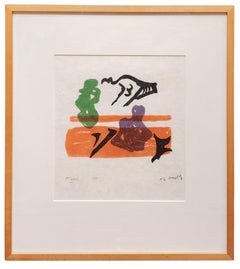
Find a wide variety of authentic Henry Moore art available for sale on 1stDibs. If you’re browsing the collection of art to introduce a pop of color in a neutral corner of your living room or bedroom, you can find work that includes elements of orange and other colors. You can also browse by medium to find art by Henry Moore in lithograph, etching, paper and more. Much of the original work by this artist or collective was created during the 20th century and is mostly associated with the modern style. Not every interior allows for large Henry Moore art, so small editions measuring 3 inches across are available. Customers who are interested in this artist might also find the work of Raoul Dufy, Giuseppe Malandrino, and Clarence Holbrook Carter. Henry Moore art prices can differ depending upon medium, time period and other attributes. On 1stDibs, the price for these items starts at $120 and tops out at $309,701, while the average work can sell for $2,640.
Questions About Henry Moore
  • 1stDibs ExpertJune 6, 2024
    Henry Moore's style of art was modern. He is best known for his monumental bronze sculptures, which are installed around the world, often as public art. He used abstract forms of the human body, typically depicting mother-and-child or reclining figures. His more abstract forms are generally pierced or contain hollow spaces. Many critics have likened the undulating shapes of his reclining figures to the landscape and hills of his Yorkshire birthplace. On 1stDibs, find an assortment of Henry Moore art.
  • 1stDibs ExpertApril 5, 2022
    Henry Moore’s sculptures often represented the connection between the human body and landscapes. The underlying meaning is that humanity is shared with the natural world, and many of his large-scale sculptures were created to compliment the outdoor landscape where they were placed. You’ll find a selection of Henry Moore sculptures and sketches on 1stDibs.
  • 1stDibs ExpertMay 30, 2024
    Henry Moore drew hands to symbolize the passage of time. His series of drawings depicting his own hands in old age and other elderly people's hands were meant to represent the effects of work and living on the human body. Much of Moore's work reflected on the human form, including his large bronze sculptures. Explore a diverse assortment of Henry Moore art on 1stDibs.
  • 1stDibs ExpertMay 3, 2024
    Opinions vary as to what Henry Moore's most famous piece is. Since the British artist's semi-abstract monumental bronze sculptures are often public works of art, many have become well known. Among them are Reclining Figure: Festival (1951), Harlow Family Group (1954-5), Helmet Head No. 4: Interior/Exterior (1963), The Arch (1963-69) and Mother and Child (1983). On 1stDibs, find a variety of Henry Moore art.
  • 1stDibs ExpertApril 5, 2022
    Henry Moore frequently used the wax resist process in his drawings, which involved sketching the forms in wax crayon and coating the drawing with a wash of gray watercolor. He then went in with black ink, gray and black crayons and white watercolor. Find a selection of Henry Moore artwork from top art dealers around the world on 1stDibs.
  • 1stDibs ExpertApril 26, 2024
    Henry Moore created sculptures for a few reasons. Born in Castleford, Yorkshire, in 1898, he had an early interest in being a sculptor, and in 1921, he was awarded a scholarship to study at the Royal Academy of Art in London. As he would explain, this is where he was particularly inspired to pursue his sculpting practice: “Even when I was a student I was totally preoccupied by sculpture in its full spatial richness, and if I spent a lot of time at the British Museum in those days, it was because so much of the primitive sculpture there was distinguished by complete cylindrical realization.” He also had an interest in exploring how the human body connected to landscapes. He often produced works with specific locations in mind, considering how his figures would relate to the space around them. His forms are usually abstractions of the human body, typically depicting mother-and-child or reclining figures, and are often pierced or contain hollow spaces. Many interpreters liken the undulating form of his reclining figures to the landscape and hills of his Yorkshire birthplace. On 1stDibs, shop a variety of Henry Moore art.
  • 1stDibs ExpertMarch 13, 2024
    Henry Moore drew sheep for a few reasons. The British artist thought sheep were peaceful and found watching them graze to be relaxing. He also liked how they stood out against the landscape due to their coloring, likening it to the way a statue draws the eye away from the rest of its surroundings. On 1stDibs, find a diverse assortment of Henry Moore art.
  • 1stDibs ExpertAugust 20, 2024
    How much a Henry Moore statue is worth depends on its history, condition and other factors. In 2022, his Reclining Figure: Festival, created for the 1951 Festival of Britain, set an auction record for the artist when it sold for $31 million. The piece is a good example of the artist's forms, which are usually abstractions of the human figure, typically depicting a mother and child or reclining figure. Moore's works are often suggestive of the female body, apart from a period in the 1950s when he sculpted family groups. If you own a Henry Moore statue, a certified appraiser or experienced art dealer can help you determine its estimated value. Shop an assortment of Henry Moore art on 1stDibs.
  • 1stDibs ExpertApril 5, 2022
    Henry Moore moved to London to study art and often visited the British Museum where he was inspired by ancient sculptures from Egypt, Africa and Mexico. His sculptures have a semi-abstract nature, but he often dabbled in other styles of art. Moore even created his own form of modernism with an eye toward the abstract. On 1stDibs, find a variety of original artwork from top artists.
  • 1stDibs ExpertApril 5, 2022
    Henry Moore used holes in his sculptures to create the illusion that his work was growing from an empty center. His sculptures Oval with Points and Double Oval are two examples of the technique. You'll find a selection of Henry Moore art on 1stDibs.
  • 1stDibs ExpertOctober 30, 2024
    Yes, Barbara Hepworth knew Henry Moore. They met while she was attending the Leeds School of Art in the 1920s. Moore and Hepworth maintained a friendly rivalry throughout their careers. Along with Paul Nash and Ben Nicholson, the two founded the Unit One art movement in 1933. The movement's purpose was to promote avant-garde art in the UK. Explore a wide variety of Barbara Hepworth art.
  • 1stDibs ExpertNovember 20, 2024
    Yes, Henry Moore and Barbara Hepworth were friends. The two met at the Leeds School of Art in the UK and maintained a friendly rivalry throughout their careers. Both Hepworth and Moore were members of Unit One, a group of British artists who sought to educate the public about avant-garde art during the 1930s. Shop a selection of Henry Moore and Barbara Hepworth art on 1stDibs.
  • 1stDibs ExpertApril 5, 2022
    Henry Moore was a prolific artist and it’s difficult to pinpoint exactly how many pieces of art he created. The Henry Moore Foundation lists that their online catalogue of his works currently features more than 11,000 sculptures, drawings, tapestries, textiles and graphics. That’s a significant number indeed and does not represent all of his contributions to the art world. On 1stDibs, find a variety of original artwork from top artists.