Want more images or videos?
Request additional images or videos from the seller
1 of 12

Oliver Samsinger
"Birth of Christ" after a Russian icon of the 15th century. Oliver Samsinger

$2,711.37
$3,396.1820% Off
£2,009.14
£2,517.3720% Off
€2,304VAT Included
€2,88020% Off
CA$3,774.44
CA$4,737.8420% Off
A$3,839.91
A$4,806.3720% Off
CHF 2,206.47
CHF 2,744.1820% Off
MX$46,175.21
MX$58,197.6120% Off
NOK 25,760.12
NOK 32,305.7120% Off
SEK 25,914.33
SEK 32,198.5020% Off
DKK 17,568.07
DKK 21,966.4920% Off

About the Item

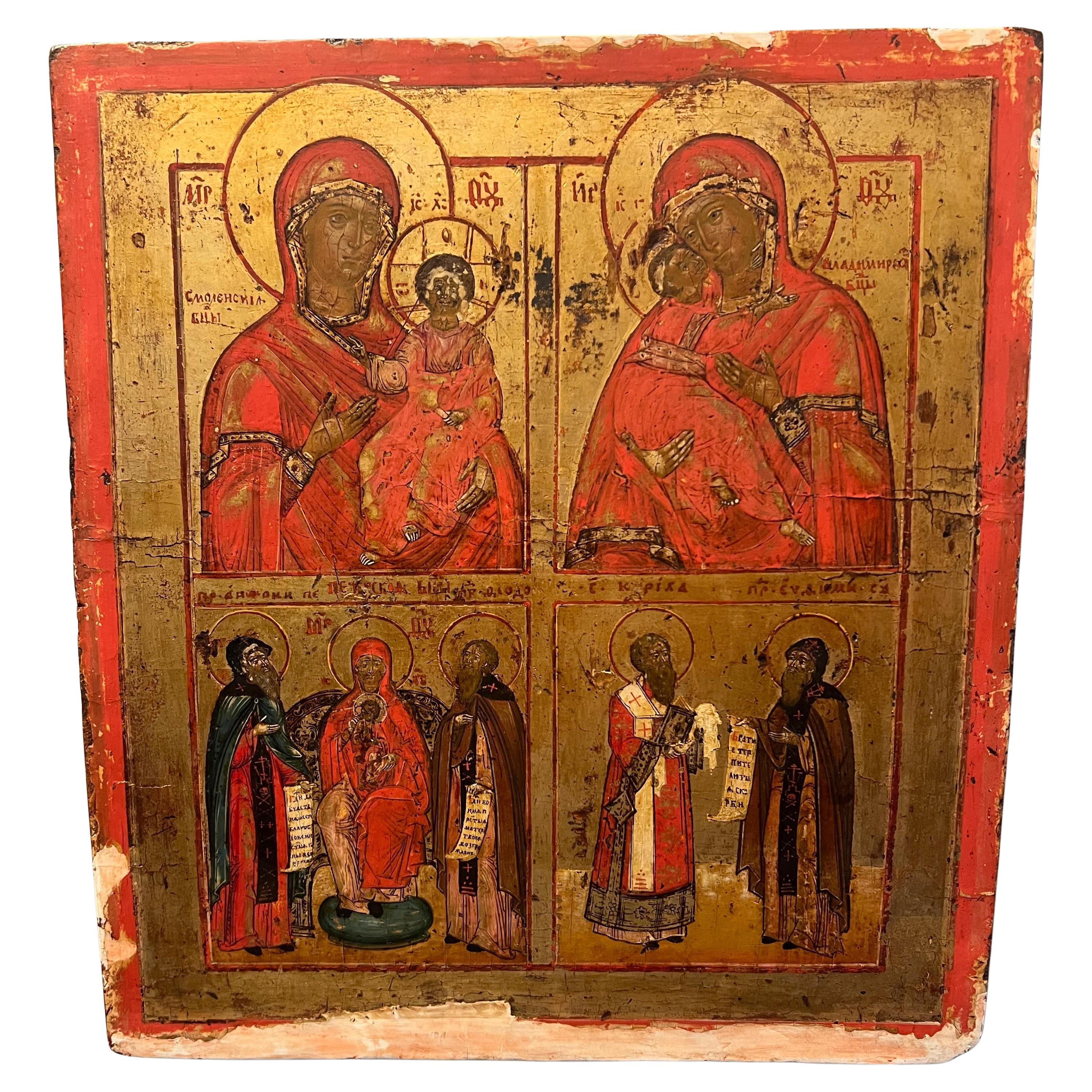
"Birth of Christ", after a Russian icon of the 15th century. Tempera and gold leaves on gesso, wooden board. Dimensions: (H) 68 x (W) 52 x (D) 4 cm. The Nativity of Christ. This icon, created by the Viennese artist Oliver Samsinger in the 1990s, is consciously rooted in the tradition of Russian icons of the 15th century, embracing not only their formal language but also their profound theological and symbolic understanding of sacred imagery. The work represents the mystery of the Nativity of Christ as a multiple and simultaneous event. In accordance with the classical model of Eastern iconography, the icon does not depict a single moment but brings together within one visual space the different episodes associated with the Incarnation: the birth in the cave, the Virgin reclining, the Child in the manger, the angels, the shepherds, the Magi, and other scenes that shape the theological narrative of the Nativity. This structure follows a spiritual rather than a temporal logic, inviting contemplation rather than linear reading. Formally, the composition adheres to the traditional principles of icon painting: inverted perspective, symbolic hierarchy of the figures, and a deliberate use of color and gold as expressions of divine light. The gold leaf is not merely decorative, but functions as a manifestation of the eternal and the transcendent, abolishing naturalistic depth and situating the scene within sacred time. The icon is executed in tempera and gold leaf on gesso, applied to a carefully prepared wooden board with a thickness of 4 cm, in accordance with the historical techniques of Eastern iconography. Its dimensions are 68 × 52 × 4 cm, giving the work a solemn and balanced presence suitable for both liturgical settings and private contemplation. Overall, this icon stands as a significant example of contemporary iconography faithful to tradition, in which Oliver Samsinger demonstrates a profound knowledge of medieval Russian models and a refined sensitivity in renewing them without betraying their spiritual and symbolic essence. ABOUT THE ARTIST Oliver Samsinger (Vienna, 1968) began to take an interest in icons in 1990. He undertakes several trips to Bulgaria, Greece and Cyprus to see in situ the original works treasured in these three countries. This experience will be crucial in his life, since the studies carried out in Sofia, the Bulgarian capital, and his stay on Mount Athos constitute his greatest impulse and motivation to dedicate himself to make his own works, in a self-taught way, inspired by the models Russians and Byzantines that he had seen so closely, applying all his technical and artistic skills to his creations. Oliver studies the ancient tradition for the realization of icons: wooden support, egg tempera paint, gold leaf, special varnishes ... it is a long and very elaborate procedure by means of which he makes very personal replicas of important icons of the orthodox church. His icons have been exhibited in the Diocesan Museum of Vienna; also in the old Carmelite Church (KarmeliteKirche) and the Villa Wertheimstein in the same city between 2003 and 2006, and have also had successful presentations in Spain. This is how the artist sums up the technique used by him to create the icon: “The aim of these steps is to create a durable painting. The icon is eternal. The first step is to choose a support, traditionally made of wood, from the center of the trunk to avoid warping it. For this purpose, two hardwood bolts were often used on the back to give the picture panel additional stability. Often a frame is milled out. Then the image carrier is sanded smooth and now 12 or 14 thin layers of gesso are applied and sanded smooth as well. Then the preliminary drawing is applied and the drawing board is prepared with a special preparation called bolus. This bolus can be polished to a high gloss. Afterwards, the gold leaf is "shot" with special brushes. It dries up within a few hours and can now be polished with an agate. Gold leaf is real 24 carat gold . Now does the actual process of painting begin. Egg tempera is made fresh from egg yolk, water and a little vinegar. This is used to prepare the color pigments. Tempera painting is done in numerous layers from dark to light. When the icon is finished, it is left to dry for a few months and varnished with a special varnish called Olifa made from boiled linseed oil and other ingredients”.
  • Creator:
    Oliver Samsinger (1968, Austrian)
  • Dimensions:
    Height: 26.78 in (68 cm)Width: 20.48 in (52 cm)Depth: 1.58 in (4 cm)
  • Medium:
  • Movement & Style:
  • Period:
  • Condition:
  • Gallery Location:
    Segovia, ES
  • Reference Number:
    1stDibs: LU74439383362

More From This Seller

View All
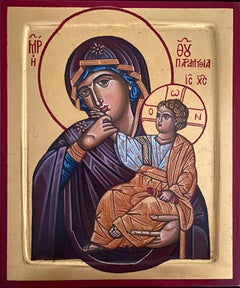
Icon of  The Holy Virgin of  Tenderness (Korsunskaya).

Icon of The Holy Virgin of Tenderness (Korsunskaya).

Located in Segovia, ES

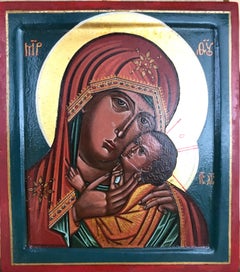
Icon of THE KORSUN VIRGIN (KORSUNSKAYA), egg tempera, and gold leave on gesso, over a piece of wood. Dimensions: (H) 26.5 x (W) 23.5 x (D) 3 cm. Also called The Holy Virgin of Tenderness, represents the Mother of God and infant Christ in a tender cheek-to-cheek embrace. The Virgin's hands tenderly surround the head and hands of the Child Jesus while he takes the cloak of the Mother of God with his left hand and plays with the fingers of his right hand, between his mother's neck and his own. Two very old icons, from the 12th and 13th Centuries, painted on the same theme, are respectively in the Uspenskii Cathedral in Moscow and in the Russian Museum in St. Petersburg. This is how the artist sums up the technique used by him to create the icon: “The aim of these steps is to create a durable painting. The icon is eternal. The first step is to choose a support, traditionally made of wood, from the center of the trunk to avoid warping it. For this purpose, two hardwood bolts were often used on the back to give the picture panel additional stability. Often a frame is milled out. Then the image carrier is sanded smooth and now 12 or 14 thin layers of gesso are applied and sanded smooth as well. Then the preliminary drawing is applied and the drawing board is prepared with a special preparation called bolus. This bolus can be polished to a high gloss. Afterward, the gold leaf is "shot" with special brushes. It dries up within a few hours and can now be polished with agate. Gold leaf is real 24-carat gold. Now, the actual process of painting begins. Egg tempera is made fresh from egg yolk, water and a little vinegar. This is used to prepare the color pigments. Tempera painting is done in numerous layers from dark to light. When the icon is finished, it is left to dry for a few months and varnished with a special varnish called Olifa made from boiled linseed oil and other ingredients”. ABOUT THE ARTIST Oliver Samsinger...

Category

1990s Byzantine Figurative Paintings

Materials

Gold Leaf

You May Also Like

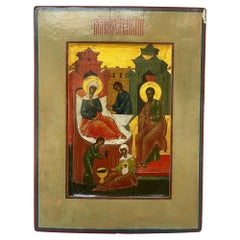
19th-century Russian Icon Depicting the Nativity of the Virgin Mary

19th-century Russian Icon Depicting the Nativity of the Virgin Mary

Located in Los Angeles, CA

19th-century Russian icon depicting the Nativity of the Virgin Mary. This finely detailed piece captures the serene and sacred moment of Mary's birth, rendered with rich colors and t...

Category

Antique 19th Century Unknown Paintings

Materials

Wood

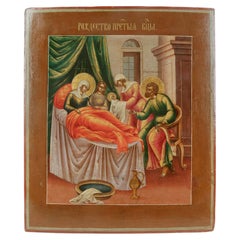
Icon "The Nativity of the Blessed Virgin Mary", Russian Empire, 19th century

Icon "The Nativity of the Blessed Virgin Mary", Russian Empire, 19th century

Located in Rīga, LV

A Russian Orthodox icon “The Nativity of the Blessed Virgin Mary”, made in the Russian Empire in the second half of the 19th century. The icon shows the birth of the Virgin Mary, al...

Category

Antique 1870s Russian Religious Items

Materials

Gesso, Wood, Paint

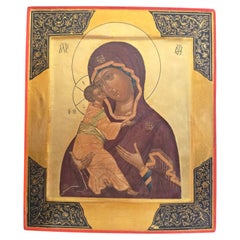
19th Century Russian Icon of the Virgin and Child

19th Century Russian Icon of the Virgin and Child

Located in Madrid, ES

Beautiful Russian icon of the Virgin Mary holding the Christ Child, painted and gilded during the 19th century. Rich in spiritual significance and devotional character, this icon represents one of the most beloved subjects of Eastern Orthodox religious art. The composition depicts the Virgin Mary (Theotokos) tenderly holding the infant Jesus in her arms, emphasizing her role as the Mother of God and intercessor for humanity. The serene expressions, solemn gaze, and sacred intimacy between mother and child reflect the profound symbolism and theological depth characteristic of Russian iconography. Executed in oil and enhanced with gilded decoration, the icon displays the traditional artistic conventions of Orthodox painting, including stylized features, symbolic colors, and a luminous golden background that evokes the divine realm. The gilding beautifully complements the painted surface, creating a rich visual effect and enhancing the devotional presence of the work. Produced during the 19th century, a period of continued flourishing of icon painting in the Russian Empire, this piece would have served as an object of private devotion or as part of a domestic icon corner, a central element of Orthodox spiritual life. Its intimate dimensions make it ideal for display in a collection of religious art, iconography, devotional objects, or Eastern European antiques...

Category

Antique 1880s Paintings

Materials

Fruitwood

Nativity Jesus David Paint 16/17th Century Oil on copper Old master Flemish Art

Nativity Jesus David Paint 16/17th Century Oil on copper Old master Flemish Art

Located in Riva del Garda, IT

The Nativity of Jesus Flemish school, late 16th/early 17th century Gerard David (Oudewater, c. 1460 - Bruges, 1523) Follower of Oil on copper 30 x 25 cm. - In frame 47 x 42 c...

Category

16th Century Old Masters Portrait Paintings

Materials

Oil

Russian Orthodox Festal Icon with the Resurrection of Christ at the Center

Russian Orthodox Festal Icon with the Resurrection of Christ at the Center

Located in NICE, FR

This exceptional Russian Orthodox festal icon presents the principal feasts of the liturgical year arranged around the central depiction of the Resurrection of Christ (Descent into H...

Category

Antique Mid-19th Century Russian Other Paintings

Materials

Wood