Want more images or videos?
Request additional images or videos from the seller
1 of 10

Julio de Diego
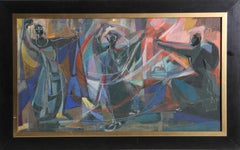
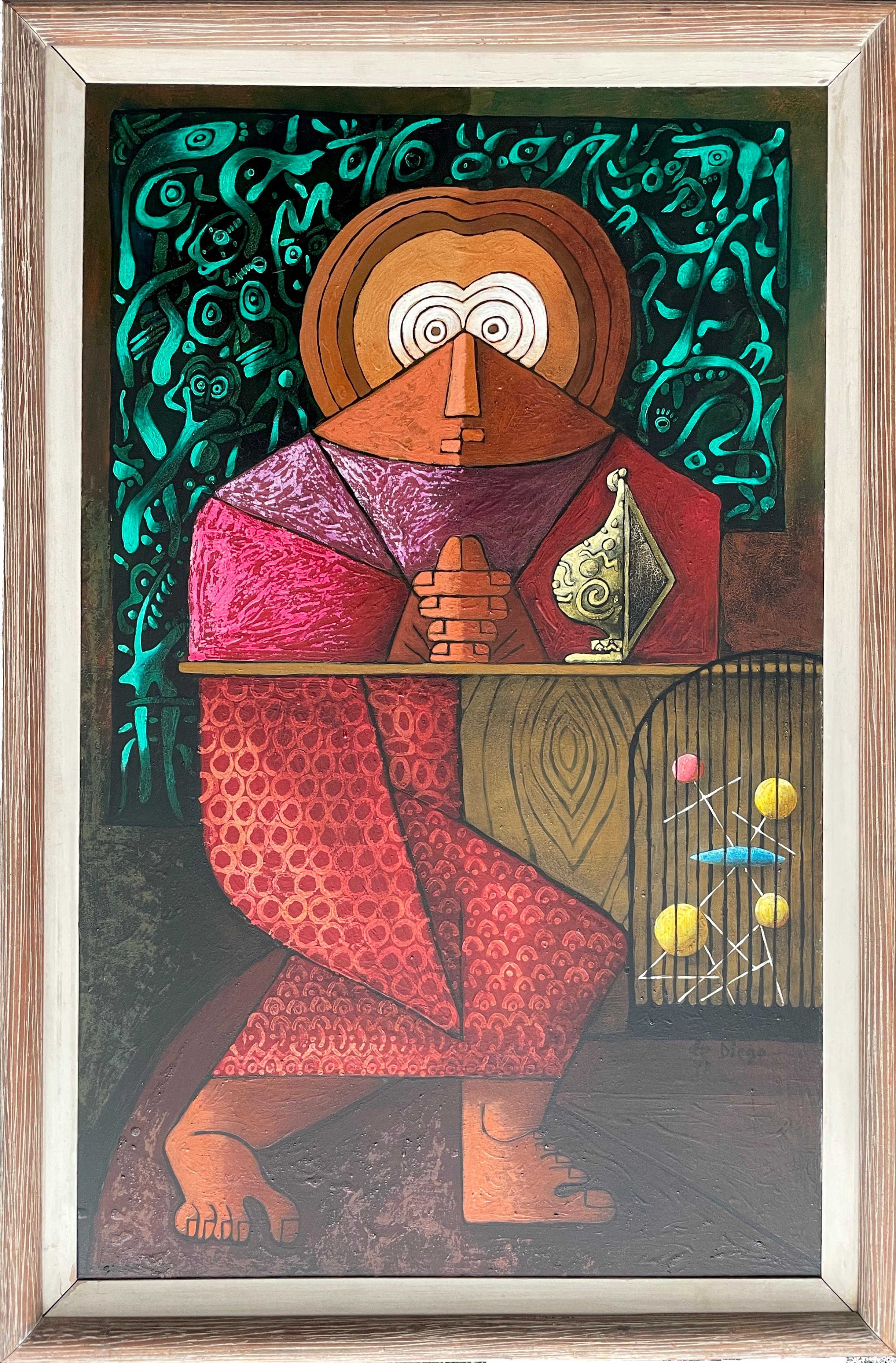
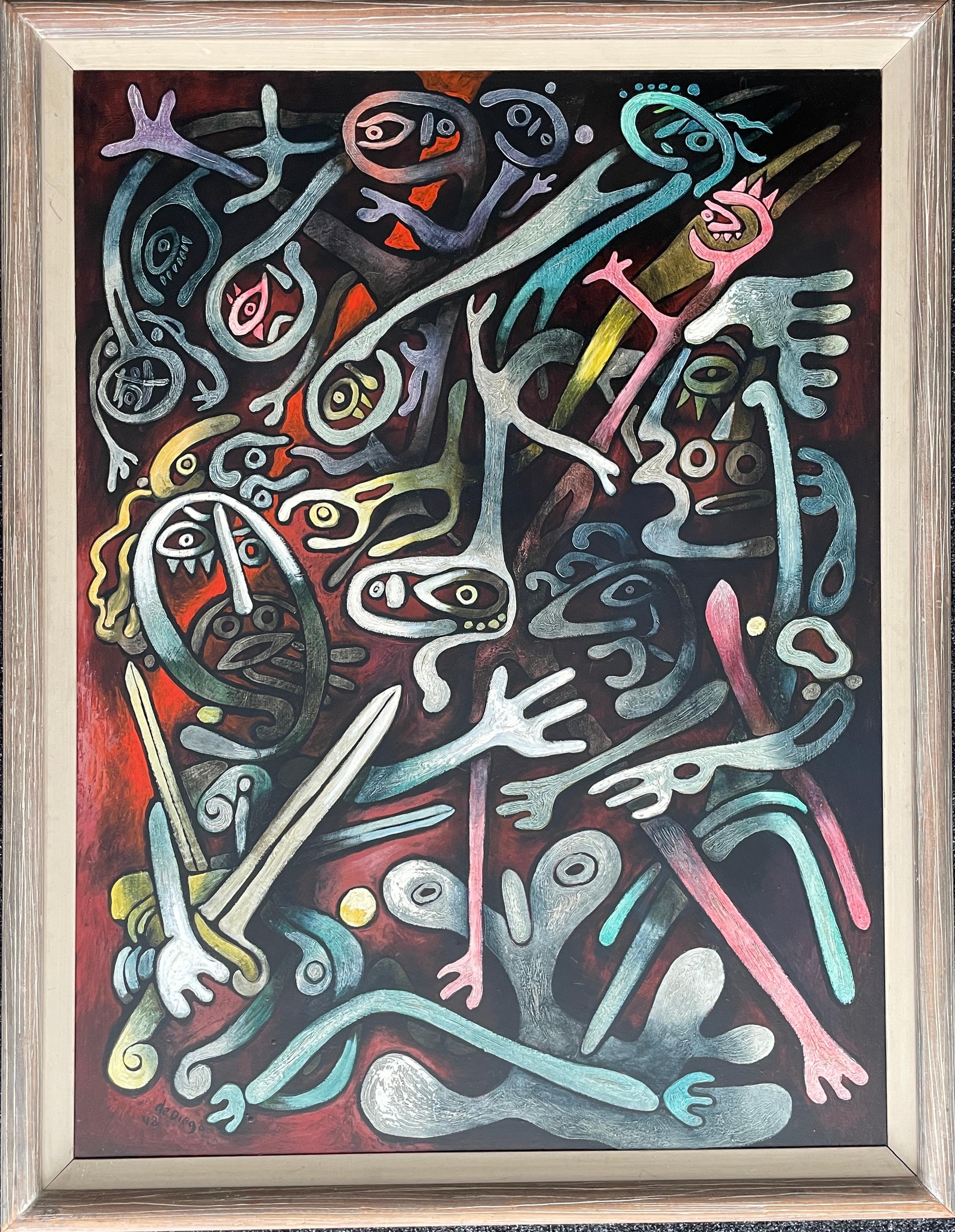
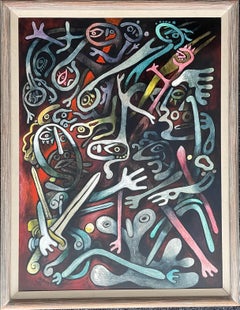
Ceremonial Dancers oil and tempera painting by Julio De Diego

1948

$26,000
£19,458.52
€22,743.68
CA$36,739.96
A$37,085.99
CHF 21,309.72
MX$449,526.92
NOK 246,649.26
SEK 251,938.30
DKK 170,015.34

About the Item

Artwork measures 48" x 30" and framed 56 ¼" x 38 ¼" x 3" Provenance: John Heller Gallery, NYC, circa 1975 (label verso) The artist's daughter Corbino Galleries, Sarasota, FL (1990) Julio De Diego’s Atomic Series paintings made an extraordinary statement regarding the shock and fear that accompanied the dawn of the nuclear age. In the artist’s own words: “Scientists were working secretly to develop formidable powers taken from the mysterious depths of the earth - with the power to make the earth useless! Then, the EXPLOSION! . . . we entered the Atomic Age, and from there the neo-Atomic war begins. Explosions fell everywhere and man kept on fighting, discovering he could fight without flesh.” To execute these works, De Diego developed a technique of using tempera underpainting before applying layer upon layer of pigmented oil glazes. The result is paintings with surfaces which were described as “bonelike” in quality. The forms seem to float freely, creating a three-dimensional visual effect. In the 1954 book The Modern Renaissance in American Art, author Ralph Pearson summarizes the series as “a fantastic interpretation of a weighty theme. Perhaps it is well to let fantasy and irony appear to lighten the devastating impact. By inverse action, they may in fact increase its weight.” About this artist: Julio De Diego crafted a formidable persona within the artistic developments and political struggles of his time. The artist characterized his own work as “lyrical,” explaining, “through the years, the surrealists, the social-conscious painters and the others tried to adopt me, but I went my own way, good, bad or indifferent.” [1] His independence manifested early in life when de Diego left his parent’s home in Madrid, Spain, in adolescence following his father’s attempts to curtail his artistic aspirations. At the age of fifteen he held his first exhibition, set up within a gambling casino. He managed to acquire an apprenticeship in a studio producing scenery for Madrid’s operas, but moved from behind the curtains to the stage, trying his hand at acting and performing as an extra in the Ballet Russes’ Petrouchka with Nijinsky. He spent several years in the Spanish army, including a six-month stretch in the Rif War of 1920 in Northern Africa. His artistic career pushed ahead as he set off for Paris and became familiar with modernism’s forays into abstraction, surrealism, and cubism. The artist arrived in the U.S. in 1924 and settled in Chicago two years later. He established himself with a commission for the decoration of two chapels in St. Gregory’s Church. He also worked in fashion illustration, designed magazine covers and developed a popular laundry bag for the Hotel Sherman. De Diego began exhibiting through the Art Institute of Chicago in 1929, and participated in the annual Chicago Artists Exhibitions, Annual American Exhibitions, and International Water Color Exhibitions. He held a solo exhibition at the Art Institute of Chicago in the summer of 1935. Though the artist’s career was advancing, his family life had deteriorated. In 1932 his first marriage dissolved, and the couple’s young daughter Kiriki was sent to live with friend Paul Hoffman. De Diego continued to develop his artistic vocabulary with a growing interest in Mexican art. He traveled throughout the country acquainting himself with the works of muralists such as Carlos Merida, and also began a collection of small native artifacts. While in Mexico, de Diego made a living designing costumes and scenery for ballets. His talents continued to expand as he moved into book illustration, and his work in jewelry making was incorporated into the 1946 Modern Handmade Jewelry exhibition at the Museum of Modern Art. He remarried in 1948, becoming the third husband of Gypsy Rose Lee. The following year the two joined the traveling carnival Royal American Shows. While Gypsy worked as a performer, de Diego developed a show for the carnival using surrealist murals and the performance of Freudian themes. After three years of separation, the couple divorced in Reno, Nevada, and de Diego eventually settled in California. Julio De Diego continued to impact the world of fine art as he produced interpretive representations of current events in an assortment of techniques. He notably worked in the Renaissance method of “velatura,” building up to as many as forty glazes of oil in each painting. He also commonly worked within gouache, graphite, and mixed media. The themes of his work were as broad in scope as the mediums he worked in, moving from surrealist and folk compositions to self-portraits and politically engaged subjects. In the time spent working for the Works Progress Administration, de Diego produced murals of landscapes and street scenes. Afterwards he pushed away from such brands of realism, asserting, “you can’t transfer nature to canvas, you have to re-invent it.” [2] His paintings of current and historical subjects became constructions both of the artist’s opinion of the facts and his vision of alternate realities. He reacted to natural disasters, produced works on World War II in a manner echoing Goya’s Disasters of War, explored the theme of atomic energy, and commented on the impact of the Cold War. His 1962 Armada series paralleled the use of technology in past and present conflict and explored the notion of defeat. The works played on apocalyptic fears of the Cold War period by invoking the infamous tragedy of the Anglo-Spanish War as well as the ultimate survival of both sides. De Diego expanded his political impact beyond the exhibition of these works, and began voicing opposition to Franco and the rise of fascism. He was a strong supporter of the radical American Artist’s Congress, which spoke in opposition to censorship and the curtailing of rights in Italy and Germany. During these years de Diego also became a teacher and took up positions at the University of Denver and the Artist Equity Workshop. In the late sixties De Diego settled in the artist’s colony of Sarasota, Florida, and remained there until his death on August 22, 1979. Reports of his years there recounted him as an animated character who entertained with tales of past encounters with famed Surrealists Andre Breton and Max Enrst, the artist Man Ray and influential Peggy Guggenheim. De Diego continued to expand his repertoire by producing the educational film Julio de Diego—Painting in Egg Tempera with the help of local resident Jay Starker. Throughout his years, life and art remained codependent entities within the artist, who noted, “A painting is not what it is, but the memory that we have a life.” [3] Julio de Diego’s works capture the sweeping vision, ambition, and passion of a curious and multifaceted artist. Written by Zenobia Grant Wingate Footnotes: [1] Peri Tucker, “Artist at Large: Julio de Diego and his worldly-wise works of art.” (St. Petersburg Times, April 1, 1962), page 8. [2] Ibid. [3] Marcia Corbino, “A Journey With Julio De Diego 1900-1979.”
  • Creator:
    Julio de Diego (1900-1979, American)
  • Creation Year:
    1948
  • Dimensions:
    Height: 48 in (121.92 cm)Width: 30 in (76.2 cm)
  • Medium:
  • Movement & Style:
  • Period:
  • Condition:
  • Gallery Location:
    Hudson, NY
  • Reference Number:
    Seller: DeJu0031stDibs: LU2465213117372

More From This Seller

View All
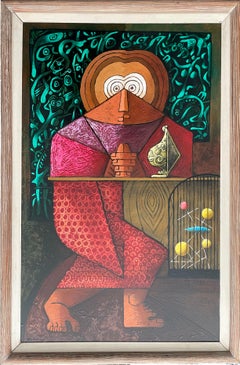
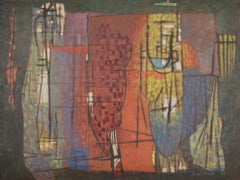
The Magician oil and tempera painting by Julio de Diego

The Magician oil and tempera painting by Julio de Diego

By Julio de Diego

Located in Hudson, NY

Julio De Diego’s Atomic Series paintings made an extraordinary statement regarding the shock and fear that accompanied the dawn of the nuclear age. In the artist’s own words, “Scientists were working secretly to develop formidable powers taken from the mysterious depths of the earth - with the power to make the earth useless! Then, the EXPLOSION! . . . we entered the Atomic Age, and from there the neo-Atomic war begins. Explosions fell everywhere and man kept on fighting, discovering he could fight without flesh.” To execute these works, De Diego developed a technique of using tempera underpainting before applying layer upon layer of pigmented oil glazes. The result is paintings with surfaces which were described as “bonelike” in quality. The forms seem to float freely, creating a three-dimensional visual effect. In the 1954 book The Modern Renaissance in American Art, author Ralph Pearson summarizes the series as “a fantastic interpretation of a weighty theme. Perhaps it is well to let fantasy and irony appear to lighten the devastating impact. By inverse action, they may in fact increase its weight.” Exhibited 1964 Marion Koogler McNay Art Institute, San Antonio, Texas This work retains its original frame which measures 54" x 42" x 2" About this artist: Julio De Diego crafted a formidable persona within the artistic developments and political struggles of his time. The artist characterized his own work as “lyrical,” explaining, “through the years, the surrealists, the social-conscious painters and the others tried to adopt me, but I went my own way, good, bad or indifferent.” [1] His independence manifested early in life when de Diego left his parent’s home in Madrid, Spain, in adolescence following his father’s attempts to curtail his artistic aspirations. At the age of fifteen he held his first exhibition, set up within a gambling casino. He managed to acquire an apprenticeship in a studio producing scenery for Madrid’s operas, but moved from behind the curtains to the stage, trying his hand at acting and performing as an extra in the Ballet Russes’ Petrouchka with Nijinsky. He spent several years in the Spanish army, including a six-month stretch in the Rif War of 1920 in Northern Africa. His artistic career pushed ahead as he set off for Paris and became familiar with modernism’s forays into abstraction, surrealism, and cubism. The artist arrived in the U.S. in 1924 and settled in Chicago two years later. He established himself with a commission for the decoration of two chapels in St. Gregory’s Church. He also worked in fashion illustration, designed magazine covers and developed a popular laundry bag for the Hotel Sherman. De Diego began exhibiting through the Art Institute of Chicago in 1929, and participated in the annual Chicago Artists Exhibitions, Annual American Exhibitions, and International Water Color Exhibitions. He held a solo exhibition at the Art Institute of Chicago in the summer of 1935. Though the artist’s career was advancing, his family life had deteriorated. In 1932 his first marriage dissolved, and the couple’s young daughter Kiriki was sent to live with friend Paul Hoffman. De Diego continued to develop his artistic vocabulary with a growing interest in Mexican art. He traveled throughout the country acquainting himself with the works of muralists such as Carlos Merida, and also began a collection of small native artifacts...

Category

1940s American Modern Abstract Paintings

Materials

Masonite, Oil, Tempera

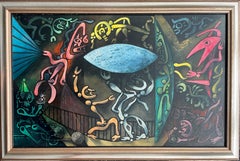
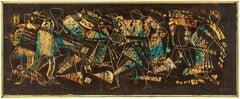
St. Atomic oil and tempera painting by Julio de Diego

St. Atomic oil and tempera painting by Julio de Diego

By Julio de Diego

Located in Hudson, NY

Julio De Diego’s Atomic Series paintings made an extraordinary statement regarding the shock and fear that accompanied the dawn of the nuclear age. In the artist’s own words, “Scientists were working secretly to develop formidable powers taken from the mysterious depths of the earth - with the power to make the earth useless! Then, the EXPLOSION! . . . we entered the Atomic Age, and from there the neo-Atomic war begins. Explosions fell everywhere and man kept on fighting, discovering he could fight without flesh.” To execute these works, De Diego developed a technique of using tempera underpainting before applying layer upon layer of pigmented oil glazes. The result is paintings with surfaces which were described as “bonelike” in quality. The forms seem to float freely, creating a three-dimensional visual effect. In the 1954 book The Modern Renaissance in American Art, author Ralph Pearson summarizes the series as “a fantastic interpretation of a weighty theme. Perhaps it is well to let fantasy and irony appear to lighten the devastating impact. By inverse action, they may in fact increase its weight.” Exhibited 1950 University of Illinois at Urbana "Contemporary American Painting" 1964 Marion Koogler McNay Art Institute, San Antonio, Texas This work retains its original frame which measures 54" x 36" x 2". About this artist: Julio De Diego crafted a formidable persona within the artistic developments and political struggles of his time. The artist characterized his own work as “lyrical,” explaining, “through the years, the surrealists, the social-conscious painters and the others tried to adopt me, but I went my own way, good, bad or indifferent.” [1] His independence manifested early in life when de Diego left his parent’s home in Madrid, Spain, in adolescence following his father’s attempts to curtail his artistic aspirations. At the age of fifteen he held his first exhibition, set up within a gambling casino. He managed to acquire an apprenticeship in a studio producing scenery for Madrid’s operas, but moved from behind the curtains to the stage, trying his hand at acting and performing as an extra in the Ballet Russes’ Petrouchka with Nijinsky. He spent several years in the Spanish army, including a six-month stretch in the Rif War of 1920 in Northern Africa. His artistic career pushed ahead as he set off for Paris and became familiar with modernism’s forays into abstraction, surrealism, and cubism. The artist arrived in the U.S. in 1924 and settled in Chicago two years later. He established himself with a commission for the decoration of two chapels in St. Gregory’s Church. He also worked in fashion illustration, designed magazine covers and developed a popular laundry bag for the Hotel Sherman. De Diego began exhibiting through the Art Institute of Chicago in 1929, and participated in the annual Chicago Artists Exhibitions, Annual American Exhibitions, and International Water Color Exhibitions. He held a solo exhibition at the Art Institute of Chicago in the summer of 1935. Though the artist’s career was advancing, his family life had deteriorated. In 1932 his first marriage dissolved, and the couple’s young daughter Kiriki was sent to live with friend Paul Hoffman. De Diego continued to develop his artistic vocabulary with a growing interest in Mexican art. He traveled throughout the country acquainting himself with the works of muralists such as Carlos Merida, and also began a collection of small native artifacts...

Category

1940s American Modern Abstract Paintings

Materials

Masonite, Oil, Tempera

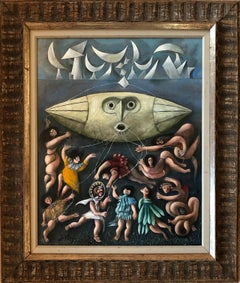
Inevitable Day – Birth of the Atom oil and tempera painting by Julio De Diego

Inevitable Day – Birth of the Atom oil and tempera painting by Julio De Diego

By Julio de Diego

Located in Hudson, NY

Julio De Diego’s Atomic Series paintings made an extraordinary statement regarding the shock and fear that accompanied the dawn of the nuclear age. In the artist’s own words, “Scientists were working secretly to develop formidable powers taken from the mysterious depths of the earth - with the power to make the earth useless! Then, the EXPLOSION! . . . we entered the Atomic Age, and from there the neo-Atomic war begins. Explosions fell everywhere and man kept on fighting, discovering he could fight without flesh.” To execute these works, De Diego developed a technique of using tempera underpainting before applying layer upon layer of pigmented oil glazes. The result is paintings with surfaces which were described as “bonelike” in quality. The forms seem to float freely, creating a three-dimensional visual effect. In the 1954 book The Modern Renaissance in American Art, author Ralph Pearson summarizes the series as “a fantastic interpretation of a weighty theme. Perhaps it is well to let fantasy and irony appear to lighten the devastating impact. By inverse action, they may in fact increase its weight.” Bibliography Art in America, April 1951, p.78 About this artists: Julio De Diego crafted a formidable persona within the artistic developments and political struggles of his time. The artist characterized his own work as “lyrical,” explaining, “through the years, the surrealists, the social-conscious painters and the others tried to adopt me, but I went my own way, good, bad or indifferent.” [1] His independence manifested early in life when de Diego left his parent’s home in Madrid, Spain, in adolescence following his father’s attempts to curtail his artistic aspirations. At the age of fifteen he held his first exhibition, set up within a gambling casino. He managed to acquire an apprenticeship in a studio producing scenery for Madrid’s operas, but moved from behind the curtains to the stage, trying his hand at acting and performing as an extra in the Ballet Russes’ Petrouchka with Nijinsky. He spent several years in the Spanish army, including a six-month stretch in the Rif War of 1920 in Northern Africa. His artistic career pushed ahead as he set off for Paris and became familiar with modernism’s forays into abstraction, surrealism, and cubism. The artist arrived in the U.S. in 1924 and settled in Chicago two years later. He established himself with a commission for the decoration of two chapels in St. Gregory’s Church. He also worked in fashion illustration, designed magazine covers and developed a popular laundry bag for the Hotel Sherman. De Diego began exhibiting through the Art Institute of Chicago in 1929, and participated in the annual Chicago Artists Exhibitions, Annual American Exhibitions, and International Water Color Exhibitions. He held a solo exhibition at the Art Institute of Chicago in the summer of 1935. Though the artist’s career was advancing, his family life had deteriorated. In 1932 his first marriage dissolved, and the couple’s young daughter Kiriki was sent to live with friend Paul Hoffman. De Diego continued to develop his artistic vocabulary with a growing interest in Mexican art. He traveled throughout the country acquainting himself with the works of muralists such as Carlos Merida, and also began a collection of small native artifacts...

Category

1940s American Modern Abstract Paintings

Materials

Masonite, Oil, Tempera

Lords of the Sky oil painting by Julio De Diego

Lords of the Sky oil painting by Julio De Diego

By Julio de Diego

Located in Hudson, NY

Lords of the Sky (c.1950) Oil on canvas, 30" x 24" 40" x 34" x 2" framed Provenance: The Artist, his daughter About this artist: Julio De Diego crafted a formidable persona within ...

Category

Mid-20th Century Modern Figurative Paintings

Materials

Canvas, Oil

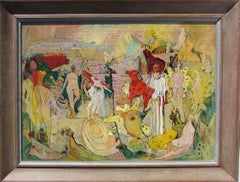
Ancient Revel oil painting by Wesley Lea

Ancient Revel oil painting by Wesley Lea

By Wesley Lea

Located in Hudson, NY

Signed and titled verso on stretcher "Lea Ancient Revel". Subtitled verso on label in artist's hand: "An attempt to marry ancient mineral matter with people". Exhibited at the 194...

Category

1940s Abstract Figurative Paintings

Materials

Oil, Canvas

Transition oil painting by Joseph Meert

Transition oil painting by Joseph Meert

By Joseph Meert

Located in Hudson, NY

Artist Joseph Meert studied at the Kansas City Art Institute and later the Art Students League of New York after immigrating to the United States as a ...

Category

Mid-20th Century Abstract Abstract Paintings

Materials

Canvas, Oil

You May Also Like

Dancing Figures, Oil on Board

Dancing Figures, Oil on Board

By David Rosen (b.1912)

Located in Surfside, FL

DAVID ROSEN Toronto, Canada, b. 1912, d. 2004 Painter David Rosen emerged onto the art scene while the country was wrought with unimaginable economic turmoil. Like most other America...

Category

20th Century Modern Figurative Paintings

Materials

Oil, Board

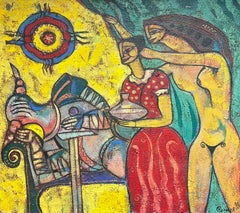
Dancers, Abstract Expressionist Oil on Canvas, Late 20th Century

Dancers, Abstract Expressionist Oil on Canvas, Late 20th Century

Located in Astoria, NY

Graciela Cassel (Argentine, b. 1956), Dancers, Oil on Canvas, unsigned, ebonized wood frame. Image: 52.75" H x 27.5" W; frame: 55.75" H x 29.5" W x 2.25" D. Provenance: From a New ...

Category

Late 20th Century Abstract Expressionist Figurative Paintings

Materials

Oil, Canvas

Three Dancers, Abstract Oil on Board by John F. Leonard

Three Dancers, Abstract Oil on Board by John F. Leonard

Located in Long Island City, NY

Three Dancers (60) John F. Leonard American (1921–1987) Date: circa 1965 Oil on Board, unsigned Size: 14 in. x 24 in. (35.56 cm x 60.96 cm) Frame Size: 17.5 x 28 inches

Category

1960s Abstract Figurative Paintings

Materials

Oil, Board

Edward Marecak Semi-Abstract Mythological Oil Painting Modernist Figures

Edward Marecak Semi-Abstract Mythological Oil Painting Modernist Figures

By Edward Marecak

Located in Denver, CO

A bold and highly collectible mid-century modern oil painting by Edward Marecak, this semi-abstract mythological composition exemplifies the artist’s signature fusion of classical narrative, symbolic figuration, and vibrant modernist abstraction. Rendered in richly layered oil, the painting transforms ancient mythological subject matter into a dynamic, color-saturated visual language. Stylized human figures emerge through bold outlines, patterned surfaces, and interlocking color fields, creating a composition that feels both narrative and abstract at once. Marecak’s approach is deeply rooted in his Slovak heritage and fascination with folklore, opera, and Greek mythology, which he consistently reinterpreted through a modernist lens. Rather than depicting literal scenes, he constructs symbolic environments where figures, gestures, and architectural forms merge into a rhythmic, mosaic-like structure. The result is a visually complex and emotionally charged work that reflects Marecak’s position as one of Colorado’s most distinctive mid-century modernists. His practice bridges folk-inspired imagery, surrealist abstraction, and postwar expressionism, placing him firmly within the broader evolution of American modern art. Mythological works such as this are among the most sought-after in Marecak’s oeuvre, as they represent his most fully realized synthesis of storytelling and abstraction. These compositions often feature densely layered surfaces, bold chromatic contrasts, and theatrical figuration that echoes both Byzantine iconography and modernist experimentation. A long-standing figure in the Denver modern...

Category

1960s Abstract Figurative Paintings

Materials

Oil