Video Loading
Want more images or videos?
Request additional images or videos from the seller
1 of 10

Jan Boeckhorst
Boeckhorst, Rubens, Saint Ursula, Decorative Old Master, Woman, Baroque, Flemish

c. 1645

$53,158.72
$70,828.5825% Off
£39,268.24
£52,328.7925% Off
€45,000VAT Included
€60,00025% Off
CA$73,802
CA$98,258.7225% Off
A$75,159.35
A$99,714.6025% Off
CHF 43,144.62
CHF 57,483.3425% Off
MX$906,933.68
MX$1,207,369.8025% Off
NOK 500,024.65
NOK 667,200.1125% Off
SEK 506,893.24
SEK 674,336.1625% Off
DKK 343,167.58
DKK 457,509.4125% Off

About the Item

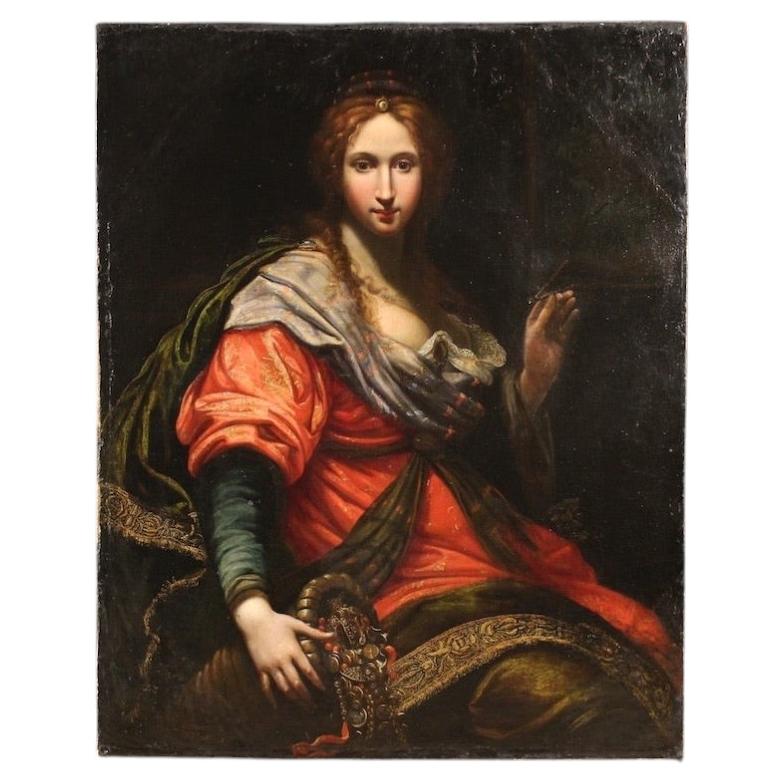
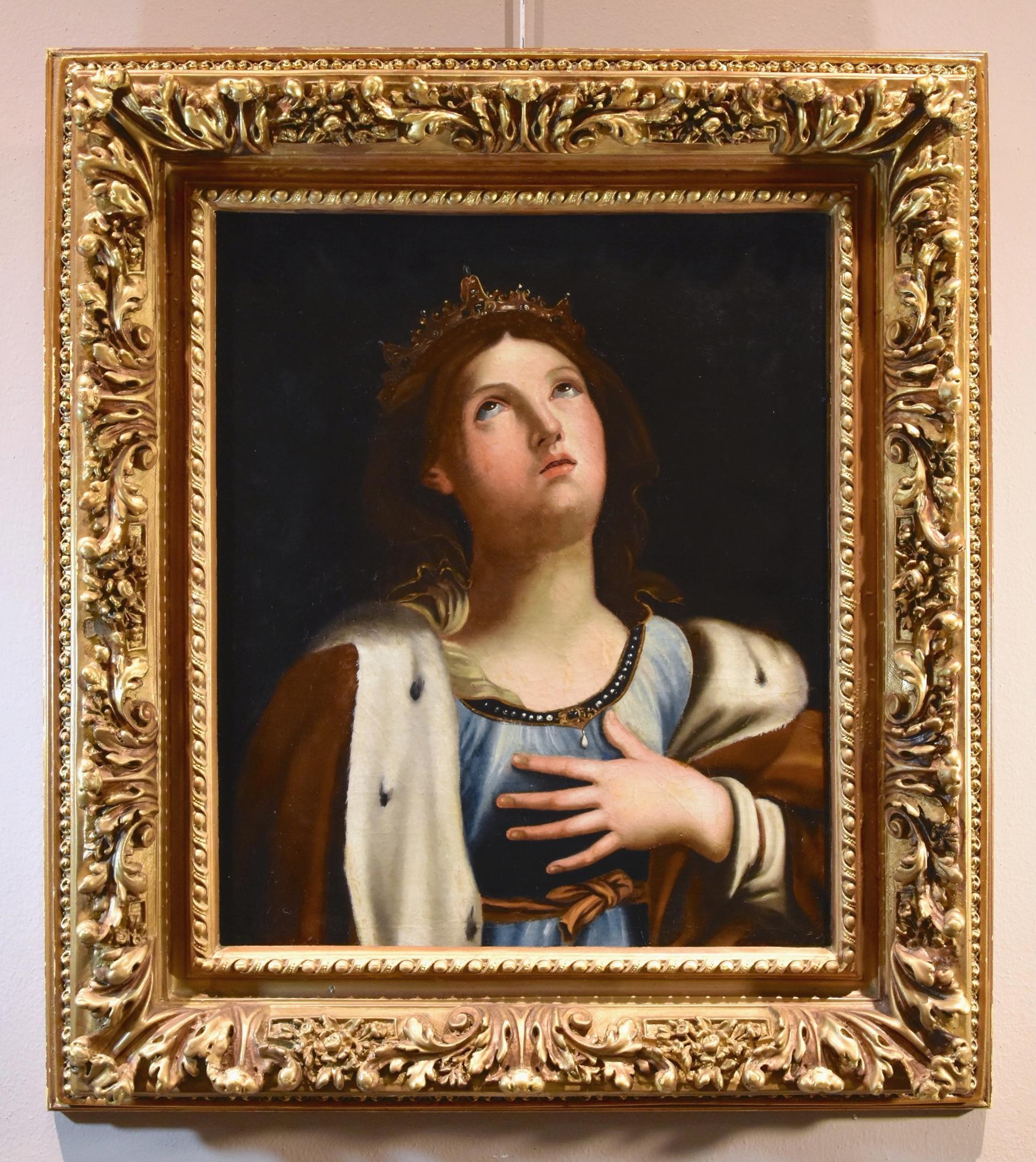
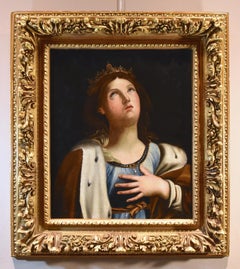
Johann Boeckhorst (Münster 1604 - Antwerp 1668) Saint Ursula Oil on canvas, 112 x 86 cm Provenance: New York, Christe's, 20.3.1981, lot 88 (as Van Diepenbeeck's circle) The present painting has only recently been rediscovered. It was not known in the art historical literature, nor had it ever been exhibited in public before. It is an important work by Johann Boeckhorst, which he created in his middle creative phase. It depicts St. Ursula with the ten thousand virgins. Ursula is said to have lived between 300 and 400 AD as the daughter of a Christian king. She committed herself to eternal virginity, but was betrothed by her father to the pagan King Aetherius of England. She agreed under certain conditions. Within three years, Aetherius was to be taught Christianity and baptized. She herself wanted to make a pilgrimage to Rome with ten companions and 11,000 virgins. The journey took them across the North Sea and the Rhine through Cologne and Basel and from there on foot to Rome. In Cologne, an angel appeared to her in a dream, foretelling her coming martyrdom. On the return journey from Rome, the pilgrims were attacked by the Huns in Cologne. The king of the Huns coveted Ursula. As she refused him, she was shot with an arrow and her companions murdered. Johann Boeckhorst was one of the most successful successors to the famous Baroque painters Peter Paul Rubens and Anthonis van Dyck. He came from an old Münster family. The second of a total of twelve children, Johann Boeckhorst was born in Münster between 1603 and 1605. At first, it seemed as if he, like his other siblings, would enter ecclesiastical or political service. However, he was the only one of his family to opt for an artistic career. He moved to Antwerp in the middle of the Thirty Years' War. This city was then one of the centers of the Counter-Reformation and the most important and influential Baroque artists were based there. In Antwerp, Johann Boeckhorst trained as a painter under a master unknown to us today. He soon became a freelance master and was employed by the important Rubens workshop. He maintained friendly contacts with famous painters of his time such as Frans Snyders, Anthonis van Dyck and Jan Wildens. He worked on the most important commissions of the time, such as the entry of Cardinal Ferdinand into Antwerp, the so-called Pompa Introitus and the decoration of the Torre de la Parada hunting lodge near Madrid. He also created paintings and large picture cycles for the Antwerp art market, for churches and for wealthy citizens of the city. His success grew after the death of the great masters Rubens and Van Dyck. He followed in their footsteps with other artists of his generation. He enjoyed an exemplary reputation as a painter of history paintings and portraits in particular. The formal language of this painting is reminiscent of other depictions of female saints, such as Saint Helena (Antwerp) and Saint Barbara (location unknown). The virtuoso rendering of the materiality is particularly impressive and is reminiscent of paintings such as King David (Ghent/Greenville). Technically, it shows Boeckhorst's typical composition of a grayish ground on which the decorative elements, such as the cloak, were then placed. The work is made to be seen from a distance; the shiny parts of the robe and the jewelry only really come into their own at a greater distance. It can be assumed that this painting was created for a church interior and was perhaps part of a series of depictions of saints.
  • Creator:
    Jan Boeckhorst (1604 - 1668, German)
  • Creation Year:
    c. 1645
  • Dimensions:
    Height: 44.1 in (112 cm)Width: 33.86 in (86 cm)
  • Medium:
  • Movement & Style:
  • Period:
  • Condition:
  • Gallery Location:
    Greven, DE
  • Reference Number:
    1stDibs: LU1550213461822

More From This Seller

View All
Sacra Conversazione, Maria, Christ, Old Master, Religious, Baroque Painting, art

Sacra Conversazione, Maria, Christ, Old Master, Religious, Baroque Painting, art

Located in Greven, DE

Attributed to Peter Candid / Pieter de Witte (Bruges c. 1540 - 1628 Munich) Sacra Conversazione Oil on wood, 29 x 37 cm The painter, sculptor and architect Peter Candid, known in Italy as Pietro Candido, was born in Bruges between 1540 and 1548. In the 1560s he stayed in Florence, where he worked in the workshop of Giorgio Vasari, with whom he collaborated on a number of commissions for the House of Medici. After a brief stay in Volterra, he went to Munich in 1586. For the next 42 years, until his death, he remained court painter to Duke William V...

Category

17th Century Renaissance Figurative Paintings

Materials

Oil, Panel

Fenzoni, Painting AND preparatorial Drawing, John the Baptist, Italy Renaissance

Fenzoni, Painting AND preparatorial Drawing, John the Baptist, Italy Renaissance

By Ferrau Fenzoni

Located in Greven, DE

The painting and the preparatory drawing are offered together. Provenance Private collection, Germany, Trier, c. 1980- 2013 Saint John the Baptist Brown ink and wash over red chalk on oatmeal paper 31 x 20.5 cm Inscribed: „Ferrau Fenzonio da Faenza invt. esque … imp. da Fran. Villamena …“. bears the collector's mark of Henry Scipio Reitlinger (1882-1950; Lugt 2274a) on a tiny label glued to the verso On the reverse is a partial drawing of a Pieta, pricked for transfer. Provenance New York, Doyle, 14. October 2015, No. 6 The painting and the preparatory drawing resemble the composition of an engraving after Ferraù Fenzoni by Francesco Villamena. Drawing, engraving and painting are almost identical, except for minor differences. Even the measurements nearly correspond: painting (32 x 25,5 cm), drawing (30 x 20,5 cm), engraving (31,1 x 23,5 cm). Dr. Guiseppe Scavizzi confirmed the attribution of the present panting to Fenzoni and he dates it to c. 1590. The inscription on the drawing reads “Ferrau Fenzonio da Faenza invt. esque. . . imp. da Fran: Villamena . . .”. The engraving’s inscription also lists place and date “Ferra Fensionius inventor/F. Villamoena sculpsit Rome/Aspectu fruitur… antra puer/cum Privilegio… 1613”. Interestingly, the engraving is not mirrored as it is in most printing processes. Painting, drawing and engraving are not reversed but the same. It is remarkable to note that there are further paintings by Fenzoni which were engraved in the same order and not reverted. They also show strong parallels regarding the compositions and the measurements (see for example “Deposition of Christ” ). Ferraù Fenzoni was an Italian painter mainly active in Todi. He is also called Il Faenzone after his birthplace (Faenza). He apprenticed in Rome during the papacy of Gregory XIII and contributed to numerous fresco cycles under pope Sixtus V, such as the Loggia della Benedizioni in the Lateran Palace, the frescoes on the walls and vaults of the Scala Santa of the adjacent Basilica of San Giovanni in Laterano, and the decoration in the Sistine library. His expressive canvases straddle the styles of Mannerism and Baroque. In 1594, he moved to Todi. A “Last Judgement” by him is housed in the cathedral of Todi. He returned to Faenza in 1599, where he decorated chapels in the cathedral from 1612 to 1616. In 1622, he completed a “Deposition”, now in the local Pinacoteca. In 1640, Fenzoni was named “cavaliere dello speron d’oro” by Cardinal Colonna and, on 25th April 1634, he was nominated vicar and “castellano of Granarolo”. Fenzoni‘s style is characterized by a mixture of the Mannerism of the Northern Netherlands and the Italian Baroque. Saint John the Baptist, Old Master, 17th Century, By Fenzoni, Religious Scene, Rome Art...

Category

16th Century Mannerist Figurative Paintings

Materials

Canvas, Oil, Handmade Paper

Flemish 17th, Orpheus and Animals, Large Decorative Wall Old Master Painting

Flemish 17th, Orpheus and Animals, Large Decorative Wall Old Master Painting

Located in Greven, DE

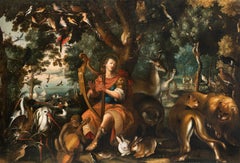
Flemish school, 17th century Orpheus and the animals Oil on canvas, 146,5 x 217 cm Provenance: South German private collection. On an impressive, room-filling format, this painting depicts "Orpheus and the Animals." The harp-playing Orpheus sits centrally in front of a tree whose trunk bifurcates above his head. This central tree frames with its crown the scenery towards the horizon and at the same time offers through branches the possibility for many birds to find space. The left half of the picture is characterized by a seascape, at the edge of which the ruins of a castle can be seen deep in the background. This seascape, framed by mountains on the horizon, is the only area where sky can be seen. On this side, waterfowl such as storks, swans and ducks can be seen. In the right half, the viewer looks into a deep European forest. On this right side, more land animals can be found, such as deer, rabbits and lions, among others. Orpheus wears opulent red and gold trimmed clothing, under his blue breastplate we see a white shirt. His feet are adorned by elaborate sandals. His head is surrounded by a radiant laurel wreath ("poeta laureatus"). The young man is clearly identifiable as the singer and poet of Greek mythology, Orpheus, by his harp, the laurel wreath and the animals surrounding him. Orpheus was one of the Argonauts who, under Jason, was searching for the Golden Fleece. He sang so beautifully that he even conquered the angry sea and enemies by the magic of his lyre. During the journey, Orpheus is said to have drowned out even the sirens with his singing. It is said that he was the greatest of all poets and charmed people, animals, stones and trees with his singing. In total, 51 birds and 37 different species are depicted in the painting. The animals are mostly depicted in great detail and, except for a few, can be identified. Mainly European species of animals are shown. Exceptions are the ostrich-like nandu peeking out from behind the deer, as well as the large parrot on the upper left, and the two lions. Similar is the case for the large animal directly behind Orpheus on the right. The shape of the head suggests an arctic fox from the polar regions, even though the body is much too large. The arctic fox was first described in 1555 by Olaus Magnus. However, it could also be a depiction of a brown or black bear. An unusual detail is the animal, which is relatively isolated in the right background and looks to the left. It is not clearly identifiable, but it shows certain similarities with the Australian kangaroo. This was first described by Vespucci in 1500 and further by Francisco Pelsaert in 1629. If it is indeed a kangaroo, this would be one of the earliest surviving pictorial representations. In this painting, Orpheus is accompanied by a small monkey playing a viola da gamba. This is an iconographic peculiarity. In general, this painting has some peculiarities compared to other paintings with "Orpheus and the animals". The central positioning of Orpheus is quite common, but he usually holds a lyre and is dressed in an antique style, but not as opulently. The choice of animals is also remarkable: European animals in particular are seen, hardly any exotic features, such as camels or elephants. The two lions in the right foreground are a quotation from Peter Paul Rubens and his depiction of "Daniel in the Lion's Den", which was realized in an engraving. The present painting can be classified as belonging to the Flemish School of the 17th century on the basis of its painterly and compositional conception. From the circle of Jan Brueghel the Younger are numerous representations of this Orpheus - theme, which take it as an opportunity to show as many exotic animals. There are also echoes of Spanish painters such as Juan de Arellano...

Category

17th Century Baroque Landscape Paintings
Materials

Canvas, Oil

Hercules and Omphale, Old Master Painting, Mannerism, Baroque, Mythology, Prague

Hercules and Omphale, Old Master Painting, Mannerism, Baroque, Mythology, Prague

Located in Greven, DE

Hercules and Omphale Oil on panel, 52 x 41 cm According to legend, Hercules had to make atonement and became a slave to the Lydian queen Omphale. When she found out who her slave was, she married him. Falling for his mistress and made effeminate by the luxury of court life, the former hero allowed himself to become the laughing stock of the court. He dressed in women's clothes, spun wool and did other women's work, whereas Omphale wore his lion's skin and carried a wooden club. When the time of punishment was over, the hero realised his delusion and left Omphale. So far, the painting could not be clearly assigned to an artist. Nevertheless, it impresses with its fluid and convincing painting, whose colourfulness and conception are reminiscent of the Prague School around Bartholomäus Spranger. This work follows an engraving and an etching made by Michel Dorigny in 1643 after a design by Simon Vouet. It shows the same scene but the print differs in minor details from the present painting (see e.g. the head of the lion) and the treatment of the faces seems to be painted more detailed and refined. So far there is no painting...

Category

17th Century Baroque Figurative Paintings

Materials

Oil, Panel

You May Also Like

17th-Century Flemish Oil - Saint Barbara, A Symbol of Protection and Resilience

17th-Century Flemish Oil - Saint Barbara, A Symbol of Protection and Resilience

Located in Aartselaar, BE

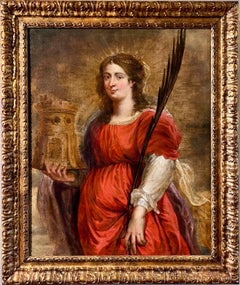
17th century Flemish School, Saint Barbara This accomplished 17th-century Flemish oil painting depicts Saint Barbara, shown as a serene and powerful woman dressed in a luminous red gown, set against a warm, atmospheric background and proudly holding her traditional attribute; a tower. The invention of the present composition stems from 17th century Antwerp and was likely drawn by Theodoor van Thulden...

Category

17th Century Old Masters Figurative Paintings

Materials

Canvas, Oil

Early 19th Century Oil - Saint Barbara of Nicomedia

Early 19th Century Oil - Saint Barbara of Nicomedia

Located in Corsham, GB

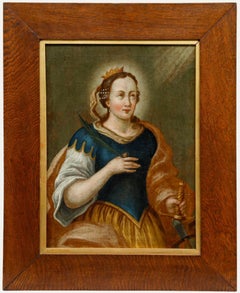
A charming depiction of Saint Barbara, a Christian martyr and a symbol of courage and devotion in the face of adversity. She is also the patron saint of armourers, artillerymen, mili...

Category

Early 19th Century Portrait Paintings

Materials

Oil

Important 17th Century Flemish or Italian School – The Penitent Magdalene – Work

Important 17th Century Flemish or Italian School – The Penitent Magdalene – Work

Located in Madrid, ES

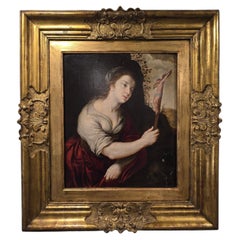
An important and emotionally compelling 17th century oil on panel depicting The Penitent Magdalene, attributed to the Flemish or Italian School and originating from the workshop of a...

Category

Antique Early 17th Century Paintings

Materials

Fruitwood

Saint Cecilia Angels De La Haye Paint 17th Century Oil on canvas Old master

Saint Cecilia Angels De La Haye Paint 17th Century Oil on canvas Old master

Located in Riva del Garda, IT

Lucas de la Haye, called Luca Fiammingo (Nivelles, 1612-Rome, 1682) Saint Cecilia and two cherubs Oil on canvas 118 x 91 cm. -Framed 129 x 102 cm. Expertise of Prof. Emilio Negro (Bologna) This evocative painting, which we are delighted to exhibit to you, has Saint Cecilia, the Roman noblewoman who later converted to Christianity and a very popular figure in the Baroque period as the patron saint of music, instrumentalists and singers, at the centre of the composition. She is depicted here as a splendid maiden dressed in regal robes...

Category

17th Century Old Masters Paintings

Materials

Oil