Antoni Clavé i Sanmartí (Barcelona, 1913 - Saint-Tropez, 2005)
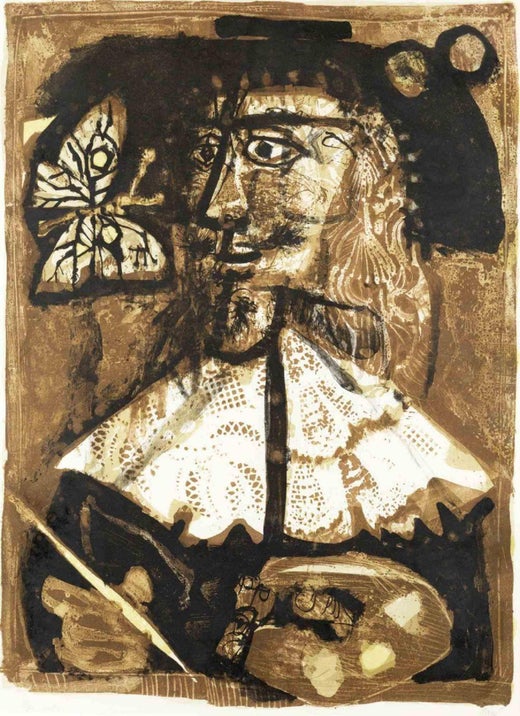
"Guerrier à la lance de profil"
ca. 1955 - 1956.
Oil on canvas.
64.6 x 81 cm (85 x 101 cm).
Signed in the lower right corner.
Bibliography:
- HARO GONZÁLEZ, S.; MAIRATA LAVIÑA, J. “Rabelais’s Gargantua, a turning point in the work of Antoni Clavé,” in Boletín de Arte, 41, 2020, pp. 81–91.
- Various Authors. Antoni Clavé: A World of Art. Works 1934–2002. Turner Publications. 2010.
Documents:
- Certificate of authenticity issued by the Antoni Clavé Archives.
Description:
In this work, characterized by its intense plasticity and pronounced drama, Clavé expresses himself through energetic color contrasts, rich textural effects, and a studied compositional simplicity, strictly frontal in keeping with the medieval heritage that characterizes his work around 1955. These are also the years in which the artist begins his journey toward informalism, moving away from figuration and focusing on the intensity and variety of pictorial and material resources. In this “Guerrier à la lance de profil” (Warrior with a Lance in Profile), Clavé's Cubist influence is also evident, especially in his production of the 1950s: frontal profile, interplay of textures reminiscent of collage, relatively restrained chromatism (though marked by characteristic flashes), spatial distortion, and the construction of volume through planes. The compositional solidity rests on the intense black line, which structures and defines the entire image. The planes of color are established in relation to the foreground with a certain tension, subordinate yet barely contained, even surpassing it at times, in a revolutionary gesture that breaks with the traditional convention of the relationship between line and color.
Especially relevant is the expressive display of contrasting surfaces, juxtaposed or superimposed: diverse textures, patterns created through brushstrokes, or by rubbing, dragging, or removing material… It is a meticulous work on a plastic level, revealing the concentrated and conscientious work characteristic of Clavé's mature style, even though it still operates within an evident figuration. This complexity also determines an exquisite richness of nuances and chromatic and luminous details, with lights and shadows contrasted violently, as in a print or a Baroque painting. Thus, the light is focused on the face, the absolute core of the painting, where pure, unmixed, yet dry white appears, acquiring nuances through layering and the very traces of the brush. Finally, a colorless varnish, applied irregularly, enriches the texture.
The iconography is recurrent and characteristic of Clavé since 1955: hieratic medieval figures as archetypes, their attributes symbolic in nature. His most frequent figures are kings and queens and, as in this case, warriors. Here, the figure appears half-length in the foreground, holding a spear in his right hand and a shield in his left. The composition, with the figure slightly shifted to the left, is balanced by the presence of a butterfly in the upper right corner, which functions as an obscure iconographic symbol. These medieval themes of Clavé's derive directly from the series of lithographs he created between 1951 and 1955 for Rabelais's "Gargantua," published by Les Bibliophiles de Provence. Originally titled “La vie très horrifique du grand Gargantua,” this is the second book in the “Gargantua and Pantagruel” series, a collection of five novels published by the 16th-century French physician, writer, and humanist François Rabelais. Published between 1532 and 1564, the works recount the adventures of two kind-hearted but gluttonous giants, father and son, with an unusual blend of humor, crudeness, violence, and fantasy. Convinced of the healing power of humor, Rabelais conceived these works to alleviate the melancholy of his patients; centuries later, Clavé would discover in his “Gargantua” a remedy for his own gloomy spirits, as evidenced by some of his letters. Following the success of his first book, “Pantagruel” (1532), Rabelais recounted the same story in “Gargantua” (1534), but from the perspective of Gargantua, Pantagruel's father. Unlike his first novel, this time the writer drew inspiration not from popular culture, but rather crafted a more literary work, imbued with humanism and focused on the satirical treatment of religious, political, and philosophical issues.
In his illustrations for “Gargantua,” Clavé filters Rabelais's satire through his own unsettling atmosphere, creating magical, metaphysical images that seem otherworldly. For the project, the artist immersed himself in medieval art, especially stained glass and miniatures. His lithographs would capture his themes and artistic resources, such as the integration of text and image, the symbolic hieratic quality of the figures, the distinctive expressiveness of Romanesque figuration, and the use of symbolic elements as iconographic attributes. The project marked a milestone in his career and also in the history of 20th-century illustration, and although Clavé himself described it as a mere commission, his paintings in the following years would reveal its influence: the iconography of warriors and monarchs, approached with a peculiar irony, and also the language of forms, lines, and textures in dialogue. Although the artist's experimental approach would evolve over time, in works contemporary to or immediately following the "Gargantua" project, such as the painting in this study, direct references to the world of lithography are evident: theme, color, and form, but also a hieratic quality and lost, Romanesque gazes, large, disproportionate heads as the expressive center of the image, and a contrast between the organic forms of the figures and the geometric interplay of the objects.
The analysis of two aspects of this work, color and structure, is particularly revealing in this regard. The translucent lithographic inks allowed him, in "Gargantua," to create expressive overlays, expanding the limited color range inherent to this technique and creating plays of transparency on a chromaticism of deep blacks and intense colors. In this painting, as noted above, the transparencies are achieved through the superimposition of textures, dry brushstrokes, and varnishes. On a compositional level, the connection to Rabelais's lithographs is also evident: the bold forms structure the image, constructed with thick black outlines reminiscent of medieval stained glass, directly alluded to in some of the plates of "Gargantua".
Clavé's work during the first half of the 1950s, roughly between 1950 and 1956, marks the beginning of his evolution toward Informalism. His style now moves along a post-Cubist line characterized by great expressive freedom and formal deconstruction: figuration constructed with spontaneous, in a sense violent, strokes, schematic forms, and intense colors that burst forth from a background tending toward monochrome. At the end of this short period, in 1955, Clavé finally managed to live exclusively from painting, and he completed his last project: set design, costumes, and stagecraft for “La Peur” by Roland Petit's ballet company. That same year, his “Gargantua” was published. Although he would return to illustration occasionally throughout the rest of his life, he would do so entirely of his own volition, without commissions or pressure. The following years saw the consolidation of his artistic language through his Great Series—Kings, Queens, and Warriors —paintings with a single figure as the center of the composition, through which Clavé evolved from figuration to informalism. Finally feeling like a painter in his own right, the artist embarked on a path of experimentation with complete freedom that would continue throughout the rest of his career.
In his Grandes Series, to which the work under study belongs, Clavé constructs increasingly simpler compositions, with solitary, hieratic, and expressive figures in the Romanesque style, sometimes deformed or outlandish in reminiscence of his “Gargantua.” The figure—its disproportionately large head—becomes the expressive center of works that demonstrate enormous formal freedom and that would quickly evolve toward informalism. Particularly close to this “Guerrier à la lance de profil” is one of his Kings, also dated between 1955 and 1956 and therefore closely linked to the imagery created for Rabelais's work. The work displays a very similar composition, with the figure in the extreme foreground accompanied by two objects/attributes, the sword and the poppy, united in a kind of mysterious, deliberately incongruous evocation of medieval symbolism. The plastic play is equivalent to that of the studio work, with impasto, juxtapositions, tension between line and color, and tenebrist lighting. In the following years, warriors, kings, and queens continued to be the protagonists of Clavé's paintings in equally simple but increasingly free compositions. In "Guerrer noir" (Black Warrior), from 1958, the line loses prominence, and the color and materiality of the paint are expressed with a new freedom. "Guerrier" (Warrior), from 1959, goes a step further, eliminating the line completely and incorporating added elements into the painting, leaving behind the illusionistic conventions of the pictorial tradition in order to achieve an unprecedented richness of textures.
Biography:
Antoni Clavé (Barcelona, 1913 – Saint-Tropez, 2005) is one of the most renowned Spanish artists of the 20th century. He entered the School of Arts and Crafts in his hometown at just 13 years old, while working as an apprentice house painter and coming into contact with the more technical and material aspect of painting. After winning second prize in a poster competition in 1932, he decided to leave his job to try his luck as a graphic artist. He then began working for the Spanish National Film Company, creating the large film posters that decorated the facades of the main cinemas in Barcelona. During these years he began to approach the avant-garde through experimentation with collage of diverse materials: between 1934 and 1936 he made his first collages-assemblages, some of which were reproduced in the German magazine Gebrauchsgraphik in 1935. A year after the outbreak of the civil war, in 1937, Clavé was called to the front and joined the Republican army, where he was lucky enough to devote himself mainly to the creation of propaganda posters. However, after the fall of Barcelona in 1939 he was forced to go to France, staying for two months in the refugee camps of Perpignan and Haras. That same year he exhibited in Perpignan the drawings he had made during his stay in these camps, in what would be his first show on French soil. At the beginning of April of that same year Clavé arrived in Paris, where he managed to make a name for himself working as an illustrator for various publications. Two years later he had his own studio in the Montparnasse district; After joining the School of Paris, he formed a deep friendship with Pablo Picasso that did not end until after the latter's death in 1973. The 1940s were a fruitful period of family stability and artistic introspection for Clavé. He worked mainly as an illustrator and engraver - he mastered all the chalcographic procedures and also lithography - and began to cultivate painting in parallel, influenced at first by Bonnard and Vuillard. In 1944 he held his first major exhibition at the Henri Joly gallery in Paris, followed by others in the same city (1946), London (1947), Oran (1948), Malmo (1949) and Gothenburg (1950). It was also during these years that he began to make himself known internationally through the collective exhibitions of the School of Paris, and he began to design stage sets and costumes for ballet. The 1950s marked Clavé's definitive international take-off. He exhibited his work in Europe, the United States and Argentina, and focused especially on the performing arts, with his work for Ruth Page's ballet Revenge, which premiered in Chicago in 1951, standing out in particular. In the middle of the decade, however, he decided to leave theatre design to focus exclusively on painting. During these years he experimented with the influence of Picasso and abstract expressionism, although he rarely reached total abstraction, usually focusing on his favourite themes: kings, warriors, still lifes and, later, symbols. In 1955, the first retrospective exhibition dedicated to his work was held at the Arthur Tooth & Sons Gallery in London, and a year later he was awarded the UNESCO Prize for Engraving at the Venice Biennale. In 1957 he received the Matarazzo Prize for painting at the Sao Paulo Biennale, where he had represented France, and in 1958 he was awarded the Kamakura Prize at the Tokyo Biennale. Already enjoying great prestige both in France and abroad, in the 1960s Clavé devoted himself entirely to plastic experimentation, working in painting, lithography, engraving and tapestry. In 1965 he settled in the south of France, where he would spend the rest of his life, working while holding exhibitions around the world. The definitive recognition of his work would come in 1978, with an important retrospective exhibition at the National Museum of Modern Art in Paris, now the Centre Pompidou, followed by one held at the Venice Biennale in 1983, one at the National Museum of Fine Arts in Santiago de Chile in 1992 and one dedicated posthumously to him, on the occasion of the centenary of his birth, at the Fundació Vila Casas in Barcelona. After Franco's death, the 1980s finally brought Clavé success in his native country: his work was exhibited in the main Spanish cities, and he was awarded the Gold Medals of the Círculo de Bellas Artes in Madrid and the Generalitat de Catalunya. In 1982 he painted an important mural at Madrid's Barajas Airport, and in 1984 the Spanish pavilion at the Venice Biennale was dedicated to him, which housed a total of 125 works including paintings, sculptures, models and theatre costume projects. In the last decades of his life, Clavé devoted much of his effort to monumental projects, while holding exhibitions around the world. In 2005, the year of his death, his last large-format paintings were exhibited in Tokyo and Paris by the Galerie Chozo Yoshii. Currently, his works are preserved in the MNCARS in Madrid, the MACBA and MNAC in Barcelona, the MoMA in New York, the Centre Georges Pompidou and the Clave Archive in Paris and the Tate Modern in London.
![Charles Levier [Mélodie cosmique] circa 1955 signed oil on board, Surrealist](https://a.1stdibscdn.com/charles-levier-paintings-charles-levier-melodie-cosmique-circa-1955-signed-oil-on-board-surrealist-for-sale/a_28432/a_168628921771312049130/Levier_Charles_Me_lodiecosmique_circa1955_101391_FT_1_Hero_Ratio_1_361_SM_Complete_HR_master.jpg?width=240)