Want more images or videos?
Request additional images or videos from the seller
1 of 10

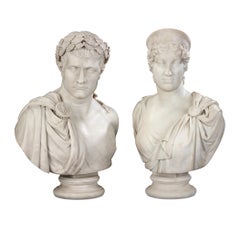
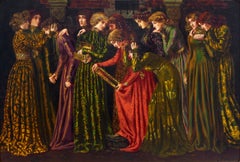
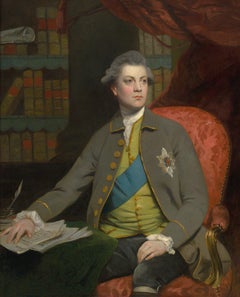
Pair of Royal Portraits of the Duke and Duchess of Burgundy

18th Century

$88,500List Price

You May Also Like

More From This Seller

View All
Henry Bowles Howard, 12th Earl Of Suffolk And 5th Earl Of Berkshire

Henry Bowles Howard, 12th Earl Of Suffolk And 5th Earl Of Berkshire

Located in New Orleans, LA

Sir Joshua Reynolds 1723-1792 British Sir Henry Bowles Howard, 12th Earl of Suffolk and 5th Earl of Berkshire Oil on canvas Sir Joshua Reynolds is unequivocally considered the most important English portraitist of the 18th century who was instrumental in adapting the Grand Manner style in the portrait genre. In fact, when the Royal Academy was founded in 1768, Reynolds was elected its first President, setting the precedent of quality for which all other portraitists would strive. Reynolds's portrait of Henry Bowles Howard, 12th Earl of Suffolk, showcases his genius in the genre and mastery over the medium. Reynolds’s portrait of the Earl expertly invokes classical values with strong lighting, rich colors and expert attention to detail to help underscore the prominence and revered echelon of the sitter. Howard was an esteemed British politician and Knight of the Garter. He served as Secretary of State for the Northern Department from 1771 to 1779, and he played a key role in utilizing mercenaries during the American Revolution and safeguarding Sweden's independence. The portrait employs Reynolds's signature style to render Howard rightfully as a gentleman of distinction. Captured seated in a stately library, the Earl appears learned and austere as he places one hand upon a stack of important documents and looks wistfully into the distance. Reynolds makes these compositional choices decisively, as the seated position gives Howard a weighty appearance of importance and the semi-profile turn captures his countenance at an attractive angle that highlights his strong, masculine features. The work draws on the classical conventions of Greek and Roman art and the Italian Renaissance masters, anchoring the nobleman in a history of refinement. Everything from his strong yet welcoming expression to his pale face enlivened by a rush of blood to the cheeks presents the picture of a strong, vital and powerful leader. As the first president of the Royal Academy in London, Reynolds’s commissions raised the status of an artist in Britain during the Romantic period and also established the portrait as an esteemed high art genre that garnered equal import to the history paintings that reigned supreme in decades prior. Today, Reynolds’s works grace the walls of the most important museums in the world, including the Louvre, the Metropolitan Museum of Art, and the National Gallery in London, among others. Circa 1770 Canvas: 50 1/2" high x 40 1/4" wide Framed: 61" high x 52 1/2" wide x 3 1/2" deep Provenance: Sir Henry Howard, 12th Earl of Suffolk and 5th Earl of Berkshire, 1739-1779 His mother, Lady Mary Howard, née Finch, Lady Andover, d. 1803 Acquired by descent to her daughter, Frances, and her husband Richard Bagot (later Howard) Acquired by descent to their daughter, Mary (1784-1877), and her husband Col. Fulke Greville Upton (later Howard), d. 1846 Acquired by descent to Lieutenant Colonel H.R.G. Howard Sale, Christie's, London, March 24, 1961, no. 29 Julius Weitzner, London and New York Sale, Paris, Musée Galliéra, December 7, 1965, no. 165 Newhouse Galleries, New York, NY Mr. and Mrs. F. Howard Walsh, Fort Worth, Texas, 1966 Walsh Family Art Trust Private collection, Oregon M.S. Rau, New Orleans Exhibited: British Institution, London, 1844, no. 130, loaned by the Hon. Fulke Greville Howard. South Kensington, "Second special exhibition of National Portraits," 1867, no. 478, lent by the Hon. Mrs. Greville. Agnew's, London, 1903, no. 17. Literature: Algernon Graves and W. V. Cronin, A History of the Works of Sir Joshua Reynolds, P.R.A., vol. 3 (London, 1899), p. 945. David Mannings...

Category

18th Century Other Art Style Portrait Paintings

Materials

Canvas, Oil

Tri-Directional Portrait Commemorating the Russo-Turkish War

Tri-Directional Portrait Commemorating the Russo-Turkish War

Located in New Orleans, LA

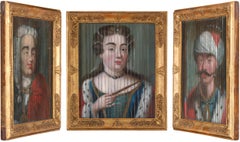
Austrian School 18th Century Tri-Directional Portrait Commemorating the Russo-Turkish War Oil on wooden strips This extraordinary tri-directional portrait exemplifies the rare innovation known as a triscenorama, capturing a pivotal diplomatic moment through ingenious artistic technique. Employing triangularly cut wooden strips, this remarkable work simultaneously depicts three imperial figures central to the Russo-Turkish War of 1735-1739: Empress Anna Ivanovna Romanova of Russia when viewed directly, Holy Roman Emperor Charles VI from the left and Ottoman Sultan Mahmud I from the right, commemorating the Treaty of Nissa that concluded this significant European conflict. The portrait utilizes an exceptionally rare optical technique that predates modern movable imaging technology. When observed from different angles, the painted triangular wooden strips create a transformative effect, revealing entirely different imperial portraits as the viewer shifts position. The precision required to execute such a work demonstrates remarkable technical mastery, as the artist had to conceptualize three distinct portraits as well as the meticulous arrangement of the panels. This sophisticated manipulation of perspective creates an interactive viewing experience considered revolutionary for its time. Almost certainly created by an Austrian artist, this diplomatic artwork likely served as a commemorative piece marking the Treaty of Nissa, signed in September 1739. The treaty concluded Russia's ambitious campaign to secure access to the Black Sea while countering Ottoman raids in Ukraine and the Caucasus regions. Given its exceptional quality and historical significance, this portrait was possibly commissioned by Emperor Charles VI himself, potentially serving as a diplomatic gift to either Empress Anna or Sultan Mahmud I during the treaty negotiations. Under Empress Anna's leadership, Russia sought to counter devastating raids from Ottoman allies, particularly the Crimean Tatars...

Category

18th Century Old Masters Portrait Paintings

Materials

Wood, Oil, Wood Panel

Saint Cosmas And Saint Damian Attributed To Bonifacio Bembo

Saint Cosmas And Saint Damian Attributed To Bonifacio Bembo

By Bonifacio Bembo

Located in New Orleans, LA

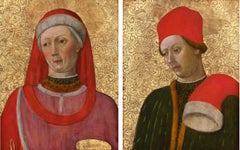
Attributed to Bonifacio Bembo c.1444-1477 Italy Saint Cosmas and Saint Damian Tempera on panel These exceptionally rare early Renaissance panels of Saint Cosmas and Saint Damian are an extraordinary new discovery. Based on the research of art historians Marco Tanzi and Andrea de Marchi, it is believed that these represent the missing panels from the famed polyptych formerly displayed on the altar of the Chapel of San Nicola da Tolentino in the Church of Sant’Agostino in Cremona, Italy. To find two matching early Renaissance panels outside of a museum or church, particularly in such remarkable condition, is an extraordinary rarity. The central and left-sided panels of the original five-part polyptych are currently in the collection of the Museo Civico Ala Ponzone in Cremona. These panels have luckily remained intact, and respectively portray the Madonna and Child Enthroned with Angels and Donor, Saint Nicholas of Tolentino (the chapel’s namesake) and Saint George. While the present panels have since been reduced, that they belong to the Cremonese altarpiece is confirmed by a number of stylistic elements. All five panels contain the same rich decorative arabesque pattern on their stamped gold background, while the figures’ knurled haloes are identical in both their fineness of line and use of perspective. The proportions of the figures coincide perfectly; Saints Cosmas and Damian would have originally also been depicted as full-length figures, fitting into the vertical, Gothic style of the altarpiece. According to the Christian religion, Saint Cosmas and Saint Damian were 3rd century physicians born in Arabia. Little is known about their lives except that they were reputedly twin brothers and that they were martyred in Syria during the persecution of Emperor Diocletian. It was believed that the saints were skilled in healing, and when their medicines failed, their faith and prayers could always perform miracles. Thus, the saints are often depicted with their medical equipment while wearing the traditional medieval doctor’s garb of crimson robes and distinctive round red hats. The saints are similarly depicted in the present panels, though considering the manner in which they have been cut, their medical tools are not immediately evident. The saints were highly popular as patrons of wealthy families during the Gothic and Renaissance eras, particularly the Medici, and thus they occur frequently in art from the era. The twins, for instance, are found in the famed San Marco Altarpiece by Fra Angelico in the San Marco Museum (Florence), as well as in a set of Medici panels crafted by Filippo Lippi...

Category

15th Century and Earlier Renaissance Portrait Paintings

Materials

Tempera, Panel

Portrait of Napoléon II

Portrait of Napoléon II

Located in New Orleans, LA

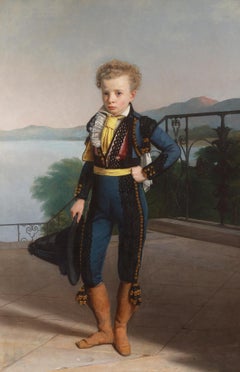
The son of the legendary Napoléon Bonaparte, Napoléon François Charles Joseph, takes a spirited stance in this remarkable oil painting attributed to the Austrian portraitist Johann Peter Krafft. Believed to have been exhibited at the Exposition Universelle of 1900 in Paris, this work stands as a testament to both Austrian artistry and the legacy of one of the most powerful men in history. After Napoléon's exile to the island of Elba in 1814, his son was seen by many of his supporters as the last hope of France. The child was named the ruler of half of Europe, holding the titles of Napoléon II...

Category

Early 19th Century Academic Portrait Paintings

Materials

Canvas, Oil

The Twelve Princesses

The Twelve Princesses

By Gustave-Max Stevens

Located in New Orleans, LA

The greatest triumph of the artist’s career, this extraordinary and monumental oil on canvas by Gustave-Max Stevens perfectly represents the highly detailed compositions and richly h...

Category

Late 19th Century Academic Figurative Paintings

Materials

Canvas, Oil